LeMond
0.883 × inseam742 mm
From the centre of the bottom bracket
0.883 × 84 cm, measured from the centre of the bottom bracket.
Free bike fit tool
Enter your inseam to see where the two common formulas put your saddle, and which point each one is measured from.
This is an example for an 84 cm inseam. Enter yours to see your own numbers.
742–743 mm
The two inseam formulas put the top of your saddle 742 to 743 mm from the centre of the bottom bracket. Start there, then check the knee angle on the bike before you settle on a height.
Millimetres from the centre of the bottom bracket to the top of the saddle
742 mm
From the centre of the bottom bracket
0.883 × 84 cm, measured from the centre of the bottom bracket.
743 mm
From the pedal axle, minus the crank
1.09 × 84 cm is 916 mm from the pedal axle. Take off the 172.5 mm crank to measure from the bottom bracket.
25–35°
Measured on the bike, not worked out
The knee bends this much from straight with you sitting still and the crank at the bottom. How to check it
LeMond's 0.883 is measured from the centre of the bottom bracket to the top of the saddle. That is how saddle height is usually written down, and how Velograph records it.
Hamley and Thomas's 109% is measured from the pedal axle at the bottom of the stroke, with the crank in line with the seat tube. To compare it with a normal saddle height, take off the crank length.
Some calculators and fit guides mix the two up. Measured from the bottom bracket, 109% puts the saddle a whole crank length too high, about 17 cm.
The formulas give a starting point, and the knee angle shows whether the height suits you. Holmes, Pruitt and Whalen set out the method in 1994. With the crank at the bottom of the stroke and you sitting still, your knee should bend 25 to 35 degrees from straight.
A fitter measures it with a goniometer lined up on three points: the hip (greater trochanter), the outside of the knee joint and the ankle bone. Your foot should be at the angle you pedal with, not with the heel dropped.
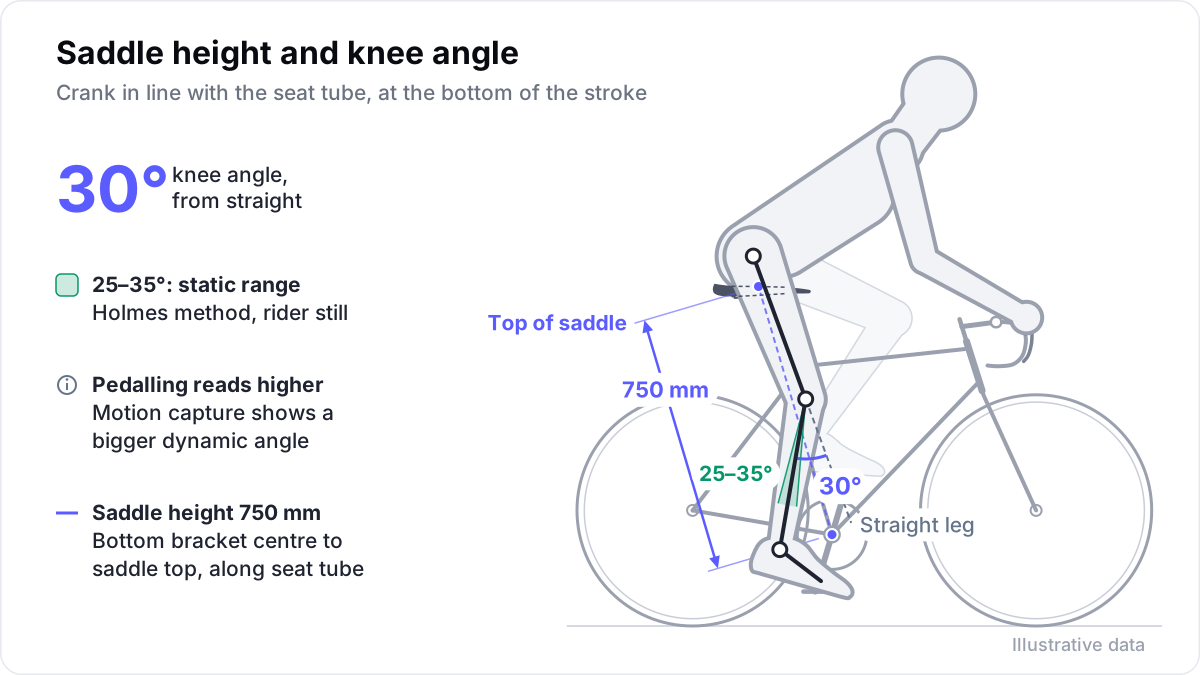
A knee measured while you pedal bends more than the same knee measured still, so the published ranges depend on how they were measured:
| Method | When it is measured | Knee bend from straight |
|---|---|---|
| Holmes (1994) | Still, crank at the bottom | 25 to 35 degrees |
| Ferrer-Roca (2012) | Pedalling, knee at its straightest | 30 to 40 degrees |
| Millour (2019) | Pedalling, crank at the bottom | 33 to 43 degrees |
Compare knee angles only when they were measured the same way. Some fit sheets give the inside angle of the knee, where a straight leg reads 180 degrees. In that convention, 25 degrees of bend reads as 155 and 35 degrees as 145.
The formulas agree near an 84 cm inseam and drift 15 to 18 mm apart for short and long legs. Millour's group in France has suggested the 109% formula for inseams under 80 cm and 88.5% of inseam for inseams over 88 cm.
Both formulas leave out foot length, ankle movement and flexibility. In studies by Peveler and colleagues, 109% of inseam put riders outside a 25 to 35 degree knee angle in 63% of cases in 2007 and in 73% in 2011.
Move the saddle a few millimetres at a time and ride normally for a week before you judge. Change one thing at a time, so you know what made the difference.
Shorter cranks need a higher saddle by the same amount: going from 172.5 mm to 170 mm cranks needs the saddle 2.5 mm higher. New cleats, pedals, shoes or a new saddle also change the height that suits you, so measure again after each.
If you have knee, hip or back pain that does not settle, see a bike fitter or a physiotherapist.
The full guide Saddle height: the methods bike fitters use, comparedVelograph is not affiliated with, sponsored by or endorsed by any rider or company named on this page. Names are used only to refer to publicly reported work.