Inseam formulas, the heel test and knee angles measured still or while pedalling: how each saddle height method works and what the research says.
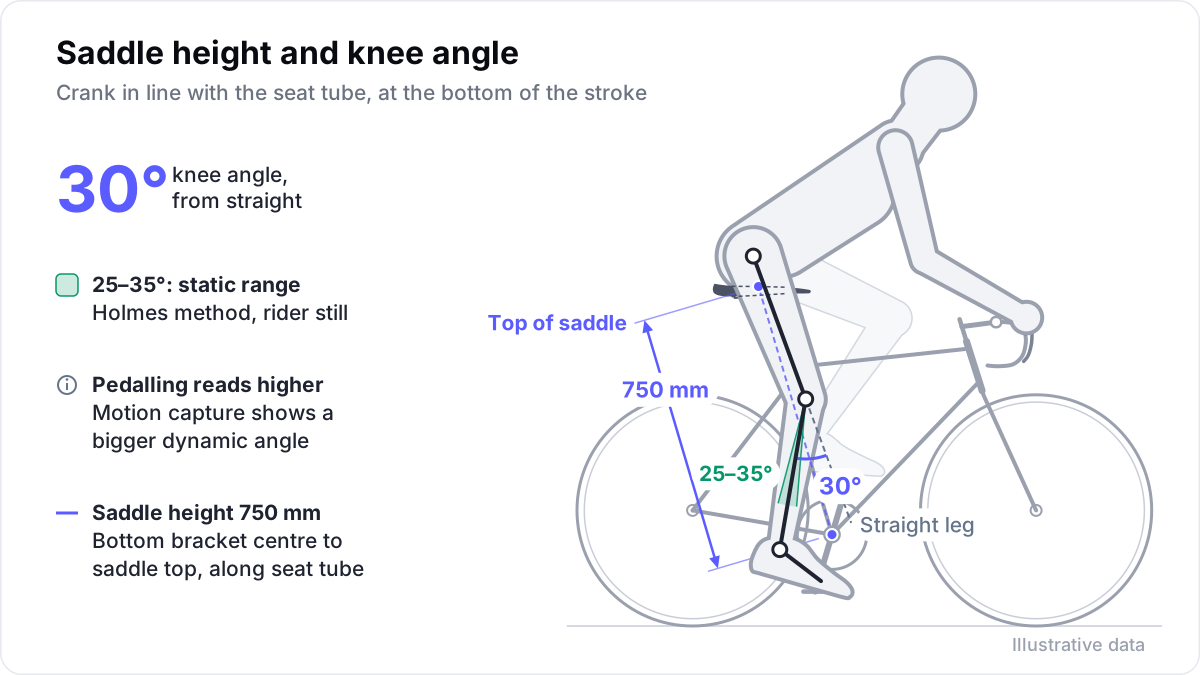
Saddle height is the distance from the centre of the bottom bracket to the top of the saddle where your sit bones rest. Inseam formulas give a starting point. The finished height comes from the knee angle at the bottom of the pedal stroke and from how you ride on it. The published targets are about 25 to 35 degrees of knee bend measured with the rider still, or roughly 33 to 43 degrees measured while pedalling. The two ranges can describe the same saddle, because the leg moves differently when it pedals.
How do you measure saddle height?
Measure saddle height in a straight line from the centre of the bottom bracket axle to the top of the saddle where your sit bones rest. Measure three times and write down the average.
Two people measuring the same bike can get numbers several millimetres apart, which is as much as a fitter might change in a session. In 2024, fourteen researchers and fitters agreed a consensus on how to measure bike set-ups (Priego-Quesada and colleagues, Sports Medicine). They define saddle height to the highest point where the sit bones touch the saddle, or to the middle of the saddle's widest section when that point is unknown. They also ask for the reference point to be stated, and for manual measurements to be taken at least three times and averaged.
A routine that gives the same answer next month:
- Put a strip of tape on the saddle where the sit bones rest and note its distance from the nose.
- Measure in a straight line from the centre of the bottom bracket axle to the top of the saddle at that tape. On most frames this line follows the seat tube.
- Use a steel tape or a fitting ruler, measure three times and write down the average.
- Note the crank length, pedals, shoes, cleat shims and insoles. The leg reaches the pedal, not the bottom bracket, so all of them change what a given number means.
- Measure inseam barefoot, feet 15 to 20 cm apart, with a book pressed firmly up between the legs, from the floor to the top of the book.
How do you calculate saddle height from inseam?
Multiply your inseam by 0.883 to get the height from the bottom bracket to the top of the saddle, which is the LeMond method. The older 109% method is measured from the pedal axle, so subtract the crank length from 1.09 times your inseam. Both give a starting point, not the finished height.
The oldest method comes from Hamley and Thomas, who published the 109% figure in The Journal of Physiology in 1967 after ergometer tests aimed at power output. Their figure runs from the pedal axle at the bottom of the stroke to the top of the saddle, not from the bottom bracket. To compare it with a normal saddle height, subtract the crank length: 1.09 times inseam, minus crank length.
The LeMond method multiplies inseam by 0.883 and gives the distance from the bottom bracket to the top of the saddle directly. Research papers credit it to Greg LeMond and Cyrille Guimard, and French fitting literature uses an almost identical 88.5%, the Genzling method. The two formulas give these heights for a 172.5 mm crank. For your own inseam and crank length, the saddle height calculator works out both and draws the point each one is measured from.
| Inseam | 0.883 x inseam | 1.09 x inseam minus 172.5 mm |
|---|---|---|
| 76 cm | 671 mm | 656 mm |
| 80 cm | 706 mm | 700 mm |
| 84 cm | 742 mm | 743 mm |
| 88 cm | 777 mm | 787 mm |
| 92 cm | 812 mm | 830 mm |
The formulas agree near an 84 cm inseam and drift 15 to 18 mm apart at either end. Millour's group in France has suggested the 109% approach for inseams under 80 cm and the 88.5% approach for inseams over 88 cm. Both formulas ignore foot length, ankle movement and flexibility, and it shows. In studies by Peveler and colleagues, 109% of inseam put riders outside a 25 to 35 degree knee angle in 63% of cases in 2007 and 73% in 2011.
The heel method needs no tools. Sit on the bike, put your heels on the pedals and pedal backwards slowly. At the bottom of the stroke the leg should be straight without the hips rocking. Clipped in on the ball of the foot, the knee then has some bend. It is quick, but the result depends on the shoe's heel, the length of the foot and how the rider sits, so treat it as a rough check.
What is the right knee angle for saddle height?
The knee should bend about 25 to 35 degrees from straight with the crank at the bottom and the rider still, or roughly 33 to 43 degrees measured while pedalling. The two ranges can describe the same saddle. The first range is the Holmes method, set out by Holmes, Pruitt and Whalen in Clinics in Sports Medicine in 1994.
A fitter measures it with a goniometer lined up on three landmarks: the hip (greater trochanter), the outside of the knee joint and the ankle bone (lateral malleolus). The foot should be at the angle the rider pedals with, not with the heel dropped.
Peveler's group then compared settings on the bike. In 2011, eleven well-trained cyclists used slightly less oxygen at a 25 degree knee angle (44.8 ml/kg/min) than at 35 degrees (45.2) or at 109% of inseam (46.0). The differences are small, a few percent at most, but they point the same way as a 2011 review by Bini, Hume and Croft, which suggested 25 to 30 degrees.
Check which convention a number uses before you compare it. Some fit sheets and motion-capture reports give the inside angle of the knee, where a straight leg reads 180 degrees. In that convention 25 degrees of bend reads as 155, and 35 degrees as 145.
Should you set saddle height from a static or dynamic knee angle?
The research now favours dynamic knee angles, measured while the rider pedals. A knee bends more at the bottom of the stroke while pedalling than when measured still, so the two methods use different target ranges.
Millour and colleagues measured 26 cyclists in 2019 and found the dynamic angle at the bottom of the stroke was 8 degrees greater than the static one. While pedalling, the ankle angle changes, the hip angle changes and the pelvis tilts from side to side, so the knee does not straighten as far as it does at rest.
Maximum knee extension while pedalling also happens slightly before the crank reaches the bottom, when the crank lines up with the seat tube. That gives three published targets that are easy to mix up:
| Method | When it is measured | Knee bend from straight |
|---|---|---|
| Holmes (1994) | Still, crank at the bottom | 25 to 35 degrees |
| Ferrer-Roca (2012) | Pedalling, maximum knee extension | 30 to 40 degrees |
| Millour (2019) | Pedalling, crank at the bottom | 33 to 43 degrees |
A 2022 systematic review by Bini and Priego-Quesada found strong evidence that saddle height should be set from dynamic knee angles. The 2024 consensus asks for at least two minutes of pedalling at the intended effort and cadence before recording, prefers 3D capture to 2D video, and wants the crank angle stated. In practice, a static 30 degrees and a dynamic 38 degrees can describe the same saddle. A number without its method is not worth comparing.
How do you know if your saddle is too high or too low?
Your saddle may be too high if your hips rock from side to side, your toes reach down at the bottom of each stroke, or you slide forward onto the nose. It may be too low if the knee stays clearly bent at the bottom and you feel cramped over the top.
Numbers start the fit; watching the rider finishes it. Look from behind and from the side, at a steady effort, after a proper warm-up.
Signs the saddle may be too high:
- The hips rock from side to side on the saddle.
- The toes reach down and the heel lifts sharply at the bottom of each stroke.
- The rider slides forward onto the nose to reach the pedals.
- Dynamic knee bend at the bottom is well under 30 degrees.
Signs it may be too low:
- The knee stays clearly bent at the bottom, over about 43 degrees while pedalling.
- The rider feels cramped over the top of the stroke and pushes forwards rather than down.
- The rider moves back on the saddle to find more room.
Pain is a different matter. Knee, hip or back pain that does not settle belongs with a physiotherapist or doctor, who can look for causes a saddle cannot fix.
How much should you change saddle height at a time?
Move the saddle a few millimetres at a time and ride normally for a week before judging. Change one thing per visit, so you know what made the difference.
Small changes can be felt, but their effect on efficiency is modest. Ferrer-Roca and colleagues moved the saddle 2% up and down from each rider's preferred height, about 15 mm on a 740 mm saddle. Raising it cut gross efficiency, the share of the energy used that reaches the pedals, from 20.6% to 19.8% in that group. Reviewing 41 studies, Bini and Priego-Quesada found that changes under 4% of leg length had trivial to small effects on loads in the leg and no effect on oxygen use. Riders differ, so go by the rider in front of you.
Several other changes move the effective saddle height without touching the seatpost:
- Crank length. Going from 172.5 mm to 170 mm cranks needs the saddle 2.5 mm higher to keep the same reach to the pedal at the bottom.
- Saddle setback. Sliding the saddle 10 mm back on its rails lengthens the distance from the bottom bracket by about 3 mm on a 73.5 degree seat tube.
- Cleats. Moving cleats back towards the arch usually needs the saddle a little lower. The cleat position checklist covers how far and why.
- Pedals, shoes and insoles. A different pedal system or sole changes the stack between foot and axle by a few millimetres.
- A new saddle. Shapes and padding differ, so measure to the sit-bone point again rather than copying the old number.
Write down each change, the date, the reason and how the rider felt two weeks later. A bike fit history turns those notes into something the next fitter can use, and it makes moving your fit to a new bike far easier. In Velograph, each fit measurement carries its own definition, including the point saddle height was measured to, so a later fitter knows what the number means. If you want to know whether a new height makes you faster rather than more comfortable, read what research says about bike fit and power before trusting a single test.
Further reading
- Methods to determine saddle height in cycling and implications of changes in saddle height in performance and injury risk: a systematic review, Journal of Sports Sciences, 2022.
- Bicycle set-up dimensions and cycling kinematics: a consensus statement using Delphi methodology, Sports Medicine, 2024.
- Comparison of static and dynamic methods based on knee kinematics to determine optimal saddle height in cycling, Acta of Bioengineering and Biomechanics, 2019.
- Effects of saddle height on economy and anaerobic power in well-trained cyclists, Journal of Strength and Conditioning Research, 2011.
Velograph is not affiliated with, sponsored by or endorsed by any team, rider or company named in this article. Names are used only to refer to publicly reported work.