How to measure saddle-to-handlebar drop, what it changes for your hips, hands and speed, how stems and spacers move it, and how to keep it on a new bike.
Handlebar drop, or saddle-to-handlebar drop, is how far your handlebar sits below the top of your saddle, measured straight up and down. There is no correct number. The right drop is the lowest one you can hold for your longest rides with light hands, a relaxed neck and no sliding forward on the saddle. It changes with how and where you ride. This guide shows how to measure it, what it changes, how stems and spacers move it, and how to keep it when you change bikes, with numbers worked out from a real frame.
How do you measure saddle to handlebar drop?
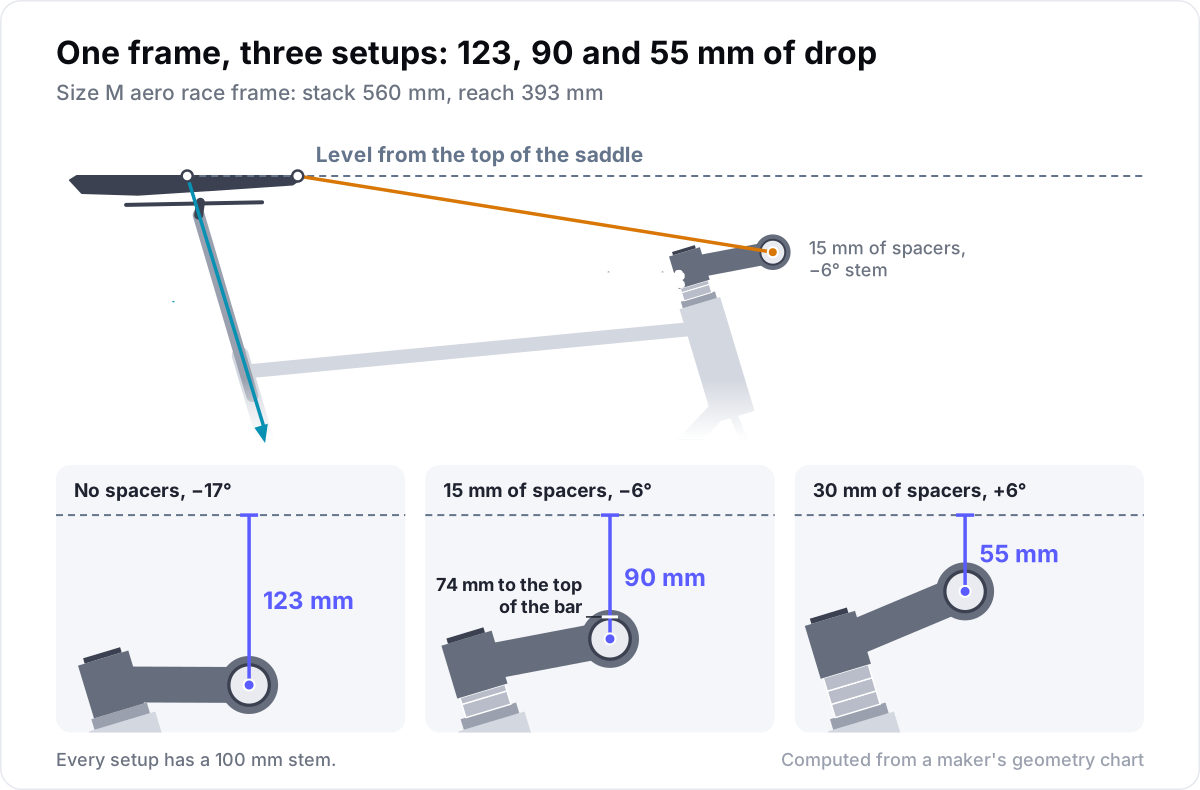
Lay a long spirit level across the top of the saddle where your sit bones rest, with the bike upright on a level floor, and measure straight down to the handlebar beside the stem. Write down which point on the bar you measured to, because its top and its centre are about 16 mm apart.
The 2024 expert consensus on bike set-up measurements, by Priego-Quesada and colleagues in Sports Medicine, measures this drop from the top of the saddle where the sit bones touch to the centre of the handlebar at the stem clamp. On a one-piece bar and stem, it uses the point where the two meet. Some fit sheets measure to the top of the bar instead. A road bar is usually 31.8 mm thick at the clamp, so its top sits 15.9 mm above its centre, and the same bike gives two numbers 16 mm apart.
Take three more numbers while the level is out:
- Drop to the hoods, measured to where your hands rest. New shifters or a new bar can move this one on their own.
- Saddle-to-bar reach, the straight line from the saddle to the centre of the bar. The consensus measures it from the sit-bone point. Measuring from the saddle nose is easier, but the number changes when the saddle does.
- Saddle height, because the drop is only meaningful beside it.
What does handlebar drop change?
Handlebar drop changes how far your torso leans forward, and with it the hip angle at the top of each pedal stroke, how much weight your hands and the front of the saddle carry, how far you lift your head to see the road, and how much of you meets the wind.
Torso and hips. If your arms keep their shape, each 10 mm of extra drop tilts a torso 600 mm long, from hip to shoulder, about 1.2 degrees further forward. Unless the pelvis rolls forward with it, the hip closes by the same angle at the top of the stroke. If it closes far enough, power suffers, as our time trial bike fit guide explains for the lowest positions.
Hands and saddle. A lower front puts more of the upper body's weight on the hands and rolls the pelvis towards the nose of the saddle. In a study of 48 competitive female cyclists, Partin and colleagues found that bars set lower than the saddle went with higher pressure on the perineum, the soft tissue between the sit bones, and with less genital sensation. The study shows a link, not a cause. Our guide to saddle pain sets out what to check.
Speed. On flat roads above about 50 km/h, around 90% of a rider's power goes into pushing air aside, according to a review by Debraux and colleagues. A lower torso meets less air, but the bar is not the only way down. In a wind tunnel at about 45 km/h, Barry and colleagues found that bending the elbows until the forearms were level, with the hands still on the hoods, cut the power needed by 13.4% compared with an ordinary hoods position.
How much handlebar drop should I have?
Choose the lowest handlebar drop you can hold for your longest rides without numb hands, an aching neck or creeping forward on the saddle, because no research gives a correct number. Change it 5 to 10 mm at a time. A rider racing for an hour can accept more drop than one riding all day.
The 2024 consensus defines how to measure the drop and gives no target for it. Fitters therefore choose it from the rider in front of them:
- The position you hold most. Fit the hoods first if that is where you spend your hours, then check that the drops are usable.
- Flexibility, tried on the bike. Off-bike tests show where to start, not where to finish. In 96 highly trained cyclists, Muyor and colleagues found that hamstring flexibility changed how the upper back and pelvis bent in a sit-and-reach test, but made no difference when the riders sat on their bikes with their hands on the drops.
- The riding. Gravel and long days usually call for a higher front than short races. Our gravel bike fit guide gives a starting point.
- The saddle first. Set saddle height and setback before the bar, because raising the saddle 10 mm on a 73.5 degree seat tube adds 9.6 mm of drop.
After each change, ride a week of normal rides and ask yourself four questions. After an hour on the hoods, are your elbows bent and your hands light? Can you ride 20 minutes in the drops without your neck aching? Do you stay on the same part of the saddle? Do you use the drops at all? If you never do, they may sit too low for you.
Is it better to have handlebars higher or lower than the saddle?
Neither height is better on its own: a bar below the saddle lowers your torso for speed if you can hold it in comfort, and a bar level with the saddle or above it suits riders with limited flexibility, back or neck trouble, or long easy days. Choose the one you can ride in from start to finish.
Pain or numbness that does not settle after a change or two belongs with a physio or doctor, not with another spacer.
How do spacers and stems change handlebar drop?
Each 10 mm of spacers under the stem reduces the drop by about 9.6 mm. Flipping a 100 mm stem from minus 6 to plus 6 degrees reduces it by about 20 mm. On a road frame, a longer stem at minus 6 degrees reduces it slightly too, because that stem points upwards.
The table models a size M aero race frame, with the stack of 560 mm, reach of 393 mm and 73.25 degree head tube from its maker's geometry chart, a conventional stem on 20 mm of spacers, 8 mm for the headset cover and half of a 40 mm stem clamp. The saddle height is 740 mm on the 73.5 degree seat tube. The maker sells this frame with a one-piece bar and stem, so read the table as the frame's arithmetic, not a parts list.
| Stem angle | 90 mm stem | 100 mm stem | 110 mm stem | 120 mm stem |
|---|---|---|---|---|
| Minus 17 degrees | 104 mm | 104 mm | 104 mm | 104 mm |
| Minus 10 degrees | 93 mm | 92 mm | 91 mm | 89 mm |
| Minus 6 degrees | 87 mm | 85 mm | 83 mm | 81 mm |
| 0 degrees | 78 mm | 75 mm | 72 mm | 69 mm |
| Plus 6 degrees | 69 mm | 65 mm | 61 mm | 57 mm |
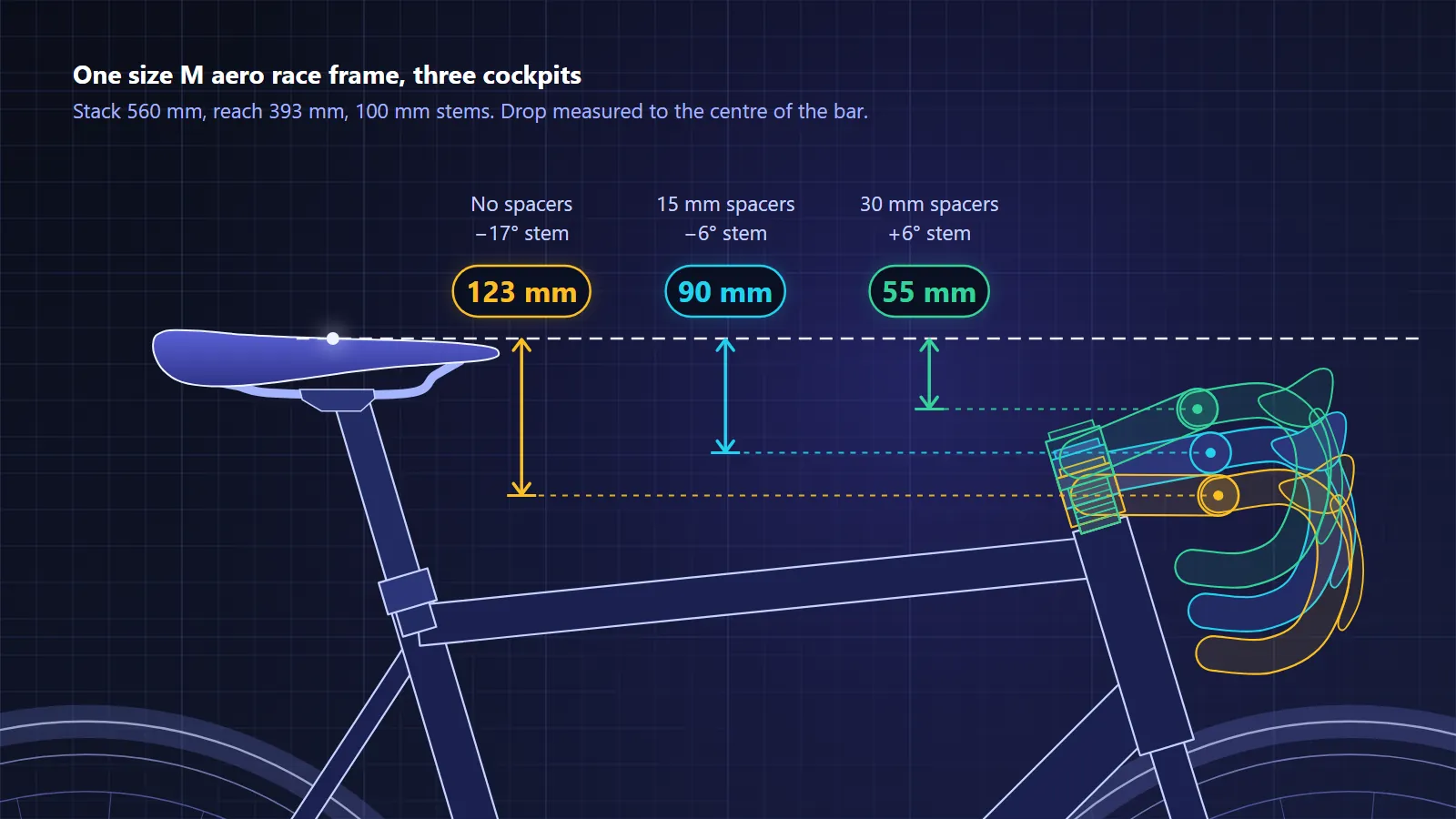
The drop is measured to the centre of the bar. With the 100 mm, minus 6 degree stem, 0, 10, 20, 30 and 40 mm of spacers give drops of 104, 94, 85, 75 and 66 mm. Whole setups spread wider: no spacers and a minus 17 degree stem give 123 mm, 15 mm of spacers and minus 6 degrees give 90 mm, and 30 mm of spacers and plus 6 degrees give 55 mm. To the top of the bar, each is 16 mm less.
A minus 17 degree stem sits almost level on this frame, so its length leaves the drop alone. Every other stem points upwards, so a longer one lifts the bar a little as it moves it forward. Our guide to stack and reach shows what the same parts do to reach.
How do you keep your handlebar drop on a new bike?
Record the drop with the points it was measured from, together with saddle height, saddle-to-bar reach and the drop to the hoods. On the new frame, choose spacers and a stem that put the bar back at the same point, then check the hoods, because new shifters and bars move the hands.
A new frame's stack changes the drop almost one for one. Take an endurance frame of the same size, with a stack of 586 mm and a 72.5 degree head tube, against the race frame's 560 mm and 73.25 degrees. With the same 100 mm, minus 6 degree stem on 20 mm of spacers, it puts the bar 27 mm higher and 6 mm closer, so the 740 mm saddle height above gets 58 mm of drop instead of 85 mm.
A rider who wants the race frame but rides happily at the endurance frame's height can get close. On the race frame, a 100 mm stem at plus 10 degrees on 20 mm of spacers, or at 0 degrees on 35 mm, puts the bar within about 3 mm of where the endurance frame has it. Check the fork maker's spacer limit first. If it takes the maximum spacers and an upturned stem, the endurance frame is the more natural choice.
The bar has a drop of its own as well: the height from the tops down to the drops. One aluminium road bar, for example, is listed by shops with a drop of 128 mm and a reach of 70 mm. A shallower bar brings your hands up in the drops even when the saddle-to-bar drop stays the same. Our step-by-step guide to moving your bike fit to a new bike covers the saddle and cleats too.
Velograph records the saddle-to-bar drop and the saddle nose to bar with every fit, each with the points it is measured from. For a new frame, a studio or team can have it list the stem and spacer setups that put the bar back where it was.
Further reading
- Bicycle set-up dimensions and cycling kinematics: a consensus statement using Delphi methodology, Sports Medicine, 2024.
- The bar sinister: does handlebar level damage the pelvic floor in female cyclists?, Journal of Sexual Medicine, 2012.
- Aerodynamic performance and riding posture in road cycling and triathlon, Journal of Sports Engineering and Technology, 2015.
- Influence of hamstring muscles extensibility on spinal curvatures and pelvic tilt in highly trained cyclists, Journal of Human Kinetics, 2011.
- Aerodynamic drag in cycling: methods of assessment, Sports Biomechanics, 2011.
Velograph is not affiliated with, sponsored by or endorsed by any team, rider or company named in this article. Names are used only to refer to publicly reported work.