How fitters measure saddle setback, what KOPS can and cannot tell you, the hands-off balance check, and what moving the saddle back does to height and reach.
Saddle setback is how far your saddle is behind a vertical line through the centre of the bottom bracket, measured level. Fitters measure it to the tip of the saddle nose, as the UCI does. There is no correct number to copy from another rider. A good setback lets you pedal hard with light hands on the bar. Set it after the cleats, then check saddle height again. Knee over pedal spindle (KOPS) is an old plumb-line rule, and a starting point at most.
What is saddle setback?
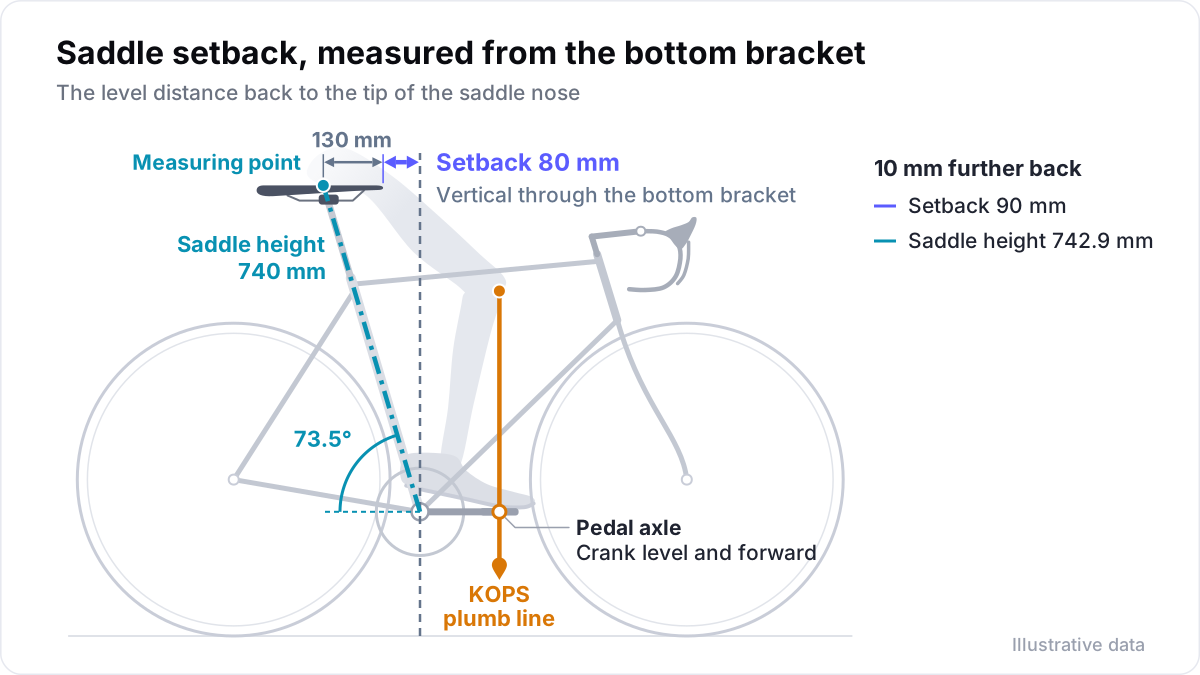
Saddle setback is the level distance from a vertical line through the centre of the bottom bracket to the tip of the saddle nose. It is positive when the nose is behind that line. Fitters also call it the saddle's fore-aft position.
The nose is easy to find again, but saddles differ in length. A short-nosed saddle ends further back, so the same seated position gives it a larger setback to the nose. For research, the 2024 expert consensus on bike set-up measurements (Priego-Quesada and colleagues, Sports Medicine) adds a second figure. It runs level from where the sit bones touch the saddle to the pedal axle, with the crank level and forward.
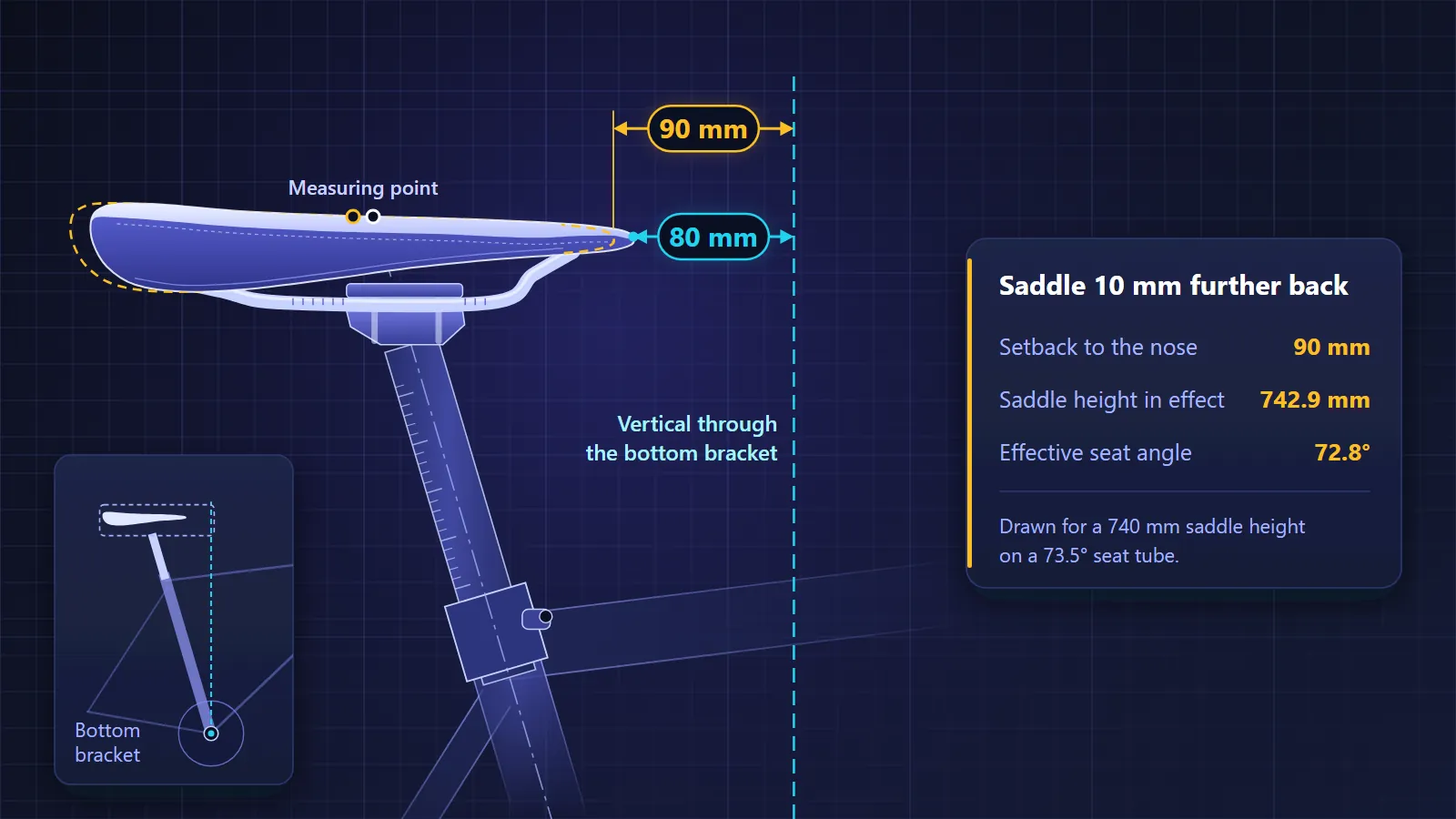
Whichever point you use, write it down with the number. A setback of 80 mm to the nose and one of 210 mm to a measuring point further back can describe the same saddle, as the worked example below shows.
A worked example
Take a saddle height of 740 mm, measured along a 73.5 degree seat tube to the measuring point. That point is 210 mm behind the bottom bracket, because 740 × cos 73.5° is 210.2 mm. It is 710 mm above it, because 740 × sin 73.5° is 709.5 mm. If the measuring point is 130 mm behind the tip of the nose, the setback to the nose is 80 mm.
The measuring point is a mark you put on the saddle, such as a strip of tape, so that you measure height and setback the same way every time. It is not where your sit bones rest, which is further back, on the flat rear part of the saddle.
How do I measure saddle setback at home?
Measure it with a plumb line and a tape measure, in the four steps below. The plumb line can be a string with a small weight on the end.
- Stand the bike upright on a level floor, with both wheel axles at the same height.
- Hang a plumb line from the tip of the saddle nose and mark the floor under it.
- Mark the floor under the centre of the bottom bracket the same way.
- Measure between the marks three times, and write down the average.
How far back must the saddle be under UCI rules?
Since 1 January 2025, UCI article 1.3.013 asks only that the saddle tip is behind the vertical plane through the centre of the bottom bracket. Until then it asked for at least 50 mm. Time trial categories that allow extensions longer than 750 mm still require 50 mm, so check the current rules before you race.
Should my knee be over the pedal spindle?
Not necessarily, because the knee over pedal spindle rule (KOPS) is a rule of thumb that research has not validated. Treat it as a rough check on a starting position, nothing more.
With the rider seated and the crank level and forward, at 3 o'clock, a plumb line hangs from the front of the knee. The rule says it should pass through the pedal axle or slightly behind it. Descriptions differ on the landmark. Some use the lower edge of the kneecap. Others, including the Australian fitter Steve Hogg, use the bony bump below it, the tibial tuberosity. Two KOPS readings may therefore not mean the same thing.
Where the rule came from is unclear. Keith Bontrager, a pioneer of the modern mountain bike, wrote about it in a 1998 essay. He suggested it probably grew out of watching good riders, many of whom had the knee somewhere over the pedal. He called the relationship coincidental. Turn the whole bike and rider around the bottom bracket, as a different seat angle does, and the knee moves off the plumb line. The leg's geometry relative to the crank stays the same. Only the rider's balance changes, and balance is what Bontrager fitted for instead.
In 2021, Holliday and Swart of the University of Cape Town noted that KOPS has not been validated scientifically, and that no data show it protects the knee. In their study of 50 well-trained male cyclists on their own bikes, setback ranged from about 6% to 15% of saddle height. Leg length, flexibility and training history together did not predict it.
Before any KOPS check, set the cleats, because moving a cleat moves the foot on the pedal, and the knee moves with it. The cleat position checklist covers that step. Time trial positions move the saddle well forward on purpose, putting the knee ahead of where KOPS would place it, as the time trial bike fit guide explains.
What does research say about saddle setback?
Research gives no setback to copy, but a few small studies show that moving the saddle back changes how the leg works and how comfortable the saddle feels.
- Pedalling effectiveness. In 2016, Menard and colleagues in Poitiers tested 11 cyclists at six setbacks, pedalling at 200 W. Compared with a forward position, sitting back raised their index of work effectiveness from 82.0% to 84.2%. The index measures how much of the force on the pedal turns the crank. Earlier work, they noted, found that sitting further forward favours maximal power.
- Forces in the knee. In a 2020 modelling study with 10 cyclists, the same group moved the saddle over about 6 cm. The compression force between the thigh bone and the shin bone was 14% higher on average with the saddle back than forward.
- Joint angles and comfort. A group in Valencia moved 34 recreational cyclists 10% forward and 10% back from their own setback, keeping saddle height the same. In their 2025 paper, the leg joints extended more with the saddle back, and comfort fell while perceived effort did not change.
The knee forces were modelled in healthy riders, so they say nothing about injury on their own. Knee pain that does not settle belongs with a physiotherapist or doctor, as our article on how a physio and a bike fitter work together explains.
How do I find the right saddle setback?
Use the hands-off balance check, which asks whether your legs and trunk can support you at a hard effort without leaning on your hands. Steve Hogg described this version on his website in 2011:
- Put the bike on an indoor trainer and warm up well.
- Ride a hard, steady effort a little below time trial pace. Hogg suggests about 85% of maximum heart rate at 95 to 105 rpm.
- Once settled, put your hands in the drops.
- Swing your arms back beside your hips and keep pedalling at the same effort.
Ideally, you stay balanced with a slight forward tilt that you can control, without arching your back or sitting up. Do the check on a trainer, never on the road.
- You tip forward and grab the bar. The saddle may be too far forward for this position, or the bar too low or too far away.
- You feel rock solid, with no forward pull at all. The saddle may be further back than you need. Hogg's view is that getting off the saddle to sprint or climb then takes longer.
Hogg puts most riders' working range at about 10 mm either side of the balance point. That point moves with torso length, pedalling technique, strength and mobility.
How does moving the saddle back change height and reach?
Sliding the saddle 10 mm back on its rails raises it in effect by about 3 mm on a road bike, because the seat tube leans back. It also adds about 10 mm to your reach, because the bar stays where it was.
Take the worked example and slide the saddle 10 mm back, so the setback becomes 90 mm. The measuring point is now 220.2 mm behind the bottom bracket and still 709.5 mm above it. Its distance from the bottom bracket is √(220.2² + 709.5²), which is 742.9 mm. The saddle is 2.9 mm higher in effect, and the effective seat angle is now 72.8 degrees rather than 73.5.
To keep 740 mm, lower the seatpost 2.9 mm. The post runs along the seat tube, so this also brings the saddle 0.8 mm forward, and the setback ends at 89 mm.
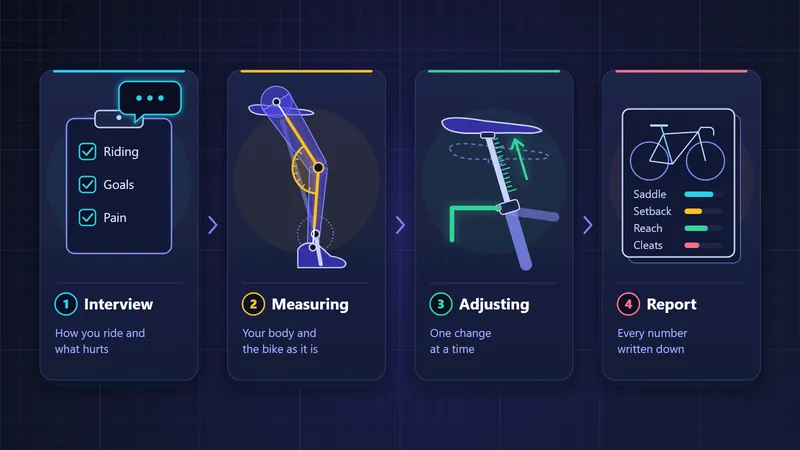
Check the knee angle again afterwards, as the saddle height guide explains. If the bar now feels too far away, a stem 10 mm shorter brings it about 10 mm back, as the guide to stack and reach shows. Change one thing at a time, in steps of about 5 mm, and ride a few times before you judge it.
How do I copy saddle setback to a new bike?
Record setback with every measurement that affects it, then rebuild the same sit-bone position on the new frame. Write these down with every fit:
| What to record | Why it matters |
|---|---|
| Setback to the saddle nose | The UCI's figure, and the easiest to repeat |
| Distance from the nose to where your sit bones rest | Gives the seat position if the saddle changes |
| Saddle model | A different saddle changes the nose figure |
| Rail scale mark and seatpost offset | Put the same saddle back in the same place |
| Seat tube angle | Sets where the post passes under the saddle |
| Saddle height and its measuring point | Height and setback change each other |
If the new frame's seat tube is 74.5 degrees instead of 73.5, it passes 13 mm further forward at a 740 mm saddle height. A 15 mm offset post in place of a straight one makes up those 13 mm, with the saddle about 2 mm further forward on its rails. Our guide to moving your bike fit to a new bike covers the whole transfer.
In Velograph, a fit records setback next to the saddle model, rail mark and seatpost offset. When a studio or team moves the fit to a new frame, the transfer page works out the seatpost offset and rail position that keep the saddle where it was. A rider keeps every fit in their own free Passport, as the page on Velograph for riders explains.
Further reading
- The Myth of K.O.P.S.: an alternative method of bike fit, Sheldon Brown's website, 1998.
- Anthropometrics, flexibility and training history as determinants for bicycle configuration, Sports Medicine and Health Science, 2021.
- Bicycle set-up dimensions and cycling kinematics: a consensus statement using Delphi methodology, Sports Medicine, 2024.
- Changes in saddle setback and intensity affect comfort and lower limb kinematics in recreational cyclists, Scientific Reports, 2025.
- UCI Cycling Regulations, Part 1: General organisation of cycling as a sport, UCI, 2026.
Velograph is not affiliated with, sponsored by or endorsed by any team, rider or company named in this article. Names are used only to refer to publicly reported work.