What a physiotherapist and a bike fitter each see, when to refer, how to hand findings over without losing them, and how the rider keeps control of the record.
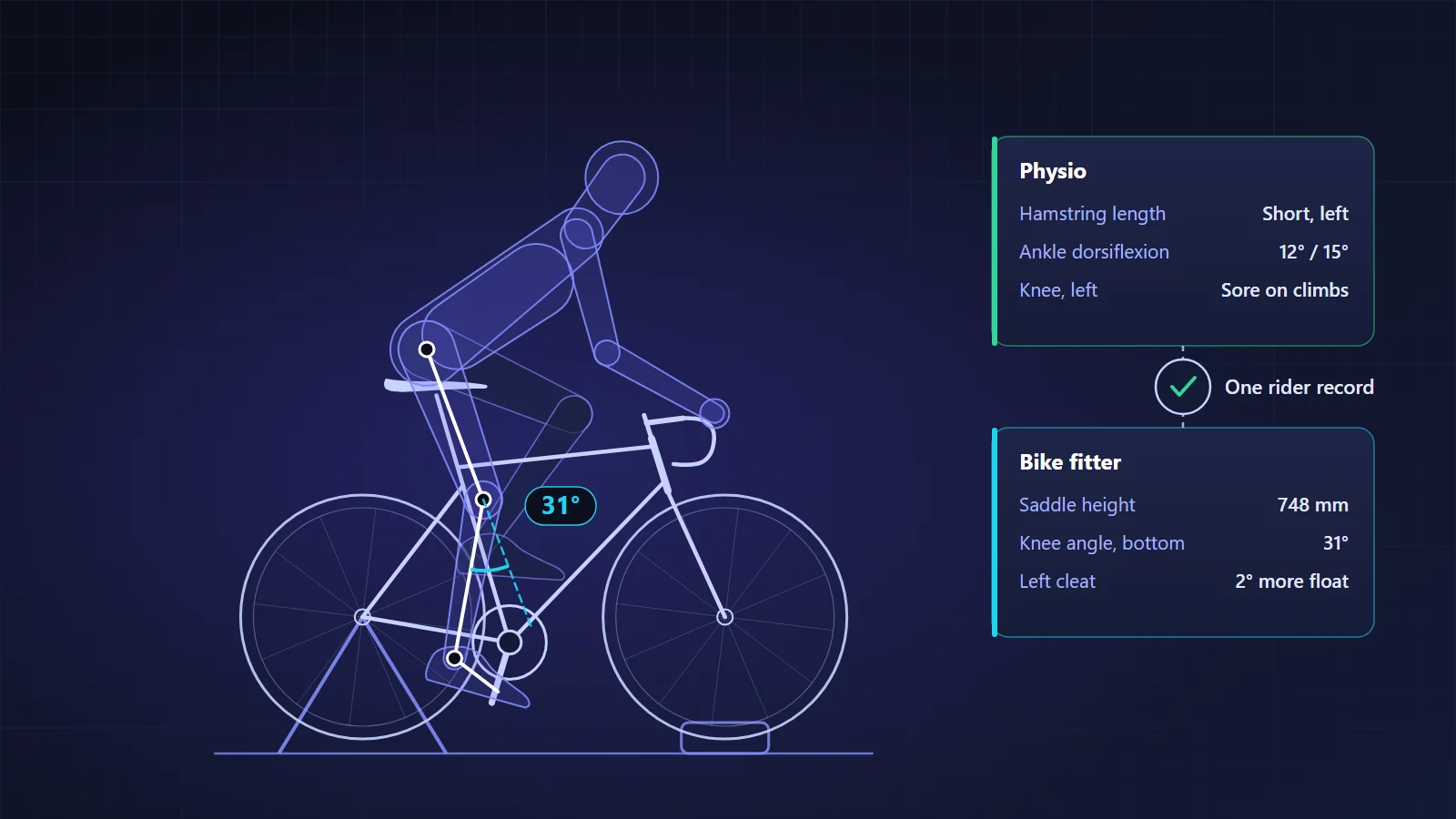
When a physio and bike fitter work together, they look at the same rider from two sides. The physiotherapist assesses the body: injury history, pain, mobility, strength and control. The fitter adapts the bike: contact points, position and equipment. A rider in pain, or coming back from injury, gets most from both when they work from one record, pass findings to each other in writing and share only what the rider agrees to. That partnership is what a clinical bike fit should mean, whether one person holds both skills or two people work side by side.
What is the difference between a physio and a bike fitter?
A physio assesses the body and can diagnose and treat, while a bike fitter adapts the bike and the rider's position on it. Neither replaces the other.
The two professions overlap on the bike and part ways off it. A fitter watches the rider pedal; a physio examines the rider on the treatment table and in movement off the bike.
| Physiotherapist | Bike fitter | |
|---|---|---|
| Starts with | Injury and surgery history, pain, training load | Goals, riding, discomfort on the bike, the bike itself |
| Assesses | Mobility (for example hip flexors with the Thomas test, hamstrings with the straight-leg raise, ankle bend (dorsiflexion) with a knee-to-wall test), strength, control, leg length | Joint angles while pedalling, pelvis and knee tracking, foot and cleat set-up, saddle pressure, reach and drop |
| Tools | Clinical examination, functional tests, referral for imaging | Measuring tools, video or motion capture, pressure mapping, sizing |
| Changes | Treatment, exercise programme, advice on load and return to riding | Saddle, cleats, wedges and shims, cranks, bars, stem, the whole position |
| Writes | A clinical record | A fit record with measurements and reasons |
Phil Burt, a physiotherapist who was lead physio at British Cycling for 12 years and fits riders himself, advises riders in pain to consider a physio-led fit. In his view, a fitter without healthcare training may not have the knowledge to help with confidence. He adds that a good fitter knows when a rider needs referring. Where one person cannot do both, a short, reliable route between two practices does the same job.
When should a bike fitter refer a rider to a physio?
A bike fitter should refer a rider to a physio when pain persists or returns after sensible position changes, after a recent injury or operation, or when the bike does not explain an asymmetry. Numbness, tingling or pain that wakes the rider at night may belong with a doctor first. Referral works in both directions.
A fitter's list of reasons to send a rider to a physio usually includes:
- Pain that persists or returns after sensible position changes, or that appears off the bike as well.
- Numbness, tingling or swelling, or pain that wakes the rider at night. Some of these belong with a doctor first.
- A recent injury or operation, before the position changes much.
- An asymmetry the bike does not explain, such as a knee that drifts inwards on one side or a pressure map that stays lopsided with the saddle set straight.
- A suspected leg-length difference, which needs a clinical assessment before anyone adds shims (our cleat position checklist explains why).
A physio sends a rider to a fitter when the bike is part of the problem or part of the plan. A rider returning after injury may need a position that keeps the healing area within a comfortable range. A mobility limit may be something the bike should work around while rehabilitation progresses. And treatment can change a body enough that the old fit no longer suits it.
How should a physio and bike fitter share findings?
A physio and a bike fitter should share findings in writing, in the other expert's terms, with the number, the method and the reason. Most of the value is lost in the handover.
A physio's note that says "right hip stiff" helps a fitter less than one that says what the bike should avoid. A fitter's note that says "saddle lowered" helps a physio less than one that gives the number, the method and the reason. Translate findings into the other expert's terms:
| Physio finding | What the fitter can consider |
|---|---|
| Limited hip flexion on one side | Avoid lowering the front end; consider shorter cranks; check how the pelvis sits and rotates on the saddle |
| Limited ankle bend | Recheck saddle height and cleat fore-aft, so the rider is not reaching for the bottom of the stroke |
| Measured leg-length difference | Shims under the shorter leg's cleat, added in small steps and reviewed |
| A forefoot that tilts at rest | Wedges under the cleat or a supportive insole, tested on the bike |
| A knee recovering after surgery | Agree the range the knee should move through, change little at a time, review often |
Agree the vocabulary as well. State which side is meant (the rider's left), how angles are measured (a knee bend measured from straight or the angle inside the joint) and whether a number was taken with the rider still or pedalling. A static knee bend of 30 degrees and a dynamic one of 38 degrees can describe the same saddle. A number without its method causes more confusion than no number.
Keep each handover short and structured. Say what the rider reported (where, when, how bad from 0 to 10, after how long on the bike), what was measured, and what was changed and why. Then say what you want the other expert to look at, and when the rider will be reviewed. Our article on bike fitter client notes sets out a note structure borrowed from clinicians.
A worked example
Here is an illustrative case. A masters road racer reports pain at the front of the right knee after two hours, rated 5 out of 10. The fitter finds the saddle effectively 8 mm lower than at the last fit, because new shoes with a thicker sole went on without anyone checking the height. The right knee also drifts inwards at the top of the stroke. The fitter raises the saddle to restore the old effective height, records the change, and refers the rider to a physio because the knee pattern looks like more than a bike problem.
The physio assesses the rider, starts a programme and writes back in bike terms: avoid any further changes to saddle height or cleats for four weeks, and review the knee's tracking then. At the review both notes sit in one record, the fitter sees the physio's summary, and the detailed clinical notes stay with the physio. The rider's own log over those weeks, how long into a ride the knee starts to ache and how much, tells both experts whether the plan is working.
Who decides what a physio and a bike fitter can see?
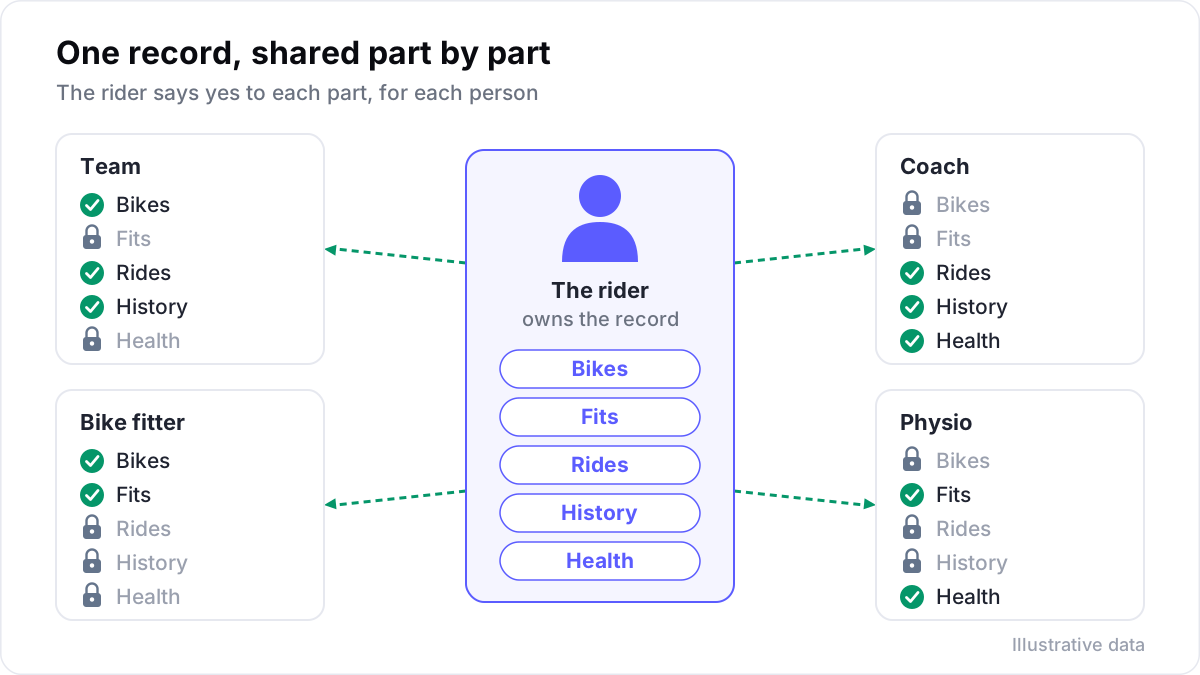
The rider decides what each expert sees. When information moves between practices, share the minimum the other expert needs, share it with the rider's explicit agreement, and let the rider change their mind.
Under the EU's General Data Protection Regulation, data concerning health is a special category: Article 9 prohibits processing it unless an exception applies, one of which is the person's explicit consent for specified purposes. Clinicians have their own legal duties for their records. Our article on athlete data privacy covers the rules in more detail. This is not legal advice.
How Velograph supports a shared record
Velograph's Studio plan is built for practices of bike fitters, coaches and physiotherapists, alone or together. It is priced per practitioner with unlimited clients, and brings a booking calendar, a client journal with dictation, bike fits with side-view diagrams, follow-ups and branded client reports. Journal notes are written by fitters, coaches and physios alike, and a note can be marked confidential so that only clinicians read it.
Every fit a studio records lands in the client's own free Passport, so the rider keeps it when they change fitter, physio or team. When a practice scans a rider's Passport card, the rider sees who is asking and for what, says yes on their own phone part by part, and can allow less than was asked. A physio's request can include the journal notes other practitioners wrote, and the rider still decides. In a team, the clinician role sees riders' profiles, bikes and fits, not their training data unless they also coach.
The result is one record the rider owns, with the fitter's numbers and the physio's summary side by side. You can read more about the bike fit passport, see the current plans and terms on the pricing page, or, as a rider, start for free. Studios can try Velograph free.
Further reading
- 11 bike fit trends you need to know about, according to British Cycling's former physio guru, Cycling Weekly, 2023.
- Art. 9 GDPR: processing of special categories of personal data, gdpr-info.eu, 2018.
Velograph is not affiliated with, sponsored by or endorsed by any team, rider or company named in this article. Names are used only to refer to publicly reported work.