Burning or numb feet on the bike come from pressure under the ball of the foot. The shoe, insole and cleat checks to try first, and when to see a doctor.
Hot foot cycling is a burning, tingling or numb feeling under the ball of the foot, often spreading into the toes, that builds during a ride and fades once you stop. It comes from pressure under the forefoot. The first changes cost little: looser straps, roomier shoes, a different insole and a small cleat move, tried one at a time.
When should I see a doctor about hot foot?
The NHS advises seeing a GP for any tingling or loss of feeling in the foot, so mention hot foot to your GP even if it fades after rides. Contact NHS 111 if the foot is hot, swollen and painful, has changed shape, or you cannot walk. With diabetes, see a GP about any foot pain.
The NHS page on pain in the ball of the foot sorts the signs by how quickly to act. Among them:
- See a GP for any tingling or loss of feeling in the foot, for pain that is getting worse, keeps coming back or has not improved after two weeks of looking after it at home, and for foot pain if you have diabetes, because foot problems can be more serious then.
- Contact NHS 111 if the pain is severe, you cannot walk, the foot has changed shape, it is hot, swollen and painful, or you feel hot, cold or shivery.
When the feeling comes only on the bike and goes within minutes of stopping, the shoe and cleat checks below are a sensible step alongside your GP's advice. A podiatrist can examine the foot itself and make insoles, and the guide to a physio and a bike fitter working together shows how a clinician's findings reach the bike.
What causes hot foot when cycling?
Hot foot comes from pressure under the ball of the foot, which carries most of the load on the pedal. A tight or narrow shoe, an insole that leaves the arch unsupported, a cleat that concentrates the load, and long efforts at high power can each add to it.
The NHS says pins and needles happen when the blood supply to the nerves is cut off, usually by sitting or lying on part of the body. On the bike, the pressure is under the forefoot.
In 2000, Sanderson and colleagues measured pressure inside the shoes of 17 recreational and 12 competitive cyclists at 100 to 400 W. In both groups, the first metatarsal, the long bone behind the big toe, carried most of the load along with the big toe itself. Because the pattern was much the same in both groups, the authors put it down to the foot, the shoe and the pedal rather than to training. A 2026 study of 50 male professional cyclists also found the highest pressures under the inner forefoot.
Numb feet are among the complaints bike fitters see most. In the records of 1,505 riders who went to bike fitters in Brazil, numb feet or toes made up 11.5% of all complaints. A 2007 review of cycling injuries by Wanich and colleagues lists numbness of the foot and pain under the ball of the foot among the common ones it calls preventable, with bike fit and equipment as the place to start.
| What you notice | First checks |
|---|---|
| Burning under the ball of the foot, worse on climbs and hard efforts | Insole and arch support, cleat fore-aft, time spent seated at high power |
| Numb toes that spread as the ride goes on | Strap tension, shoe width at the forefoot, sock thickness |
| The forefoot feels squeezed from the sides | Shoe width, the thickness of the insole |
| One foot only | That foot's cleat, shoe and insole, and any difference between your feet |
What should I change first for hot foot?
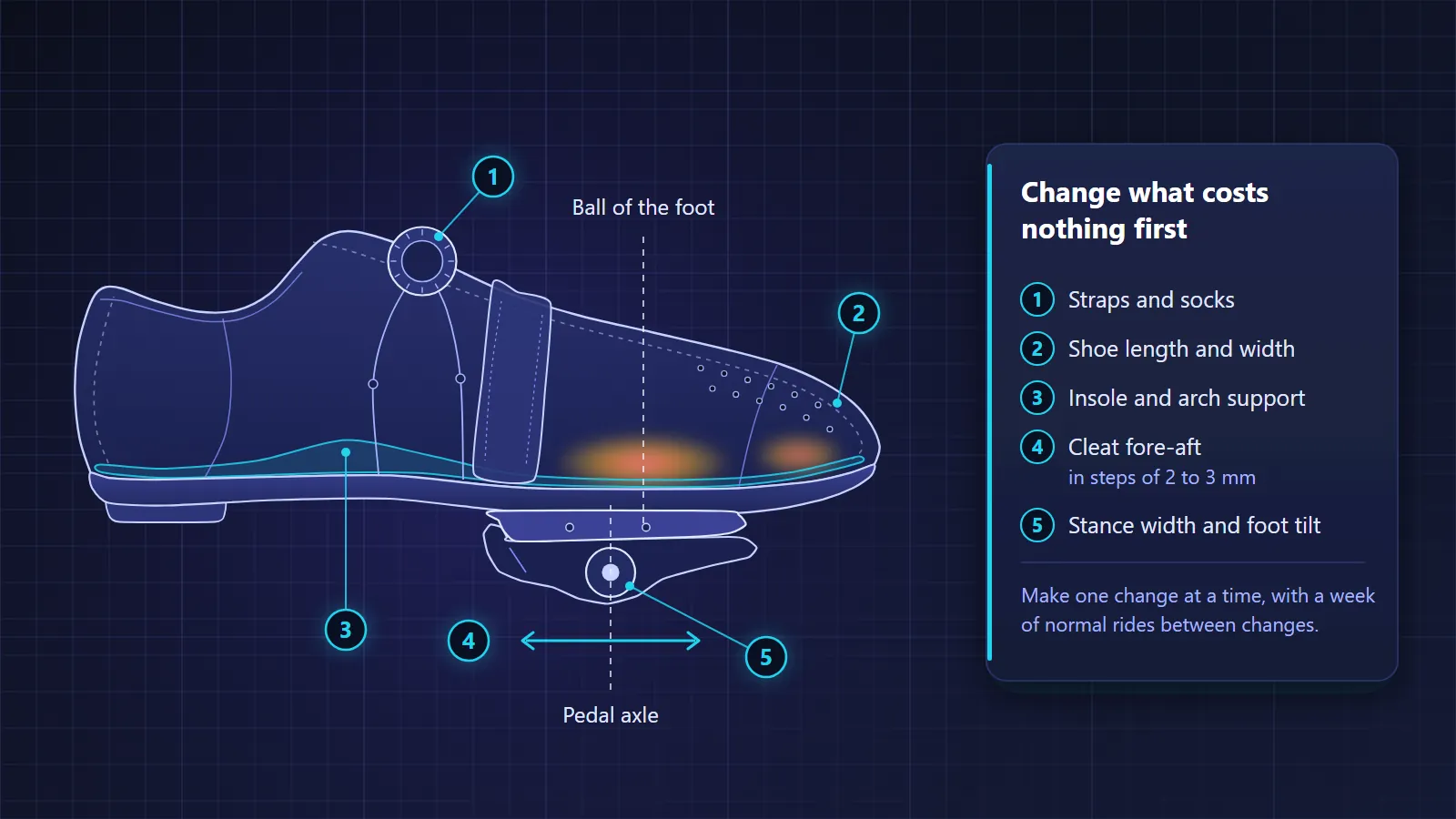
Change what costs nothing first: loosen the straps and check that your shoes have room with the socks you ride in. Then try a supportive insole, and then move the cleats a few millimetres. Make one change at a time, with a week of normal rides between changes.
- Straps and socks. Loosen the top strap or dial a little, and try a thinner sock.
- Shoe length and width. Check that the shoe does not squeeze the forefoot.
- Insole and arch support. Try an insole that follows the arch.
- Cleat fore-aft. Move the cleat in steps of 2 to 3 mm.
- Stance width and foot tilt. Check them last, with a fitter if you can.
Are my cycling shoes too tight or too narrow?
Your shoes may be too tight or too narrow if your toes cannot move inside them or the sides of your forefoot press against the upper. The NHS advice for pain in the ball of the foot starts with shoes that give your feet plenty of room, and cycling shoes are no exception.
A quick home test helps. Stand barefoot on a sheet of paper and draw round your foot. Take the insole out of the shoe and lay it on the drawing. If your foot is clearly wider than the insole across the ball, the shoe is narrow for you. Try new shoes with the socks and insoles you ride in, and do the straps up as you would on a ride.
Do insoles or arch support help hot foot?
Insoles can help, because a contoured insole spreads the load over more of the foot. In a laboratory study, a contoured insole increased the contact under the middle of the foot and felt more supportive at the arch, but riders did not rate it more comfortable than a flat one. Test any insole on real rides.
That study, by Bousie and colleagues in 2013, tested 12 cyclists at 90 rpm. The contoured insole also raised the share of pressure under the big toe, so it moved the load as well as spreading it. In a 2018 follow-up with 23 cyclists, a softer contoured insole spread contact across the middle of the foot and the heel. In a study of 18 healthy recreational cyclists at 200 W, a stiff insole reinforced under the forefoot lowered the peak pressures compared with a standard foam insole and a plain stiff one, but comfort was not measured.
A metatarsal pad is a small dome placed a little behind the ball of the foot. No cycling study we found has tested one, so try it on short rides first, and have a fitter place it.
Should I move my cleats back for hot foot?
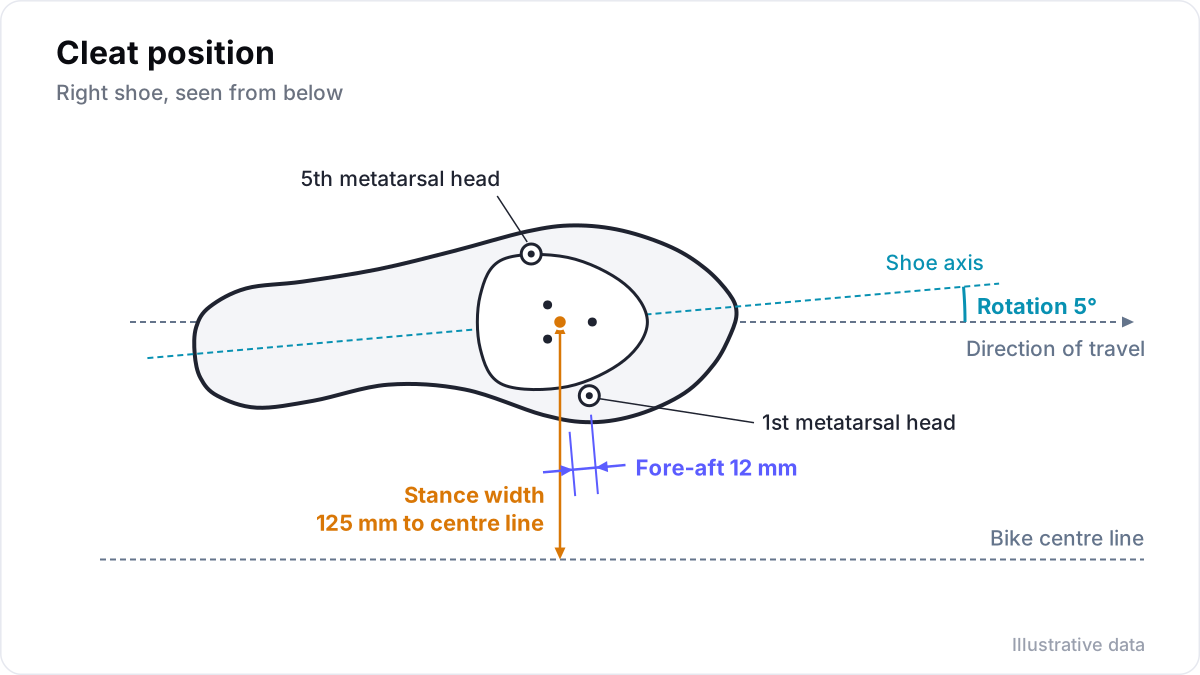
Moving the cleat 2 to 3 mm back, so the pedal axle sits a little further behind the ball of the foot, is one common trial. We found no study of whether it helps hot foot, and some advice suggests moving the cleat the other way, so change it in small steps and judge each one after a week.
Our cleat position checklist shows how to find the ball of the foot on each shoe and measure fore-aft from it. Moving the cleat back usually means lowering the saddle a little, because the foot reaches the pedal differently, as the saddle height guide explains. A cleat move can also change how your knee feels. If a knee starts to ache after the change, read our guide to knee pain when cycling.
Does stance width or foot tilt matter for hot foot?
Foot tilt can matter, because if your foot rolls inwards on the pedal under load, the big-toe side of the forefoot, which already carries the most, can take even more. A supportive insole or a cleat wedge can level the foot, and the stance width affects whether your knee tracks straight above it.
Wedges come in steps of about 1 to 1.5 degrees and should follow a measured forefoot angle, not a guess. Check the stance width again after adding them, as the cleat position checklist describes.
Why do my feet burn more on long climbs and hot days?
Long climbs keep your power high and you seated for a long time, and higher power raises the pressure under the foot. On hot days and late in long rides, shoes that fitted at the start can feel tight, so loosen the top strap a little before a long climb.
In the 2026 study of professional cyclists, power was the main thing that set the pressure under the foot. Doubling it from 100 W to 200 W raised the peak pressures by about 85%. Pedalling faster at the same power did not lower them. Going from 80 to 100 rpm raised them by about 16%. So do not count on spinning faster to cure hot foot. Notice instead whether the burning starts at a given time, on a given climb or above a given power, and write it down.
How do you keep track of foot changes?
Write down your shoe model and size, the insoles, each cleat's position for each foot, and how your feet felt on each ride, with when the burning started. Change one thing at a time, so that you know which change helped.
An illustrative example, for a rider whose feet burn on hilly rides:
| Date | Change | Ride | Feet from 0 to 10 | It started after |
|---|---|---|---|---|
| 1 June | None, to set a baseline | 3 hours, two long climbs | 6, both feet | 75 minutes |
| 8 June | Top straps one click looser | Same route | 5 | 95 minutes |
| 15 June | Contoured insoles | Same route | 3 | 2 hours 20 minutes |
| 22 June | Cleats 2 mm back, saddle 1 mm lower | Same route | 1 | Near the end |
It is the same method as for a sore lower back, with one change, a week of rides and a score each time. A bike fit history keeps the numbers for the next pair of shoes and the next fitter. In Velograph, a fit records the shoes, the insoles and each cleat's fore-aft, sideways position and rotation for the left and right foot separately. The studio's body map scores the feet and toes on each side from 0 to 10, and each follow-up asks about the same spots again. Those fits stay in the rider's own record, as the page for riders explains.
Further reading
- The influence of cadence and power output on force application and in-shoe pressure distribution during cycling by competitive and recreational cyclists, Journal of Sports Sciences, 2000.
- Contoured in-shoe foot orthoses increase mid-foot plantar contact area when compared with a flat insert during cycling, Journal of Science and Medicine in Sport, 2013.
- Effect of power output and pedaling cadence on plantar pressures in professional cyclists with overuse injuries, Sports, 2026.
- Pain in the ball of the foot, NHS, 2025.
Velograph is not affiliated with, sponsored by or endorsed by any team, rider or company named in this article. Names are used only to refer to publicly reported work.