Where your knee hurts tells a bike fitter what to check first, from saddle height to cleats. Some signs mean you should see a physio or doctor first.
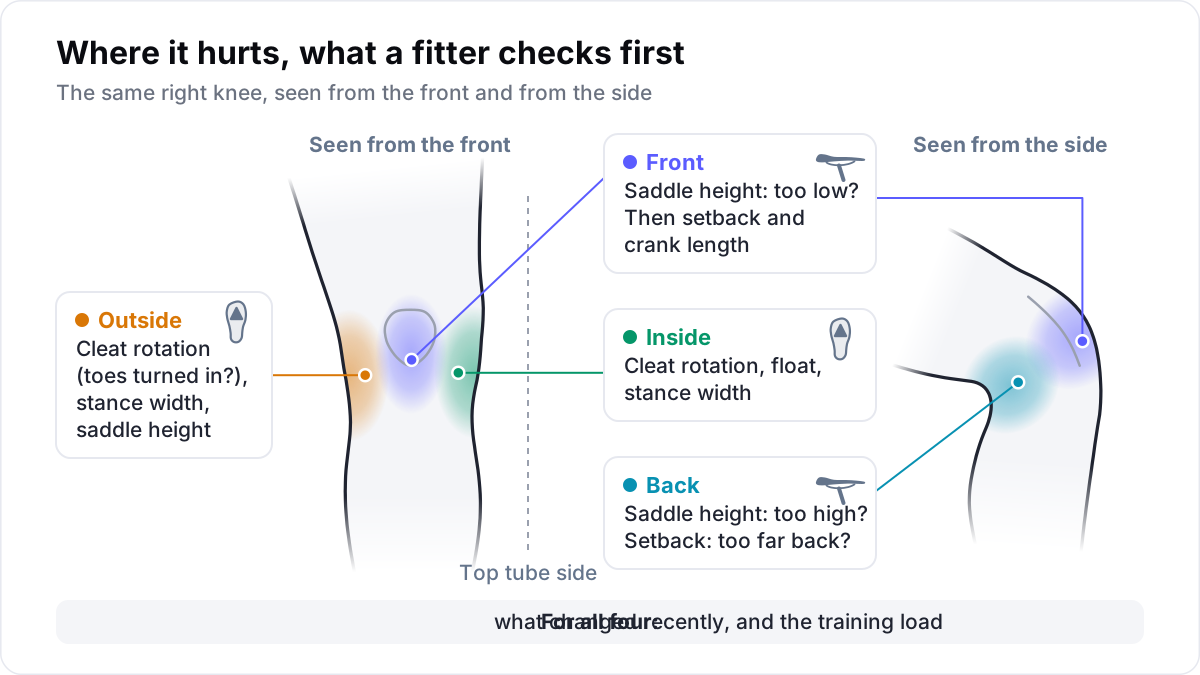
When you get knee pain cycling, where it hurts tells a bike fitter where to look first. Pain at the front of the knee starts with a check that the saddle is not too low. Pain behind the knee raises the opposite question: is the saddle too high or too far back? Pain on the inside or the outside sends the fitter to the cleats and to how far apart they hold the feet. These are fit checks, not a diagnosis, and some signs mean you should see a physio or doctor first.
When should I see a physio or doctor about knee pain?
See a physio or doctor before anyone changes the bike, and stop riding until then, if any of the signs below apply. These signs need an examination, which a bike fitter cannot give.
- The pain came on suddenly, or after a crash, a fall or a twist.
- The knee is swollen or has changed shape, or it feels hot and looks red.
- It locks, gives way or catches, for example as you twist the heel out to unclip.
- You cannot straighten it or put weight on it.
- It hurts off the bike as well, on stairs, after sitting for a while or at night.
- It has not improved within a few weeks, or it keeps coming back after sensible changes to the bike.
The NHS treats a very painful, badly swollen or locking knee, or one you cannot put weight on, as a reason to get urgent advice. For pain that builds slowly on the bike and settles off it, a fit check is a reasonable first step, often alongside a physio. Our article on how a physio and a bike fitter work together shows how findings pass between the two.
How common is knee pain in cycling?
Knee pain is one of the commonest overuse problems in cycling, and pain at the front of the knee is the most frequent kind. In 2010, Clarsen and colleagues interviewed 109 professional road cyclists from seven teams.
Over the previous 12 months, 36% had had pain at the front of the knee, and 19% had seen medical staff about it. The knee accounted for 57% of the overuse injuries that cost riders time off the bike.
The research is clearer on what bike settings do to the knee than on what causes pain. A 2017 systematic review by Johnston and colleagues found 14 small studies, only four of them with riders in pain, and no direct link between bike settings and knee injury. In a small study described in a 2018 review by Bini and Bini, riders with knee pain did not ride lower saddles than riders without it. So treat each check below as a likely place to start, and watch how the knee responds.
What will a bike fitter ask about my knee pain?
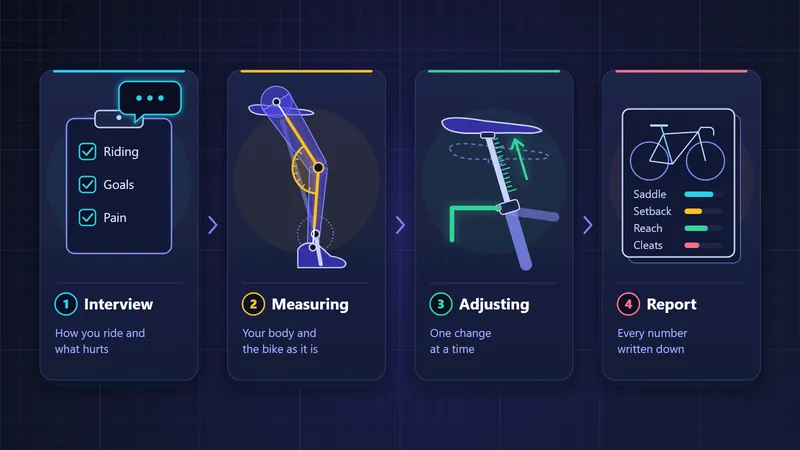
A fitter will ask where and when it hurts, and what has changed recently in your equipment and your training. Asplund and St Pierre's 2004 guide for clinicians names recent equipment changes, and training distance and intensity, as things to consider alongside the fit. Expect questions like these:
- Where exactly does it hurt, and in one knee or both?
- How long into a ride does it start, and how bad is it from 0 to 10?
- Is it worse on climbs, in hard efforts, on the indoor trainer or when you stand on the pedals?
- What changed in the last six weeks? New shoes, cleats, pedals, a saddle, cranks or a whole bike? More hours, more climbing or a training camp?
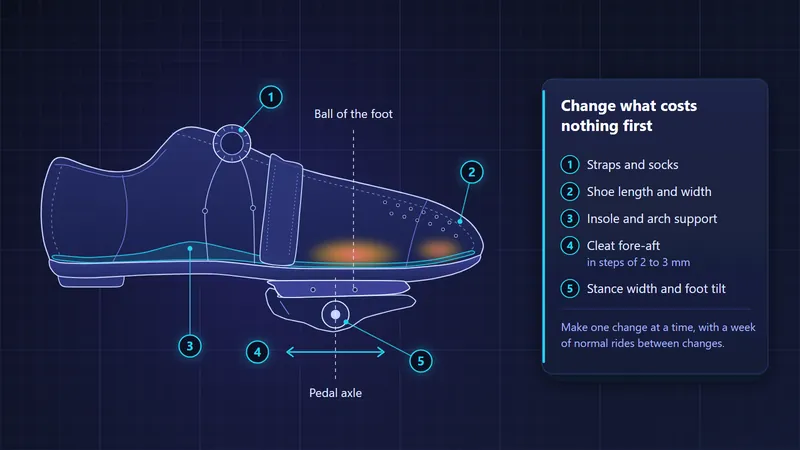
New shoes or pedals can change the distance between the foot and the pedal axle, and so the effective saddle height, by a few millimetres, although nobody touched the seatpost. Keep a short log for two weeks before the appointment: the date, the ride, when the pain started and how bad it was.
Where it hurts and what a fitter checks first
| Where it hurts | First fit checks | Also look at |
|---|---|---|
| Front, around or below the kneecap | Saddle height: is it too low? Then setback and crank length | Hard efforts, long climbs, a jump in hours |
| Back, the hollow behind the knee | Saddle height: is it too high? Setback: is it too far back? | Signs of reaching for the pedal |
| Inside, facing the top tube | Cleat rotation against the foot's natural angle, float, stance width | A knee that drifts inwards, forefoot tilt |
| Outside, facing away from the bike | Cleat rotation (toes turned in?), stance width, saddle height | A sudden rise in distance |
What should I check for pain at the front of the knee?
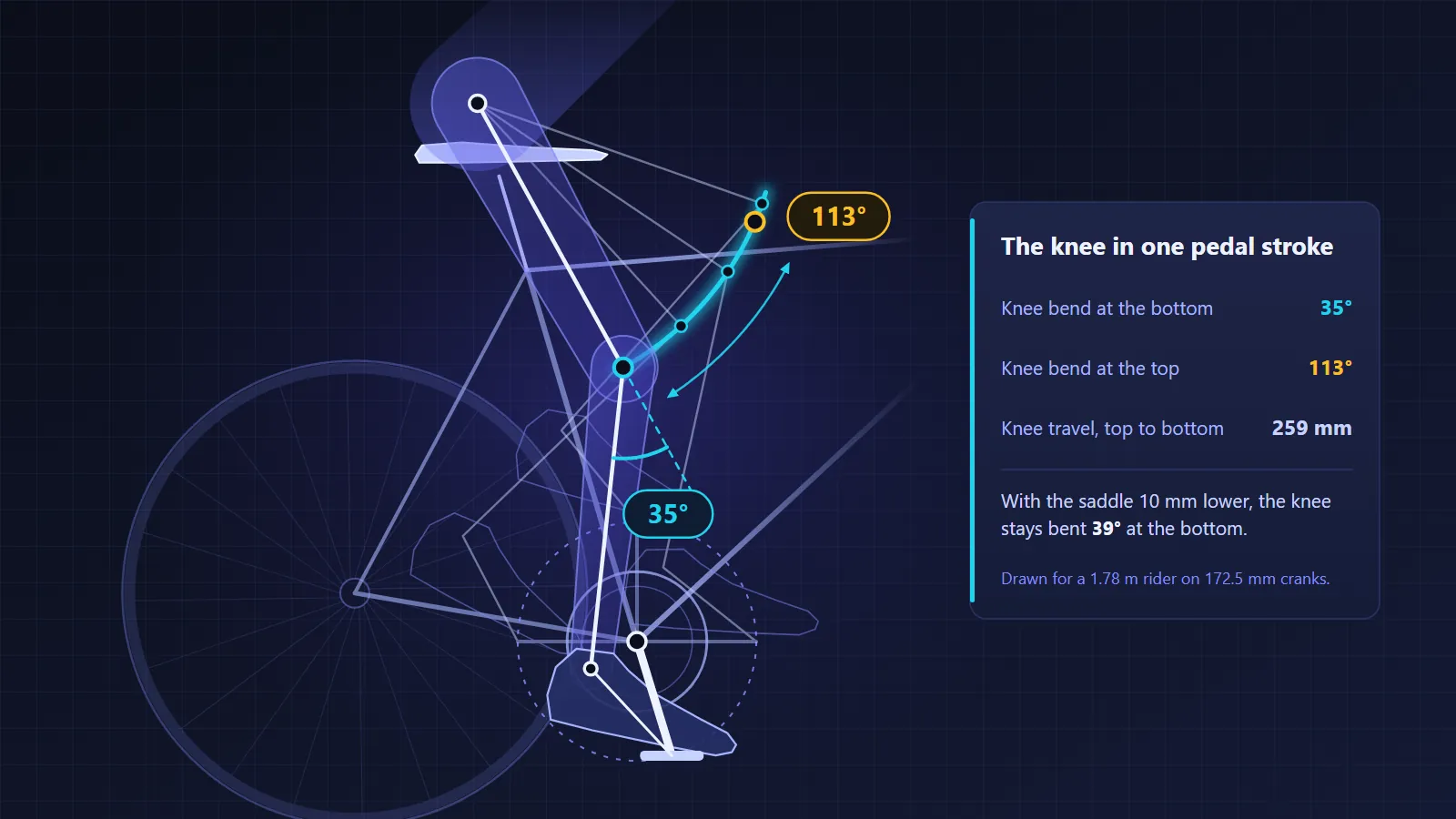
Check first that the saddle is not too low, because a low saddle keeps the knee more bent while it pushes. In a 1987 laboratory study of six healthy men, Ericson and Nisell found that the forces behind the kneecap rose as the saddle went lower. They also rose as the workload went up.
A 2011 review by Bini, Hume and Croft came to the same view. Check the knee angle at the bottom of the stroke as our saddle height guide describes.
Setback comes next, and it seems to matter less. In 21 competitive cyclists, sitting further forward or further back on the saddle changed the compressive forces behind the kneecap by only 1 to 4% (Bini and colleagues, 2013). Crank length matters at the top of the stroke, because a longer crank bends the knee further there. Then look at the load. The 2017 review lists hill climbing, heavy workloads and an increase in training among the possible causes of pain at the front of the knee.
What should I check for pain behind the knee?
Check whether the saddle is so high, or so far back, that the leg reaches for the pedal. Pain behind the knee is the least common of the four, and research on it is thin.
The 2017 review names a saddle that is too high and tight hamstrings as possible causes. Signs of reaching include hips that rock on the saddle, toes that point down hard at the bottom of the stroke and a rider who slides forward onto the nose.
Height and setback are checked together, because sliding the saddle 10 mm back on its rails raises the effective height by about 3 mm on a typical road frame. Our saddle setback guide shows how to measure setback at home. A physio can assess hamstring flexibility, and the fitter then works around what they find.
What should I check for pain on the inside of the knee?
Check the cleats first, looking at their rotation and float and at the stance width. Float is the free rotation a cleat allows before it starts to release, and stance width is how far apart the feet are on the pedals.
Is the cleat turned to match the foot's natural angle, or does the heel rest against one end of the float on every stroke? Watched from the front, does the knee track straight over the foot at this stance width, or drift inwards towards the top tube on the downstroke? In one small study described in the 2018 review, riders with a history of pain at the front of the knee showed more of that inward movement than riders without pain. It may be a result of the pain rather than its cause, but it is easy to check.
In 1993, Ruby and Hull found that pedals that let the foot rotate reduced the twisting and side-to-side loads at the knee in 11 riders. No long-term study has yet shown that more float means less knee pain, so float does not make up for a badly turned cleat.
There is no agreed rule for which way to turn a cleat for pain on the inside of the knee. The fitter matches the cleat to the foot first, then changes it a degree or two at a time, as our cleat position checklist describes.
What should I check for pain on the outside of the knee?
Check cleat rotation first, this time looking for toes turned in, and then stance width and saddle height. The 2017 review lists three possible causes of the most common kind of outside-knee pain in cyclists. They are toes that point inwards on the pedals, a saddle that is too high and a rapid increase in distance.
A 2003 laboratory study of ten recreational athletes by Farrell and colleagues also suggested that a saddle set too high could aggravate it.
Can more training make my knee hurt?
Yes, a bike that has not changed can start to hurt when the training changes. Typical jumps are the first long rides of spring, a training camp or a new block of hard indoor sessions.
Look at your weekly hours or your training load, a single score for how long and how hard you rode, over the four weeks before the pain started. Compare them with the month before. If the rise is large, the training plan is part of the answer, and that is for your coach and physio as well as your fitter.
Change one thing, and write it down
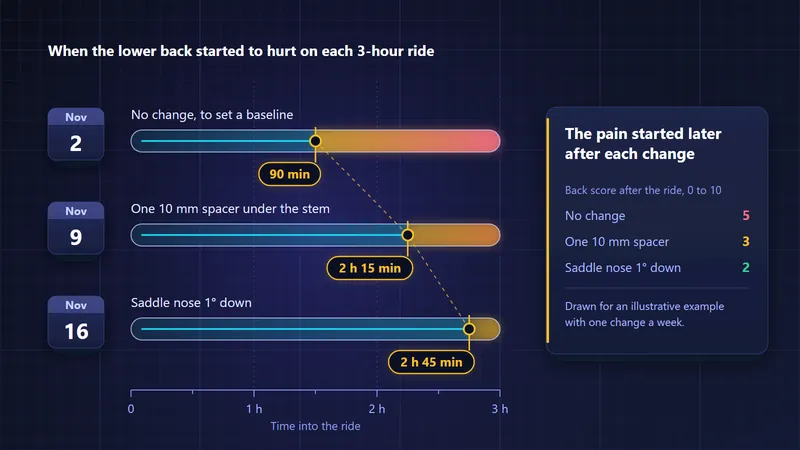
If you move the saddle, turn the cleats and cut your hours in the same week, and the knee settles, nobody knows which change helped. Make one small change at a time: a few millimetres of saddle height or a degree or two of cleat rotation. Ride normally for a week or two, and rate the knee after each ride from 0 to 10, with how far into the ride the pain started. If the pain gets worse, or does not settle after sensible changes, stop adjusting the bike and have the knee checked.
Record each change with the date, the number, the reason and the result. A bike fit history lets the next fitter or physio see what was tried and what helped.
In Velograph, a studio records where it hurts on a body map, with the front, back, inside and outside of the knee as separate spots, each rated from 0 to 10. At each check-in after the fit, the rider rates the same spots again, so the fitter can see whether the pain went down. Every fit is saved in the rider's own record, and the rider decides who sees it. Our page for riders sets out what a rider gets on their own.
Further reading
- The influence of extrinsic factors on knee biomechanics during cycling: a systematic review of the literature, International Journal of Sports Physical Therapy, 2017.
- Potential factors associated with knee pain in cyclists: a systematic review, Open Access Journal of Sports Medicine, 2018.
- Overuse injuries in professional road cyclists, The American Journal of Sports Medicine, 2010.
- Knee pain, NHS, 2023.
Velograph is not affiliated with, sponsored by or endorsed by any team, rider or company named in this article. Names are used only to refer to publicly reported work.