Bodies, bikes and goals change. A dated record of every bike fit, with the numbers and the reasons, lets each new fitter start from evidence, not from zero.
A bike fit history is the dated record of every fit you have had: the numbers, the equipment, who measured them and why each change was made. It matters because a fit is a snapshot of one body, on one bike, for one goal, and all three change. With the history in hand, the next fitter starts from evidence instead of from zero. A new bike can be set up in an afternoon, and you can see whether a change helped.
Why do bike fit numbers get lost?
Bike fit numbers get lost because they end up scattered across emails, drawers, laptops and spreadsheets. A PDF report sits in an old email. A paper sheet sits in a drawer. Motion-capture files live on a studio laptop in a town they no longer ride from. A team's mechanic has a spreadsheet that left with the mechanic.
Then the rider moves, changes team, sees a physio or buys a new bike. The next fitter measures from scratch, and may undo a change that was made for a good reason nobody wrote down.
The numbers themselves can mislead too. Two fitters can measure saddle height to different points on the saddle and get figures several millimetres apart for the same bike. A 2024 expert consensus on bike set-up measurements asks for the reference point of every measurement to be stated for exactly this reason. Our saddle height guide shows how much the method changes the number.
What changes between bike fits?
Between fits, the body, the bike, the goal and the season can change what the fit should be, and a new fitter may measure the same position differently. A fit is right for its moment.
| What changes | Examples | What it can mean for the fit |
|---|---|---|
| The body | Flexibility, injury or surgery, weight, age | Saddle height, bar drop, cleats |
| The bike | New frame, cranks, saddle, bar, pedals or shoes | Every contact point needs measuring again |
| The goal | From sportives to racing, gravel or time trials, or from racing to long days | A lower or higher front, a different saddle |
| The fitter | Different methods and tools | The same position measured differently |
| The season | A winter bike, an indoor trainer | Separate set-ups that should still match |
What should a bike fit record include?
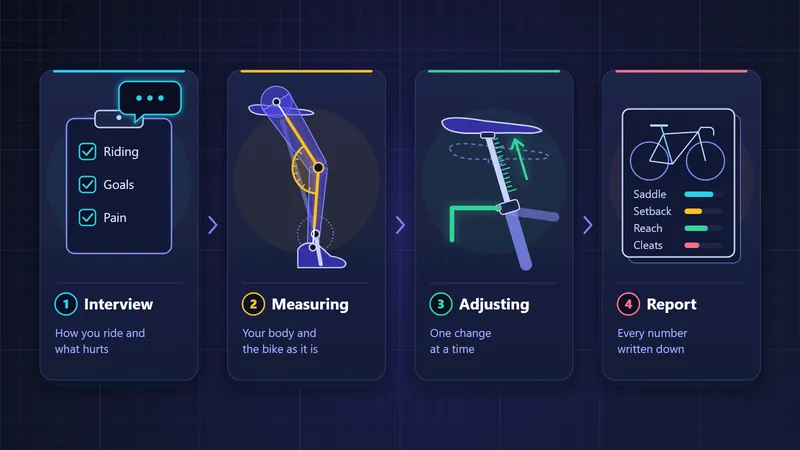
A bike fit record should include the date, fitter and tools, the reason for the fit, the contact points with their reference points, cleats and equipment, what changed and why, and how it felt two to six weeks later. A record is useful when someone else can rebuild the position from it without phoning the person who wrote it.
- The date, the fitter and the studio, and the tools used: tape, laser, motion capture.
- Why the fit happened: a new bike, discomfort, a new goal, a referral from a physio.
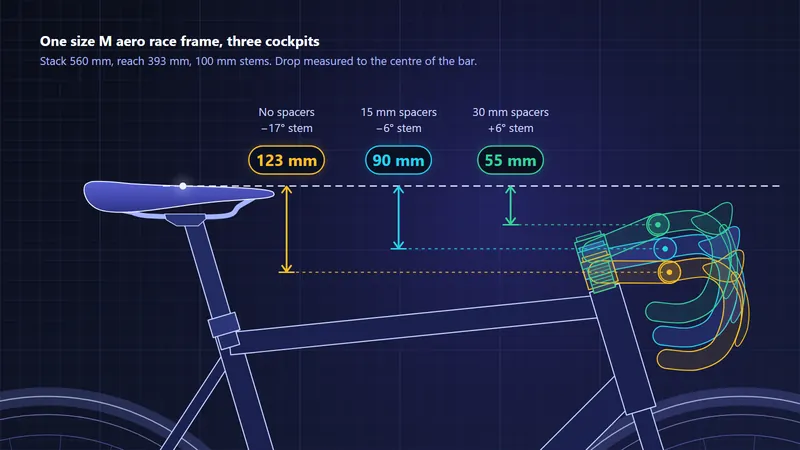
- Contact points with their reference points: saddle height, setback and tilt; saddle-to-bar reach and drop; hood position; bar width; crank length.
- Cleats for each foot: fore-aft, rotation, sideways position, wedges and shims, with the shoes and insoles.
- Equipment: saddle, handlebar, stem and spacers, pedals.
- Rider measurements: height, inseam, flexibility, and any leg-length difference with how it was compensated.
- Joint angles, when measured, with the method: still or while pedalling.
- What changed since the last fit, and why.
- How it felt two to six weeks later.
The last two lines are the easiest to skip, and they are worth the most. A number tells the next fitter where you were. The reason and the result tell them what has already been tried.
Reading a history: an example
Here is one rider's road bike over two and a half years, recorded by two different studios:
| Date | Reason | Saddle height | Saddle-to-bar drop | What happened next |
|---|---|---|---|---|
| March 2023, Studio A | New road bike | 742 mm | 85 mm | Hips rocked on long climbs |
| April 2023, Studio A follow-up | Rocking on the saddle | 738 mm | 85 mm | Steady on the saddle after three weeks |
| March 2024, Studio A | First road races, wanted a lower front | 738 mm | 105 mm | Comfortable for races up to three hours |
| September 2025, Studio B | Longer days, less racing | 738 mm | 90 mm | Rides of five hours without changing position |
Studio B can now see that the saddle came down 4 mm for a reason, so it does not raise it back to what an inseam formula suggests. It can also see which front-end heights the rider has already lived with, and for what kind of riding. Without the record, Studio B would have started again and perhaps repeated 2023.
Should you keep a separate fit for each bike?
Yes, keep a fit for each bike, because fits belong to a bike, not only to a rider. A road bike, a time trial bike and a gravel bike are set up differently by design, and a spare race bike should match the first one exactly.
Give each set-up a name that says what it is for, such as "race position", "long days" or "after knee surgery". You can then compare like with like, and see how the road and time trial positions relate.
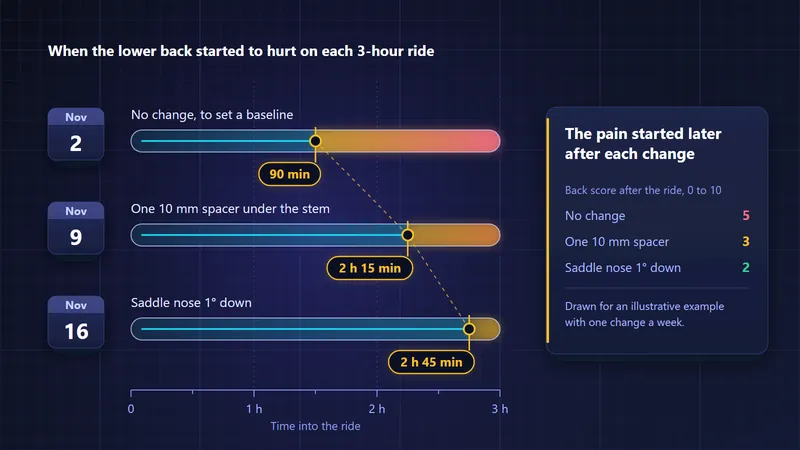
A history also tells you which changes were real. Measuring the same bike twice rarely gives identical figures. Velograph counts a difference as noticeable from 3 mm for positions and lengths, from 1 mm at the cleat or crank, and from 1 degree for angles. Anything smaller is more likely a difference in measuring than a real change. When you buy a new frame, the same record is where the transfer starts, as our guide to moving your bike fit to a new bike explains.
How do you start a bike fit history?
Start from what you already have by gathering old fit reports and sheets, asking your last fitter for the full measurements and measuring each bike as it is today. An hour is enough to build a useful record, and nobody starts with a perfect one.
- Search your email for fit reports and save the attachments in one place.
- Photograph any paper fit sheets, including the handwritten notes in the margins.
- Ask your last fitter for the full measurements, not only the summary page.
- Measure each bike as it is today: saddle height to the sit-bone point, setback, saddle-to-bar reach and drop, crank length and cleats. Label it as your own measurement, with the date.
- Write down what you remember about why each change was made and how it felt.
Your own measurements are less precise than a fitter's, and that is fine. They show the next fitter where the bike is now, and the reports show how it got there.
How Velograph keeps your bike fit history
Velograph keeps every bike and every fit from every fitter in the rider's own profile, on the free Rider plan, which never expires. A fit is never written over. A new fit is a new record, so you can always see what changed and when.
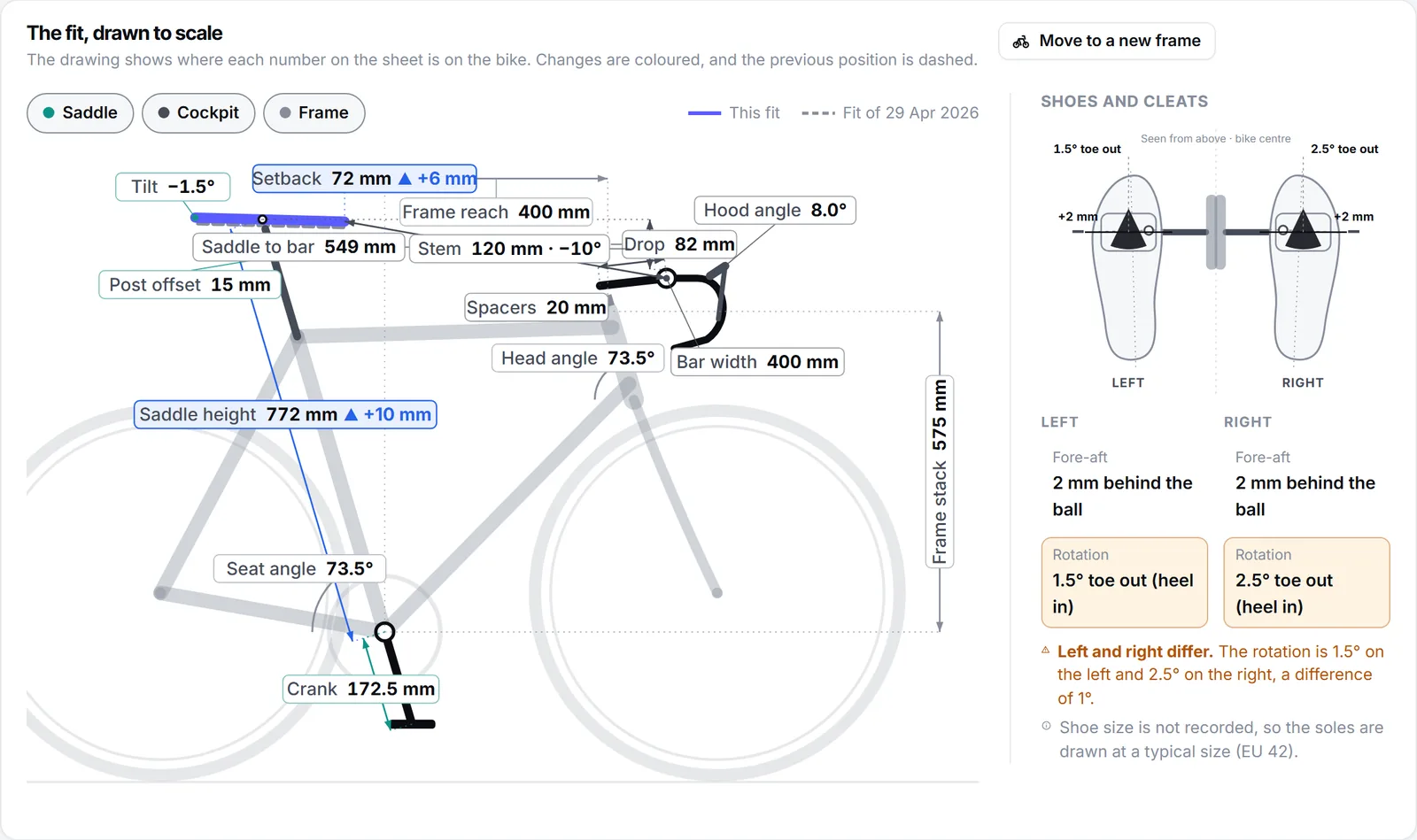
- Fits from studios using Velograph are recorded with diagrams and land in the rider's own free Passport. The rider keeps them when they change fitter or team.
- Fits from outside Velograph can be typed in by the rider from a fitter's sheet. They are shown as entered by the rider, so nobody takes them for a studio's own record.
- One number over time: pick saddle height, or any other measurement, and follow it across every fit and every bike, with the reason for each fit beside it. Two fits can also be compared side by side.
- The rider decides who sees it. The bike fit passport lets a studio or team see the rider's fit and bikes after the rider says yes on their own phone, part by part.
For riders, the record sits next to their rides in the free cycling app. For fitters, Velograph's Studio plan brings bookings, a client journal, follow-ups and branded reports, and every fit recorded there lands in the client's Passport. Plans and prices are on the pricing page, or you can start for free and add your first bike today.