A sore lower back after riding points to the cleats, saddle, reach and drop, cranks or a jump in training. What to check first, and when to see a doctor.
When you get lower back pain cycling, it usually builds the longer you ride and eases once you are off the bike. A fitter looks for three causes: a position that keeps your lower back bent forward for hours, a set-up that makes your pelvis rock or twist on every stroke, and training that rose faster than your back could follow. These are fit and training checks, not a diagnosis.
When should I see a doctor about back pain from cycling?
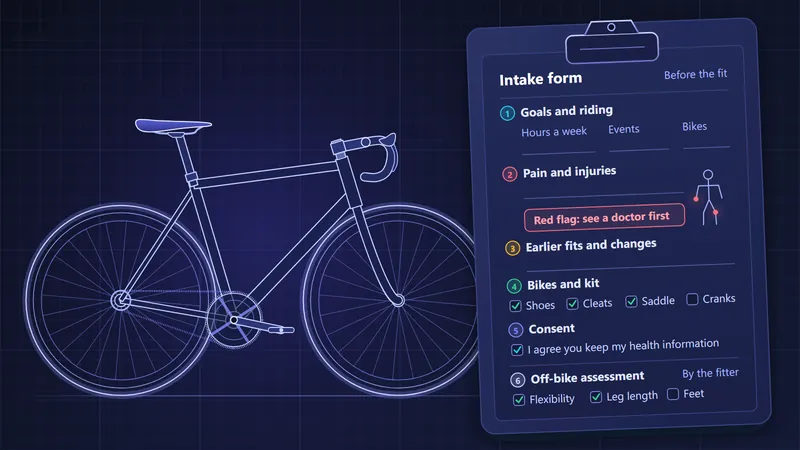
Get medical advice before you change the bike if the pain is severe and sudden, getting worse quickly, worse at night or comes with weight loss you cannot explain. Call 999 or go to A&E if it comes with weakness or numbness in both legs, numbness around the genitals or anus, or changes in bladder or bowel control.
The NHS sorts the warning signs by how quickly to act. Among them:
- Call 999 or go to A&E if back pain comes with pain, tingling, weakness or numbness in both legs, loss of feeling around the genitals or anus, changes in bladder or bowel control, or chest pain, or if it started after a serious accident.
- Ask for an urgent GP appointment or call NHS 111 if you feel hot, cold, shivery or generally unwell, or if the pain is severe and started suddenly, or is getting worse quickly.
- See a GP if it has not improved after a few weeks of looking after it at home, is worse at night or not eased by rest, or comes with weight loss you cannot explain or a lump or swelling in your back.
Long hours on the saddle can numb the saddle area too, as our saddle pain guide explains, but with back pain, numbness around the genitals or anus is one of the NHS's emergency signs. A bike fitter cannot examine any of these. When the ache grows during rides and fades afterwards, start with a fit check, ideally alongside a physiotherapist, who can examine your back, hips and trunk. Our guide to a physio and a bike fitter working together shows how they share findings.
Why does my lower back hurt when cycling?
The pattern researchers find most often is a lower back that stays bent forward for hours. Riders with back pain bent their lower back further on the bike and hurt more the longer they rode, but photos of their position on the bike did not tell them apart from riders without pain.
Back pain is common at every level. In 2010, Clarsen and colleagues reported that 58% of 109 professional road cyclists had had lower back pain in the previous 12 months, and 41% had seen medical staff about it. In the records of 1,505 riders seen by bike fitters in Brazil, it made up 29.1% of complaints, more than any other.
In 2012, Van Hoof and colleagues in Leuven put posture sensors on eight cyclists with long-standing back pain of a kind linked to bending, and on nine without pain. Over a two-hour ride on their own bikes, the riders with pain kept their lower back more bent, and their pain rose. A 2017 review of eight studies by Streisfeld and colleagues found the same extra bend in riders with back pain, and back muscles that tired sooner. It also found more bend at the base of the spine with a lower handlebar.
The bike's numbers do not explain it on their own. Bini and Hunter photographed 71 road cyclists on their bikes and found no significant differences in body position between riders with and without back pain. Cycling itself does not seem to harm the spine. An MRI study of 18 cyclists who had ridden more than 150 km a week for at least five years found signs of better-hydrated discs and more trunk endurance than in 18 people who did no sport.
What should a bike fitter check for lower back pain?
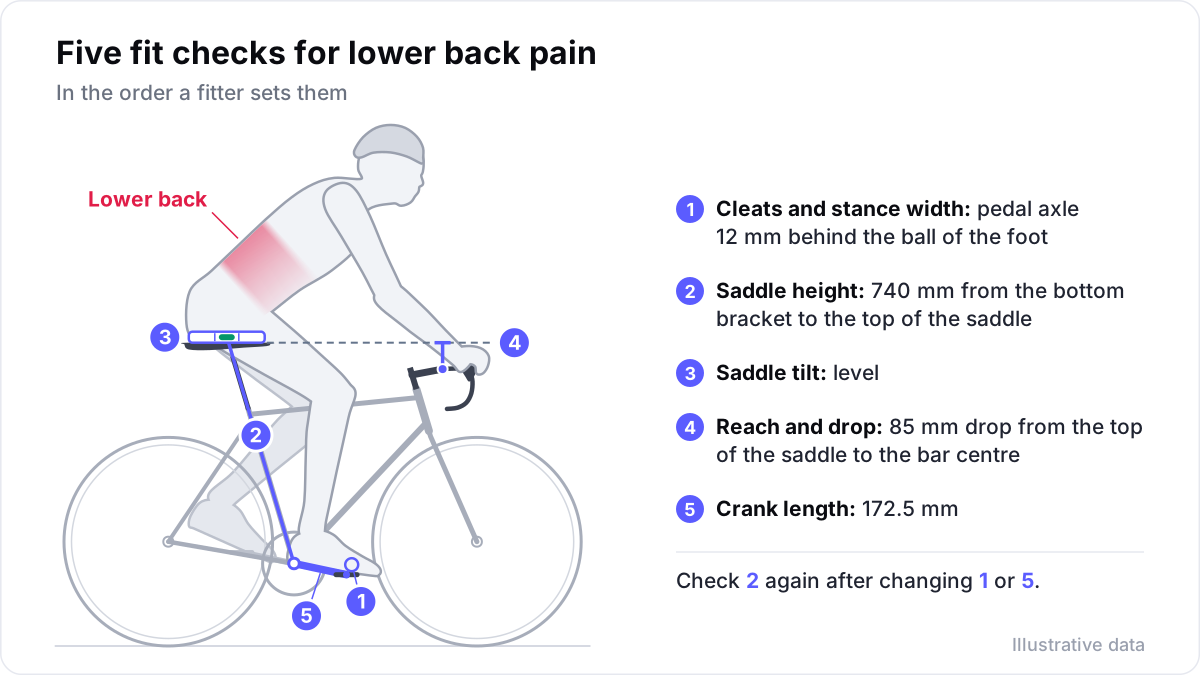
A fitter checks five things that change how your lower back bends, rocks or twists: the cleats, saddle height, saddle tilt, the reach and drop to the handlebar, and crank length. The first four are set in that order, because each one moves the ones after it, and new cranks come last.
Is my saddle too high for my back?
Your saddle may be too high for your back if your hips rock from side to side on it, because a rocking pelvis moves your lower back with it on every stroke. A saddle that is too low cramps the hip over the top of the stroke instead. Check the knee angle first, then watch your hips from behind.
Our saddle height guide lists the signs of a saddle that is too high or too low and shows how to measure the knee angle. Change the height a few millimetres at a time.
Can saddle tilt cause lower back pain?
Saddle tilt can affect lower back pain, because it sets how your pelvis sits. In a 1999 study, Salai and colleagues tilted the saddle nose down for club cyclists with back pain, and more than 70% reported a major improvement. The abstract reports no comparison group, so treat tilt as a trial, one degree at a time.
Start with the saddle level. Too much tilt slides you forward and puts more weight on your hands, as the saddle pain guide explains.
How do reach and handlebar drop affect back pain?
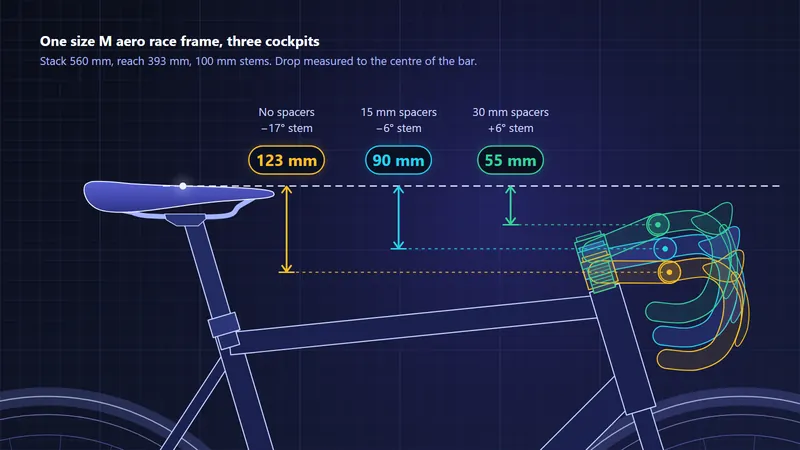
The further and lower your handlebar, the further you lean, and studies show the lower back bends more as the bar goes lower. If your back aches on long rides, raising the bar 5 to 10 mm or fitting a stem 10 mm shorter is a sensible first trial.
In 28 professional cyclists measured by Muyor in 2015, the lower back was bent forward in every hand position, most of all on aero bars. Our guide to handlebar drop shows how much each spacer and stem change moves the bar, and the guide to stack and reach covers how far forward it sits.
Can crank length cause back pain?
Crank length can play a part if your hip runs out of room at the top of the stroke, which shows as sliding forward on the saddle, rocking, or not staying low for long. A shorter crank gives the hip more room. We found no study of shorter cranks for back pain, so try them last.
Our guide to crank length shows how much room a shorter crank gives, and why the saddle then goes up by the difference in crank length.
What do cleats have to do with lower back pain?
Cleats set how each leg reaches its pedal, so a difference between your legs or your cleats can make your pelvis dip or twist on every stroke. If one leg reaches further, the pelvis can drop towards that side. Pain on one side of the lower back is a reason to check this.
Measure both cleats from the ball of each foot, and compare the stance width on the left and the right, as our cleat position checklist describes. A shim under one cleat comes only after a leg-length difference has been assessed and measured, and then in small steps.
Can more training cause lower back pain?
Yes, a quick rise in training can bring on lower back pain, even on a bike that has not changed. Watch your weekly distance, your longest ride and your time in a low position. Compare the four weeks before the pain started with the month before them.
Distance and time both show up in the research. In a survey of 66 recreational cyclists from nine clubs by Schultz and Gordon, riders who covered 160 km or more a week were 3.6 times as likely to report back pain as riders who covered less. In a trial with 40 recreational male riders, back pain was worse after a three-hour ride, on the road and on a mountain bike alike.
So build long rides up over several weeks, and move between the tops, hoods and drops during them. Stand on the pedals for a few strokes now and then. Look at your weekly hours, or at your training load, which puts how long and how hard you rode into one number. If the rise before the pain was large, the plan is part of the answer.
Does core strength or flexibility help with back pain on the bike?
Core strength may help, but the evidence is mixed. In several studies, cyclists with back pain had back muscles that tired sooner, yet among club riders no flexibility, strength or bike fit measure predicted who would get injured. Train your trunk alongside the fit, not instead of it.
Dahlquist and colleagues followed 63 experienced road cyclists for eight weeks. Flexibility, strength and bike fit did not predict injury, but a previous injury did, and the knee and the lower back were injured most often.
A Romanian deadlift trains the hip hinge you hold on the bike, and a one-arm row trains the upper back that holds the bars, as our guide to strength training for cyclists explains.
How do you know which change helped?
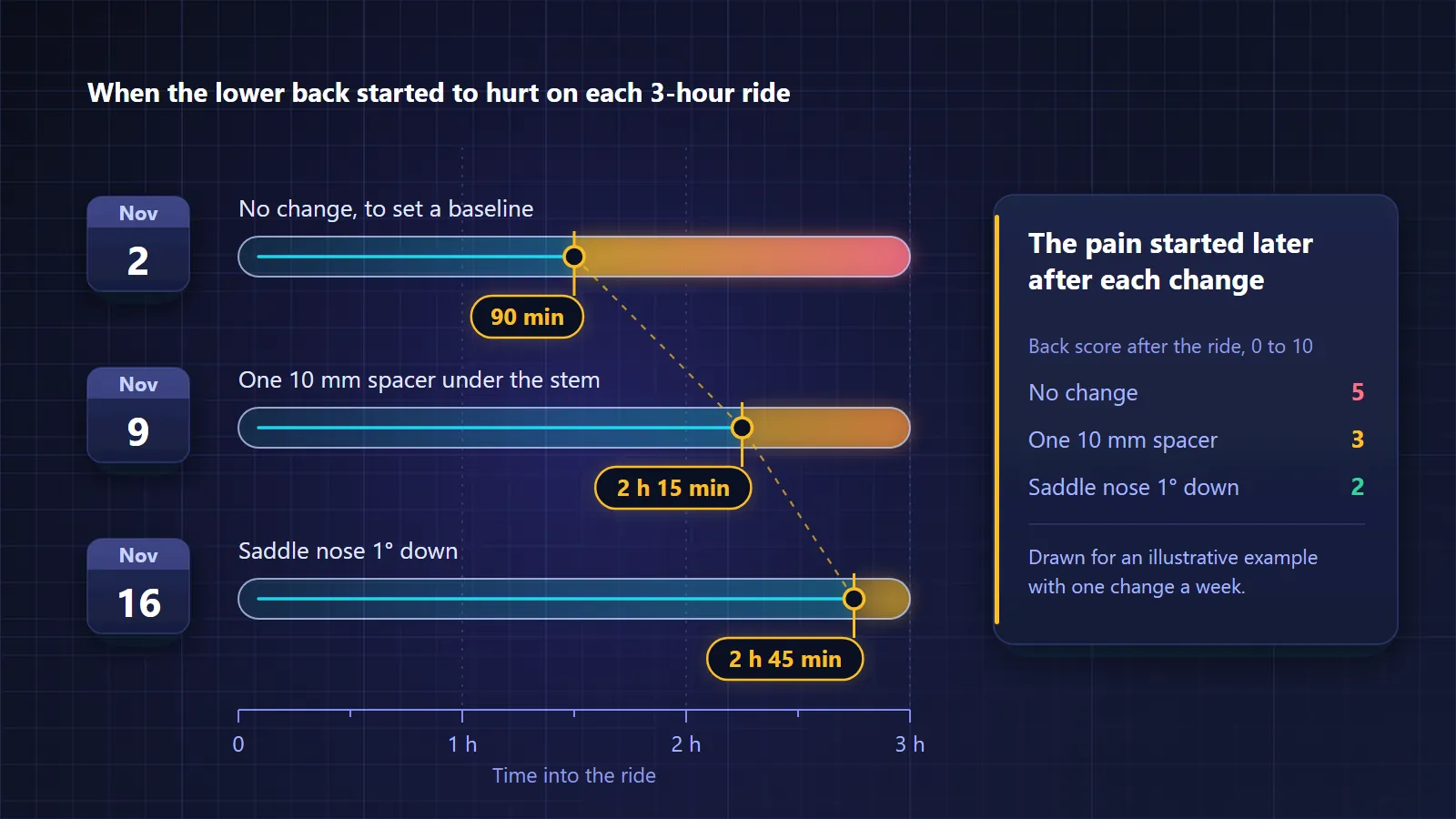
Change one thing at a time, and score your back after every ride from 0 to 10, with how long into the ride the pain started. Ride for a week or two before the next change, so that you can see which one helped.
An illustrative example, for a rider whose back aches on long rides:
| Date | Change | Ride | Back score from 0 to 10 | It started after |
|---|---|---|---|---|
| 2 November | None, to set a baseline | 3 hours outdoors | 5 | 90 minutes |
| 9 November | One 10 mm spacer under the stem | 3 hours outdoors | 3 | 2 hours 15 minutes |
| 16 November | Saddle nose 1 degree down | 3 hours outdoors | 2 | 2 hours 45 minutes |
Keep the table with your bike fit history, so the next fitter or physio starts from it. In Velograph, a studio records lower back pain on the body map with a score from 0 to 10. Each follow-up after the fit asks the rider to score that spot again, which shows the fitter whether the pain eased. Every fit is kept in the rider's own record, which the riders page describes.
Further reading
- Relationship between body positioning, muscle activity, and spinal kinematics in cyclists with and without low back pain: a systematic review, Sports Health, 2017.
- Comparing lower lumbar kinematics in cyclists with low back pain (flexion pattern) versus asymptomatic controls: field study using a wireless posture monitoring system, Manual Therapy, 2012.
- Pain and body position on the bicycle in competitive and recreational road cyclists: a retrospective study, Sports Biomechanics, 2023.
- Back pain, NHS, 2026.
Velograph is not affiliated with, sponsored by or endorsed by any team, rider or company named in this article. Names are used only to refer to publicly reported work.