Shorter cranks barely change power, but they open the hip and knee at the top of the stroke. Here is the research, the saddle change and what you will feel.
Crank length is the distance from the centre of the bottom bracket axle to the centre of the pedal axle. Across the usual road lengths of 165 to 175 mm, it changes power very little. In a lab study by Martin and Spirduso, 16 trained cyclists produced maximal power less than 4% apart on cranks from 120 to 220 mm. What a shorter crank does change is the top of the pedal stroke, where the knee and hip bend most. That is why riders in low time trial positions, shorter riders and riders whose hips feel cramped move to shorter cranks. If you do, raise the saddle by the difference.
What does a shorter crank change?
A shorter crank shrinks the circle the pedal travels, so the knee and hip bend less at the top of the stroke once the saddle is raised by the difference. The diameter of that circle is twice the crank length.
Make the crank 5 mm shorter and the circle shrinks by 10 mm. The pedal then ends 5 mm higher at the bottom of the stroke and 5 mm lower at the top. Raise the saddle by 5 mm and the leg reaches as far at the bottom as before. At the top, the pedal is now 10 mm further from the hip.
Two other things change. At the same cadence the foot covers less distance on each turn, so it moves more slowly. The crank is also a lever, so for the same power at the same cadence, a shorter one needs about 3% more force on the pedal for every 5 mm.
Does crank length affect power?
Within the usual road lengths, crank length changes power very little. Researchers have tested cranks from 120 to 220 mm, in sprints and in steady riding, and the results below agree on that.
| Study | Riders | Cranks | What they found |
|---|---|---|---|
| Martin and Spirduso, 2001 | 16 trained cyclists, sprints | 120 to 220 mm | Peak power from 1,149 W (220 mm) to 1,194 W (145 mm) |
| Barratt and colleagues, 2011 | 15 trained cyclists, sprints | 150 to 190 mm | At each crank's optimal cadence, hip, knee and ankle gave the same shares of power |
| Ferrer-Roca and colleagues, 2017 | 12 amateur road cyclists, steady riding | Own length and 5 mm either way | Gross efficiency 20.1 to 20.4%, no significant difference; longer cranks bent the hip and knee 1.8 to 3.4 degrees more |
| Li and colleagues, 2025 | 28 trained amateur men | 165, 170 and 175 mm | Same economy and 6-second sprint power; steady riding felt easier on 165 and 170 mm than on 175 mm |
| Reynolds and colleagues, 2026 | 14 amateur cyclists, steady riding | Own length and up to 10 mm either way | Same power; shorter cranks gave less hip and knee bend and a steadier pelvis |
Martin and Spirduso concluded that standard 170 mm cranks would cost most adults little maximal power. A 2024 systematic review by Husband and colleagues found no clear recommendation for crank length, and rated none of the studies it assessed as good quality. So choose crank length for the position and the joints, not for watts. Our article on bike fit and power explains how to test a fit change without fooling yourself.
Why do riders switch to shorter cranks?
Most riders switch to shorter cranks to give the hip and knee more room at the top of the stroke. The usual reasons are a low time trial position, short legs, a body that is still growing or hips and knees that feel cramped in any position.
Low positions and the hip angle
The closed hip angle is the angle between the torso and the thigh at the top of the pedal stroke, where the knee comes closest to the chest. Lowering the torso closes it. A hip that runs out of room can show as a rider who slides forward on the saddle, rocks or cannot stay low for long. A shorter crank lowers the knee at the top and gives some of that room back.
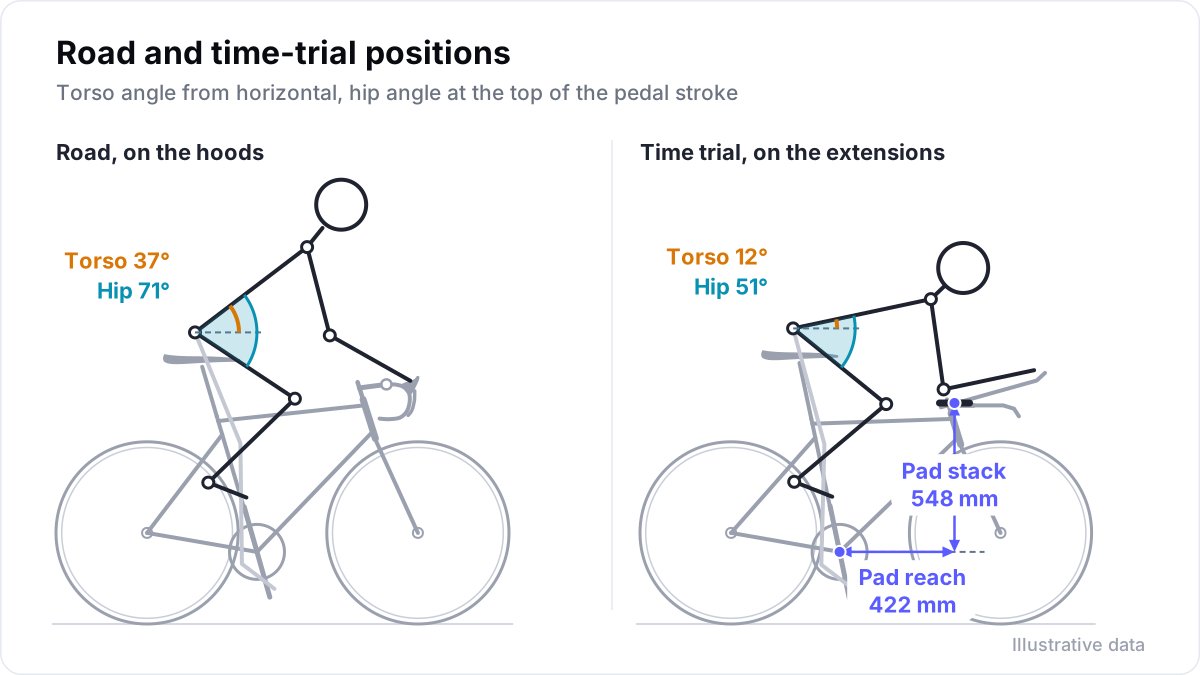
Low positions are where the case for shorter cranks is strongest. Phil Burt, for 12 years lead physio at British Cycling, has written that his rule is cranks 5 mm shorter for time trials than for the road. Shorter cranks have reached road racing too. TOUR and Cycling Weekly reported that Tadej Pogačar switched from 172.5 mm to 165 mm cranks at the start of the 2024 season.
Shorter riders
Most complete road bikes come with 170, 172.5 or 175 mm cranks, yet legs differ far more than that. A 172.5 mm crank is 20.5% of an 84 cm inseam but 22.7% of a 76 cm inseam.
We worked this through with a simple side-view model of the leg, with the knee bent 35 degrees at the bottom of the stroke. On 172.5 mm cranks, a rider 160 cm tall has the knee about 7 degrees more bent at the top than a rider 180 cm tall. Their hip is also about 5 degrees more closed. The shorter rider would need cranks of about 155 mm to come close. A shorter crank also brings the toe back, which helps on small frames where the shoe can touch the front wheel.
Juniors and growing riders
Martin, Malina and Spirduso tested 17 boys aged 8 to 11 on standard 170 mm cranks and on cranks 20% of each boy's estimated leg length. Maximal power was the same, 364 W against 366 W. For a growing rider, crank length is a question of fit and comfort more than power. Check it each time a growth spurt moves the saddle up. More on growing riders is in our guide to junior cycling training.
Hips and knees that want more room
Some riders switch because the top of the stroke feels tight in any position. Burt has written that he prescribes shorter cranks expecting better comfort with no loss of performance. Pain is a different matter. Hip, knee or back pain that does not settle belongs with a physiotherapist or doctor, who can look for causes a crank cannot fix.
How much should I raise my saddle for shorter cranks?
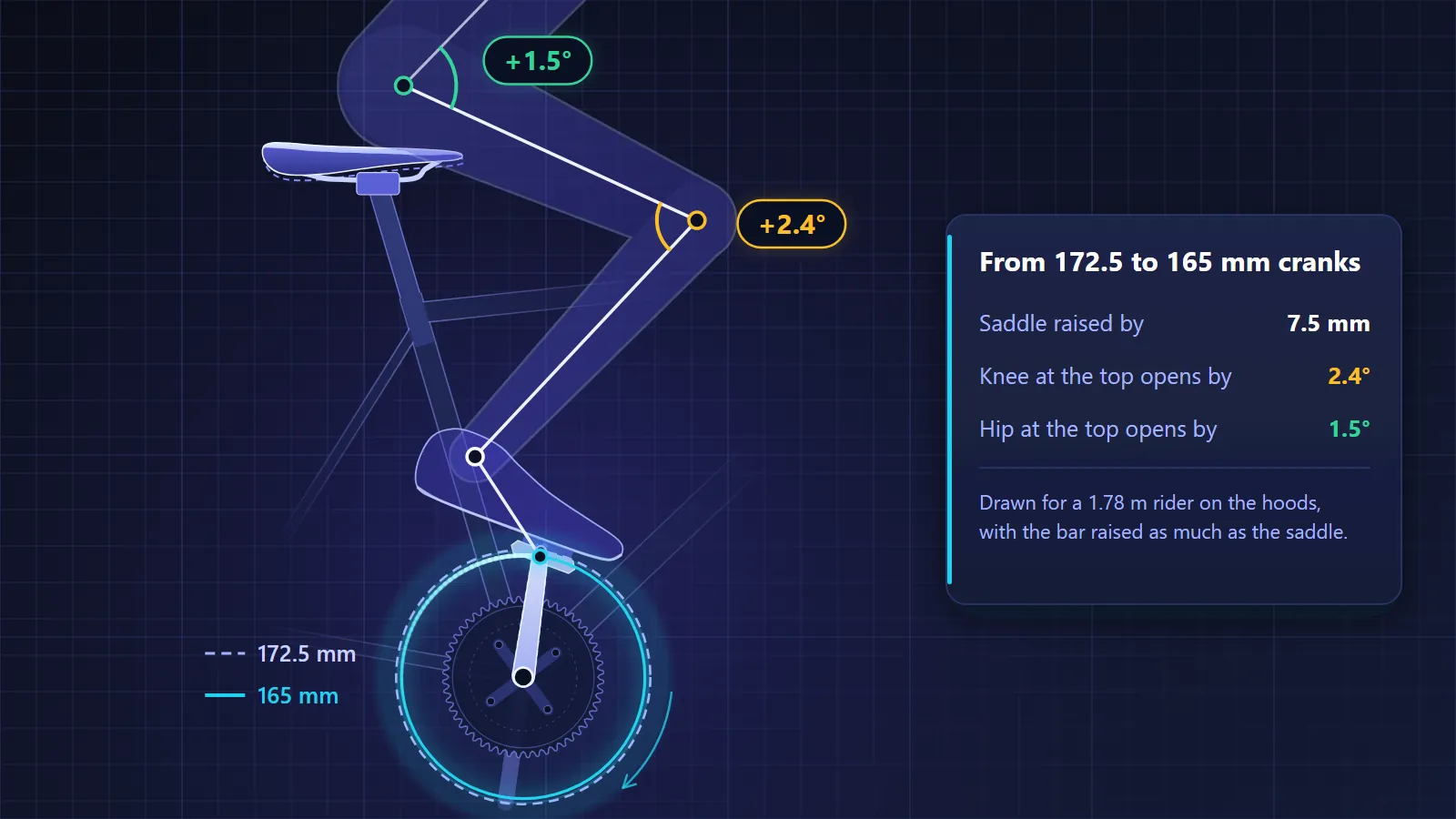
Raise the saddle by the difference in crank length, so going from 172.5 to 165 mm cranks means a saddle 7.5 mm higher. Measure it the usual way for saddle height, from the centre of the bottom bracket along the seat tube to the top of the saddle where the sit bones rest.
Leave the saddle where it was and the knee bends about 2 degrees more at the bottom for every 5 mm, as if you had dropped the saddle 5 mm. The table shows the gain at the top of the stroke once the saddle is raised.
| New crank, from 172.5 mm | Raise the saddle by | Knee at the top opens by | Hip at the top opens by, bar raised as much as the saddle | Hip at the top opens by, bar left where it was |
|---|---|---|---|---|
| 170 mm | 2.5 mm | 0.8 degrees | 0.5 degrees | 0.3 degrees |
| 167.5 mm | 5 mm | 1.6 degrees | 1.0 degrees | 0.5 degrees |
| 165 mm | 7.5 mm | 2.4 degrees | 1.5 degrees | 0.8 degrees |
| 162.5 mm | 10 mm | 3.1 degrees | 2.0 degrees | 1.1 degrees |
| 160 mm | 12.5 mm | 3.9 degrees | 2.5 degrees | 1.3 degrees |
The table is illustrative. It comes from a side-view model of a rider 178 cm tall on the hoods, with an 84 cm inseam, a 742 mm saddle height and a 73.5 degree seat tube. A time trial position gives the same changes to within 0.2 degrees.
The last two columns show a choice. A saddle raised 5 mm with the bar left alone adds 5 mm of drop, which lowers the torso about half a degree and takes back half the hip gain. Raise the bar by the same amount to keep the upper body as it was. On a time trial bike you can use the gain the other way. For each 5 mm of shorter crank, the model lets the armrests go about 4 mm lower and the torso about 1 degree lower, with the hip angle unchanged.
Check three more things:
- Setback. Raising the saddle along a 73.5 degree seat tube also moves it back about 1.4 mm for every 5 mm. Leave the setback alone at first and check it later.
- Power meter. Pedal-based power meters work out torque from the pedal force and the crank length you enter. Garmin's manual for its Rally pedals says the correct length is needed for accurate power. Leave 172.5 mm entered on 165 mm cranks and the meter reads about 4.5% high.
- The record. Write down the old and new crank length, the new saddle height and the date.
On a Velograph fit sheet with the rider's height or inseam, Try a change estimates what other cranks would do to the knee and hip angles. It can raise the saddle by the difference too, before anyone touches a spanner. Riders keep their own fits there for free, whoever recorded them.
What do shorter cranks feel like?
Expect the top of the stroke to feel freer and each gear to feel slightly heavier. The extra 3% of pedal force for each 5 mm is about half the 6% step between a 16 and a 17 tooth sprocket. You may therefore ride one sprocket easier on some roads.
Your cadence may rise a little, and Pogačar gave a higher cadence as one of his reasons for the change. To keep the foot moving as fast as it did on 172.5 mm cranks at 90 rpm, a 165 mm crank needs 94 rpm. The downsides show up at very low cadence. Burt told Cycling Weekly that short cranks give a little away from 0 to 30 rpm, as in a standing start on the track or a very steep off-road climb.
Give a new crank length two or three weeks, and change nothing else in that time. Then compare the same steady ride at the same power, and check your ride files for changes in cadence and heart rate. If you have no discomfort, a position you can hold and no plan to ride lower, there is little reason to change cranks.
Further reading
- Determinants of maximal cycling power: crank length, pedaling rate and pedal speed, European Journal of Applied Physiology, 2001.
- Acute effects of small changes in crank length on gross efficiency and pedalling technique during submaximal cycling, Journal of Sports Sciences, 2017.
- The impact of minor crank length adjustments on lower body cycling kinematics, Sports Biomechanics, 2026.
- Are shorter cranks worth the hype? What science says about power production, fit, and comfort, Cycling Weekly, 2026.
Velograph is not affiliated with, sponsored by or endorsed by any team, rider or company named in this article. Names are used only to refer to publicly reported work.