How fitters set up a TT position: hip angle, pad stack and reach, extension angle, the UCI and triathlon rules, and how to test drag against power.
A good time trial bike fit puts you in the lowest-drag position you can hold at race power for the whole race, inside the rules of your event. Lower is not automatically faster. Closing the hip angle costs power, and a position you can only hold for ten minutes saves nothing over forty. The fitter's job is to find the point where the watts you lose are smaller than the drag you save. The rider's job is to train until that position feels normal.
Why does position matter so much in a time trial?
Position matters because, on flat roads at race speed, air resistance is most of what you push against. Your position changes your drag area. Each 0.01 m² of drag area costs about 8.6 W at 40 km/h and about 12.3 W at 45 km/h.
The physics is set out in our guide to cycling aerodynamics. Fitters and engineers describe air resistance with CdA, the drag area: your frontal area multiplied by how cleanly the air flows around your shape. The power needed to push through the air rises with the cube of speed, so small changes in drag area are worth a lot of watts.
Here is the trade-off in numbers. Take a 75 kg rider on a 9 kg bike who can hold 300 W for an hour in position A, with a drag area of 0.250 m². A lower position B cuts drag area to 0.230 m², 8% less. How much power can position B cost before it stops paying?
| Position | Drag area | Power held | Speed | 40 km time |
|---|---|---|---|---|
| A, higher | 0.250 m² | 300 W | 42.6 km/h | 56:21 |
| B, lower, same power | 0.230 m² | 300 W | 43.7 km/h | 54:53 |
| B, 5% less power | 0.230 m² | 285 W | 42.9 km/h | 55:56 |
| B, 7% less power | 0.230 m² | 279 W | 42.6 km/h | 56:21 |
| B, 10% less power | 0.230 m² | 270 W | 42.1 km/h | 57:03 |
The table assumes a flat road, no wind, sea-level air (1.225 kg/m³), a rolling resistance coefficient of 0.004 and 97.5% drivetrain efficiency. The numbers are illustrative, computed from the standard cycling power equation. The lesson: on a flat course, a lower position is faster only if the power it costs, in percent, is smaller than the drag it saves. The break-even sits a little below the drag saving, because rolling resistance does not fall with you.
Does a lower aero position cost power?
A lower aero position usually costs power, because lowering the torso closes the hip angle when nothing else changes. Fitters lower the torso without closing the hip by rotating the rider forward, shortening the cranks and choosing a saddle for the position.
The closed hip angle is the angle between your torso and your thigh at the top of the pedal stroke. Fintelman and colleagues tested 19 well-trained cyclists at torso angles of 0, 8, 16 and 24 degrees and at their preferred angle. Maximal values, peak power among them, fell as the torso went lower, and the flat 0 degree position affected the body most.
The same group built two models of the trade-off in 2014. Aerodynamic losses outweighed power losses above about 46 km/h, a fully horizontal torso was never optimal, and below about 30 km/h a more upright position was better. A rider who averages 35 km/h, or a long-course triathlete, usually belongs a little higher than a professional racing at 50 km/h.
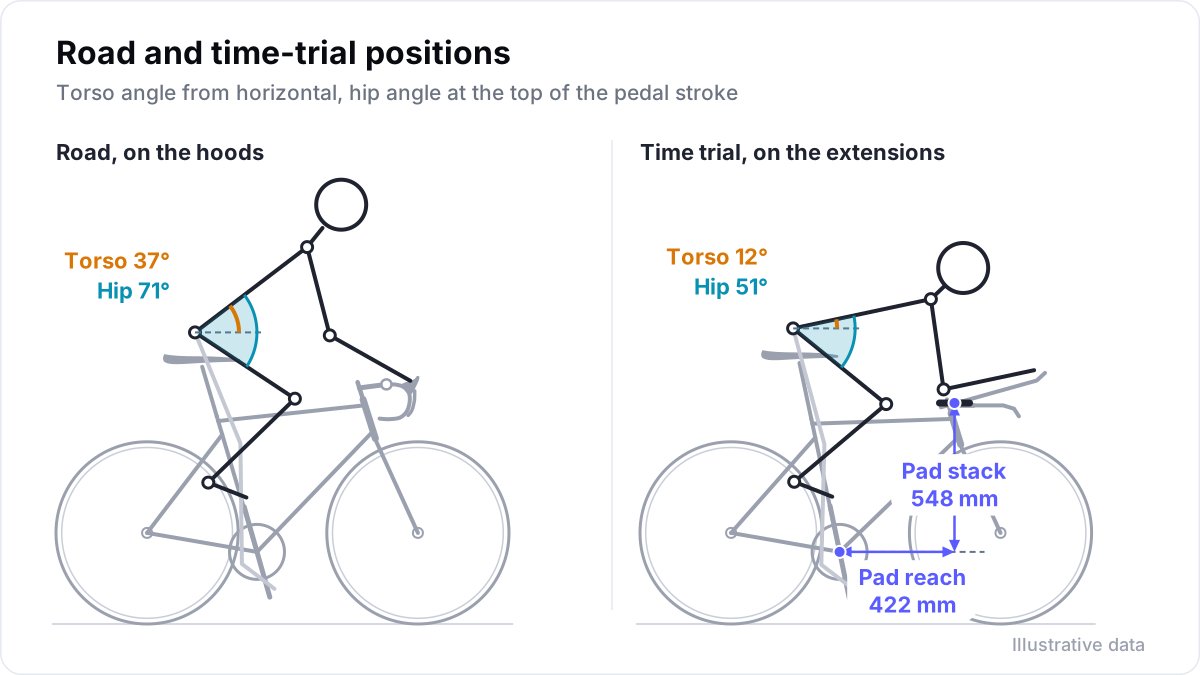
Fitters have three main ways to lower the torso without closing the hip:
- Rotate the rider forward. Moving the saddle forward and up together steepens the effective seat angle, so the body pivots around the bottom bracket instead of folding at the hip. In a lab study by Price and Donne, 14 road cyclists riding at 200 W used less oxygen with an 80 degree seat tube angle than with 74 degrees.
- Shorten the cranks. A shorter crank lifts the knee less at the top of the stroke. Phil Burt, for 12 years lead physio at British Cycling, has written that his rule of thumb is cranks 5 mm shorter for time trials than for road riding.
- Choose the saddle for the position. Rotated forward, you sit on the nose of the saddle. Short-nosed time trial saddles give that part of the pelvis a supported platform instead of a narrow nose.
Rotating forward has a bonus for triathletes. Garside and Doran had eight male triathletes ride 40 km at about 70% of their maximal oxygen uptake with seat angles of 73 and 81 degrees, then run 10 km on a treadmill. They ran 42:55 after the steep set-up and 46:15 after the shallow one. It is one small study, but it supports what many triathletes had reported.
What are pad stack and pad reach?
Pad stack is the vertical distance from the centre of the bottom bracket to the top of the armrest, and pad reach is the horizontal distance to the armrest. Pad stack changes the torso and hip angles, and pad reach changes the elbow angle and the load on the shoulders.
Fitters describe the front of a time trial bike with coordinates measured from the centre of the bottom bracket, the same way frames are compared by stack and reach. Record each number with the point it was measured to, because conventions differ: some fitters measure pad reach to the centre of the armrest, others to its rear edge.
| Measurement | Measured from and to | What it changes |
|---|---|---|
| Saddle height | Bottom bracket centre to the top of the saddle | Knee angle, as on the road bike |
| Saddle tip position | Vertical line through the bottom bracket to the saddle tip | Effective seat angle, and the rules |
| Pad stack | Bottom bracket centre, vertically, to the top of the armrest | Torso angle and hip angle |
| Pad reach | Bottom bracket centre, horizontally, to the armrest | Elbow angle and load on the shoulders |
| Pad width | Centre to centre of the armrests | Frontal area, breathing, steering |
| Extension length | Bottom bracket centre, horizontally, to the tip | Hand position, and the rules |
| Extension angle | The extensions against horizontal | Hand height, shoulder shape, head position |
| Crank length | Pedal axle to crank axle | Hip and knee angles at the top of the stroke |
A common starting point is the upper arm close to vertical under the shoulder, with the pads about shoulder width apart or a little narrower. From there, most of the drag work is about the shoulders and the head. Raising the hands, by tilting the extensions upwards, helps some riders round the shoulders and tuck the head into them. Others are faster and steadier with flat extensions. Test both.
Pad stack is the number riders most want to drop and fitters most often raise. If a lower pad makes you look up through your eyebrows or slide forward on the saddle every few minutes, the drag saving disappears in the race.
What are the UCI rules for a TT position?
In UCI time trials, the saddle tip must sit behind a vertical line through the bottom bracket. If your extensions reach more than 750 mm forward, as the height categories allow, it must sit at least 50 mm behind. Since 2023, the extension limits depend on the rider's height. Triathlon rules allow a position further forward.
The position must meet the UCI's equipment regulations, which the UCI explains in detail in its Clarification Guide of the Technical Regulation. These are the extension limits for each height category:
| UCI height category | Rider height | Extensions, maximum forward of the bottom bracket | Maximum height difference, forearm supports to extensions |
|---|---|---|---|
| 1 | Under 180 cm | 800 mm | 100 mm |
| 2 | 180 to 189.9 cm | 830 mm | 120 mm |
| 3 | 190 cm and taller | 850 mm | 140 mm |
The 50 mm applies only to the longer extensions that the height categories allow. With extensions of 750 mm or less, the saddle tip need only be behind the line, as on a road bike since the UCI changed the rule on 1 January 2025. Riders of 180 cm and taller must be on the UCI's height list, applied for at least 15 days before the event, to use the longer limits. Forearm supports may tilt up to 30 degrees, and the saddle up to 9 degrees from horizontal. The rules change, so check the current UCI regulations, and your national federation's rules for its own events, before you race.
A triathlon bike fit for a non-drafting race works to different rules. World Triathlon allows the saddle tip anywhere from 5 cm in front of the bottom bracket line to 15 cm behind it. The bars and clip-ons must not reach beyond the front edge of the front wheel. Organisers of long-distance races publish their own rulebooks. A position built for triathlon can therefore be further forward than one that would pass a UCI bike check.
How do you test whether a TT position is faster?
Test a new TT position by measuring how much drag it saves and how much power it costs. If the drag saving in percent is clearly larger than the power loss, the new position is faster on a flat course.
- Drag. A wind tunnel is the most controlled option, a velodrome with a power meter and accurate speed the next. On the road, Robert Chung's virtual elevation method compares positions over repeated laps of a quiet loop, ridden without brakes in near-still air, with helmet, skinsuit, wheels and tyre pressure unchanged.
- Power. Ride the effort that matters in the new position: race power for the race duration, or at least 20 minutes for a 40 km event. Compare it with the same effort in the old position on a similar day. Heart rate and perceived effort at a fixed power add a second view.
- Both together. Compare the drag saving in percent with the power loss in percent, as in the table above. If the drag saving is clearly larger, the new position is faster on a flat course. On a hilly course the aero gain shrinks on the climbs, so the power cost matters more.
Many riders lose the most power in their first weeks in a new position and win some of it back as they adapt. Unless it hurts, test again after a few weeks before you reject it. The same logic shapes the race itself: our guide to time trial pacing shows how to spread the power you can hold over the course.
How do you get used to a TT position?
Get used to a TT position by building the time in it steadily. For example, ride three blocks of 10 minutes on the extensions during endurance rides and add a few minutes each week. Then ride race-pace intervals in position until you hold the race duration with time to spare.
A time trial position is a skill as well as a set-up. Many riders who test well for ten minutes sit up, shuffle on the saddle or drop power after twenty.
Check the ride files as well as the feeling. Power that falls whenever the road rises, or cadence that drifts as the minutes pass, often means the position is not yet sustainable. Some neck, shoulder and saddle discomfort is common at first and usually eases. Pain that does not ease goes back to the fitter, and to a physiotherapist if it persists. Our article on bike fit and power explains how to test a change without fooling yourself.
Keep the road and time trial positions as separate records. In Velograph each bike keeps its own fit history. The time trial bike's pad stack, pad reach and extension numbers sit beside the road bike's, so the next fitter starts from what worked, not from zero.
Further reading
- UCI Regulations for road cycling: changes for time trials, UCI, 2023.
- UCI Cycling Regulations, Part 1: General organisation of cycling as a sport, UCI, 2026.
- Optimal cycling time trial position models: aerodynamics versus power output and metabolic energy, Journal of Biomechanics, 2014.
- The effect of time trial cycling position on physiological and aerodynamic variables, Journal of Sports Sciences, 2015.
- 11 bike fit trends you need to know about, according to British Cycling's former physio guru, Cycling Weekly, 2023.
Velograph is not affiliated with, sponsored by or endorsed by any team, rider or company named in this article. Names are used only to refer to publicly reported work.