Even power is the baseline; a few percent more on climbs and into the wind is the refinement. How to set targets, plan the course and review the file.
Good time trial pacing means riding close to even power from start to finish, then moving a few percent of your effort to where you are slowest: climbs and headwinds. The two classic mistakes are starting too hard and riding the fast sections as hard as the slow ones. With a power meter, a written plan for each part of the course and an honest look at the file afterwards, most riders can find tens of seconds over 40 km without getting any fitter.
Is even power the fastest way to pace a time trial?
For events longer than about two minutes, a fairly even effort tends to give the fastest time, as Abbiss and Laursen's 2008 review of pacing research concluded. Where the course has climbs or wind, a little variation around that even power saves time.
That matches the physics. On a flat road, air resistance rises steeply with speed, so extra watts buy little extra speed. Riding 20% harder makes you only about 7% faster.
Consider a rider and bike weighing 84 kg, in a time-trial position, whose even pace for 40 km is 300 W and about 55 minutes. If they ride the first three minutes at 360 W instead, they gain about 150 metres, roughly 12 seconds. That looks tempting until you count what it costs.
The cost is your reserve above critical power. Critical power (CP) is roughly the highest power you can hold without draining a limited reserve, and W′ (W prime) is the size of that reserve, the work you can do above CP. Critical power and W′ explains the model in full. Say this rider's CP is 300 W and their W′ is 20 kJ. Three minutes at 360 W spends 60 W × 180 seconds, 10.8 kJ, more than half the store. W′ refills only when you ride below CP, and more slowly the closer to CP you ride, as Skiba and colleagues showed in 2012. In a time trial ridden near CP, it barely refills at all.
The usual result is a fade. If the hard start leaves the rider 4% below their target for the final 20 minutes, they lose about 18 seconds there, and the 12 seconds gained at the start become a net loss. The start is the most expensive place to look for time.
How much should you vary power on climbs and into the wind?
As a starting point, ride 3 to 8% above target on climbs and into headwinds, rarely more than 10%, and less on long climbs. On flat sections with a tailwind, ride 3 to 5% below target. The savings are modest, and the effort is the same on average.
Even power is the baseline, not the optimum. Where the course has climbs or wind, a little variation saves time. The reason is that you spend the most time on the slow sections, so watts added there buy the most seconds. On fast sections, such as descents and tailwinds, watts buy almost nothing.
Two modelling studies put numbers on it. Swain (1997) found that varying effort with the terrain and wind, at the same average, saved about 1.5 minutes on a hilly 10 km course and 29 seconds on a windy 40 km course. Atkinson, Peacock and Passfield (2007) repeated the work with a more up-to-date model. For a rider averaging 289 W, varying power by 10% either side saved 126 seconds on the hilly course, 51 seconds on the windy one and 26 seconds on a standard 40 km time trial. They noted that riders with lower power gain the most, and that nobody yet knows how much variation a rider can tolerate.
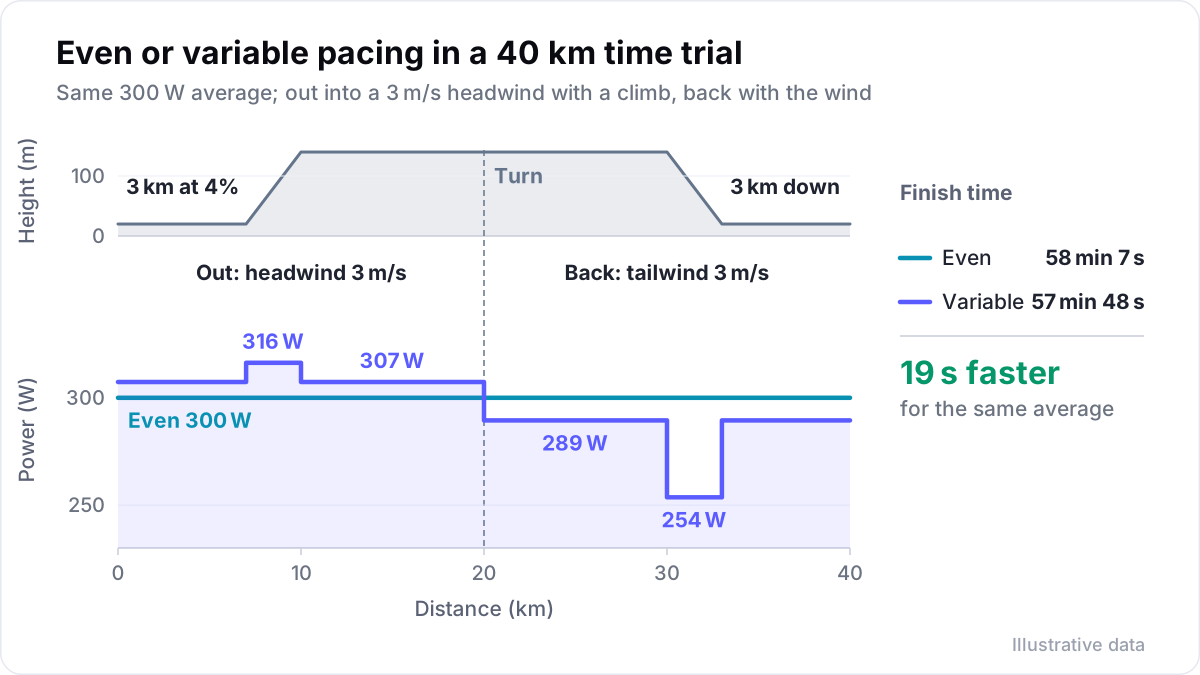
Here is a worked example. The course is 40 km out and back, with a 3 m/s (11 km/h) headwind on the way out. A 2 km climb at 4% starts at the 8 km mark and becomes a descent on the way back. The rider averages 280 W either way.
| Strategy | Time | Saved |
|---|---|---|
| Even 280 W throughout | 59:00 | |
| 5% more into the wind, 5% less with it | 58:47 | about 14 seconds |
| As above, plus 10% more on the climb and 20% less on the descent | 58:37 | about 23 seconds |
The savings are modest, the effort is the same on average, and the physiological cost of a few percent of variation is small. Larger swings are where the risk starts: 10% above target on a long climb means spending W′, and the first part of this article applies again.
As a starting point, try these limits:
- Climbs and headwinds: 3 to 8% above target, rarely more than 10%, and less on long climbs.
- Flat with a tailwind: 3 to 5% below target.
- Descents: keep pedalling while it still adds speed; when it no longer does, tuck and recover.
- Turnarounds and corners: brake late, accelerate smoothly, and accept a short spike out of the turn. Seconds above target are fine; a minute is not.
What power should you target in a time trial?
Target the power your recent data says you can hold for the event's duration. For efforts of about 3 to 20 minutes, the CP model gives that power, and you start 2 to 3% below it. For longer events, use your best recent power for a similar duration, or your FTP if the event lasts about an hour.
Your target should come from recent data, not from hope. For efforts between about 3 and 20 minutes, the CP model gives a direct answer: the power you can hold for a given time is CP plus W′ divided by that time in seconds. For the rider above, with a CP of 300 W and a W′ of 20 kJ:
| Event duration | CP model | Sensible starting target |
|---|---|---|
| 5 minutes | 367 W | about 360 W |
| 10 minutes | 333 W | about 325 W |
| 20 minutes | 317 W | about 310 W |
| 40 to 60 minutes | model less reliable | your recent best for that duration, or FTP |
Start a little below the model, around 2 to 3%, and raise the power in the last quarter if you have it. For longer events, the CP model tends to overestimate, so use your own best recent power for a similar duration, or your FTP for efforts of around an hour.
Adjust for the conditions. Heat and altitude point the target down, and so does a test ridden on fresh legs or in a different position. Power in a low time-trial position is often a little lower than on a road bike, which is why the time trial bike fit has to be tested at race effort. The position you train in is the position you can pace.
How do you plan a TT pacing strategy?
Split the course into five to eight sections and write a target power and one instruction for each. Base the plan on the course file, the wind forecast and a ride over the key parts at race speed. Cap the first five minutes at your target and leave the last 10% open.
A plan is only as good as your picture of the course. Before the race:
- Get the course file and mark the climbs, the descents, the turnaround and any tight corners or roundabouts.
- Check the wind forecast and note which sections will be into the wind and which with it.
- Ride the course, or at least the key parts, at race speed. Learn where to brake and where you can hold the tuck.
- Split the course into five to eight sections and write a target power and one instruction for each.
- Cap the first five minutes at your target, and leave the last 10% open.
For the worked example above, the plan could look like this:
| Section | Km | Conditions | Target |
|---|---|---|---|
| Start | 0 to 8 | flat, headwind | 290 W; no higher in the first five minutes |
| Climb | 8 to 10 | 4%, headwind | 305 W, seated |
| Out to the turn | 10 to 20 | flat, headwind | 290 W, hold the tuck |
| Back | 20 to 30 | flat, tailwind | 265 W, high cadence |
| Descent | 30 to 32 | tailwind | pedal to about 220 W, then tuck |
| Home | 32 to 40 | flat, tailwind | 265 W, open up for the last 4 km |
Velograph's race pace plans work the same way: the course is split into segments, each with a target power, wind and a note, and the plan shows the time it should give.
On the day
- Warm up and stay warm. Finish the warm-up close to your start time and keep warm layers on while you wait.
- Show few numbers. Section or lap average power, 3-second or 10-second power, and elapsed time. Speed is distracting into a headwind.
- Distrust the first minutes. Adrenaline makes the target feel easy, and heart rate lags behind the effort. Trust the power.
- Hold the position. Sitting up costs more than it seems; every time you rise, the speed drops at the same power.
- Empty the tank late, not early. The final 10% is where any reserve left over should go.
How do you review your time trial pacing?
Compare the ride with the plan, section by section, within a day or two while you still remember how it felt. Check how hard you started, how the second half compared with the first and where your W′ balance reached its lowest point. The review is where pacing improves.
- The first five minutes: how far above target were you? More than 5% is worth fixing.
- First half against second half: a big drop points to a hard start or a target set too high.
- Each section against its target: did you add power where planned and ease off where planned?
- W′ balance: where did it reach its lowest point? A deep dip early in the race is a pacing error; a deep dip at the finish is good pacing.
- Speed at the same power on flat sections: if it fell late in the race, you were probably sitting up more as you tired.
- The turnaround: how many seconds did braking and accelerating cost?
Then write down one thing to change next time. Over a season of time trials, those single changes add up. The same approach works for road races, as the guide to race analysis shows.
Further reading
- Describing and understanding pacing strategies during athletic competition, Abbiss and Laursen, Sports Medicine, 2008.
- A model for optimizing cycling performance by varying power on hills and in wind, Swain, Medicine and Science in Sports and Exercise, 1997.
- Variable versus constant power strategies during cycling time-trials, Atkinson, Peacock and Passfield, Journal of Sports Sciences, 2007.
- Modeling the expenditure and reconstitution of work capacity above critical power, Skiba and colleagues, Medicine and Science in Sports and Exercise, 2012.