The last four weeks before a gravel race: study the course, set power caps, plan food and water by the hour, choose tyres and kit, and carry your own tools.
Gravel race preparation in the last four weeks is about the race itself, not more fitness. Learn the course and where the water is, set power caps for the start and the climbs, and plan what you will eat and drink each hour. Choose tyres and kit, practise repairs, rehearse it all on one long ride, then ease off for the final two weeks. The training before that is in our 12-week gravel training plan.
What should you do in the last four weeks before a gravel race?
Use the last four weeks to settle every decision you can make before race day. Study the course and choose tyres three weeks out, rehearse the whole race plan on your longest ride two weeks out, then taper, practise repairs and pack in the final fortnight.
| Week of the plan | Training | Race preparation |
|---|---|---|
| 9, three weeks out | An hour at race power on gravel | Read the rules, study the course, fit race tyres and bags |
| 10, two weeks out | Longest ride: 4 h (100 km) or 6 h 30 min (200 km) | Rehearse race food, kit, pressures and power caps; weigh yourself before and after |
| 11, taper | About a third less riding, short efforts kept | Practise repairs, change the plan from what the rehearsal showed |
| 12, race week | Short and easy, openers the day before | Pack food by the hour, charge devices, load the course, check the forecast |
How do you study a gravel race course?
Read the organiser's rules and load the course file before you plan anything else. Mark where water, food and help are allowed, the cut-off times, the long climbs and the roughest sectors. Then work out how long each stretch between supply points will take you.
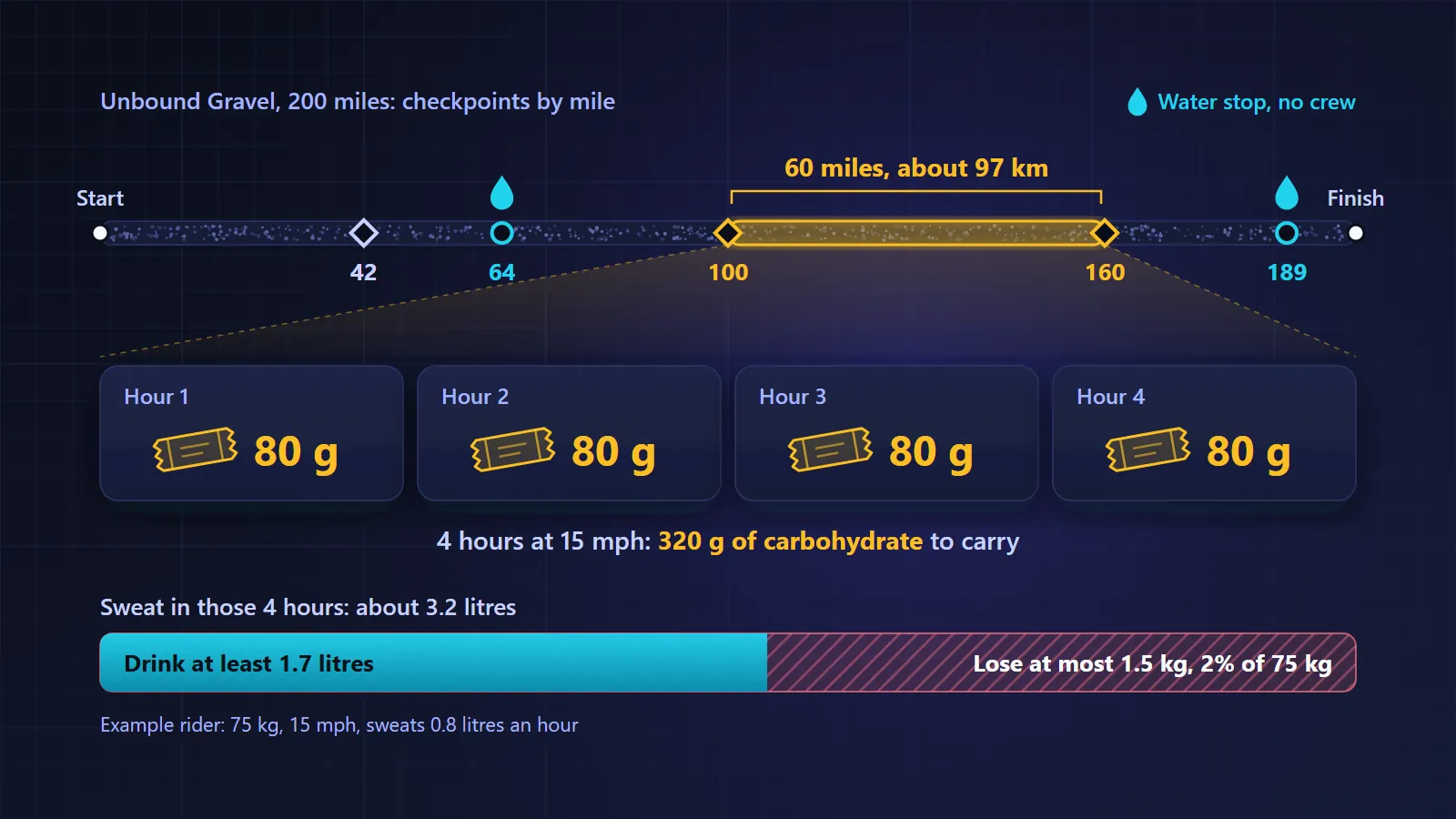
Unbound Gravel's official rules for 2026 show why. In its 200-mile age-group race, checkpoints are at miles 42, 64, 100, 160 and 189, and those at miles 64 and 189 are water stops with no crew access. Feeding or support anywhere else is grounds for disqualification, though riders may help each other and buy supplies at shops on the route. The organiser says not to rely on course markings and provides GPS files and cue sheets. Checkpoint cut-offs are based on an average of 10 mph, about 16 km/h.
The longest stretch in that list is the 60 miles, about 97 km, from mile 100 to mile 160. A rider moving at 15 mph, about 24 km/h, needs 4 hours for it. For your own race, write these down:
- Supply points. Note where each is, and whether it has water, food or your crew.
- Time between them. Divide each stretch by your moving speed on gravel, not on the road.
- Cut-offs. Put the latest time at each checkpoint beside your planned time.
- Hard parts. Mark long climbs, loose descents, sand, mud and stretches without phone signal.
- Weather. Check the heat, because it makes you sweat more and changes the water plan.
Ride a test route with navigation on, to learn the turn alerts and how long the battery lasts. The course and feeding tables in our race day plan template work for one rider too.
How should you pace a gravel race?
Pace a gravel race by power or heart rate, not speed, because loose and rough ground slows you at the same effort. Cap the first hour, ride long climbs below threshold, and go above threshold only to stay in a useful group or get over a short, steep rise.
These caps are starting points for a race of four to six hours, for a rider with an FTP of 250 W. Check them against your rehearsal ride, and for a race of eight to ten hours take 5 to 10 percentage points off the steady figures.
| Part of the race | Cap, as a share of FTP | At FTP 250 W |
|---|---|---|
| First hour, flat and rolling | 70 to 75% on average | 175 to 188 W |
| Steady stretches later on | 65 to 75% | 163 to 188 W |
| Short, steep rises of under 2 minutes | Up to about 120% | Up to 300 W |
| Climbs of 5 to 20 minutes | 90 to 95% | 225 to 238 W |
| Climbs of over 20 minutes | 85% or less | 212 W or less |
Every minute above your critical power spends part of a limited reserve called W′, which refills only below critical power. Spending it to hold a fast group on a long, windy road can pay back; spending it in the first ten minutes rarely does. As in time trial pacing, close to even effort is the baseline.
The power left after hours of riding is your durability, and surging early hours lower it more than steady ones. If your power faded in the last hour of the rehearsal, lower the caps for the first half. Without a power meter, ride the first hour in heart rate zone 2, and expect heart rate to creep up later at the same effort.
In Velograph, a race on your calendar can hold a pace plan, with a target power and a note for each section of the course and a rolling resistance set for the surface. Race tools are part of Rider Plus, a paid plan; the riders page lists what the free Rider plan keeps.
How much should you eat and drink in a gravel race?
For well-trained riders, sports nutrition guidance is up to about 60 g of carbohydrate an hour for races of two to three hours, and about 90 g an hour for longer ones, from glucose and fructose together. Drink enough to lose no more than 2% of your body weight, and never so much that you gain weight.
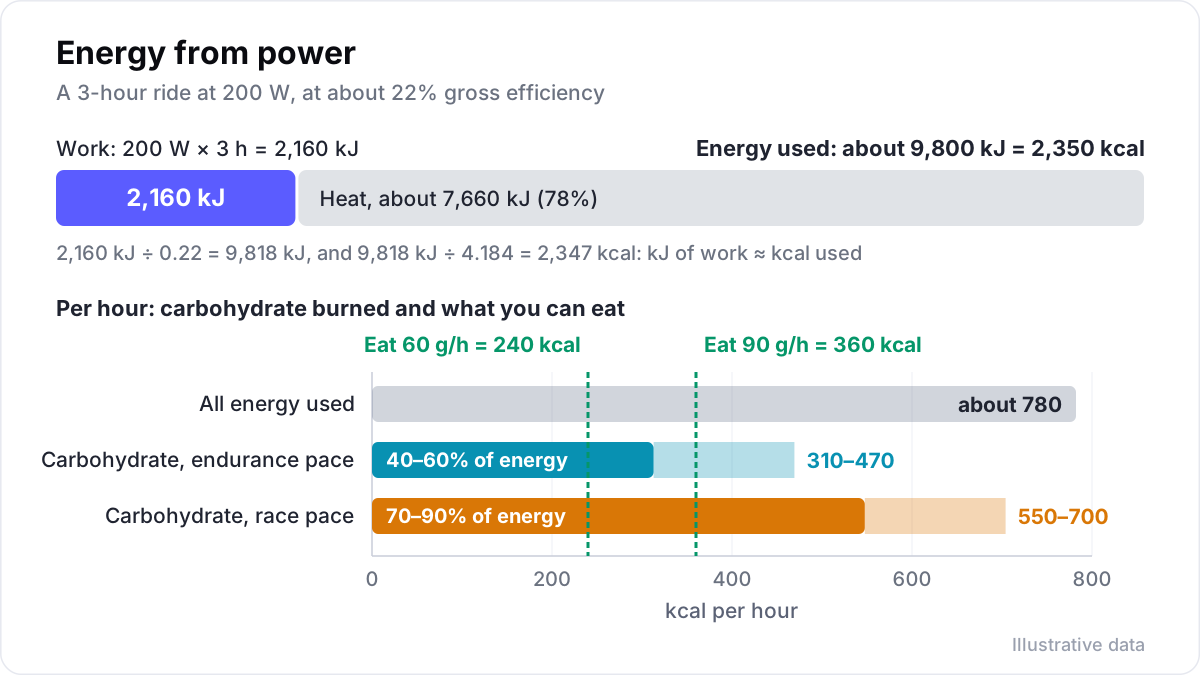
Each kilojoule of work costs roughly one kilocalorie, so five hours at 170 W, about 3,060 kJ, uses roughly 3,060 kcal. The aim is not to eat that back but to take in enough carbohydrate to keep the pace; carbohydrate on the bike explains how to train your gut for it.
| Race time | Carbohydrate an hour, well-trained rider | In total |
|---|---|---|
| 2 to 3 hours | Up to about 60 g | 120 to 180 g |
| 4 to 6 hours | About 90 g, glucose and fructose, a trained gut | 360 to 540 g |
| 8 to 10 hours | About 90 g, glucose and fructose, a trained gut | 720 to 900 g |
At an easy pace, or with less training, you may need less. Eat by the clock, every 20 minutes from the first half hour, and open food on smooth stretches.
Sweat rates differ a lot between riders. The American College of Sports Medicine's position stand aims to avoid a loss of more than 2% of body weight from water deficit. It says you can estimate your sweat rate from your weight before and after exercise. Weigh yourself without clothes before and after an hour at race effort, and add what you drank. A 75 kg rider who loses 0.6 kg and drinks 0.2 litres sweats about 0.8 litres an hour, and their 2% is 1.5 kg.
Drinking more than you sweat is a risk too. A 2017 update on exercise-associated hyponatraemia, a dangerous fall in blood sodium, says weight gain during exercise means you drank more than you lost, and advises drinking according to thirst.
On Unbound's 60-mile stretch, a rider who has trained their gut to 80 g an hour carries 320 g of carbohydrate for the 4 hours. The rider above sweats about 3.2 litres there, so they must drink at least 1.7 litres to lose no more than 1.5 kg on that stretch alone. The rules ask riders to carry enough water for 50 miles and recommend at least 2 litres, so plan a hydration pack, a third bottle or a shop stop. These figures are general; for a plan built on your own sweat rate, stomach and any medical condition, talk to a registered sports dietitian.
Which tyres, kit and tools should you take to a gravel race?
Choose tyres for the roughest ground you will meet often, set the pressure for that surface and your total weight, and race only kit you have used on a ride as long as the race. Carry what you need to fix a puncture, a broken chain or a loose bolt on your own.
Our guide to gravel bike fit explains how to start from a pressure calculator. Fit the race tyres in week 9, so you rehearse on them. If your hands went numb or your neck ached on the rehearsal, change one thing and test it on another long ride, never on race day.
Start from a must-have list like Unbound's, which names a helmet, navigation, a phone to call for a pickup, water and food. Then add tools you have practised with:
| Problem | What to carry | Practise at home |
|---|---|---|
| Tubeless puncture | Plugs and their tool | Plug a hole in an old tyre, timed |
| A cut a plug cannot close | A tube, levers, a tyre boot, a pump or CO2 | Fit a tube into a tubeless tyre |
| Broken chain | A chain tool and a quick link that fits | Join a chain with the link |
| Loose bolts | A multi-tool with every size on your bike | Check each bolt with it |
| Bent derailleur hanger | A spare hanger for your frame | Fit it once |
How should you taper and spend race week?
Ride about a third less in the second-to-last week, keeping short race-pace efforts, then ride short and easy in race week. In a 2007 meta-analysis, a two-week taper that cut training volume by 41 to 60% and kept the intensity and the number of sessions gave the largest gains.
For a Saturday race, have the bike serviced on Monday, so there is time to find anything the service got wrong. Top up sealant on Tuesday, pack food in labelled bags by the hour on Wednesday and charge every device on Thursday. On Friday, ride 30 to 45 minutes with three short efforts and eat a carbohydrate-rich meal you know well. On race morning, eat a breakfast you have tested in training, two to three hours before the start.
How do you review your gravel race afterwards?
Within two days, compare the race file and your notes with the plan. Check your first hour against its cap, the power left in the last hours, your stopped time, what you ate and drank each hour, and your weight change. Then write down the one change you will make next time.
Stopped time is easy to miss. Ten minutes at each of five checkpoints adds up to 50 minutes. Race analysis shows how to read the rest of the file.
Further reading
- Life Time Unbound Gravel official rules, Life Time, 2026.
- A step towards personalized sports nutrition: carbohydrate intake during exercise, Jeukendrup, Sports Medicine, 2014.
- American College of Sports Medicine position stand: exercise and fluid replacement, Sawka and colleagues, Medicine and Science in Sports and Exercise, 2007.
- Exercise-associated hyponatremia: 2017 update, Hew-Butler and colleagues, Frontiers in Medicine, 2017.
Velograph is not affiliated with, sponsored by or endorsed by any team, rider or company named in this article. Names are used only to refer to publicly reported work.