A 12-week plan for a 100 km or 200 km gravel event: long rides with surges, over-unders, low-cadence climbs, handling skills and fuelling practice.
A good gravel training plan builds three things at once. You need the endurance to ride for four to ten hours, the strength to surge again and again on short climbs and rough ground, and the skills and fuelling to keep doing both late in the day. Twelve weeks is enough for a rider who already rides several times a week. The plan below works for a 100 km or a 200 km event, and every session gives its target as a share of FTP, your functional threshold power.
What does gravel racing demand from your body?
Gravel racing demands long hours of steady power broken by many short surges, on climbs, out of corners and when the group splits. Rough ground costs more watts at the same speed, steep climbs are often ridden at low cadence, and you stay on the hoods and keep eating for hours.
Ian Boswell's winning ride in the 200-mile race at Unbound Gravel in 2021 shows the pattern. According to Velo's analysis of his file, he rode 331 km in about 10 hours 14 minutes at an average of 247 W. His normalized watts, which give hard surges more weight than an average does, were 280 W, 13% higher. The first hour of racing was full of hard efforts on short, steep climbs, many of them at a cadence in the mid-60s. Over the day he did about 9,100 kJ of work.
Each of those demands needs its own training:
- Long steady power. Most of the day is endurance and tempo, and the last hours depend on your durability, how much power is left late in a long ride.
- Repeated surges. Every short climb or split costs part of your reserve above threshold, and the race goes on at tempo straight after.
- Torque at low cadence. Steep, loose climbs often keep you seated at a low cadence, so the rear tyre grips.
- Hours on the hoods. Your position has to last all day; see gravel bike fit.
- Fuel. At about 1 kcal used per kJ of work, Boswell's ride cost around 9,100 kcal, far more than you can eat back during a race.
What does a 12-week gravel training plan look like?
A 12-week gravel training plan has four weeks of base, four of build and two of gravel-specific work, then a taper week and race week. Weeks 4 and 8 are easier. The long ride grows to about 4 hours for a 100 km event and about 6 hours 30 minutes for a 200 km event, two weeks before the race.
It assumes you already ride four or five times a week, about 6 to 8 hours for 100 km or 8 to 11 hours for 200 km. It also assumes the event takes you roughly 4 to 5 or 8 to 10 hours. Ride the long rides on gravel when you can.
| Week | Phase | Two key sessions | Long ride, 100 km | Long ride, 200 km |
|---|---|---|---|---|
| 1 | Base | Tempo 3 × 15 min; low-cadence tempo 4 × 10 min | 2 h 30 min | 3 h 30 min |
| 2 | Base | Tempo 3 × 15 min; low-cadence tempo 4 × 10 min | 2 h 45 min | 4 h |
| 3 | Base | Sweet spot 2 × 20 min; low-cadence tempo 4 × 10 min | 3 h | 4 h 30 min |
| 4 | Easier | Sweet spot 2 × 20 min only | 2 h | 2 h 30 min |
| 5 | Build | Over-unders 4 × 8 min; torque 5 × 6 min | 3 h with bursts | 4 h 30 min with bursts |
| 6 | Build | Over-unders 4 × 8 min; torque 5 × 6 min | 3 h 15 min with bursts | 5 h with bursts |
| 7 | Build | Over-unders 3 × 12 min; torque 5 × 6 min | 3 h 30 min with bursts | 5 h 30 min with bursts |
| 8 | Easier | Over-unders 4 × 8 min only | 2 h 15 min | 3 h |
| 9 | Specific | Over-unders 3 × 12 min; one hour at race power on gravel | 3 h 30 min | 5 h 30 min |
| 10 | Specific | Over-unders 4 × 8 min; torque 5 × 6 min | 4 h | 6 h 30 min |
| 11 | Taper | Over-unders 2 × 8 min | 2 h 30 min | 3 h |
| 12 | Race week | Openers the day before | The event | The event |
Around the key sessions, ride endurance at 65 to 75% of FTP, take one rest day a week, and from week 2 add a skills ride. Keep an easy day between the two key sessions and put the long ride at the weekend. In week 11, ride about a third less than in week 10. In race week, ride short and easy. If a week falls apart, keep the long ride and one key session.
For a 200 km event, you can split the longest weekend into two days, such as 5 hours on Saturday and 2 hours 30 minutes on Sunday. The guide to structured training plans explains how sessions and weeks fit together.
Which sessions matter most for gravel?
Three sessions do most of the work in a gravel plan: the long ride with surges, over-unders and low-cadence torque work. The watts below are for a rider with an FTP of 260 W; work out your own from your FTP, and ride them on gravel or on the trainer.
Long ride with surges
Ride endurance at 65 to 75% of FTP (169 to 195 W). In the last third, add three 15-minute blocks of tempo at 80 to 85% (208 to 221 W), with a 10-second burst at 150% (390 W) every 3 minutes and 5 minutes easy after each block. The bursts come late on purpose, because races are often decided on tired legs. Outdoors, use short rises for the bursts and settle back to tempo at the top.
Over-unders
Over-unders train you to keep riding hard after an effort above threshold, as when a group surges over a climb and keeps going. In the 4 × 8-minute version, ride 2 minutes at 90 to 94% of FTP (234 to 244 W) and 1 minute at 105 to 110% (273 to 286 W), twice, then 2 more minutes under. Recover for 5 minutes between the four sets. The 3 × 12-minute version switches every minute between 92 to 95% (239 to 247 W) and 105 to 108% (273 to 281 W), with 6 minutes easy between sets.
Low-cadence torque
Ride 5 × 6 minutes at 85 to 90% of FTP (221 to 234 W) at 55 to 60 rpm, seated, with the upper body still and 4 minutes easy between. In the base weeks, the gentler version is 4 × 10 minutes at 76 to 85% (198 to 221 W) at 55 to 65 rpm. Both rehearse a steep, loose climb where standing would spin the rear wheel. Go easy on your knees, and stop if they hurt.
The evidence that low cadence makes you fitter is weak. In a 2014 study by Kristoffersen and colleagues, well-trained veteran cyclists rode 40 rpm intervals at moderate intensity twice a week for twelve weeks. Neither their 30-minute performance nor their leg strength improved. Treat torque work as practice for the terrain, not as a shortcut to a higher FTP.
How much should you eat on long gravel training rides?
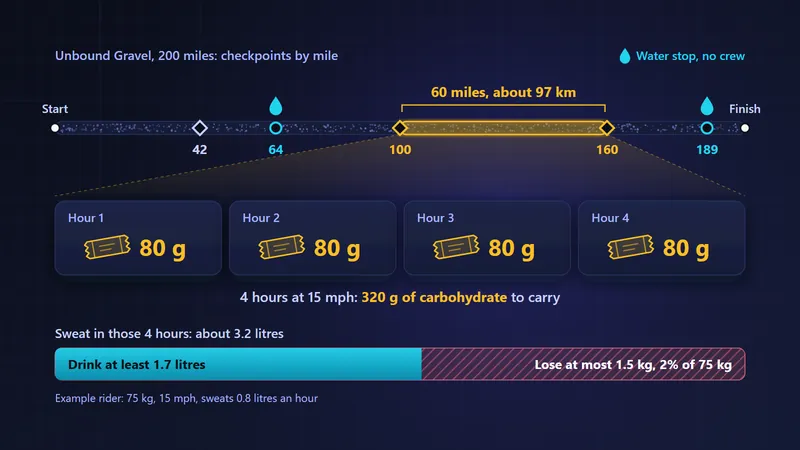
Eat the carbohydrate you plan to race with. For well-trained riders, sports nutrition guidance is up to about 60 g an hour on rides of two to three hours and about 90 g an hour on longer ones, from glucose and fructose together. Less may do at an easy pace, and any target needs practice first.
Worked through, a 100 km event ridden at an average of 170 W for 4 hours 30 minutes is about 2,750 kJ of work, so about 2,750 kcal used. Sixty to 90 g an hour over that time is 270 to 405 g of carbohydrate, or about 1,080 to 1,620 kcal at 4 kcal a gram. A 200 km event at an average of 150 W for 9 hours is about 4,860 kJ, and 90 g an hour comes to 810 g.
Gravel makes eating harder, because rough ground keeps both hands on the bar. Open food on smooth stretches, carry it in a top-tube bag and set a timer for every 20 minutes. Ride the long rides in weeks 9 and 10 as rehearsals, with race-day food and bottles. The guide to carbohydrate on the bike explains how to train your gut for larger amounts. For a personal plan, especially with a medical condition, talk to a registered sports dietitian.
Do you need skills and core training for gravel?
Skills training is worth a weekly slot for most gravel riders, because it saves energy and time on every loose corner and descent. A skills ride of 45 to 60 minutes on mixed ground is enough. Many riders also add two short core sessions a week to stay comfortable on the hoods for hours.
Practise these, a few minutes each:
- Loose corners. Brake before the corner, look through it and press your weight onto the outside pedal.
- Descents. Ride in the drops with a finger on each brake, elbows and knees loose.
- Lines. Look a few bike lengths ahead, pick the smoothest track and ride light over stones.
- Eating and drinking. Take out food and a bottle one-handed on rough ground.
- Riding a wheel. Sit a little further back and to one side than on the road, out of the dust and stones.
A core session can take 15 minutes: front plank, side planks, dead bugs, bird dogs and glute bridges, three rounds of 30 to 45 seconds each.
How do you read your own gravel ride file?
Read four things in each long gravel file: how far normalized watts are above your average power, how often you went above threshold, how much power was left in the last hour, and how much you ate each hour. Compare each with the plan and with your previous long ride.
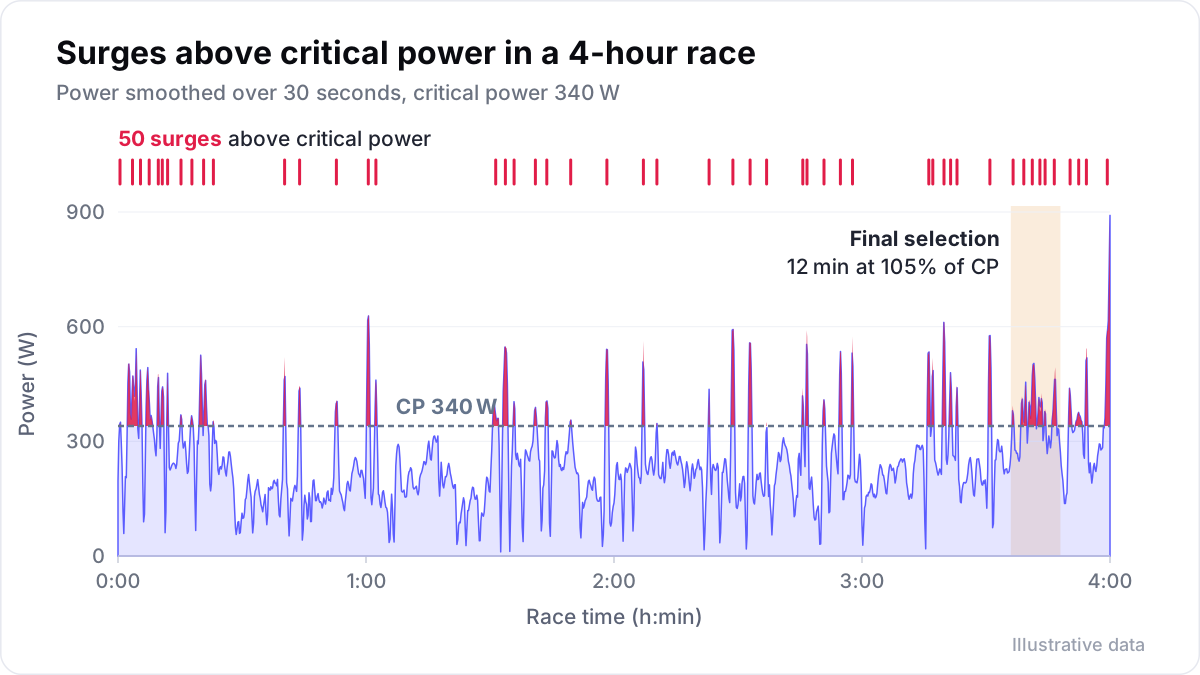
A gravel race with many short climbs can look much the same.
- Variability. Divide normalized watts by average power. Boswell's 280 W against 247 W gives 1.13. A higher number on the same course means a less even ride, often from surging on climbs or chasing after corners.
- Time above threshold. Count the surges above critical power, or the minutes above FTP, and note where in the race they happened.
- Late power. Compare your best 5 and 20 minutes in the last hour with your fresh best powers. That is your durability on the day.
- Fuel. Write the grams of carbohydrate you ate each hour beside that hour's kilojoules.
In Velograph, the ride page counts the surges above critical power and draws the reserve above it, called W′, from the ride's own file. Rides with that analysis stay on the free Rider plan; the riders page explains what else a rider keeps there.
Further reading
- Power analysis: Ian Boswell's epic race-winning ride at Unbound Gravel, Velo, 2021.
- A step towards personalized sports nutrition: carbohydrate intake during exercise, Sports Medicine, 2014.
- Low cadence interval training at moderate intensity does not improve cycling performance in highly trained veteran cyclists, Frontiers in Physiology, 2014.
Velograph is not affiliated with, sponsored by or endorsed by any team, rider or company named in this article. Names are used only to refer to publicly reported work.