How many grams of carbohydrate per hour to take on the bike, why glucose plus fructose matters, how to train the gut and how to plan race fuel from kJ.
Cycling nutrition on the bike starts with a number your power meter already records: kilojoules of work. As a rough rule, each kilojoule you push through the pedals costs about one kilocalorie of food energy, and the harder you ride, the larger the share that comes from carbohydrate. For rides of two to three hours, sports nutrition research supports up to about 60 g of carbohydrate per hour; for longer events, about 90 g, using glucose and fructose together. One professional team reports aiming for 90 to 120 g an hour in races such as the Tour of Flanders. Here is how to turn your own ride data into a fuelling plan.
How many calories do you burn on a ride?
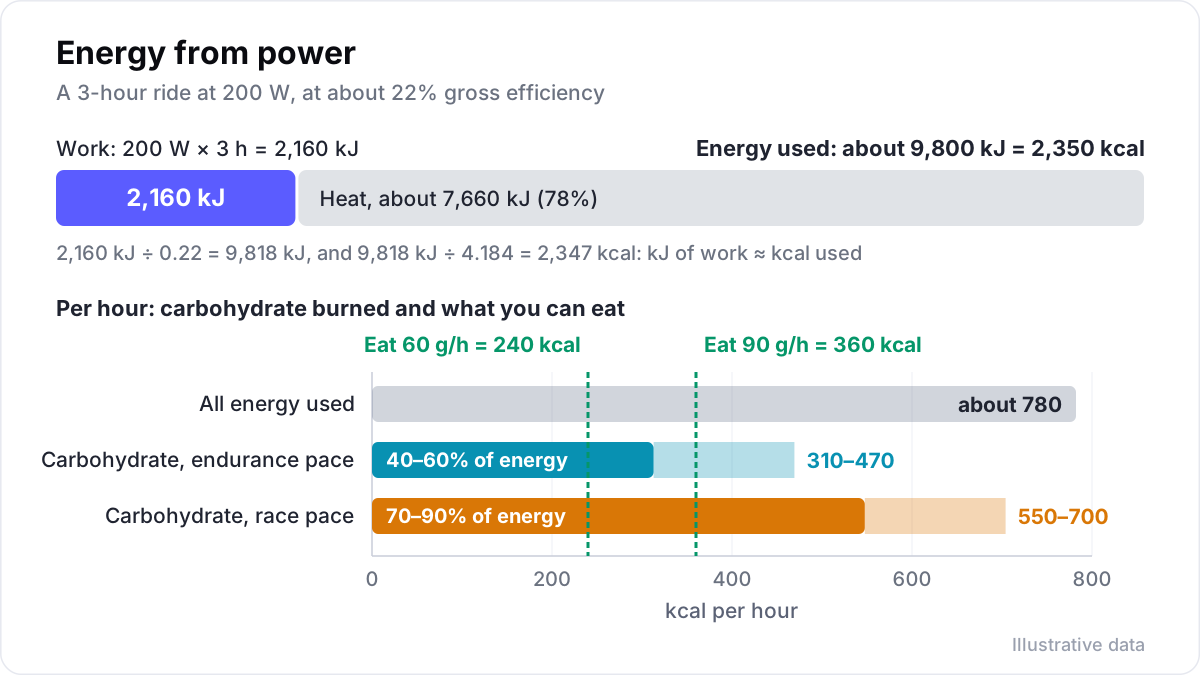
You burn roughly one kilocalorie for each kilojoule of work your power meter records, and a little more at a typical efficiency. Three hours at 200 W is 2,160 kJ of work and uses about 2,350 kcal.
A watt is one joule per second, so one hour at 1 W is 3.6 kJ of work. Multiply average power by hours and by 3.6: three hours at 200 W is 2,160 kJ. Most head units and analysis tools show this figure for every ride.
Your body is not a perfect engine. Gross efficiency, the share of food energy that ends up as work on the pedals, is around 20 to 22% in trained cyclists. Horowitz, Sidossis and Coyle (1994) measured 20.4% and 21.9% in two groups of trained riders. The rest leaves your body as heat.
Then comes a convenient coincidence. One kilocalorie is 4.184 kJ, so at an efficiency of about 24%, kilojoules of work and kilocalories used are the same number. At a more typical 22%, the energy you use is about 9% higher than the kilojoule figure, and at 20% it is about 20% higher. The rule that kJ equals kcal therefore slightly underestimates what you use, but it is good enough for planning. The example ride, 2,160 kJ at 22% efficiency, uses about 2,350 kcal.
How much carbohydrate do you burn when cycling?
About half your energy comes from carbohydrate at endurance pace, and three quarters or more at race pace. For a three-hour ride at 200 W, that is about 290 g at endurance pace and about 440 g at race pace.
Fat and carbohydrate share the work, and the split moves with intensity. In a study by van Loon and colleagues (2001), trained cyclists got about 46% of their energy from carbohydrate at 40% of their maximal workload, 51% at 55% and 76% at 75%. Fat use peaked at the moderate intensity and fell as the effort rose.
Intensity is relative. A steady 200 W can be an easy endurance pace for one rider and race pace for another. For the first, roughly half of the 2,350 kcal comes from carbohydrate: about 1,170 kcal, or 290 g at about 4 kcal per gram. For the second, it is three quarters or more: about 1,760 kcal, or 440 g.
Compare that with what you carry. Murray and Rosenbloom's 2018 review puts whole-body glycogen, the body's carbohydrate store, at about 600 g: on average 500 g in muscle (with a range of 300 to 700 g) and about 80 g in the liver. Muscle glycogen can only fuel the muscle that stores it, so not all of it is available to the legs. A three-hour ride at race pace can drain most of what is usable, which is one reason power fades late in long events. Durability in cycling looks at that fade and how to train against it.
Well-trained riders at high power burn even more. In a study by Podlogar and colleagues (2022), highly trained cyclists rode three hours at a steady pace a little below their first threshold. In the final hour they burned roughly 3.7 g of carbohydrate a minute, around 220 g an hour, of which about 1.5 g a minute came from their drinks.
How much carbohydrate per hour do you need on the bike?
For well-trained riders, sports nutrition research supports up to about 60 g of carbohydrate an hour on rides of two to three hours, and about 90 g in longer events, as glucose and fructose together. At a low intensity you may need less, and any target should be practised in training first.
For carbohydrate taken during exercise, the gut sets the limit, not the muscle. Glucose crosses the intestinal wall through one transporter, called SGLT1, and a single source like this can be used at up to about 60 g an hour. Fructose crosses through a different transporter, GLUT5. Combining the two lets more through: Jentjens and Jeukendrup measured peak use of 1.75 g a minute from a glucose and fructose drink, against about 1.06 g from glucose alone. Researchers call these blends multiple transportable carbohydrates.
Asker Jeukendrup's 2014 review turned this into guidance by duration for well-trained athletes:
| Ride or race | Carbohydrate per hour | Type |
|---|---|---|
| About 1 hour, hard | A mouth rinse or small amounts | Any |
| 2 to 3 hours | Up to about 60 g | A single source such as glucose is enough |
| Longer, ultra-endurance | About 90 g | Glucose and fructose together |
| Hardest professional races (one team's report) | 90 to 120 g | Glucose and fructose, with a trained gut |
The review adds two caveats that matter for amateurs. The targets may need to come down when your absolute intensity is low, and any strategy should be practised in training first.
Professional cycling has since pushed past 90 g. Podlogar and colleagues (2022) compared 120 g with 90 g an hour in trained cyclists. The higher intake raised the carbohydrate used from the drink (1.51 against 1.29 g a minute) but did not spare more of the body's own stores. Performance was not tested.
Team Visma | Lease a Bike describes its approach openly. For the Tour of Flanders, its riders aim for 90 to 120 g an hour, usually as three items an hour, with about 40 g in each item at the top end. The team's FoodCoach app, introduced in 2018 with the Jumbo supermarket chain, logs grams per hour during racing. A prediction model built by Visma estimates energy needs from power, the race profile and the weather. Researchers who advise teams also stress that such intakes match professional workloads, not an amateur's weekend ride.
How do you train your gut for cycling?
Raise your carbohydrate intake step by step on long rides, starting where you are comfortable and adding about 10 g an hour once your stomach copes. Practise at race intensity too, with the products you will race with.
The gut adapts to what you ask of it. Jeukendrup's 2017 review describes stomach emptying, stomach comfort and absorption in the intestine as trainable, with adaptations specific to the nutrient you practise with. In a study by Cox and colleagues (2010), 28 days of training on a high daily carbohydrate intake raised how much glucose cyclists used from a drink during exercise.
A practical progression on long rides:
- Start where you are comfortable, for example 50 to 60 g an hour, beginning in the first 30 minutes.
- If your stomach copes on two long rides in a row, add about 10 g an hour.
- Practise at race intensity as well as endurance pace, because hard riding is tougher on the stomach.
- Use the products you will race with, in the order you will take them.
- Log grams per hour and stomach comfort from 0 to 10 after every long ride.
This guide is general and cannot take your history into account. If you have recurring stomach problems or a condition that affects digestion or blood sugar, or you want a plan for your own needs, ask a registered sports dietitian or your doctor before you change your intake.
How do you plan race nutrition for cycling?
Estimate the race's work in kilojoules from last year's file, turn it into energy and grams of carbohydrate, then choose an hourly target you have trained. A race fuelling plan is arithmetic followed by rehearsal.
- Work: use last year's file from the same race, or a similar race, as average power × hours × 3.6.
- Energy: treat kJ as kcal, or divide by your efficiency for a closer figure.
- Carbohydrate share: about half at endurance pace, three quarters or more at race pace.
- Hourly target: choose the one you have trained, not the one you have read about.
- Items: turn grams into bottles, gels and bars, with the grams from each label.
- Timing: eat before climbs and narrow sections, at feed zones, and before you feel you need it.
- Review: after the race, compare what you took with the plan and how the final hour went.
A worked example for a four-hour road race at an expected 230 W average:
| Step | Number |
|---|---|
| Work | 230 W × 4 h × 3.6 = 3,312 kJ |
| Energy used (22% efficiency) | about 3,600 kcal |
| Carbohydrate share (about 70%) | about 2,500 kcal, or 630 g |
| Planned intake (gut trained to 80 g an hour) | 320 g over four hours |
| Each hour | one bottle with 40 g, one gel with 25 g, half a bar with 15 g |
The gap between the 630 g used and the 320 g taken comes from the stores you started with, which is why the meals of the day before and the morning matter too. The plan belongs in your race plan: how to write a cycling race plan shows where feeding fits beside tactics and equipment.
Can under-fuelling harm your health?
Yes. The International Olympic Committee's 2023 consensus statement on Relative Energy Deficiency in Sport (REDs) describes how eating too little for your training load, over weeks, harms health and performance, in women and in men. It is a different problem from running out of fuel in one race.
The pull towards a lower weight for climbing makes this risk real for cyclists; watts per kilo explains why the number tempts riders and why weight questions belong with professionals.
Big training blocks raise needs sharply. Doubling your weekly hours on a cycling training camp roughly doubles the energy you spend on the bike, so plan the food as carefully as the rides.
Further reading
- A step towards personalized sports nutrition: carbohydrate intake during exercise, Sports Medicine, 2014.
- Training the gut for athletes, Sports Medicine, 2017.
- Increased exogenous but unaltered endogenous carbohydrate oxidation with combined fructose-maltodextrin ingested at 120 g h−1 versus 90 g h−1 at different ratios, European Journal of Applied Physiology, 2022.
- The role of nutrition during the Tour of Flanders, Team Visma | Lease a Bike, 2025.
- 2023 International Olympic Committee's consensus statement on Relative Energy Deficiency in Sport, British Journal of Sports Medicine, 2023.
Velograph is not affiliated with, sponsored by or endorsed by any team, rider or company named in this article. Names are used only to refer to publicly reported work.