A one-page race plan template for staff: the course, the wind, roles, plan B, bottles and kit, how to brief it, and what changes in a stage race.
A cycling race plan that riders use fits on one page and answers four questions. What does the team want from this race? Where will the race be decided? Who does what? What happens when it goes wrong? Feeding, equipment and timings support those answers. Write the plan two or three days before the race, brief it the evening before, and keep it for the debrief afterwards.
What should a cycling race plan include?
A cycling race plan covers the objective, the key moments, the weather, each rider's role, the tactics, plan B, feeding, equipment and the questions still open. All of it should fit on one page.
Race plans tend to fail in one of two ways. Some are good intentions, such as "stay alert and ride near the front", that nobody can act on. Others run to six pages that riders skim on the bus. A plan that works is short, specific and written in the order the race unfolds. Fill these headings with places, kilometres and names.
| Section | What to write | Example line |
|---|---|---|
| Objective | One or two sentences on what success looks like | Win the bunch sprint; top 10 for the second leader if a break stays away |
| Key moments | The three to five places where the race turns, with kilometres | Km 118: left turn onto the open dyke road, crosswind from the right |
| Weather | Wind direction and strength at the key moments, temperature, rain | South-west wind at 25 km/h, 14 °C, dry until 15:00 |
| Roles | One job per rider, with a start and an end | Cover moves until 40 km to go, then bottles |
| Tactics | Plan A in race order: start, middle, finale | Let a break of up to four go and hold the gap at three minutes |
| Plan B | What happens after a crash, a puncture or a break that goes without us | If the sprinter punctures after km 150, two named riders wait |
| Feeding | Fuelling targets, bottles, feed zone, staff positions | Feed zone at km 96 on the right; two bottles each from the car at km 60 |
| Equipment | Wheels, tyres and pressures, gearing, clothing, spares | 30 mm tyres; a 32-tooth sprocket for the 14% climb |
| Open questions | What still needs checking before the start | Is the last kilometre resurfaced? Ask the organiser |
The objective comes first because every other line serves it. "Win" is not a useful objective for most races. "Get our climber into the top five on the summit finish" or "put a rider in every move until the climb" gives each rider something to judge their own decisions against when the radio is quiet.
Where on the course will the race be decided?
A race is usually decided at three to five key places on the course, often where position matters more than fitness. Think of the foot of the main climb, a narrow bridge, a cobbled sector, a sharp turn into a crosswind or the last roundabout.
Mark each with its kilometre, what will happen there and where the team needs to be two or three kilometres before it. Riders remember "top 20 before the left turn at km 118" far better than "be well placed".
The organiser's technical guide gives the route, the climbs, the feed zone and a detailed map of the final kilometres. A GPX file of the route gives the profile and the gradients. Riders who raced last year's edition, and their ride files from that day, show where the race went hard. A recon ride on the decisive part of the course is worth more than any map, if the calendar allows it.
For the last 10 km, check five things: the final climb or short rise, narrowings and traffic islands, the distance from the last corner to the line, the slope of the finishing straight and the wind direction in it. A sprint team that discovers a 90-degree corner at 400 metres to go loses its lead-out.
How do you plan for echelons in a crosswind?
Mark every stretch where the road turns into a crosswind, and name the rider who brings the team together before each one. In flat races, the wind is often what splits the field.
When the wind blows across the road, riders shelter in diagonal lines called echelons, and only as many fit in each line as the road is wide. A team that knows where the road turns into a crosswind can be at the front before the split happens. A team that finds out on the day is usually behind it.
Stage 13 of the 2013 Tour de France shows the cost. The 173 km stage from Tours to Saint-Amand-Montrond was almost flat. Omega Pharma-Quick Step lifted the pace in a crosswind and split the peloton, and Saxo-Tinkoff attacked about 30 km from the finish. Alberto Contador gained 1 minute 9 seconds on the race leader, Chris Froome, and Mark Cavendish won the stage. Alejandro Valverde, second overall that morning, punctured, was caught behind a split and lost several minutes.
Note, from the hourly forecast, where the wind comes from and how strong it is at each key moment. Temperature changes how many bottles riders need. Rain changes tyre pressures, clothing and how riders take the descents.
How do you assign rider roles in a race plan?
Give each rider one job with a start and an end, and say what comes next, because a role on its own is not an instruction. Write it so a tired rider can recall it in one breath.
The usual roles are leader, protected rider, sprinter, lead-out, climber, road captain, domestique, breakaway rider and free role. Each rider's line in the plan needs three parts: the job, until when, and what comes next.
- Cover every move of three riders or more until 50 km to go, then fetch bottles and keep the leader out of the wind.
- Take the front at 1.5 km to go, ride flat out to 600 metres, then pull aside and leave the sprinter on the next wheel.
Power targets help where pacing matters, for example "no more than 380 W on the first climb, so you are still there on the second". Keep them few. A rider racing to a number usually misses what the race is doing.
Roles also let a team play more than one card. On stage 11 of the 2022 Tour de France, Jumbo-Visma had two riders who could win, Primož Roglič and Jonas Vingegaard. They took turns attacking Tadej Pogačar on the Télégraphe and the Galibier, so he had to answer each time. On the final climb to the Col du Granon, Vingegaard attacked with less than 5 km to go, won the stage and took the yellow jersey. For how to match riders to these jobs, see rider selection with data.
How do you write a plan B for a race?
Write the likely race-day problems as "if, then" lines, with names, so nobody has to decide in a panic at 50 km/h.
- If the leader punctures before the last 30 km, two named riders wait and the rest hold position at the front.
- If the leader crashes or is dropped in the finale, a named rider gets a free role.
- If a break of more than five riders goes without us, a named rider bridges in the first 10 km, and after that the team chases only on the road captain's call.
- If the sprinter is dropped on the last climb, the plan switches to the second sprinter or to attacking.
- If the radio fails, the road captain makes the calls.
Agree in advance who decides on the road when the team car cannot see the race, and write that name into the plan.
Feeding, bottles and equipment
Write each rider's fuelling target in grams of carbohydrate per hour, using the amount they have practised in training. Race day is no place for a new number or a new product. Add the feed zone kilometres, the side of the road where staff will stand, and how many bottles each rider takes from the car and when. For the background on hourly carbohydrate, see cycling nutrition by the numbers. Individual plans belong with a registered sports dietitian.
Put the litter zones in the plan too. Since April 2021, UCI rules have allowed riders to drop bottles and waste only in the organiser's litter zones, or to hand them to team staff at the roadside or to team and organiser vehicles. Michael Schär was disqualified from the 2021 Tour of Flanders for throwing a bottle towards spectators. The UCI eased the sanctions within weeks, but throwing waste outside the zones remained forbidden.
The equipment section is a checklist. It covers wheel depth for the expected wind, tyre width and pressure for the road surface and the weather, gearing for the steepest gradient, clothing for the forecast, spare wheels in the car, race numbers and the timing chip.
How do you run a race briefing?
Brief the full plan the evening before, in about 20 minutes, with a short recap on the morning of the race. Then ask each rider to say their own job back in one sentence, which is the quickest way to find out what was not clear.
Go in the order of the template: the objective, then the course and its key moments with the profile on screen, the weather, each rider's role by name, plan B, and feeding and equipment last.
Give riders a version they can read again on their phone; some also tape the key kilometres to the top tube. After the race, bring the plan to the race debrief and set it beside the files, because reading the race file shows where the race turned.
What changes in a stage race?
A stage race needs two layers of plan. The overall plan sets the general classification goal, and each day gets a short stage plan, written in the evening after that day's debrief.
The overall plan also names the stages the team wants to win and the stages where riders should save energy. Each day's plan is written fresh because the classification, the riders' legs and the weather all change overnight. A sprint stage and a mountain stage need different roles, so the roles are written per stage.
Race plans in Velograph
In Velograph, every race on a team's calendar has its own page with the riders and their roles, the course, pacing, the race plan and the debrief. The plan has much the same sections as the template above: objective, tactics, key moments, nutrition, equipment, contingencies and open questions. Staff write it themselves, or ask the AI to draft the sections still empty. The AI reads the course and the selected riders' recent form, marks what it wrote as AI, never replaces what a person wrote, and adds questions it could not answer.
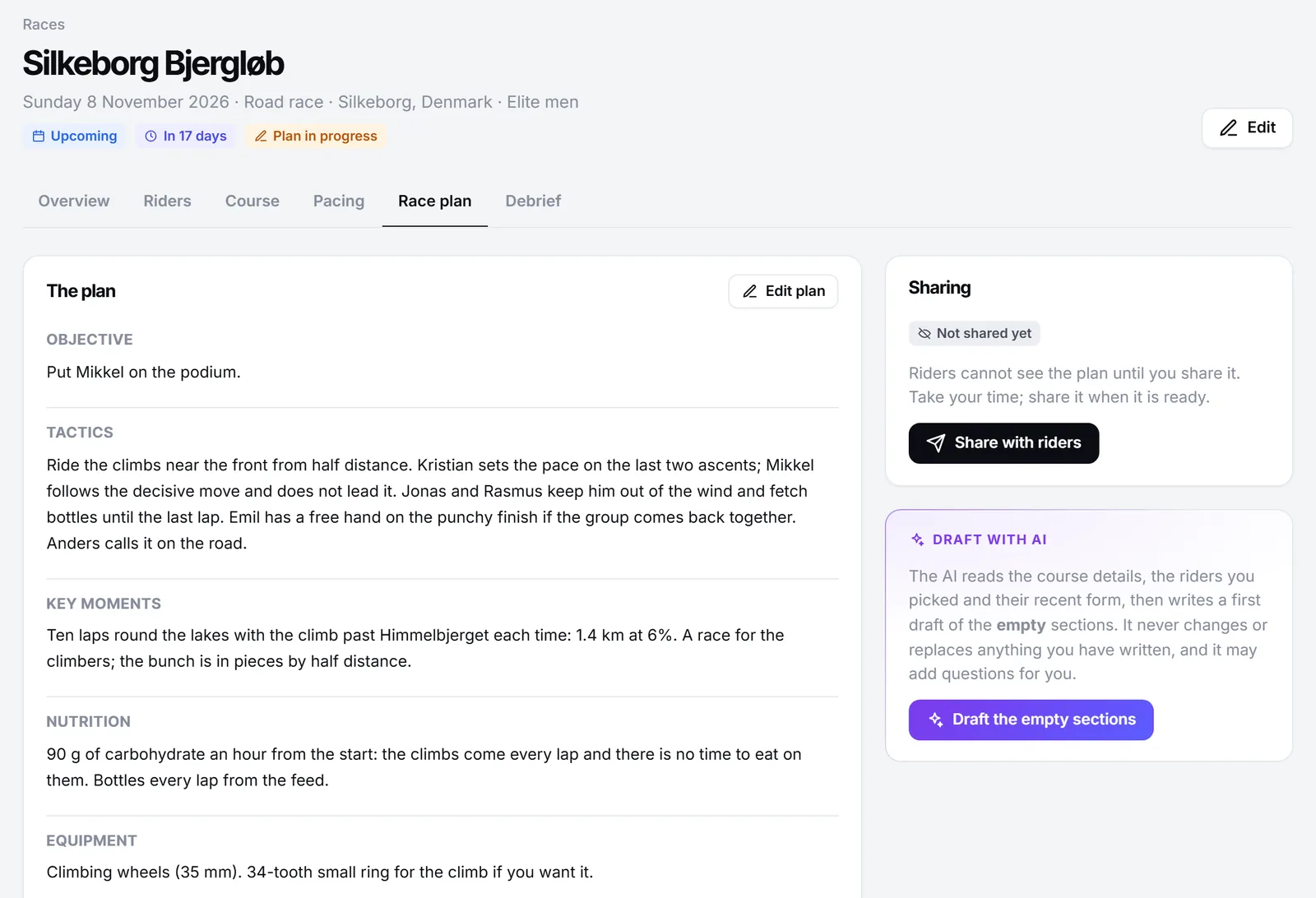
Riders see the plan only once staff share it, with their own role and instructions at the top. A stage race gets its stages, each with its type, distance, climbing and notes. Pacing gives a rider target power for each section of the course and the time it should give. A finished race without a GPX file gets its course drawn from the riders' own rides. The pricing page shows which plans include race plans.
Further reading
- UCI adapts rules on the discarding of bottles and waste at the Giro d'Italia, UCI, 2021.
- Bottlegate: no automatic DQ for riders throwing water bottles as UCI softens littering penalties, road.cc, 2021.
- Mark Cavendish wins, Alejandro Valverde loses on stage 13 of the Tour de France, Cycling Weekly, 2013.
- Pogačar cracks on Col du Granon but vows to 'fight until the end', SBS Sport, 2022.
Velograph is not affiliated with, sponsored by or endorsed by any team, rider or company named in this article. Names are used only to refer to publicly reported work.