A junior season plan template by age band, from under-12s to juniors of 17 and 18, built around school, growth and racing, and filled in for one rider.
This junior season plan template gives clubs and parents one plan for each age band, from riders under 12 to juniors of 17 and 18, and fills in the oldest band for a whole season for Robin, a made-up first-year junior. In the UCI's rules only riders of 17 and 18 are juniors; younger riders race in their federation's youth categories. Every band follows the same three rules. School comes first, the plan follows the rider's growth, and the hours rise slowly.
Which age band is a young rider in?
Count age as the racing year minus the year of birth, as the UCI does for its categories. A rider born in 2010 is 17 in 2027, and so a first-year junior all that year, whatever their birthday. Riders of 16 and under race in national youth categories, which each federation names and runs itself.
| Age in 2027 | Born in | Band in this template | Racing category |
|---|---|---|---|
| 17 and 18 | 2009 or 2010 | 17 and 18 | UCI junior |
| 15 and 16 | 2011 or 2012 | 15 and 16 | National youth category |
| 12 to 14 | 2013 to 2015 | 12 to 14 | National youth categories |
| 11 or younger | 2016 or later | Under 12 | National youth categories, or none |
Plan winter training by the coming year's age. The training that starts in November 2026 builds towards the 2027 season, so Robin, born in 2010, trains this winter as a junior. Cyclo-cross counts differently, because its season runs across New Year. In UCI cyclo-cross races, a rider keeps for the whole winter the category they will be in on 1 January, so Robin already races the 2026 to 2027 cyclo-cross season as a junior.
Federations set any gear and race-distance limits for youth riders, and some for juniors too. From 2026, Belgium allows juniors at most 10.16 m per pedal turn in national road races, so check your federation's rules first. The bands and hours match the junior cycling training guide, which explains growth, sleep and what to record for young riders.
What should a season plan include at each age?
Riders under 12 need no season plan, only a year of varied riding and other sports. Riders of 12 to 14 plan by school term, riders of 15 and 16 get a first season with a base, a build and a racing block, and juniors of 17 and 18 plan back from one A race.
| Age in the season | Riding a week | Shape of the year | Hard sessions a week | Racing | Checks |
|---|---|---|---|---|---|
| Under 12 | 1 to 3 hours, plus other sports | No phases; skills in winter, games and short events in summer | None; hard efforts come from games | Fun events and club races, if the child wants them | A skills list each term |
| 12 to 14 | 2 to 5 hours, plus other sports | Three terms: cyclo-cross or mountain bike in autumn, other sports and skills in winter, road or track in spring and summer | One, short and playful | A few short races the rider chooses | A timed skills course twice a year |
| 15 and 16 | 4 to 8 hours | Base from November to February, build in March and April, racing from May to September, a break in October | One or two | One or two goal races, the rest for experience | A test in winter and in spring; a review every six to eight weeks |
| 17 and 18 | 6 to 12 hours | Back from an A race: base, build, peak, racing and a break | Two or three | One A race, a few B races, C races ridden as training | Two or three tests; a review every six to eight weeks |
In every band, measure standing height every three months, as the junior guide describes. When it jumps, the plan holds its intensity steady while the bike is checked again, starting with saddle height.
Add up every organised sport, not only cycling. In a 2015 case-control study, Jayanthi and colleagues found higher odds of serious overuse injury in young athletes who did more hours of organised sport a week than their age in years, and in those whose organised sport outweighed free play by more than two to one. A 13-year-old with 4 hours of club cycling and 5 hours of football is at 9 hours, under that line. Treat it as a ceiling, not a target, and take aches and pains to a doctor or physiotherapist.
How do you plan a junior's season around school?
Write the school year into the plan before any training: term dates, exams, early starts and school trips. Then make exam weeks easier weeks, put hard sessions straight after school so the evening stays free for homework and sleep, and keep the long ride for the weekend.
This is Robin's usual week in the build, with 9 hours of riding. Its targets use FTP, functional threshold power, which is the highest power a rider can hold steadily for roughly 30 to 70 minutes.
| Day | Session | Riding |
|---|---|---|
| Monday | Rest; school and homework | 0 |
| Tuesday | Straight after school: 3 × 10 minutes at threshold, 95 to 100% of FTP, home by 18:00 | 1 h 30 min |
| Wednesday | Easy ride, then 30 minutes of strength work at home | 1 h |
| Thursday | Straight after school: 5 × 3 minutes at VO2max, 110 to 120% of FTP | 1 h 30 min |
| Friday | Rest; bike and kit ready for Saturday | 0 |
| Saturday | Club ride with some tempo, or a race | 3 h |
| Sunday | Easy ride, or a second race day | 2 h |
Sleep is the other half of the week. The American Academy of Sleep Medicine recommends that teenagers of 13 to 18 sleep 8 to 10 hours in every 24 hours. With a 07:00 alarm, lights out at 22:00 gives Robin 9 hours.
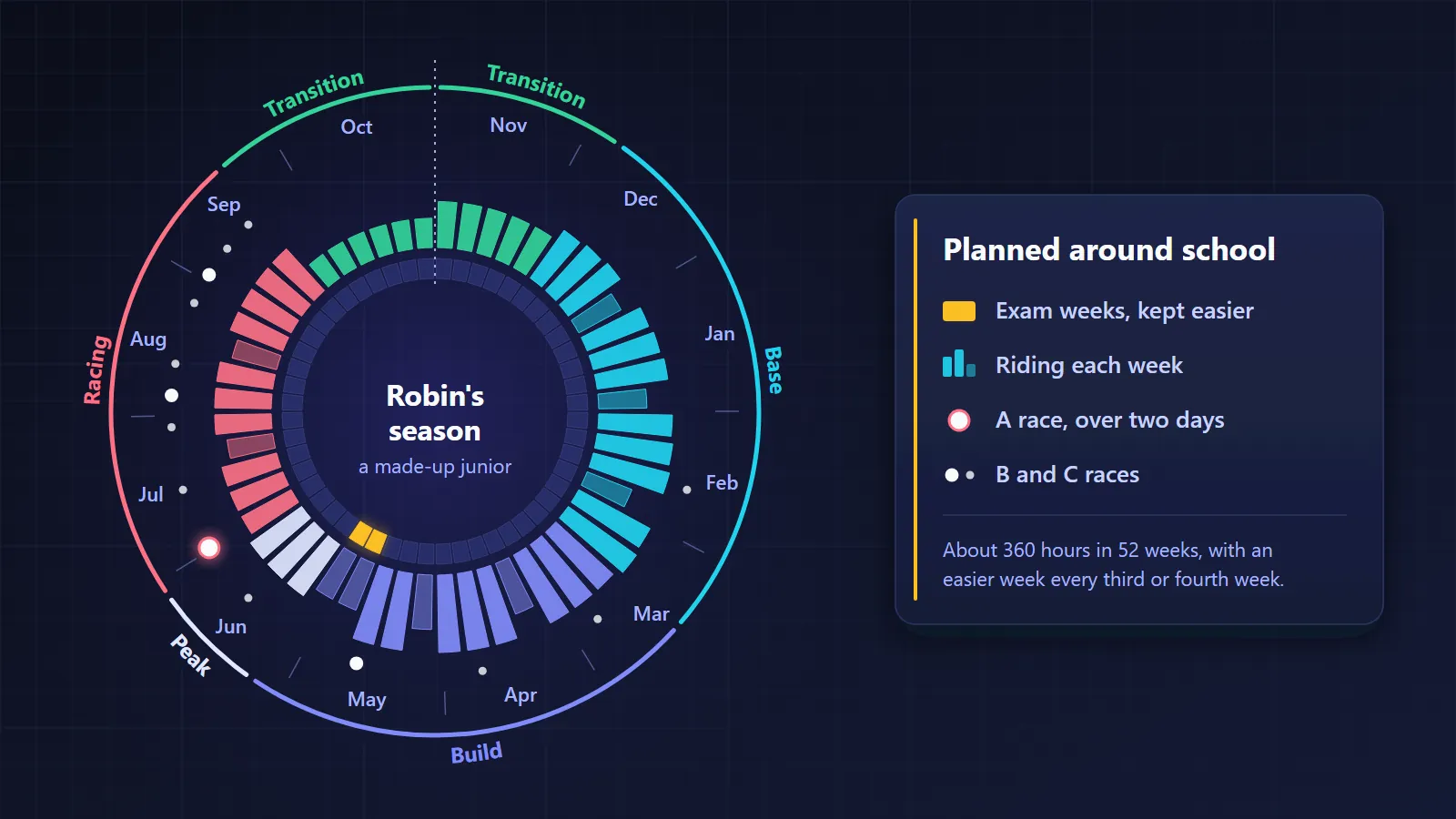
Robin's exams fall in weeks 30 and 31, from 24 May to 6 June 2027. Both weeks drop to 6 hours, with two short rides midweek, easy riding at the weekend and no racing. The last B race before them is on the Sunday before the first exam, and the test after them waits until week 32.
What does a full season plan look like for a 17-year-old?
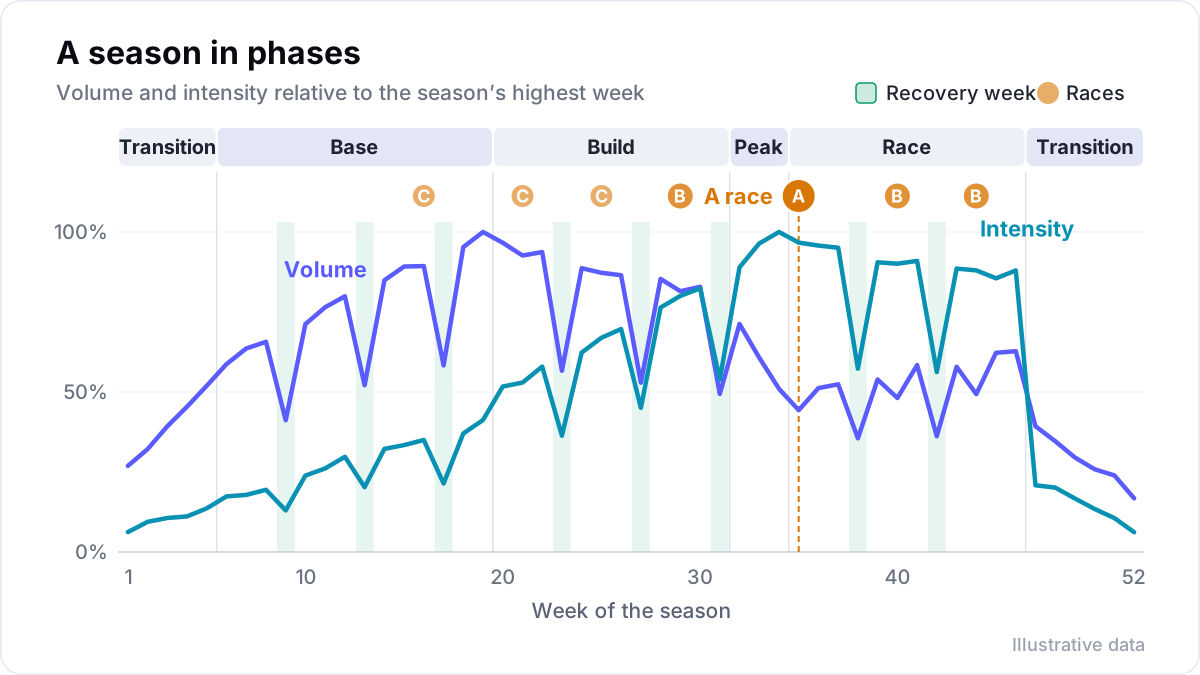
Robin, a made-up first-year junior born in 2010, trains from 2 November 2026 to 31 October 2027 and builds back from one A race, a two-day race on 3 and 4 July. The plan has six phases, an easier week every third or fourth week, exams as easier weeks and 17 race days.
| Weeks | Dates | Phase | Riding a week | Training | Races | School and checks |
|---|---|---|---|---|---|---|
| 1 to 5 | 2 Nov to 6 Dec | Transition | 5 to 6 h, plus a team sport | Easy rides, skills, short sprints, strength | Cyclo-cross for fun | Season meeting with parents; height |
| 6 to 19 | 7 Dec to 14 Mar | Base | 7 rising to 10 h; 5.5 to 6 h in easier weeks 9, 13 and 17 | Long rides, tempo, sprints, strength | C race in week 16 | Christmas is easier week 9; test 1 in week 10 |
| 20 to 31 | 15 Mar to 6 Jun | Build | 9 to 9.5 h; 6.5 h in easier weeks 23 and 27 | Threshold, VO2max, the Saturday ride or a race | C races in weeks 21 and 25; B race in week 29 | Test 2 in week 24; exams in weeks 30 and 31 at 6 h |
| 32 to 34 | 7 Jun to 27 Jun | Peak | 7 to 8 h | Race-like efforts; openers before races | C race in week 33 | Test 3 in week 32 |
| 35 to 46 | 28 Jun to 19 Sep | Racing | 6 to 7.5 h with races; 5.5 h in easier weeks 38 and 42 | One session between races | A race in week 35; B races in weeks 40 and 44; C races in weeks 37, 39, 41, 43, 45 and 46 | Summer holiday; review after the A race |
| 47 to 52 | 20 Sep to 31 Oct | Transition | 3 to 4 h, plus other sports | Riding for fun | None | Season review in week 48 |
The A race and the two B races in weeks 40 and 44 are two-day races; the B race in week 29 and every C race last one day. That makes 10 C race days, 5 B race days and 2 A race days. The plan adds up to about 360 hours, or about 7 hours a week on average, against about 6 hours a week in Robin's season at 16.
The annual training plan guide explains how to count a season back from an A race. For the club's own winter sessions, the club winter training plan has a 12-week template that starts on the same Monday.
How do you keep a junior's training load sensible?
Raise the weekly hours by half an hour to an hour at a time, hold each step for two or three weeks, and plan an easier week every third or fourth week. Then let the rider overrule the plan, because poor sleep, fading enjoyment, illness or a growth spurt each mean the plan gives way.
In Robin's plan, no week is more than an hour above the highest of the four weeks before it. The easier weeks come down to between three fifths and four fifths of the weeks around them, and the checks below decide when the plan changes.
| Check | When in Robin's plan | What changes the plan |
|---|---|---|
| Weekly check-in on energy, sleep, school, enjoyment and aches | Every Sunday evening | Two poor weeks in a row make the next week an easier one |
| Session effort, 0 to 10, times the minutes | After every session | A week far above the last few |
| Standing height | Weeks 1, 14, 27 and 40 (2 Nov, 1 Feb, 3 May, 2 Aug) | A jump of several centimetres |
| Power test | Weeks 10, 24 and 32, each after an easier week | New zones for the next block |
| Review with Robin and a parent | Weeks 1, 7, 14, 21, 28, 36 and 43, and the season review in week 48 | Anything that is not working |
Judge the season by what Robin learnt and how they progressed, not by the results of one summer. Riders who mature early win many youth races, so a strong or a weak summer at 17 is not a verdict; talent identification in cycling shows what data can and cannot say about young riders. The week-48 meeting follows the season review template.
Before the first week, write down what the club records, why and who sees it, and share it with Robin and their parents; the guide to athlete data privacy explains when a parent must agree. In Velograph, for example, the rider or their coach can put a note on a week, such as "exams", that only the rider and the people who plan their training see, and the coach can set each week's target in hours.
Further reading
- Sports-specialized intensive training and the risk of injury in young athletes: a clinical case-control study, Jayanthi and colleagues, American Journal of Sports Medicine, 2015.
- Recommended amount of sleep for pediatric populations, Paruthi and colleagues, Journal of Clinical Sleep Medicine, 2016.
- UCI Cycling Regulations, Part 1: General organisation of cycling as a sport, UCI, 2026.
Velograph is not affiliated with, sponsored by or endorsed by any team, rider or company named in this article. Names are used only to refer to publicly reported work.