What power profiles, maturation, durability and Zwift Academy show about young cyclists, and why data should open doors while scouts and coaches decide.
Good talent identification in cycling uses data to open doors, not to close them. A power profile, a rider's progress over several seasons and a measure of how much power survives a long day can find riders that traditional scouting misses. Read as a verdict on a 16-year-old, the same numbers mislead. Research on young cyclists shows where the data helps, where it fails, and how scouts and coaches can use it well.
Can a power profile predict which juniors turn pro?
A power profile shows which young riders are strong today, but it cannot reliably pick future professionals. One study found no model that predicted who turned professional. Another found that juniors who reached the WorldTour had produced more maximal aerobic power at 18. A strong engine raises the odds, and a weaker one does not close the door.
A power profile is a rider's best power at each duration, from a five-second sprint to an hour or more. Its shape says whether a rider leans towards sprinting, climbing or time trialling, and the power curve explained shows how to read it.
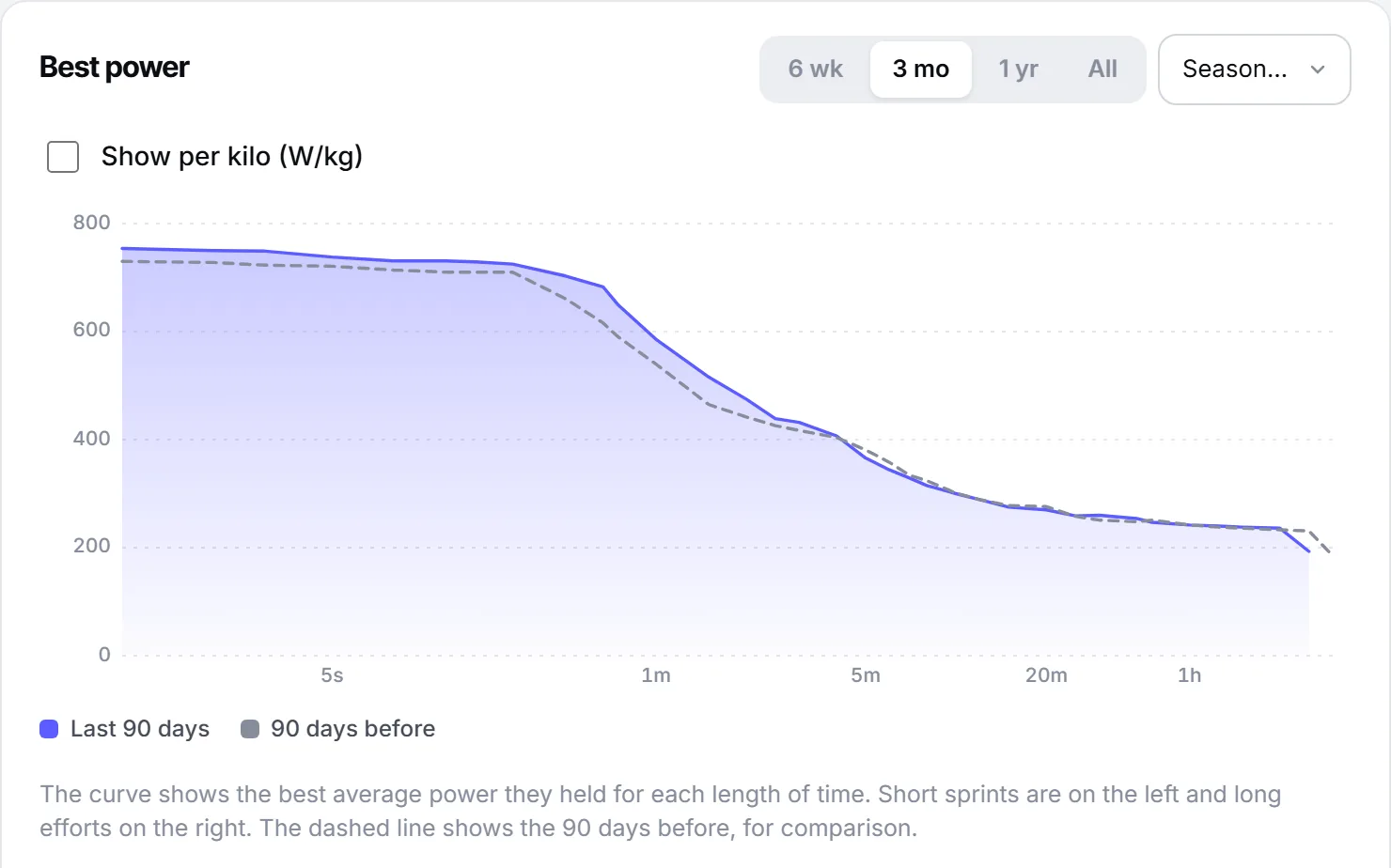
Two studies of junior cyclists show both its value and its limits. In 2010, Menaspà, Sassi and Impellizzeri tested 309 young cyclists with an average age of 17.5. Aerobic fitness separated riders by their current level: national team riders had higher values than the rest. Yet no statistical model could correctly identify which riders went on to turn professional. The authors concluded the measures were useful to find juniors who excel in their category, not to identify future professionals.
A 2018 study by Svendsen and colleagues looked back at 80 male junior road cyclists and grouped them by what they had reached at 23. The nine who reached the WorldTour had, at 18, produced more maximal aerobic power than those who did not: 533 W against 451 W, or 6.9 against 6.2 W/kg. They had also placed better at their national championships. The group was small and the design looked backwards, so it shows tendencies, not a formula.
A young rider's profile also has gaps that are not weaknesses: many juniors have never ridden an all-out 20-minute effort, junior races are shorter, and pacing skill is still developing. Treat a missing or low point on the curve as a question, not an answer.
What is the relative age effect in cycling?
The relative age effect means that the older children within an age group generally outperform the younger ones and are picked more often. In cycling the pattern reaches into the under-23 years, and early selection on physical factors often leaves out late developers.
Young riders mature at different speeds. The IOC's consensus statement on youth athletic development (2015) notes that selection in youth sport often happens during the adolescent growth spurt, between about 9 and 15, and that it favours early maturers. Within any age group, the older children generally outperform the younger ones, which is known as the relative age effect. Early selection on physical factors often leaves out late developers.
Cycling shows the same pattern into the under-23 years. Voet, van Erp and colleagues (2022) studied 2,854 riders from the 25 leading nations in the ProCyclingStats ranking who rode for UCI Continental development teams between 2005 and 2016. Among riders who never turned professional, teams had picked more riders born early in the year than late, at the ages of 19 and 20. Among riders who did reach the professional level, that bias was gone. The authors' reading: development teams may choose relatively older riders over younger peers who could develop later.
For a scout, that means a few habits:
- Note birth month and stage of growth next to every number, and compare riders with others at the same stage.
- Compare against age-group riders of a similar birth quarter, not the whole field.
- Keep the door open. Re-select every season instead of fixing a squad at 15.
How do you judge a junior cyclist's potential?
Judge a junior cyclist's potential by how their power at fixed durations changes over two or three seasons, more than by today's numbers. Much of a rider's development comes after the junior years.
Juniors are still far from their adult numbers. In a 2022 study, Alejo and colleagues compared juniors, under-23 riders and professionals. Juniors trailed both older groups on most endurance measures, including VO2max and time-trial power. Under-23 riders matched professionals on VO2max but still trailed them on time-trial power. Much of a rider's development comes after the junior years.
So the most informative data is change over time: how a rider's power at fixed durations moves across two or three seasons, how long they have trained in a structured way, and how they respond to a training block. A simple comparison makes the point.
| Rider A | Rider B | |
|---|---|---|
| Age | 17 | 17 |
| Structured training | 5 years | 18 months |
| Best 5-minute power | 360 W | 330 W |
| Change over the last two seasons | +3% | +11% |
These are made-up numbers. Rider A is stronger today. Rider B may be the better prospect, and the only honest way to find out is to keep watching. Body mass changes fast in growing riders, so follow absolute watts as well as watts per kilo, and leave conversations about weight to the rider, their family and professionals.
Why does durability matter in junior cycling?
Durability, how much power a rider has left late in a long ride, matters because road races are decided late. It separates under-23 riders from professionals, yet juniors rarely show it, because junior races are shorter. A long training ride with a hard effort after two or three hours can still show it.
Ed Maunder and colleagues (2021) defined durability as when, and how much, a rider's physiological profile deteriorates during prolonged exercise.
Research on professional and under-23 riders keeps pointing the same way:
- Successful professionals fade less. Teun van Erp, Dajo Sanders and Robert Lamberts (2021) found that more successful climbers kept more of their 5 and 20-minute power after large amounts of work. More successful sprinters kept more of their 10-second and 1-minute power.
- It separates under-23 riders from professionals. Peter Leo and colleagues (2021) compared nine under-23 riders with eight professionals at the Tour of the Alps. The professionals produced more power per kilo after 1,000 to 3,000 kilojoules (kJ) of work, and the authors suggested the profile could help judge when an under-23 rider is ready to turn professional.
- It changes across a season. In 30 under-23 riders, James Spragg, Peter Leo and Jeroen Swart (2023) found that power after 2,000 kJ of work varied more across a season than fresh power did.
Juniors rarely show their durability in races, because junior races are shorter. A scout can still ask for it: a long training ride with a hard 5 or 20-minute effort after two or three hours tells a lot. Velograph, for example, measures durability after set amounts of work, counted in kJ per kilo of body weight. It labels each by the hours into the ride, so the late efforts sit beside the fresh ones. The article on durability in cycling covers how to measure and train it.
Has anyone turned pro through Zwift Academy?
Jay Vine and Neve Bradbury both won professional contracts through Zwift Academy, run by the indoor cycling platform Zwift. In 2020, Vine, then 25, won the men's final and a contract with Alpecin-Fenix. Bradbury, 18, won the women's final and a contract with Canyon-SRAM.
Zwift Academy is the clearest example of data widening the net. The 2020 finals were judged on data analysis from a series of competitions and workouts. The finalists also met their prospective teammates to judge how they would fit in.
Two years later, Vine won two mountain stages of the 2022 Vuelta a España. Three lessons stand out. The finalists came from seven countries, from Colombia to New Zealand, so the search reached riders no scout would have seen. Vine was 25, a reminder that late developers exist. And the numbers only opened the door: the team still met the riders, and they still had to prove themselves on the road. The guide to indoor cycling training covers how to make trainer numbers count.
What can't data tell you about a young cyclist?
Numbers cannot show race craft, positioning, bike handling, tactical sense, motivation, how a rider takes feedback, or how they balance school, work and family. Those come from watching races, talking to coaches and spending time with the rider.
Data opens the door, and scouts and coaches decide. A good scouting file holds both kinds of evidence:
- Power at 5 seconds, 1, 5 and 20 minutes, with dates and conditions.
- Power after hours of riding or after a set amount of work.
- The trend over two or three seasons.
- Training history: years of structured training and weekly hours.
- Birth month and stage of growth.
- Race results with context: the team, the role, the course.
- The coach's notes and the rider's own goals.
Ask before you collect any of it. The rider, and a parent if the rider is under 18, should agree to what is shared and with whom. The junior cycling training guide covers consent for minors, and rider selection in cycling shows how the same principles work when a team picks riders for a race.
Further reading
- Aerobic fitness variables do not predict the professional career of young cyclists, Menaspà, Sassi and Impellizzeri, Medicine and Science in Sports and Exercise, 2010.
- Training, performance, and physiological predictors of a successful elite senior career in junior competitive road cyclists, Svendsen and colleagues, International Journal of Sports Physiology and Performance, 2018.
- The role of the relative age effect on talent identification in professional road cycling, Voet and colleagues, Journal of Sports Sciences, 2022.
- Power profiling, workload characteristics, and race performance of U23 and professional cyclists during the multistage race Tour of the Alps, Leo and colleagues, International Journal of Sports Physiology and Performance, 2021.
- Neve Bradbury, Jay Vine win Zwift Academy finals, Velo, 2020.
Velograph is not affiliated with, sponsored by or endorsed by any team, rider or company named in this article. Names are used only to refer to publicly reported work.