A sports director's guide to rider selection: match the course to power profiles, check form and durability, fill every role, then explain the choice.
Rider selection is easiest in three steps. First describe what the race will demand, then find the riders whose power profile, form and durability match those demands, and finally fill every role the race plan needs. Data narrows the list and makes the reasons visible. Staff still decide, because no file shows team dynamics, a rider's confidence or what experience of a particular course is worth.
What should you know about a race before selecting riders?
Know how long the race will take, how much climbing it has and how steep it gets, where it is usually decided, the likely weather and roads, and how many riders each team may start. Write it down before you open a single file.
Those answers turn "who is going well?" into a sharper question: who is going well at the efforts this race rewards?
| Race type | Usually decided by | Efforts that matter most | Also check |
|---|---|---|---|
| Flat race with a bunch sprint | Positioning and the final seconds | 5 to 30 seconds; repeated 1-minute efforts in the lead-out | Lead-out experience, calm in the bunch |
| Crosswind or cobbled race | Repeated hard efforts to hold position | 30 seconds to 2 minutes, many times | Absolute watts, bike handling |
| Hilly one-day race | Short climbs late in the race | 1 to 5 minutes after four or more hours | Durability |
| Mountain stage or summit finish | The final climb | 20 to 60 minutes | Watts per kilo, durability, heat |
| Time trial | The whole race | 10 to 60 minutes, steady | Position, pacing |
Research on professional racing supports this kind of table. Sanders and Heijboer studied nine riders from one WorldTour team at the 2016 Giro d'Italia. Flat and semi-mountainous stages produced the highest short peak powers, from 5 seconds to 2 minutes. Mountain stages and time trials produced the highest power for efforts longer than 10 minutes. Time trials were the most intense stages, while mountain stages gave the highest overall load.
How do you compare riders for race selection?
Compare riders on their power curves, looking only at the durations the race rewards. Use watts per kilo for long climbs, where gravity dominates, and absolute watts for flat, windy and cobbled races, where air resistance matters more than body weight.
A power curve shows each rider's best power at every duration, so it is the natural place to compare candidates.
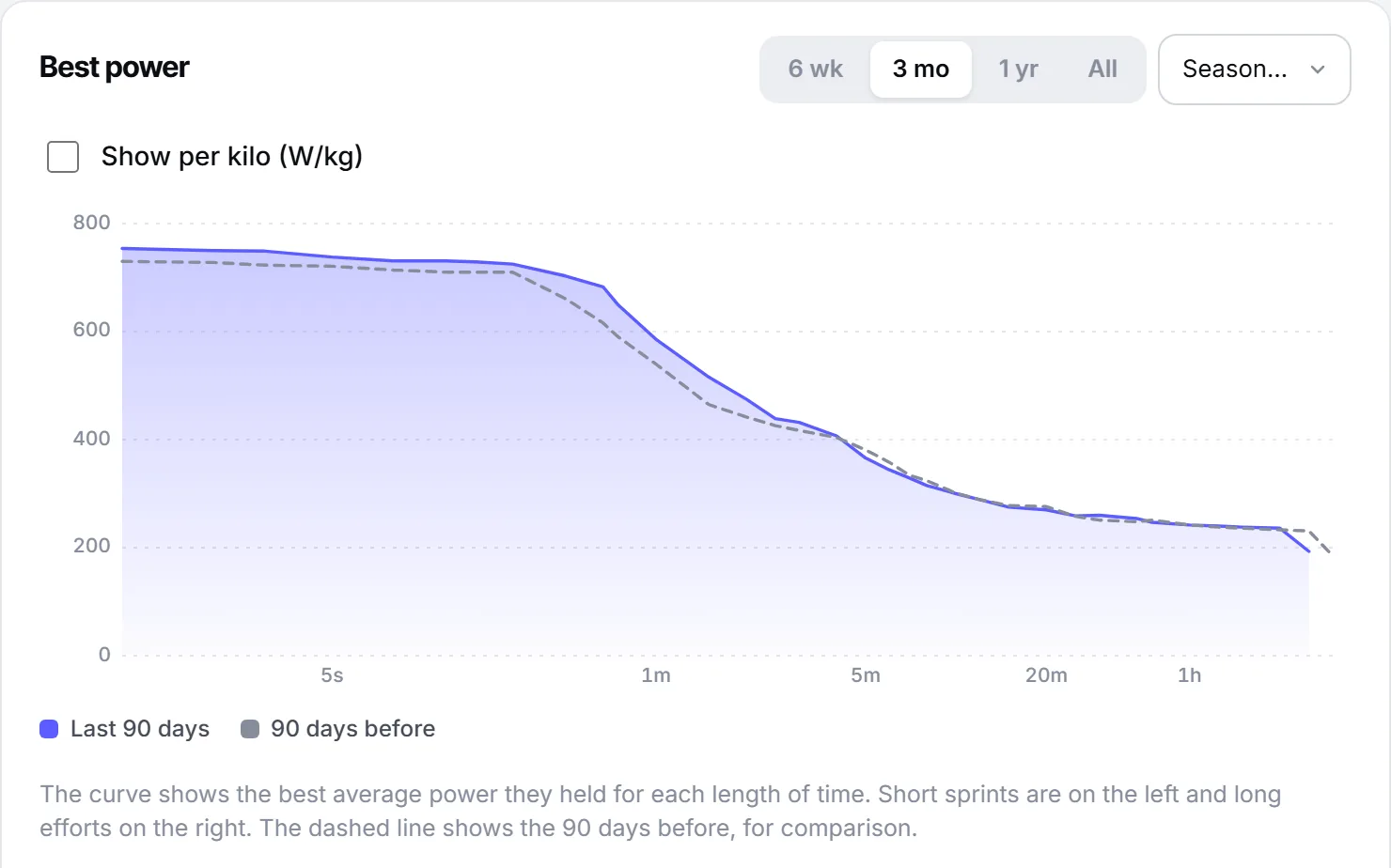
Compare the same period for every rider, usually the last 8 to 12 weeks of races and training. Season-best numbers from a spring training camp say little about August. Treat gaps with care. A weak point on the curve may be untested rather than a real weakness: if a rider has not ridden a hard 1-minute effort for two months, the curve cannot show what they can do.
Here is a worked example with made-up riders, choosing the last place for a hilly one-day race of about five hours, decided on two late climbs of 3 to 4 minutes each.
| Made-up rider | Best 1 min | Best 5 min | Best 20 min | 5-min power after 4 hours | Fitness trend, last 6 weeks |
|---|---|---|---|---|---|
| Rider A | 9.6 W/kg | 6.0 W/kg | 5.1 W/kg | 88% of fresh | Flat |
| Rider B | 9.1 W/kg | 5.8 W/kg | 5.2 W/kg | 96% of fresh | Rising |
| Rider C | 10.4 W/kg | 5.6 W/kg | 4.8 W/kg | 90% of fresh | Falling after illness |
Rider A has the strongest 5-minute power when fresh. Rider B keeps far more of it after four hours, and their form is rising. For a five-hour race decided late, Rider B is the stronger choice, even though Rider A wins on the fresh numbers.
How do you check a rider's form before selection?
Look at a rider's fitness trend over the last four to eight weeks and their recent race files, then ask a few direct questions about illness, racing, goals and sleep. The trend tells you whether their numbers are still true.
Fitness, fatigue and form show whether a rider is building, holding or fading, as explained in reading your training load. Recent race files show how they raced, not only what they produced in training.
Ask a few direct questions before you pick. Has the rider been ill or injured in the last month? How many race days have they had lately, and how did they recover? Is their own season aimed at a later goal, which this race would disrupt? How are their sleep and readiness this week? When two riders are close on the numbers, the one whose form is rising usually serves the team better.
Why does durability matter in rider selection?
Durability, how much power is left late in a long ride, matters because many important road races last four hours or more and are decided late. A fresh power curve can mislead here, because it shows what a rider can do in the first hour, not the fifth.
Compare candidates on their best 5-minute or 20-minute power after three or four hours of riding, taken from long races and long training rides. Two riders with similar fresh 5-minute power can be several percent apart after four hours. In the example above, Rider A's 6.0 W/kg falls to about 5.3 W/kg, while Rider B's 5.8 W/kg holds at about 5.6 W/kg. For a long classic or a mountain stage, that gap matters more than the fresh number. The durability guide explains how to measure it.
What are the roles in a cycling team?
The roles in a race team include a leader, a protected rider, a sprinter and lead-out, climbers, a road captain, domestiques and a breakaway rider. With seven or eight places, most riders need more than one job.
Team size shapes everything else. Since 2018, UCI rules have allowed eight riders per team in the Grand Tours and at most seven in other men's road races. The 2025 Tour de France started with 23 teams of eight, 184 riders in all. Women's races and lower categories have their own limits, so check the organiser's technical guide.
| Role | What to look for |
|---|---|
| Leader | The rider who suits the decisive effort, with durability and rising form |
| Protected rider | A second option if the leader has a bad day or a crash |
| Sprinter and lead-out | Peak power for the sprinter; strong 30 to 60-second power at high speed for the lead-out; time spent racing together |
| Climbers | Power for 10 to 30 minutes late in the race, and the ability to set a steady pace |
| Road captain | Experience and calm judgement; data shows little of this |
| Domestiques | Long steady power for pulls, positioning, and skill in crosswinds |
| Breakaway rider | Repeated efforts of 30 seconds to 5 minutes, and durability |
Write the roles down first, then fill them with names. The gaps become obvious: a team with three climbers and no one to ride in the wind on the flat run-in has a problem before the race starts.
Selection also decides which tactics are possible on the day. On stage 11 of the 2022 Tour de France, Jumbo-Visma had two riders who could win, Primož Roglič and Jonas Vingegaard. They took turns attacking Tadej Pogačar, and Vingegaard won on the Col du Granon and took the yellow jersey. Picking two leaders for eight places meant fewer helpers, but it made that tactic possible.
A selection worksheet
A simple worksheet makes the discussion concrete. Score each candidate from 1 to 5 on four criteria and weight them to suit the race. For a hilly one-day race, a sensible weighting might be course fit 35%, form 25%, role fit 25% and durability 15%.
| Made-up rider | Course fit (35%) | Form (25%) | Role fit (25%) | Durability (15%) | Weighted score |
|---|---|---|---|---|---|
| Rider A | 5 | 3 | 4 | 3 | 3.95 |
| Rider B | 4 | 5 | 4 | 5 | 4.40 |
| Rider C | 4 | 2 | 3 | 3 | 3.10 |
The worksheet does not pick the team. It shows where staff agree and where they disagree, and the disagreements are the useful part. Then add what the numbers miss: experience of this race, how a rider works with the leader, whether they can read a race or follow the road captain, and what the race would mean for their own development.
How do you tell riders they were not selected?
Tell the riders who are not selected first, in person or by phone, before the list goes public. Give the reason in terms of the race's demands and the criteria, and say what would change the decision next time.
How a selection is told matters as much as the choice itself. Riders accept a hard decision far better when the criteria were clear before anyone was picked.
Tell each selected rider their role at the same time, so the race plan briefing holds no surprises. Keep the same criteria all season. With development riders and juniors, selection is also about giving experience, which is a valid reason when staff say it openly. For the longer view of how young riders are spotted and developed, see talent identification in cycling.
In Velograph, staff can compare up to eight riders' fitness, fatigue and form on the fitness page and open each rider's power curve. They can then pick the riders for a race and give each one a role and instructions on the race page.
Further reading
- UCI reduces team sizes in top races including Tour de France, road.cc, 2017.
- 2025 Tour de France: Full startlist, Domestique, 2025.
- Physical demands and power profile of different stage types within a cycling grand tour, Sanders and Heijboer, European Journal of Sport Science, 2019.
- Pogačar cracks on Col du Granon but vows to 'fight until the end', SBS Sport, 2022.
Velograph is not affiliated with, sponsored by or endorsed by any team, rider or company named in this article. Names are used only to refer to publicly reported work.