A new-rider questionnaire for cycling coaches in seven parts, with a health screen and red flags, a filled-in example and the first four weeks it leads to.
A cycling coaching questionnaire is the set of questions a coach sends a new rider before the first conversation. It covers goals, history, the time they have to train, kit and data, health, life and sleep, and how they like to hear from you. Every question should change something in the first four weeks. Below are the seven parts as tables to copy, a worked example and a consent box.
What should a cycling coaching questionnaire ask?
A cycling coaching questionnaire should ask what the rider wants and by when, what they have done, which hours and days they can train, what they ride and record, their health, their life outside cycling and how they like to communicate. Leave out any question whose answer would not change the plan.
Pain on the bike, position and kit belong on a fitter's bike fit intake form. Ask for the rider's latest fit record instead of repeating it.
The questionnaire, part by part
The right-hand column, why you ask, stays on your copy.
Part 1: goals and events
| Question | Why you ask |
|---|---|
| What do you want from coaching this season? | The rider's own words set the tone of every review |
| Which events will you ride, with dates? Which one matters most? | The one that matters most becomes the A race |
| What would make the season a success, even if that event goes badly? | It gives you goals the rider controls |
| Have you been coached before? What worked, and what did not? | You avoid repeating what failed |
The guide to cycling goals turns these answers into outcome, performance and process goals, and the annual training plan counts the season back from the A race.
Part 2: history and best results
| Question | Why you ask |
|---|---|
| How many years have you ridden and raced? | Training age sets how fast the load can rise |
| How many hours a week have you ridden in the last 12 weeks? | The plan starts from what the rider did, not what they hope to do |
| How long was your longest ride in the last two months? | The first long rides grow from it |
| Your best results and numbers, with dates: FTP, best 5 and 20 minutes? | Zones and targets, if the numbers are recent |
| Any illness, injury or break longer than a week in the last 12 months? | Gaps explain the numbers, and repeats matter |
Ask for the last 12 weeks of ride files too; importing your cycling history explains how.
Part 3: weekly time
| Question | Why you ask |
|---|---|
| How many hours can you train in a normal week? | The plan's total |
| Which days, at what times and for how long? | Which days get the key sessions |
| Do you have a home trainer? | Bad weather and dark evenings stop costing sessions |
| Which fixed commitments shape your week: shifts, school, family? | Plans fail on the days nobody asked about |
| Which weeks can you already not train: holidays, exams, travel? | They go on the calendar now |
Part 4: kit and data
| Question | Why you ask |
|---|---|
| Do you have a power meter? Which one, and on which bike? | Power targets need one, and two devices rarely agree exactly |
| Do you record heart rate with a chest strap or a watch? | You know which heart rate to trust |
| Where are your rides recorded, and which apps hold them? | Where you will read them |
| When was your last bike fit? Does anything hurt on the bike? | A position problem goes to a fitter before the load rises |
Which health questions belong on a coaching questionnaire?
Ask a short general screen, ideally the PAR-Q+ attached as it is, then current injuries and who treats them, and any medicine that affects exercise. A yes to chest pain, fainting or a heart condition means the rider sees a doctor before hard training starts.
The PAR-Q+, from the PAR-Q+ Collaboration, asks seven general questions on its first page, about the heart and blood pressure, chest pain, dizziness or fainting, chronic conditions, medicines, bone, joint or soft-tissue problems, and a doctor's advice to exercise only under supervision. A yes leads to follow-up pages. The form may be copied but must be used whole and unchanged, and its clearance lasts at most 12 months, so attach it and ask again each season.
| Question | Why you ask |
|---|---|
| Do you have an injury or pain now? Where, how bad from 0 to 10, and since when? | You plan around it |
| Who treats it? May I talk to them? | The clinician leads, and the plan follows their advice |
| Do you take any medicine that affects exercise or heart rate? | Heart-rate zones may not fit |
| Anything else about your health you would like me to know? (optional) | Some riders choose to share more, such as their menstrual cycle |
Put the red flags as tick boxes: chest pain or pressure when riding, fainting or nearly fainting during or after exercise, breathlessness far beyond what the effort explains, and a known heart condition. Add one line under them: "If you have ticked a box, see your doctor before any hard training, and tell me what they said."
Why ask a new rider about stress and sleep?
Ask because, in studies across many sports, athletes with more stress or less sleep had more injuries. The answers set how hard the first weeks are and which days get the key sessions.
| Question | Why you ask |
|---|---|
| How many hours do you usually sleep, and how well, from 1 to 5? | Hard sessions go after the good nights |
| How stressful are work, school or family right now, from 1 to 5? | Stress adds to the load of training |
| Do you work shifts or care for small children? | The week is planned around them |
| Are big changes coming: exams, a move, a new job? | Easier weeks go there |
Ivarsson and colleagues (2017) pooled 48 studies of athletes and found athletes' stress responses linked with injury rates, and their history of stressful events more weakly. Among 112 adolescent athletes surveyed by Milewski and colleagues (2014), those sleeping under 8 hours a night were 1.7 times as likely to have been injured. Both are associations, and neither studied cyclists.
What should you ask a new rider about communication?
Ask how they want to hear from you, how often, how much of the reasoning they want, how they like feedback and when not to message them. Riders under 18 also need a named parent or guardian, and every rider can tell you who else coaches or treats them.
| Question | Why you ask |
|---|---|
| Messages, calls or video? How often? | You set the rhythm once, at the start |
| Do you want the plan only, or the reasons behind it? | Some riders follow a plan better when they know why |
| Do you like feedback straight or gently? | You choose words they will hear |
| Who else coaches or treats you: a club, a team, a physio, a fitter? May I talk to them? | One plan rather than three |
How do you turn the answers into the first four weeks?
Use the first four weeks to check the answers rather than to push. Start at about the hours the rider has ridden lately, set zones from a test in week 2, put the key sessions on the days they said are free, and review together after week 4.
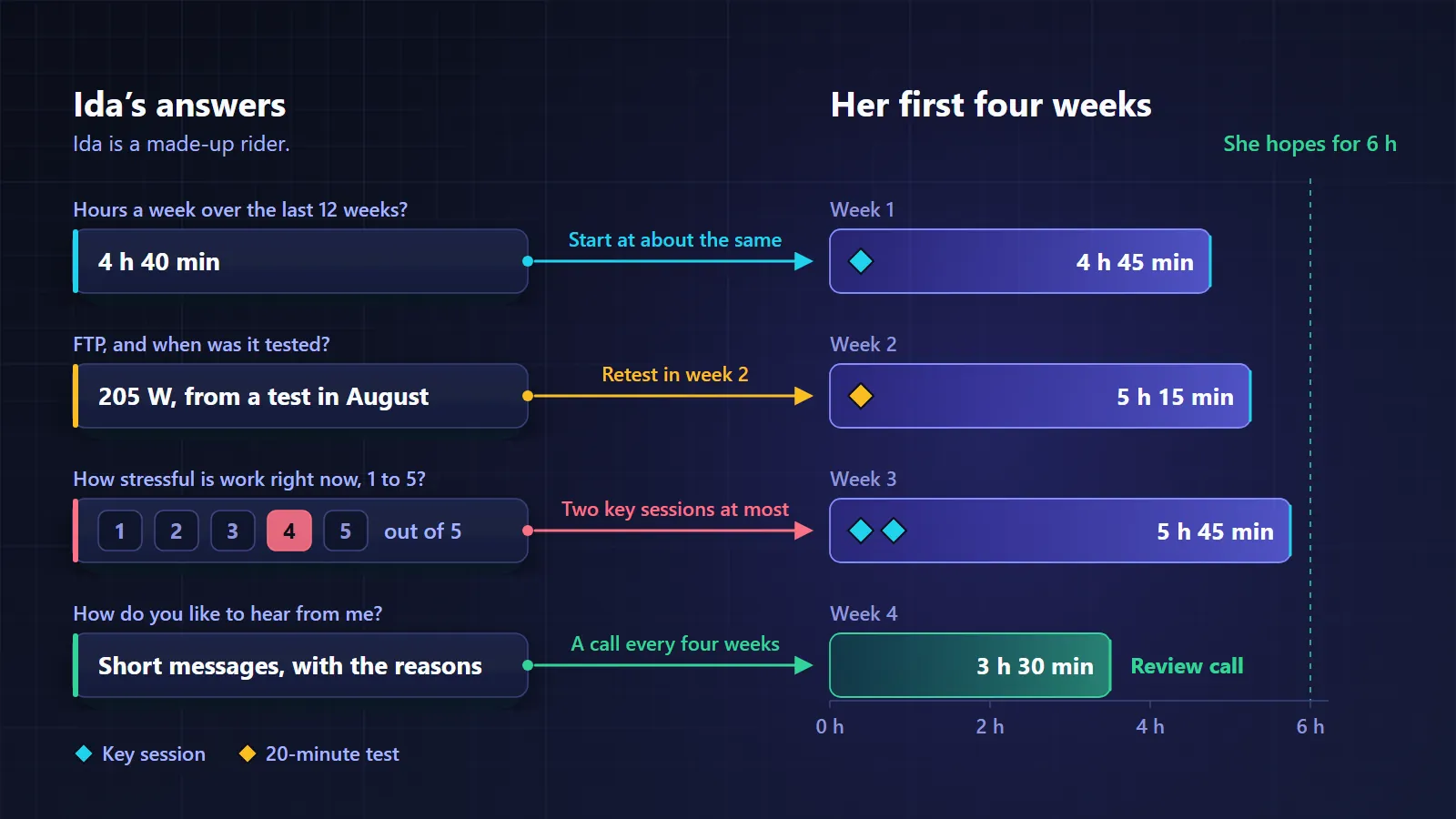
Ida is a made-up rider, a nurse on shifts with three years of riding and no racing. She wants a first season of criteriums, with the regional championship in July as her A race, and she answers no to the PAR-Q+ questions on the heart, chest pain and dizziness. Each answer becomes a decision.
| Ida's answer | What it changes |
|---|---|
| 4 h 40 min a week over the last 12 weeks; she hopes for 6 hours | The plan starts at 4 h 45 min and grows by about half an hour a week |
| FTP 205 W from a test in August | A 20-minute test in week 2 |
| Shifts; 6.5 hours of sleep after a night shift | Key sessions follow a normal night, never a night shift |
| Work stress 4 out of 5 | At most two key sessions a week until the review |
| Right knee aches after long rides, 2 out of 10 | Long rides grow slowly, and she is asked when the bike was last fitted |
| Short messages, with the reasons | One line on why with each session, and a call every four weeks |
| Week | Hours | Key sessions | Purpose |
|---|---|---|---|
| 1 | 4 h 45 min | One: 3 × 10 minutes at tempo | Her usual riding; check-ins and ride ratings begin |
| 2 | 5 h 15 min | A 20-minute test after a rest day | Zones from a recent test |
| 3 | 5 h 45 min | Two: threshold, and short hard efforts | Her first full week |
| 4 | 3 h 30 min | None | An easier week, then the review call |
The week 4 call sets the answers against what happened. If she rode most of the plan, the hours grow; if night shifts cost more than expected, her usual week changes. A training diary keeps that record between calls.
How should a coach store the answers and ask for consent?
Keep the questionnaire where only the people coaching the rider can read it, ask separately for explicit consent to the health parts, say why you keep each part and for how long, and make withdrawing as easy as agreeing. Health data has stricter rules under the GDPR.
Article 9 of the GDPR names health data as a special category, which may be processed with explicit consent for stated purposes. Under Article 7(3), consent must be as easy to withdraw as it was to give. Article 5 asks you to keep only what you need, for no longer than you need it. Under Recital 32, a pre-ticked box does not count as consent, so every box starts empty for the rider to tick. A wording to adapt:
☐ I agree that [coach] keeps the health answers on this questionnaire, such as injuries, medicines and the PAR-Q+, to plan my training. Only [coach] can read them. They are deleted when the coaching ends, and I can withdraw my consent whenever I want by telling [coach].
☐ I agree that [coach] may talk to [physio, doctor, club or team] about my training and health.
Who may consent for a rider under 18 depends on the country, as our guide to athlete data privacy explains. None of this is legal advice.
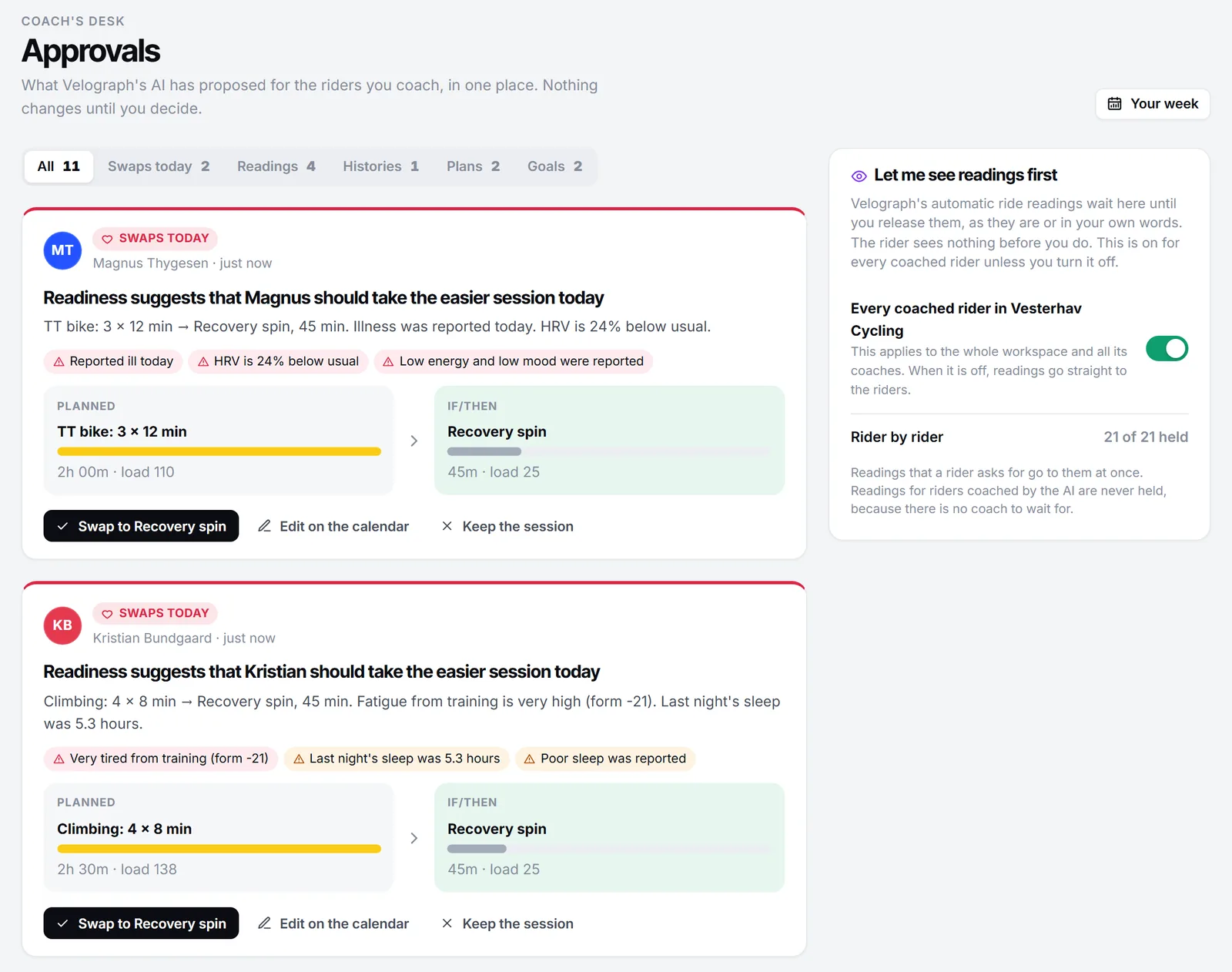
In Velograph, goals, FTP and heart rates go in the rider's profile, and the usual week marks each day as normal, limited to so many minutes or a day off. The rider decides what each coach may see. Morning check-ins keep the answers about sleep, energy and illness current, and the coach's desk shows when they suggest an easier day, as cycling coaching software describes.
Further reading
- PAR-Q+: the Physical Activity Readiness Questionnaire for Everyone, PAR-Q+ Collaboration, 2025.
- Psychosocial factors and sport injuries: meta-analyses for prediction and prevention, Ivarsson and colleagues, Sports Medicine, 2017.
- Chronic lack of sleep is associated with increased sports injuries in adolescent athletes, Milewski and colleagues, Journal of Pediatric Orthopaedics, 2014.
Velograph is not affiliated with, sponsored by or endorsed by any team, rider or company named in this article. Names are used only to refer to publicly reported work.