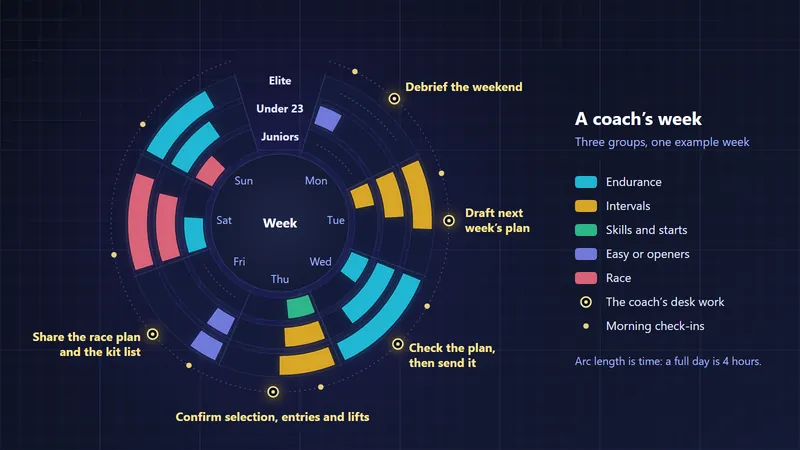
Where a coach's week goes, what cycling coaching software should take off your desk, and how an approvals list keeps you in charge of the AI.
Good cycling coaching software gives a coach back the hours spent opening files, chasing riders and retyping sessions, and puts that time into the riders who need a decision. It shows exceptions first, keeps the plan and the ride side by side, and lets an AI draft and flag, never decide. This article explains how to judge that, and how Velograph's coach's desk does it.
What TrainingPeaks and intervals.icu gave coaches
Online coaching as most coaches know it owes a great deal to TrainingPeaks. It grew out of Joe Friel's coaching business in the late 1990s, when his son Dirk Friel and the engineer Gear Fisher built a web-based training log. By the company's own account, within a year it became the first online training log that let a coach work with an unlimited number of athletes. Its training plan store and coach search later made it a marketplace where coaches sell plans and athletes find coaches.
intervals.icu brought deep training analysis to everyone, free. David Tinker, a software developer and cyclist in Cape Town, started it in mid-2018 as a side project, and went full-time on it in 2024. A coach who takes on a rider who already uses it does not need to ask them to start again.
Velograph is designed to sit beside those habits rather than fight them. Rides come in from intervals.icu, and planned sessions can be sent to a rider's intervals.icu and follow your later moves and edits there. Our guide to how intervals.icu and Velograph work together shows the details.
How much time does a cycling coach spend checking rides?
At about five minutes a ride, a coach with 20 riders who each ride five times a week spends more than eight hours a week checking their 100 rides. That comes before a single session is planned, a message answered or a race discussed.
Professional teams staff for this. In TrainingPeaks' 2026 case study of Decathlon CMA CGM, each WorldTour coach looks after six to eight riders, and eight is described as about the most one coach can analyse in detail. An independent coach with 20 or 30 amateur riders usually has no analyst behind them at all.
Most of the week goes on these jobs:
- opening ride files to check each session was ridden as intended;
- chasing riders who did not upload, did not check in or went quiet;
- writing and moving sessions when work, family or weather gets in the way;
- answering the same questions about fatigue, form and FTP;
- writing a round-up for each rider or for a team's staff.
The first two are where software helps most, because a computer can read every file and tell you which few are worth your eyes.
What should you look for in cycling coaching software?
Look for cycling coaching software that reads every ride against its planned session and flags only what differs. The shift that matters is from "check everything" to "check what changed", so the software finds who needs you.
The flags cover a missed session, a ride far shorter or longer than planned, a morning when several readiness signals are off, a reported illness or a race plan still not shared. Riders on track get a name and a quiet line. You still see them; you do not have to read them.
Two rules make an exception list worth trusting. Every flag says why, in words, so you can disagree at a glance. And every number is measured from the ride file by fixed rules rather than guessed, so the same ride gives the same answer every time. In Velograph, a session ridden more than 20% under or over its planned load shows amber as short or long, and a day the rider was off sick never counts against them.
How should AI work alongside a cycling coach?
When a rider has a coach, the AI should assist the rider and the coach, and the coach decides. An AI can read a hundred rides before breakfast, but the risk is that it talks to your riders in a voice that is not yours.
In Velograph, the human coach comes first. Our article on an AI cycling coach that answers to your coach explains the whole design. For a coach, three things matter most.
- Readings wait for you. "Let me see readings first" is on by default. The AI's automatic reading of a coached rider's ride waits on your desk, and the rider sees nothing until you release it as written, in your own words, or not at all.
- Requests reach you as drafts. When a coached rider asks Ask, the AI assistant, for sessions, the sessions go to you for approval. Nothing in the rider's plan changes until you decide.
- The AI backs your plan. When a coached rider questions a session, Ask explains the likely reasoning behind your plan and suggests they raise the doubt with you, by name. For pain or illness it tells them to rest and talk to you.
The coach's desk: approvals and your week
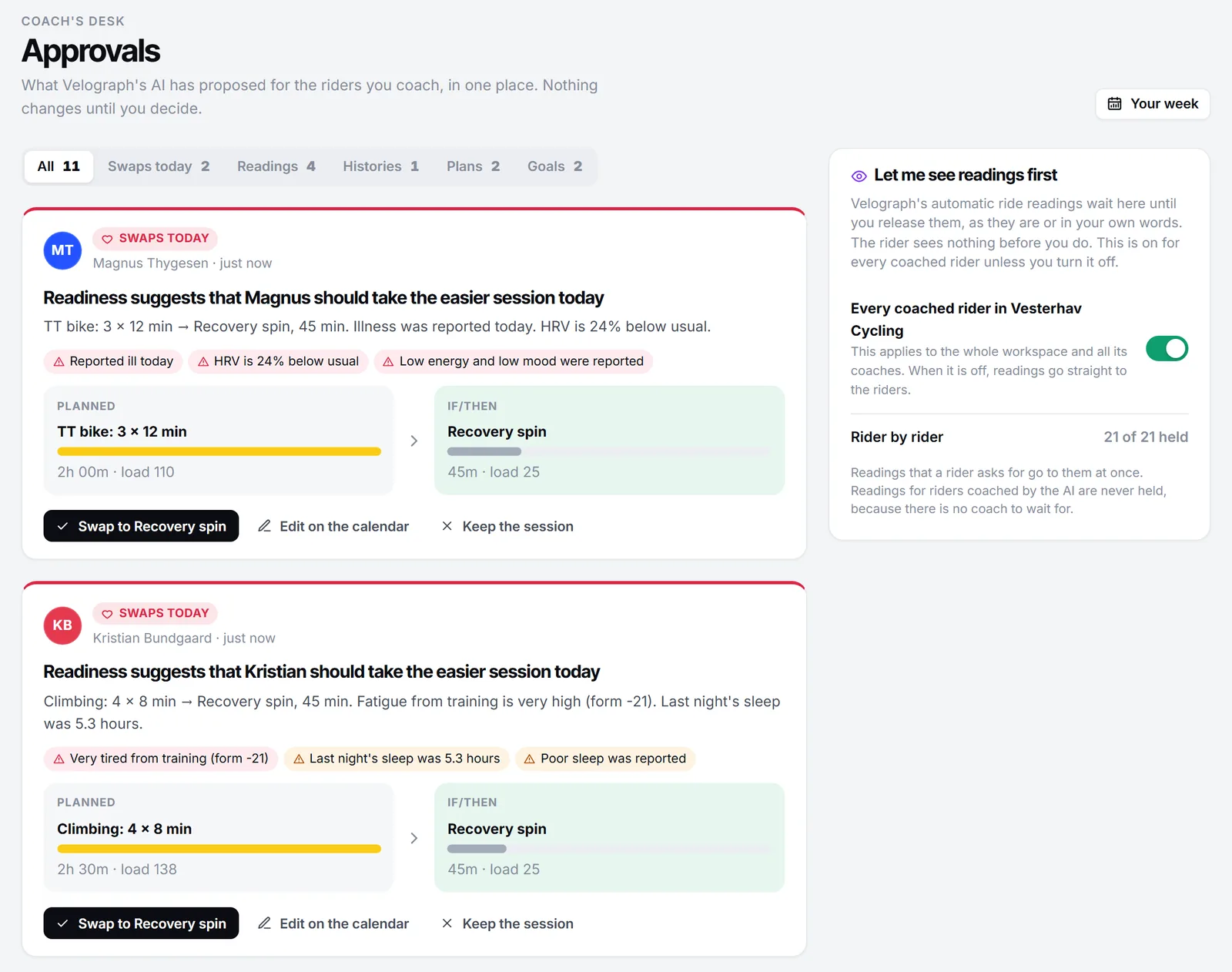
Approvals is one list across every rider you coach. It holds sessions a rider sent from Ask, the AI's other drafts, a goal FTP or W/kg a rider proposed, an easier session suggested when readiness says to hold back, and readings held for you. Each one can be approved, approved in your own words or numbers, or rejected, and every decision is kept.
Your week answers one question: who needs you, and why? It is built from facts Velograph already measures: readiness, the plan against what was ridden, rides that did not match their session, good news and what waits in approvals. Every AI line points to a measured fact and is marked as Velograph's AI. Riders who need you come first, health first. On Monday it arrives as one email at your chosen time, and a week when nobody needs you sends no email at all.
How can coaching software cut planning time?
Coaching software cuts planning time when you can drag, copy and reuse sessions rather than retype them. Planning is the other half of the admin. Velograph's calendar lets you drag sessions between days, copy and paste them across riders, add day and week notes, set weekly targets and keep a usual week for each rider.
Sessions, tests and blocks come from Velograph's own library or from yours, and a test ride can suggest a new FTP for you to accept or ignore. For the anatomy of a good week, read our guide to building a structured training plan.
Studio or team: where you coach
Independent coaches work in a Studio, priced per practitioner with unlimited clients. It adds a calendar with bookings, a client journal with dictation, follow-ups and branded client reports. Coaches inside a team work in the team's space, where staff accounts are free; our guide to cycling team management software covers that side. Either way, AI runs on Velograph's AI credits or on your own Claude or OpenAI key, except a Studio's journal notes, which always run on its own key.
Studios and teams can try everything free, with no card needed. Compare the plans on the pricing page, or start for free and plan one rider's week there to see how it feels.
Velograph is not affiliated with, sponsored by or endorsed by any team, rider or company named in this article. Names are used only to refer to publicly reported work.