What an AI cycling coach does well, where it should stop, and how Velograph's Ask works for riders with a human coach and riders who train alone.
An AI cycling coach is worth having when it reads your rides, explains them in plain words and drafts sessions for a person to approve. It goes wrong when it decides alone. The safest design is an assistant. If you have a human coach, the coach decides and the AI helps you both. If you train alone, the AI coaches within written safety rules, and you choose what goes on your calendar.
What can an AI cycling coach do?
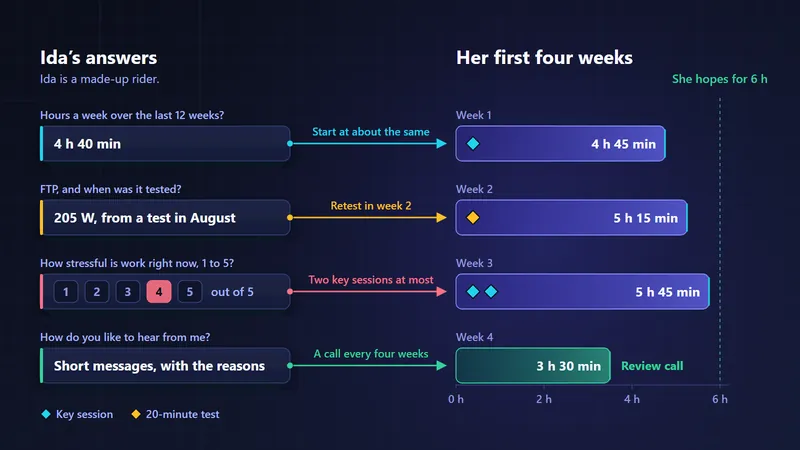
An AI cycling coach can read every ride, explain a number in your own terms and turn a goal and a free Tuesday evening into a draft session in seconds. This is the work that takes up a coach's evenings, and a language model does it without tiring.
It is patient, too. The fifth question about why threshold felt hard this week gets the same care as the first.
Questions an assistant can answer well from your own data:
- "Why did my power fade in the last hour of Sunday's ride?"
- "What does my power curve say I have not tested lately?"
- "I have six hours this week and a race on Sunday. What should I ride?"
- "Explain W′ using yesterday's intervals."
A good answer quotes numbers from the ride, says when the data is thin and asks a question rather than guessing. A good draft session looks like one a coach would write: a warm-up, a clear main set with targets in % of FTP, recoveries and a cool-down. Our guide to building a structured training plan shows what that looks like across a week.
What should an AI coach never decide?
An AI coach should never decide alone about pain, illness, injury, one person's weight or fuelling, or anything that overrules your coach. It does not know how you slept unless you tell it. It cannot see your knee, and it can state a wrong thing in a confident voice.
- Diagnosis. Pain, illness and injury belong with a doctor or physio. A good assistant tells you to rest today and to talk to a professional.
- Weight and fuelling for one person. Individual advice on body weight or diet belongs with a registered sports dietitian, and weight targets have no place in a junior's training.
- Overruling your coach. If someone has built your season, the AI should explain their plan, not offer a rival one.
- Inventing numbers. Every figure should come from a measured ride or from what a person entered, never from the model's imagination.
Velograph's AI follows a written standard of safety rules for training advice. A small set is marked Always and forms a floor that a coach's or a rider's own rules cannot lower. It covers emergency symptoms, illness and pain, under-fuelling and anti-doping. It rules out diagnosis, medicines, weight targets for under-18s and invented data, and it leaves decisions to people. Teams, coaches and riders can add rules of their own, and where two rules on the same subject differ, the one closest to the rider applies.
Can an AI cycling coach work with a human coach?
Yes, when a coach is attached in Velograph, the AI assists the rider and the coach, and the coach decides. If nobody coaches the rider in Velograph, the AI coaches them within its safety rules. Velograph works this out for each rider, rather than asking anyone to pick a mode.
| Rider with a coach | Rider without a coach | |
|---|---|---|
| Sessions Ask proposes | Sent to the coach for approval | The rider adds them to their own plan, with Undo |
| Automatic ride readings | Held for the coach to read first, by default | Straight to the rider |
| Doubts about the plan | Ask explains the coach's likely reasoning and suggests talking to the coach | Ask can propose changes, which the rider accepts or not |
| Pain or illness | Rest today, tell the coach; signs of illness are for a doctor | Rest today; signs of illness are for a doctor |
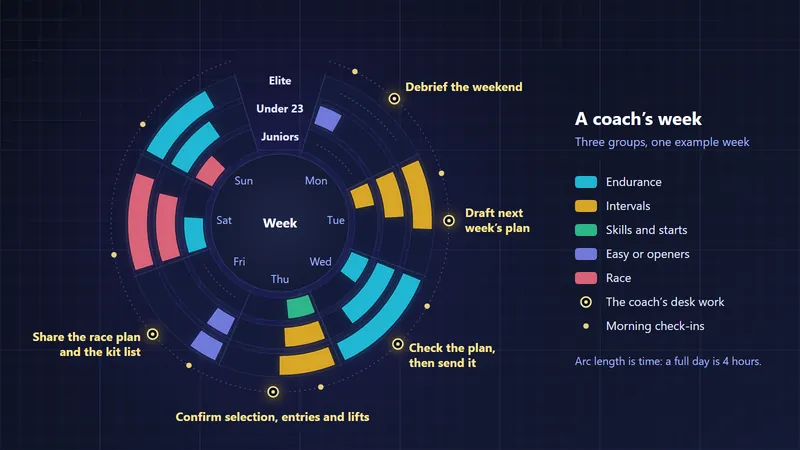
For a coach, this means the AI is on the plan's side. When a coached rider doubts a session, Ask explains the reasoning the coach probably had, from the block, the races ahead and the rider's numbers, and suggests they raise the doubt with the coach by name. Our article on cycling coaching software covers the coach's side: an approvals list, readings held for review and a weekly digest.
How Ask works
Ask is Velograph's AI assistant. It answers from the rider's own data: rides, power curve, fitness and form, the calendar and the races ahead. When it proposes sessions, they appear under the answer with their profiles, and nothing changes until a person presses the button.
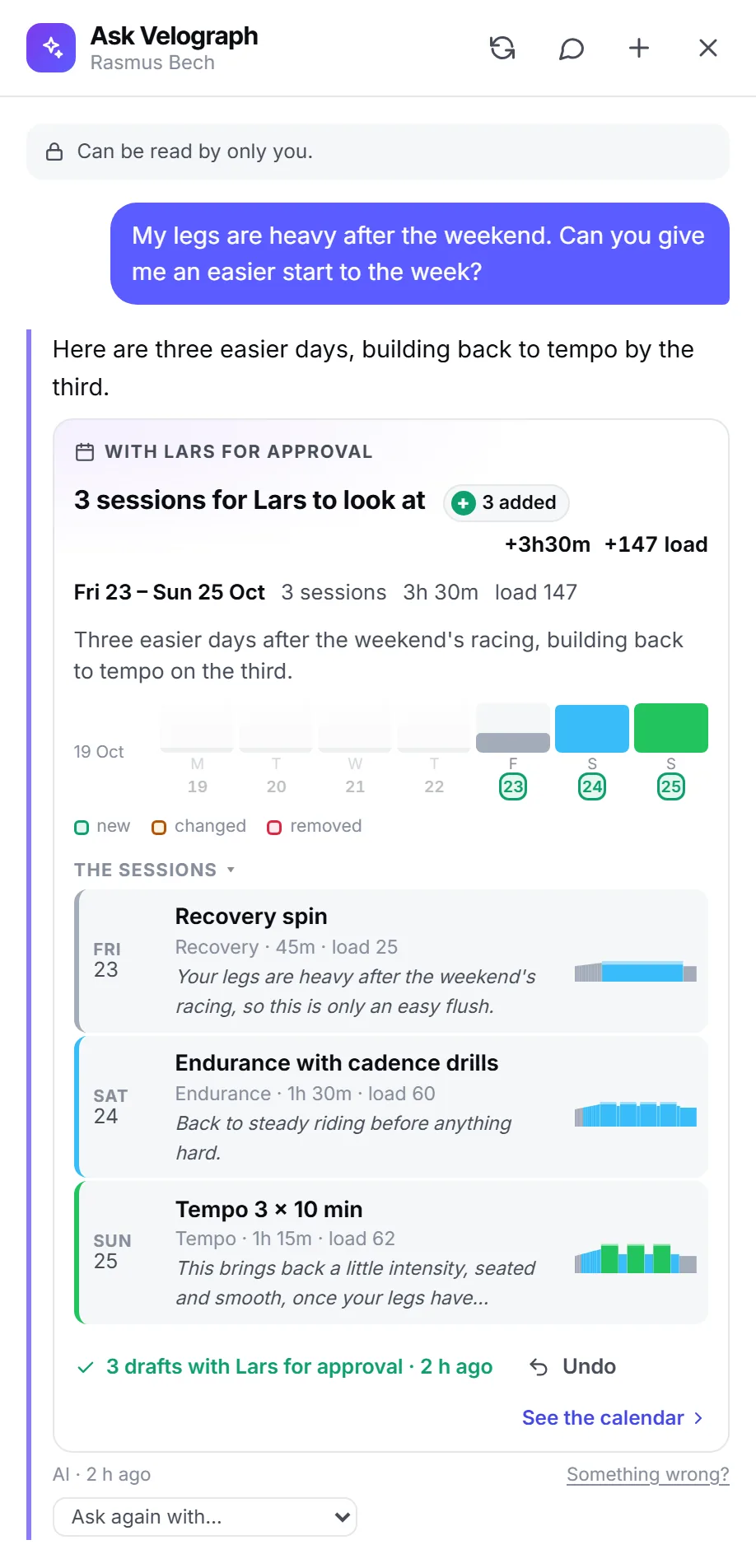
- For a coach planning a rider's training, the sessions become drafts marked as AI, which the rider does not see until the coach publishes them.
- For a rider who plans their own training, the sessions go into their plan, and Undo takes them off again.
- For a coached rider, the sessions go to the coach as drafts, and nothing in the plan changes until the coach decides.
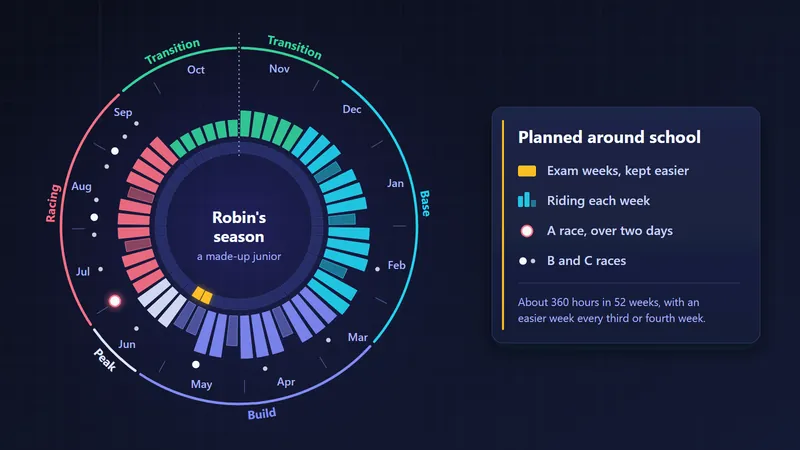
Every proposed session is checked against the guardrail limits before anyone sees it, and the AI is told what the checks found so it can correct the sessions first. You can also talk a week through before anything is proposed, or have Ask shape a whole season back from your A race; our guide to the annual training plan explains that method.
What data does an AI cycling coach use?
Velograph's AI coach explains numbers worked out by fixed rules from the original file your device saved for each ride, wherever there is one. The AI does not work the numbers out itself. Strava rides are shown to the rider only and are never used by the AI.
- Numbers come from the rides, not from the AI. Velograph reads each ride from the original device file wherever there is one, and works out the power curve, W′, durability, records and training load by fixed rules. The AI reads those numbers and explains them.
- Strava rides are shown to the rider only and are never used by the AI. Rides that come in from intervals.icu or as FIT files can be read by the AI.
- Answers are always labelled as AI. A rider and a coach can always tell what a person wrote and what the AI wrote.
- The AI never writes to the calendar by itself. It proposes; a person adds.
Do you need your own AI key for an AI coach?
No, not for Velograph's AI coach, which runs on Velograph's AI credits. Studios and teams can use credits or bring their own Claude or OpenAI key, and a fitting studio's journal notes always run on its own key.
Rider Plus, the paid plan for riders, adds training plans, race tools and an AI coach with monthly AI credits, on top of the free Rider plan that keeps every bike, fit and ride. The plans are on the pricing page.
If you train alone, Ask can be your coach within its safety rules, and you stay the one who decides what you ride. If you have a coach, invite them, and the AI starts working for both of you. Either way, you can start for free.
Velograph is not affiliated with, sponsored by or endorsed by any team, rider or company named in this article. Names are used only to refer to publicly reported work.