Build an annual training plan backwards from your A race: phases, recovery weeks, B and C races, a taper, and a check against your fitness chart.
An annual training plan for a cyclist starts at the most important race of the season and works backwards. Put the A race in the calendar, then mark out the race week, the taper, the peak, the build and the base in front of it. Add an easier week every third or fourth week, fit the B and C races around the phases, and check the result against your fitness chart before the first week starts.
What is periodisation in cycling?
Periodisation means dividing the year into periods with different aims, so that training builds towards the races that matter instead of staying the same all year. The basic pattern starts general and becomes more specific as the goal comes closer.
Tudor Bompa's textbook on the theory and methodology of training, first published in 1983 and later written with G. Gregory Haff, is one of the standard texts on the idea.
Joe Friel's The Cyclist's Training Bible, now in its fifth edition (VeloPress, 2018), made the model familiar to many amateur cyclists. He names periods such as Preparation, Base, Build, Peak and Race. In a 2013 blog series written for older athletes, Friel describes Preparation starting roughly six to seven months before the first A race. The Build starts about 12 weeks before it and lasts 9 to 10 weeks.
Block periodisation is a newer variation. In 2010, Vladimir Issurin argued for short blocks that each concentrate on a few abilities, rather than training everything at once. The evidence is still limited. In one small study of trained cyclists, Rønnestad and colleagues (2014) gave one group a week of five high-intensity sessions followed by three weeks with one each. That group raised its VO2max by about 4.6%, while a group doing the same number of sessions, two a week, showed no clear change.
How do you start an annual training plan?
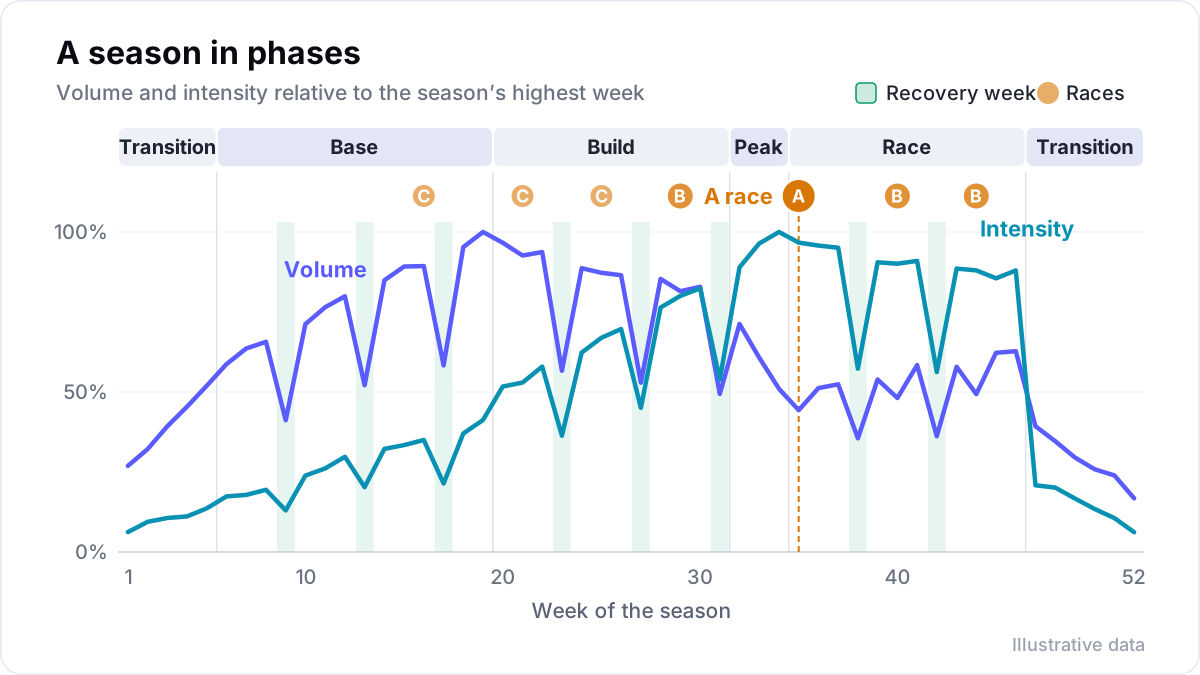
Start with the A race and count the weeks back from race day, giving each week a phase. An A race is a goal of the season, and the training builds towards it and tapers into it. Choose one A race, or at most two or three spread well apart.
Here is a worked example for a rider who averages about 9 hours a week, with the A race on a Sunday at the end of June.
| Weeks before the A race | Phase | Main aim | Example weekly hours |
|---|---|---|---|
| 0 | Race week | Openers two days before, rest the day before | 5 |
| 1 to 2 | Taper | Less riding, short race-pace efforts kept | 6 to 7 |
| 3 to 4 | Peak | Race-like efforts at the season's highest intensity | 9 to 10 |
| 5 to 12 | Build | Two key sessions a week: threshold and VO2max | 9 to 11 |
| 13 to 24 | Base | Long steady rides, some tempo, short sprints | 8 to 10, rising |
| 25 to 30 | Preparation | Easy riding, gym work, other sports | 6 to 8 |
After the last race of the season comes a transition of two to four weeks: easy riding, other sports and rest. It is a planned part of the year, not a gap in it. Riders who skip it can start the next base already tired.
The table is a starting point, not a prescription. A rider with fewer weeks can shorten the base. A rider with a long history of training may need less base and more build. Write down why each phase has the length it has, so the reasoning can be checked later.
How do you plan B and C races around an A race?
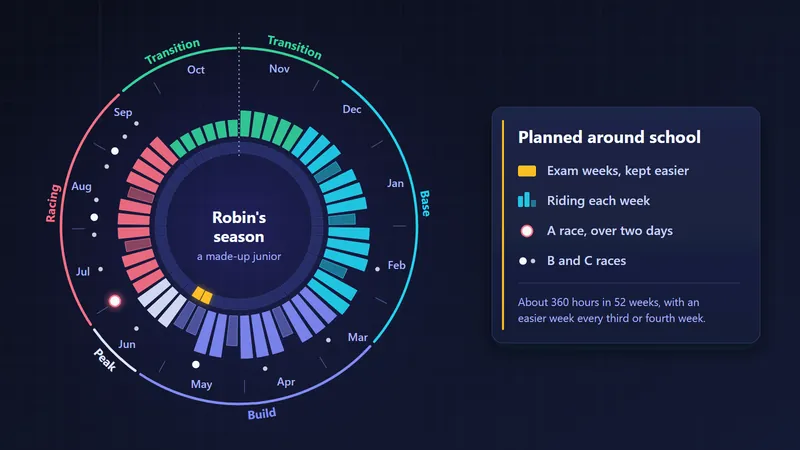
Give every race a priority, A, B or C, before it goes into the plan. Most riders race far more often than they peak, so only an A race gets a full taper. A B race gets a few easier days before it, and a C race is ridden as hard training.
- A race: a goal of the season. The plan builds and tapers into it.
- B race: matters, but no full taper. Give it two or three easier days before, and return to training soon after.
- C race: ridden as hard training, with no easier days before it.
Put B races where they help the build, such as a hilly race three to five weeks before a hilly A race. Use C races as interval sessions with company and a number on the back. Avoid B races in the last two weeks before the A race, when the taper needs the room. When a B race lands on a loading week, move the easier week to it, so the race and the recovery share the same days.
How often should you take a recovery week?
A common pattern is three loading weeks and one easier week, or two and one for riders who recover slowly. Training only works when the body has time to absorb it.
An easier week of about three quarters of the weeks around it keeps the routine and lets fatigue drop. For harder resets, after a training camp for example, half a normal week works better.
Keep the rises between loading weeks gentle. A week far above the four before it is a common way to arrive at the build already tired. If a week must jump, after a holiday or around a camp, plan an easier week straight after it. The article on planning a training camp shows how to ramp into one.
A taper of about two weeks gave the largest gains in a 2007 meta-analysis by Bosquet and colleagues. Training volume was cut by 41 to 60%, while intensity and frequency were kept. In practice, that means shorter rides with a few short, hard efforts, not rest.
The taper before the A race is the part of the plan with the clearest research behind it.
How do you check your plan against your fitness chart?
Look at what the plan does to your fitness, fatigue and form before the season starts, and check it against reality every four weeks. Fitness should rise steadily through the base and the build. Fatigue should drop in each easier week. Form, which is fitness minus fatigue, should turn positive in the last days before the A race.
A plan on paper and a plan in the body can drift apart. The guide to reading your training load explains these three lines.
Then check the plan against reality every four weeks. Is fitness rising as planned? Did illness, work or travel cost a week? If so, do not cram the missing load into the next one. Shorten the base, or accept a slightly lower peak. A plan is a tool for decisions, so change it whenever the facts change.
How do you turn training phases into weekly targets?
Give each phase weekly targets that a rider can see, in hours, training load or both. Add a short note to each week on its purpose, such as "base, long ride Saturday" or "easier week before the B race". Then fill the weeks with sessions. The guide to building a structured training plan covers the sessions themselves.
A usual week makes the work faster. If the rider can train on Tuesday, Thursday, Saturday and Sunday, and rests on Monday and Friday, every week can start from that pattern. Days away, such as holidays and work trips, go in early so the targets fit around them.
Building the season in Velograph
In Velograph, each race on the calendar can be marked as an A, B or C race. Ask, the AI assistant, can then propose the season back from the next A race: the phases, what each phase works on, and a training load and hours target for every week. The proposal appears under the answer as a chart, with Velograph's checks in plain words.
The checks ask whether the load builds gently, by default with no week more than 15% above the average of the four weeks before it. They ask whether an easier week comes at least every fourth week, whether the last two weeks taper into the A race, and whether each B race gets an easier week. Nothing changes until a person applies the proposal, and Undo puts back what was there before. With a coach attached, the AI assists the rider and the coach, and the coach decides. More on how that works is in an AI cycling coach that answers to your coach.
Once applied, the weekly targets and the phases sit beside the calendar, with week notes and the usual week, and the load ridden shows against each target. The pricing page shows which plans include training plans and Ask.
Further reading
- New horizons for the methodology and physiology of training periodization, Issurin, Sports Medicine, 2010.
- Effects of tapering on performance: a meta-analysis, Bosquet and colleagues, Medicine and Science in Sports and Exercise, 2007.
- Block periodization of high-intensity aerobic intervals provides superior training effects in trained cyclists, Rønnestad, Hansen and Ellefsen, Scandinavian Journal of Medicine and Science in Sports, 2014.
Velograph is not affiliated with, sponsored by or endorsed by any team, rider or company named in this article. Names are used only to refer to publicly reported work.