How to build a structured training plan: session anatomy with targets as % of FTP, a weekly pattern, four-week progressions and checking plan against ride.
A structured training plan is a calendar of sessions where each one has a purpose, a length and a target. The targets are usually set as a percentage of your FTP, so the plan still fits after your fitness changes. Building one takes four steps: design the sessions, arrange them into a weekly pattern, make the weeks progress, and compare what you rode with what was planned.
How do you structure an interval session?
Structure an interval session as a warm-up, a main set with planned recoveries, and a cool-down, with every target set as a share of your FTP. The main set is the reason for the session. The recoveries between efforts are part of the design, not a pause in it.
The warm-up raises heart rate and gets the legs ready, often with one or two short efforts called openers. The cool-down brings you back down gently.
Set targets as a share of FTP, your functional threshold power, roughly the highest power you can hold for an hour. A target written as "95 to 100% of FTP" works for every rider, and it moves with them when a new test raises their FTP. If your FTP is out of date, start with the guide to what FTP is and how to test it.
Here is a classic threshold session, 2 × 20 minutes, worked out for a rider with an FTP of 260 W.
| Step | Time | Target (% of FTP) | Watts at 260 W FTP |
|---|---|---|---|
| Warm-up | 10 min | Rising from 50 to 75% | 130 to 195 W |
| Opener | 1 min | 95% | 247 W |
| Easy | 2 min | 55% | 143 W |
| Opener | 30 s | 120% | 312 W |
| Easy | 1 min 30 s | 55% | 143 W |
| Interval 1 | 20 min | 95 to 100% | 247 to 260 W |
| Recovery | 10 min | 55% | 143 W |
| Interval 2 | 20 min | 95 to 100% | 247 to 260 W |
| Cool-down | 10 min | Falling from 60 to 45% | 156 to 117 W |
The session takes 75 minutes. A range rather than a single number allows for wind, gradients and the way power meters wander. Pace both intervals evenly, so the second feels like the first, only harder to finish.
What sessions should a cycling training plan include?
Most plans are built from seven kinds of session, from easy recovery and endurance rides through tempo, sweet spot and threshold to VO2max, anaerobic efforts and sprints.
The ranges in the table follow the common power zones, explained in more detail in cycling training zones. Treat the edges as guides, not walls.
| Session type | Target (% of FTP) | Typical main set | What it trains |
|---|---|---|---|
| Recovery | Below 55% | 30 to 60 minutes easy | Recovery between hard days |
| Endurance | 56 to 75% | 1.5 to 5 hours steady | Aerobic base and durability |
| Tempo | 76 to 90% | 3 × 15 minutes | Long, steady efforts |
| Sweet spot | 88 to 93% | 2 × 20 minutes | Time near threshold, with less fatigue |
| Threshold | 91 to 105% | 2 × 20 or 4 × 10 minutes | FTP |
| VO2max | 106 to 120% | 5 × 4 minutes, or 30-second on, 15-second off | The most oxygen your body can use |
| Anaerobic and sprints | 121 to 150%; sprints all out | 8 × 30 seconds, 6 × 10-second sprints | Attacks, short climbs, the sprint |
Short on-off intervals are worth knowing about. In a small study of elite cyclists, Rønnestad and colleagues (2020) compared two ways of riding nine sessions over three weeks: 30-second efforts with 15-second recoveries, or the same work in 5-minute intervals. The short-interval group did 3 sets of 13 repetitions, with 3 minutes between sets. Their mean power in a 20-minute test rose by 4.7%, while the long-interval group's fell by 1.4%. With nine riders a group, it is a promising result rather than a rule.
How many interval sessions should you do a week?
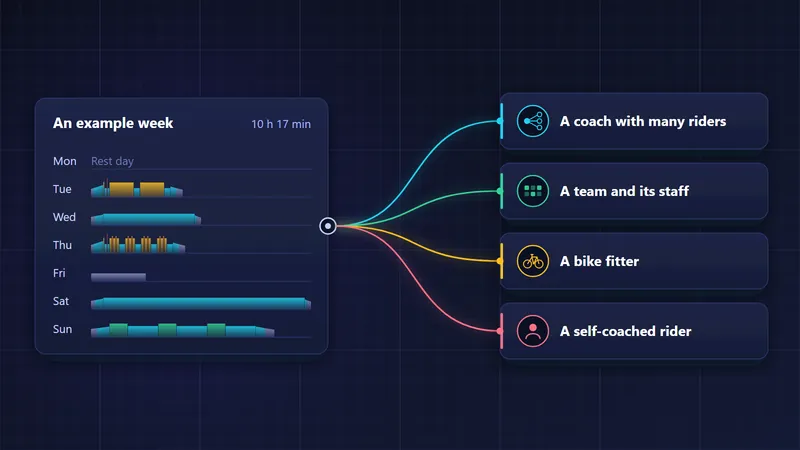
For most riders with 8 to 10 hours a week, a structured week has two key interval sessions, one long ride and easy riding around them. That weekly pattern keeps hard days hard and easy days easy.
Here is a build-phase week.
| Day | Session | Time |
|---|---|---|
| Monday | Rest | 0 |
| Tuesday | Threshold 2 × 20 minutes | 1 h 15 min |
| Wednesday | Endurance | 1 h 30 min |
| Thursday | VO2max 5 × 4 minutes | 1 h 15 min |
| Friday | Recovery spin, or rest | 45 min |
| Saturday | Long ride with 3 × 15 minutes of tempo | 3 h |
| Sunday | Endurance | 2 h |
That makes about 10 hours. Put the key sessions on days when you are fresh and have time, not where the calendar happens to have a gap. Keep at least one easy day between them. If work or family takes a day, protect the key sessions and the long ride, and drop the easy riding first.
How do you progress a structured training plan?
Progress a structured training plan one thing at a time, and usually extend the time at a target before raising the target itself. A common four-week pattern has three loading weeks and one easier week. A plan that repeats the same week soon stops moving you forward.
| Week | Threshold session | VO2max session | Long ride |
|---|---|---|---|
| 1 | 3 × 10 minutes | 5 × 3 minutes | 2 h 30 min |
| 2 | 4 × 10 minutes | 5 × 4 minutes | 3 h |
| 3 | 2 × 20 minutes | 3 sets of 13 × 30 s on, 15 s off | 3 h 30 min |
| 4 (easier) | Openers only | None | 2 h, with an FTP test near the end of the week |
The test in the easier week sets the targets for the next block. Test when you are rested, and use the same test each time so the results compare. Many coaches retest every six to eight weeks. How the whole season fits together, from base to taper, is covered in the annual training plan.
How do you compare your rides with your training plan?
After each key session, check whether every interval was on target, under, over or missed. One missed interval means little. A pattern over several sessions shows whether the FTP, the load or the set needs to change.
- Under the target in every session. The FTP may be set too high, or fatigue is building. Check sleep, the week's load, and whether the rides were indoors in the heat.
- Over the target everywhere, and it felt fine. The FTP may be out of date. Plan a test.
- Strong in the first intervals, fading in the last. The set may be too long for now. Shorten it and build again.
- Key sessions missed. Do not stack them into the next days. Move one, drop the easy ride, and keep the long ride.
Add how the session felt, from 1 to 10, and a line of notes. Over a few weeks, those notes explain the numbers better than the numbers explain themselves.
Building and running a plan in Velograph
Planning tools have shaped how riders and coaches work. TrainingPeaks built a large coaching ecosystem with a store of ready-made plans, and intervals.icu offers deep, free analysis beside its training calendar. Velograph has its own planning tools, built around teams, coaches and the riders they work with.
Velograph's own library holds sessions in folders from recovery to sprints, and the common FTP and critical power tests. It also holds blocks, such as a recovery week, a base block of three weeks plus one easier week, a build block, a ten-day taper and a training camp week. Every target is a share of the rider's own threshold, so one session fits every rider, and anyone can copy a session to adapt it. A planned test ride can suggest a new FTP.
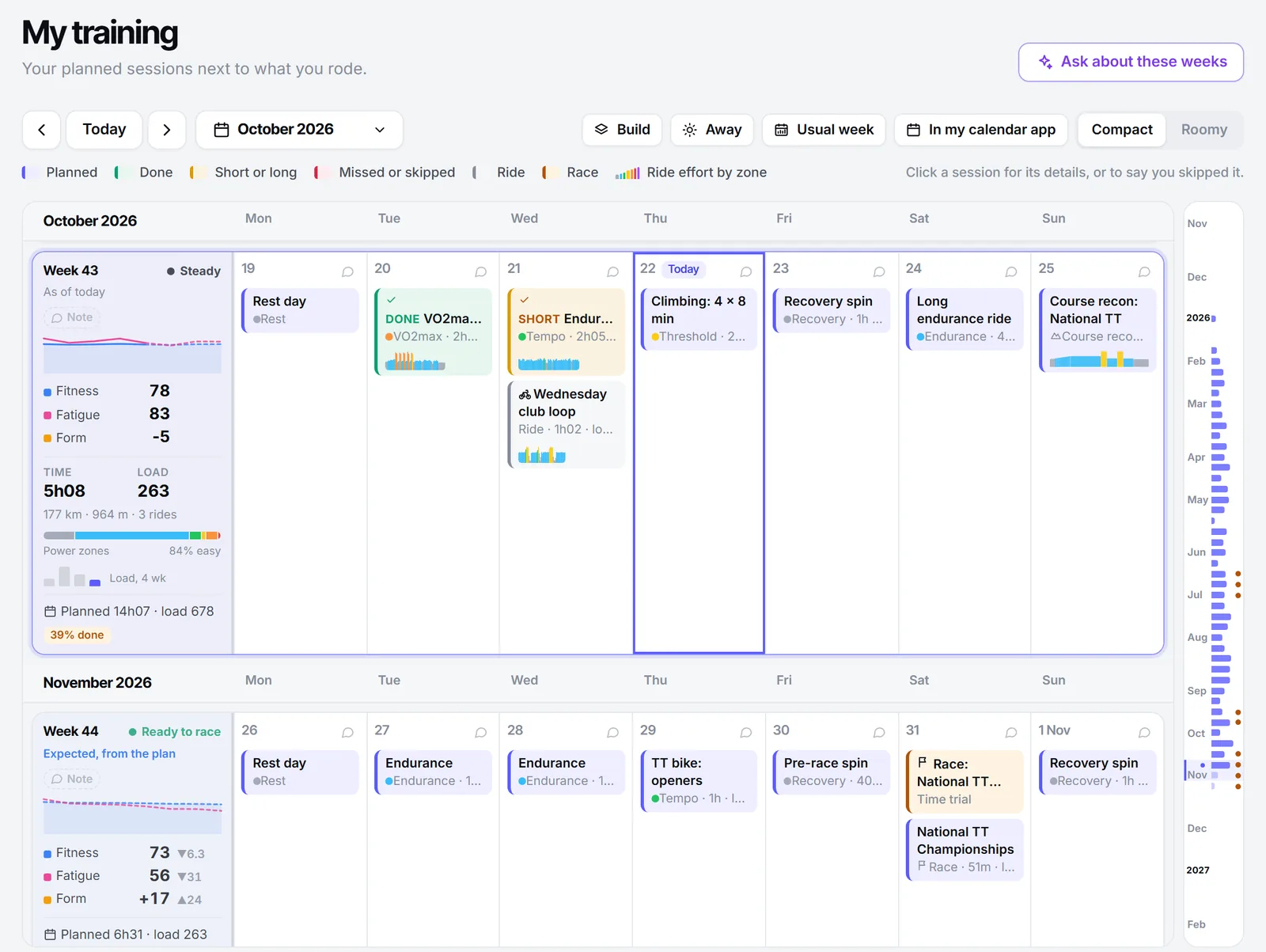
On the calendar, sessions move by drag and drop, and coaches can copy and paste them across riders. Each week can have a note, targets for hours and training load, and a usual week to start from. Planned sessions can be sent to intervals.icu, and they follow later moves and edits there. How the two work side by side is explained in intervals.icu and Velograph. After the ride, the ride page shows each interval against its target. The pricing page shows which plans include training plans.
Further reading
- Superior performance improvements in elite cyclists following short-interval vs effort-matched long-interval training, Rønnestad and colleagues, Scandinavian Journal of Medicine and Science in Sports, 2020.
- Block periodization of high-intensity aerobic intervals provides superior training effects in trained cyclists, Rønnestad, Hansen and Ellefsen, Scandinavian Journal of Medicine and Science in Sports, 2014.
Velograph is not affiliated with, sponsored by or endorsed by any team, rider or company named in this article. Names are used only to refer to publicly reported work.