FTP is the power you can hold steadily for a long effort. How it was defined, how to test it, how it differs from lactate threshold, and when it misleads.
What is FTP? Functional threshold power is the highest power you can hold in a steady effort without fatiguing. For trained riders, that is a power they can sustain for somewhere between 30 and 70 minutes. It anchors your training zones, sets the targets in structured sessions and tracks your fitness through the season. You can estimate it with a 20-minute test, a ramp test or a full hour, and each method has its own quirks.
Is FTP the power you can hold for an hour?
FTP is often called one-hour power, but the hour is only an approximation. TrainingPeaks puts the time you can hold it between about 30 and 70 minutes, and usually 40 to 55 minutes for trained athletes.
Andrew Coggan, the exercise physiologist who developed the idea, defines FTP as "the highest power a rider can maintain in a quasi-steady state without fatiguing". Quasi-steady means close to steady: breathing, heart rate and effort settle rather than climbing out of control.
How long you can hold FTP is called time to exhaustion. TrainingPeaks, working with Coggan, puts it between about 30 and 70 minutes, and usually 40 to 55 minutes for trained athletes. Research agrees. In a 2018 study by Fernando Borszcz and colleagues, 23 trained male cyclists rode to exhaustion at 95% of their 20-minute power. They lasted about 51 minutes on average, with a spread of 16 minutes either way.
That spread matters in practice. Two riders with an FTP of 260 W can differ a lot: one holds it for 40 minutes, the other for 65. They need different threshold sessions, and they will pace a long climb differently.
How do you test your FTP?
You test FTP by riding a known effort and converting the result to an estimate, because no test measures FTP directly. A 20-minute test takes 95% of your average power, and a ramp test takes 75% of your highest one-minute power.
| Test | What you ride | FTP estimate | Suits | Watch out |
|---|---|---|---|---|
| One hour | 60 minutes all-out, alone | Average power | The definition itself | Hard to pace and to motivate |
| 20 minutes | 20 minutes all-out after a long warm-up | 95% of the average | Most trained riders | 95% is an average, not a rule |
| 30 minutes | A solo 30-minute time trial | Average power for the 30 minutes | Riders who also want heart rate zones | Pacing over 30 minutes |
| Two times 8 minutes | Two 8-minute efforts, 10 minutes easy between | 90% of the higher | Riders new to pacing | Flatters a strong VO2max |
| Ramp | One-minute steps that rise until you stop | 75% of your highest minute | Indoors, short, less daunting | Flatters strong anaerobic capacity |
| Critical power | All-out efforts of 3 and 12 minutes | A little below critical power | Riders who also want W′ | Two hard efforts in one session |
The 30-minute test comes from coach Joe Friel, who also takes the average heart rate of its last 20 minutes as your lactate threshold heart rate. The two 8-minute efforts are Carmichael Training Systems' field test. The 95% rule for the 20-minute test comes from Hunter Allen and Andrew Coggan's book Training and Racing with a Power Meter.
Indoor platforms have made testing part of the routine for many riders. Zwift's ramp test adds 20 W every minute until you cannot hold the target, and a gentler version adds 10 W a minute for lighter or less powerful riders. Zwift and TrainerRoad both take 75% of your highest one-minute power in the ramp as your FTP. Both are quick, need no pacing skill and can be repeated often, which is a real strength. If you test indoors, keep your indoor and outdoor numbers apart; the article on indoor cycling training explains why they can differ.
Which FTP test should you choose?
Pick the test that matches your strengths and stick with it, because consistency matters more than the method. The ramp test rewards anaerobic capacity, and the 20-minute test rewards good pacing.
In a ramp test, a rider with a big sprint lasts one or two steps longer, so 75% of their highest minute can overstate FTP. A steady diesel rider may be underestimated by the same test. For the 20-minute test, the conversion factor varies by level.
That last point is easy to miss. In a 2023 study of 120 cyclists, Sitko and colleagues found that 60-minute power was 96% of 20-minute power in professionals, 95% in well-trained riders, 92% in trained riders and 88% in recreational riders. A recreational rider with 250 W for 20 minutes would get 238 W from the usual 95%, but 220 W from their group's factor. That 18 W gap makes every threshold interval harder than intended.
How do you ride a 20-minute FTP test?
Test rested, and warm up for 15 to 20 minutes with two or three short efforts. Then ride 20 minutes all-out, starting at the power you expect to hold and lifting the last five minutes if you can. The usual FTP estimate is 95% of the average power.
- Test rested, after an easy day, at the time of day you usually train.
- Eat and drink as you would before a hard session.
- Warm up for 15 to 20 minutes, with two or three short efforts to open the legs.
- Use the same bike, place and power meter each time.
- On a smart trainer, use resistance or slope mode rather than ERG, so you set the pace.
- Start at the power you expect to hold, ride the first five minutes slightly conservatively and lift the last five if you can.
- Note the conditions: temperature, sleep, fatigue, indoors or out.
How is FTP different from lactate threshold and critical power?
FTP estimates the top of steady effort from one test, while lactate thresholds come from blood samples and critical power is fitted from several all-out efforts. FTP and critical power are close on average, but two studies concluded they should not be used interchangeably.
Three related ideas describe the top of steady effort, and they are measured in different ways.
- Lactate thresholds come from blood samples in a lab or a field test. The first threshold is where lactate starts to rise above resting levels. The second marks the highest intensity at which lactate can still settle, close to what scientists call the maximal lactate steady state.
- FTP is a performance estimate of that upper steady state, from one test effort.
- Critical power is the power the power-duration curve levels off towards, fitted from several all-out efforts.
They land close together but are not the same number. Karsten and colleagues tested 17 trained cyclists and triathletes. Critical power averaged 256 W and FTP 249 W, but for individuals critical power ranged from about 19 W below FTP to 33 W above it. McGrath and colleagues found 282 W against 266 W in 15 highly trained athletes. Both groups concluded the two should not be used interchangeably. The article on critical power and W′ explains the second number that comes with critical power.
What is FTP used for?
FTP sets your power zones and session targets by turning percentages into watts. Most power zones are set as a share of it, and most structured sessions give targets as a percentage.
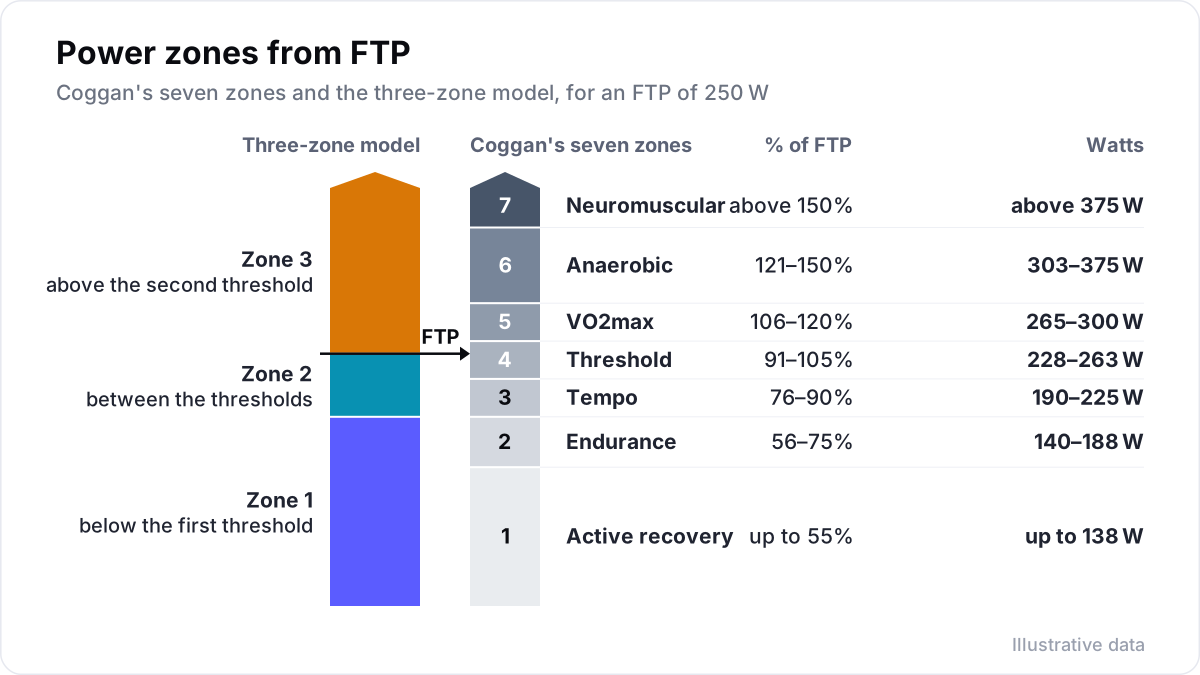
For an FTP of 250 W, endurance riding is about 140 to 188 W, threshold work about 228 to 263 W and VO2max intervals about 265 to 300 W. The article on cycling training zones gives the full table. If your FTP is set 5% too high, every session built on it is 5% harder than planned. Over a block of structured training, that is the difference between finishing intervals and failing them.
When does FTP mislead?
FTP misleads in short and very long events, and in tests ridden tired, hot or at altitude. It can also be wrong for a bike with a different position. It is one point on a curve, and it describes steady efforts well and other efforts poorly.
- Short events. A criterium or a short hill climb is decided by power from 30 seconds to 5 minutes. Two riders with the same FTP can differ a great deal there.
- Very long events. After three or four hours, the power you can produce at a threshold effort tends to drop. How much it drops is durability, and FTP does not show it.
- Fatigue, heat and altitude. A test after a hard week, on a hot day or at altitude reads low. That is the day, not your fitness.
- Different positions. Riders often hold less power on the time-trial bike than on the road bike. A separate FTP for each position avoids wrong targets.
- One number for everything. Sessions set only from FTP ignore how long you can hold it. Watch time to exhaustion as well.
How often should you do an FTP test?
Retest at the start of each training block, roughly every four to eight weeks, and after illness or a break. Retest sooner when sessions feel easy across the board, or when a race or a hard ride produces a 20-minute effort well above your current FTP divided by 0.95.
Use the same test, under the same conditions, every time. A small change from one test to the next can be day-to-day variation; a change you see in tests, sessions and rides together is real. In Velograph, a planned test session is read when the ride comes in, and the rider and whoever plans their training see the new FTP it suggests.
Further reading
- Introduction of the new time to exhaustion metric in WKO4, TrainingPeaks, 2016.
- Functional threshold power in cyclists: validity of the concept and physiological responses, International Journal of Sports Medicine, 2018.
- Relationship between the critical power test and a 20-min functional threshold power test in cycling, Frontiers in Physiology, 2021.
- An update of the Allen and Coggan equation to predict 60-min power output in cyclists of different performance levels, International Journal of Sports Medicine, 2023.
Velograph is not affiliated with, sponsored by or endorsed by any team, rider or company named in this article. Names are used only to refer to publicly reported work.