A 16-week sportive or gran fondo plan for 5, 8 or 10 hours a week: the long-ride build, climbing sessions, fuelling practice, the taper and pacing on the day.
A sportive training plan of 16 weeks builds one thing above all: the long ride, which grows to about three quarters of the time you expect to take on the day. Around it go two key sessions a week for threshold and climbing power, practice with the food you will eat, and a two-week taper. The tables give the plan at three levels, for about 5, 8 or 10 hours a week, for a sportive, a gran fondo or a century ride of 100 miles.
What does a 16-week sportive training plan look like?
A 16-week sportive plan has three blocks of three harder weeks and one easier week, then a rehearsal week, a last week of steady work, a taper week and the event week. Two key sessions a week build threshold and climbing power, and the weekend long ride builds endurance.
| Weeks | Phase | Tuesday | Thursday | Long ride |
|---|---|---|---|---|
| 1 to 3 | Base | Tempo 3 × 15 min | Sweet spot 3 × 10 min | Endurance, with hills ridden steadily |
| 5 to 7 | Build | Sweet spot 2 × 20 min | Threshold 3 × 10 min, seated, at 70 to 80 rpm | Endurance with 3 × 15 min of tempo |
| 9 to 11 | Specific | Threshold 2 × 15 min | VO2max 4 × 5 min | Hilly, climbs at event climbing power |
| 4, 8 and 12 | Easier | Sweet spot 3 × 10 min, or threshold 3 × 10 min in week 12 | Easy | Shorter and easy |
| 13 | Rehearsal | Sweet spot 2 × 20 min | Easy | Longest, with event food, kit and pacing |
| 14 | Last steady week | Threshold 3 × 10 min | Sweet spot 3 × 10 min | Shorter, with climbs |
| 15 | Taper | Sweet spot 3 × 10 min | 45 min with 3 × 1 min hard | Short |
| 16 | Event week | 3 × 3 min at threshold | Easy | The event |
Targets are shares of your FTP, your functional threshold power: tempo 80 to 88%, sweet spot 88 to 93%, threshold 95 to 100%, and VO2max 106 to 115% with 5 minutes easy between efforts. Endurance riding is 65 to 75%, the pace of zone 2. At the 5-hour level, 20-minute blocks can be 15. Our guide to structured training plans explains how sessions fit together.
To find week 1, count back from the event, as in an annual training plan. The Maratona dles Dolomites is on Sunday 4 July 2027, according to its organiser, so its week 1 starts on Monday 15 March 2027.
How many hours a week do you need for a sportive?
This plan's three levels need about 5, 8 or 10 hours in a normal week. The 5-hour level suits a 100 km sportive, the 8-hour level 160 km or a century ride, and the 10-hour level a long mountain gran fondo. Each level assumes you already ride three or four times a week.
| Day | 5-hour level | 8-hour level | 10-hour level |
|---|---|---|---|
| Tuesday | Key session, 1 h | Key session, 1 h 15 min | Key session, 1 h 30 min |
| Wednesday | Rest | Easy, 1 h | Easy, 1 h |
| Thursday | Key session, 1 h | Key session, 1 h 15 min | Key session, 1 h 30 min |
| Saturday | Long ride | Long ride | Long ride |
| Sunday | Easy, 45 min | Endurance, 1 h 30 min | Endurance, 2 h |
Monday and Friday are rest days. In the easier weeks, keep only the Tuesday session and shorten the other rides.
How long should your longest ride be before a sportive?
Build your longest ride to about three quarters of the time you expect to take on the day, and ride it three weeks before the event. Add about 15 minutes to the long ride most weeks, and shorten it in every fourth week.
The long rides assume event times of about 4 hours 40 minutes, 6 hours and 7 hours 20 minutes for the three levels. If you expect to take longer, lengthen the long rides from week 9 in proportion.
| Week | 5-hour level | 8-hour level | 10-hour level |
|---|---|---|---|
| 1 | 4:30 / 1:45 | 7:30 / 2:30 | 9:00 / 3:00 |
| 2 | 4:45 / 2:00 | 7:45 / 2:45 | 9:15 / 3:15 |
| 3 | 5:00 / 2:15 | 8:00 / 3:00 | 9:30 / 3:30 |
| 4 | 3:45 / 1:30 | 6:00 / 2:00 | 6:45 / 2:15 |
| 5 | 5:00 / 2:15 | 8:00 / 3:00 | 9:45 / 3:45 |
| 6 | 5:15 / 2:30 | 8:15 / 3:15 | 10:00 / 4:00 |
| 7 | 5:30 / 2:45 | 8:30 / 3:30 | 10:15 / 4:15 |
| 8 | 3:45 / 1:30 | 6:15 / 2:15 | 7:00 / 2:30 |
| 9 | 5:30 / 2:45 | 8:30 / 3:30 | 10:15 / 4:15 |
| 10 | 5:45 / 3:00 | 8:45 / 3:45 | 10:30 / 4:30 |
| 11 | 6:00 / 3:15 | 9:00 / 4:00 | 11:00 / 5:00 |
| 12 | 4:00 / 1:45 | 6:30 / 2:30 | 7:15 / 2:45 |
| 13 | 6:15 / 3:30 | 9:30 / 4:30 | 11:30 / 5:30 |
| 14 | 5:15 / 2:30 | 8:30 / 3:30 | 10:30 / 4:30 |
| 15 | 3:30 / 1:45 | 5:15 / 2:15 | 6:15 / 2:45 |
| 16 | 1:45 + the event | 2:30 + the event | 3:00 + the event |
Each cell shows the week's riding, then the long ride, in hours and minutes.
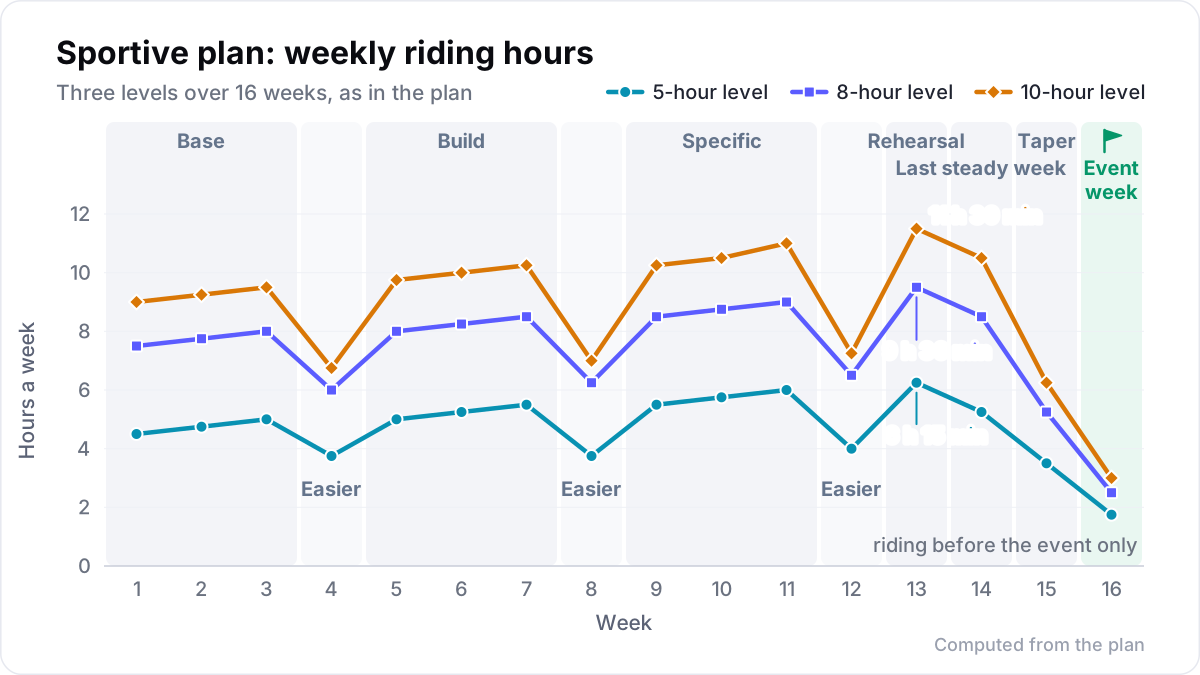
If the longest weekend does not fit in one day, split it, such as 3 hours on Saturday and 1 hour 30 minutes on Sunday. If a week falls apart, keep the long ride and one key session.
If you plan in Velograph, each week's hours can be set as a weekly target, and the calendar shows it against what you planned and rode. Planning comes with Rider Plus, a paid plan. The free Rider plan keeps your bikes, bike fits and rides with ride analysis, as the riders page explains.
How do you train for the climbs in a sportive?
Train for long climbs with seated blocks a little below threshold, at the cadence you will climb at, and ride hilly long rides from week 9. On the day, ride long climbs at about 80 to 88% of FTP, because a mountain pass can take an hour or more.
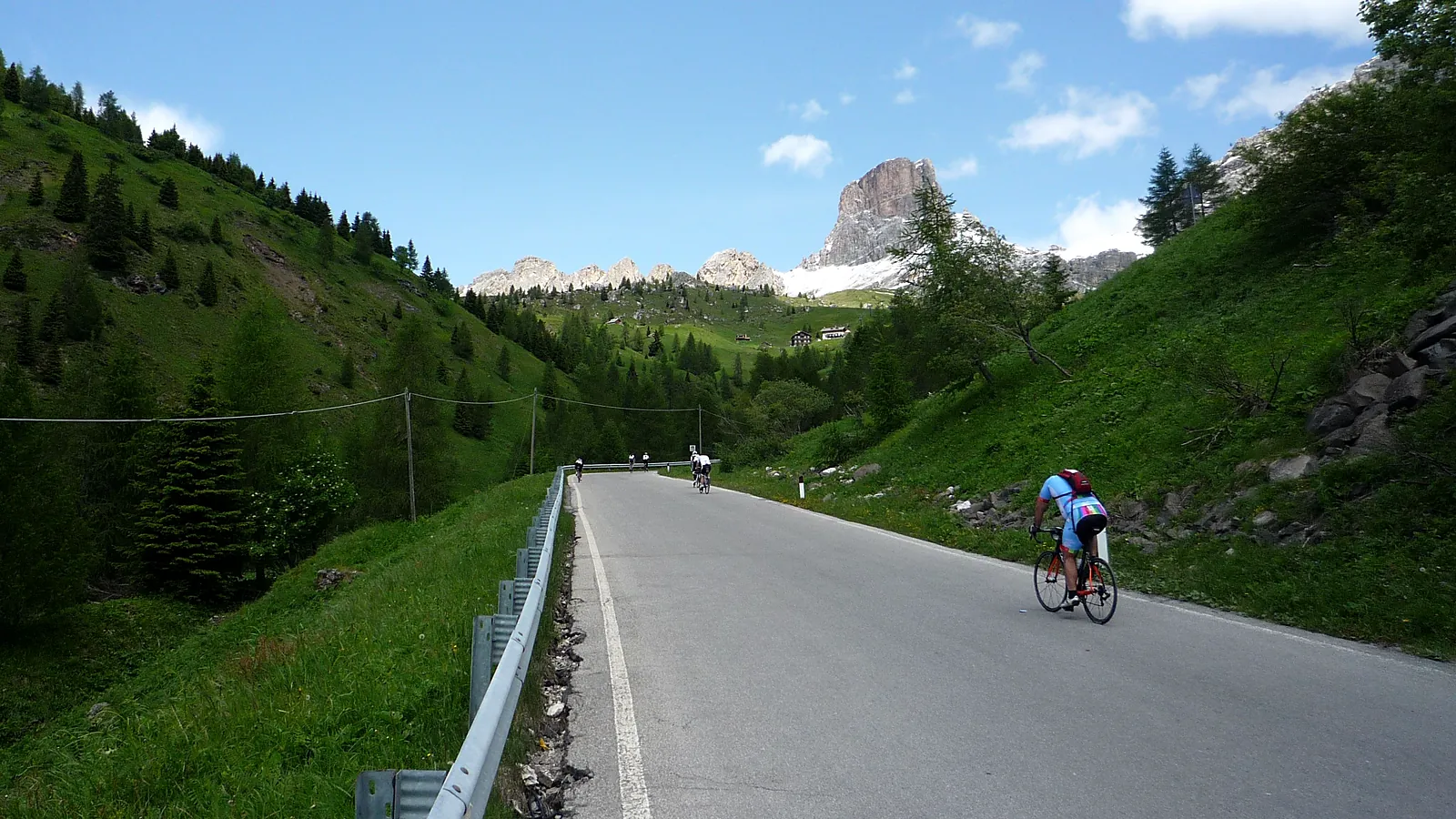
The Maratona dles Dolomites shows the scale. Its organiser gives the 138 km course 4,230 m of climbing, and Passo Giau alone rises 922 m in 9.9 km, at 9.3% on average and 15% at its steepest. From the physics of climbing, we estimated the time for a 75 kg rider on an 8 kg bike. It is about 1 hour 12 minutes at 2.5 W/kg (188 W), 1 hour 5 minutes at 2.8 W/kg (210 W) and an hour at 3.0 W/kg (225 W).
An hour at FTP is a full test effort, and Giau is one of seven climbs the organiser lists for the course. So ride it below FTP: for a rider with an FTP of 265 W, 225 W is 85%. Watts per kilo explains how W/kg turns into climbing time.
Without long climbs near home, ride sweet spot 2 × 20 minutes on a trainer at your climbing cadence, or repeat a shorter hill at a steady power. Check your lowest gear too: on a 15% ramp, you want one that lets you stay seated.
How do you practise fuelling for a sportive?
Practise on every long ride from week 5. Eat from the first half hour, aim for a set number of grams of carbohydrate an hour, and raise it step by step. For well-trained riders, sports nutrition guidance is up to about 60 g an hour for two to three hours and about 90 g an hour for longer events.
- Weeks 5 to 8. Start where your stomach is comfortable, perhaps 50 to 60 g an hour.
- Weeks 9 to 12. Add about 10 g an hour after two long rides in a row go well.
- Week 13. Rehearse the event's food, bottles and hourly amounts.
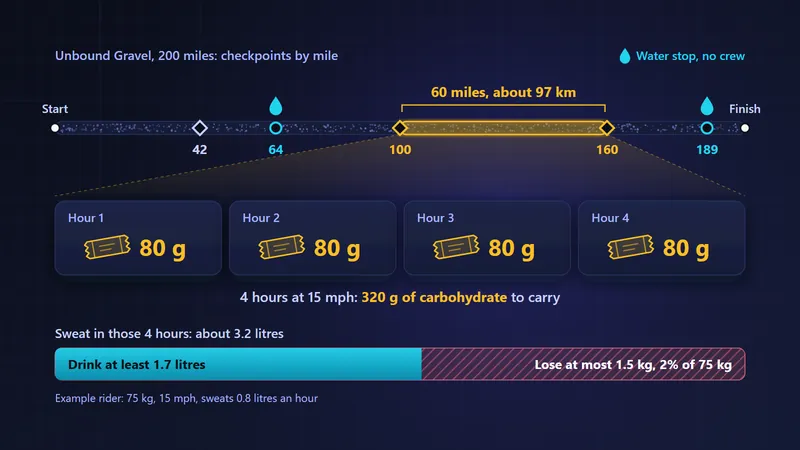
For a 6-hour event, 70 g an hour is 420 g of carbohydrate, about 1,680 kcal. Six hours at 160 W is about 3,460 kJ of work, roughly 3,460 kcal used, so finishing short is normal. Check what the feed stations serve, and practise with it or carry your own.
Weigh yourself before and after long rides to learn how much you sweat, as our gravel race preparation guide shows. Carbohydrate on the bike covers gut training step by step. For a plan around your own needs or a medical condition, talk to a registered sports dietitian.
How do you taper for a sportive?
In the second-to-last week, ride about 45% less than in your biggest week and keep short efforts at sweet spot and above, then ride short and easy in event week. That matches a 2007 meta-analysis, in which two-week tapers that cut volume by 41 to 60%, without easing intensity or the number of sessions, gave the largest gains.
The last week, for an event on Sunday, with Monday and Friday as rest days:
| Day | Riding |
|---|---|
| Tuesday | 3 × 3 min at threshold, in 45 min at the 5-hour level or 60 min at the others |
| Wednesday | Rest at the 5-hour level; otherwise 30 min easy, or 45 at the 10-hour level |
| Thursday | 30 min easy, or 45 at the 10-hour level |
| Saturday | 30 min with 3 × 30 s hard |
| Sunday | The event |
Have the bike serviced a week before, not the day before, and pack food in bags by the hour.
How should you pace a sportive by power or heart rate?
Ride the first hour easier than feels right and keep flat roads at endurance pace. By power, that is about 65 to 75% of FTP on the flat and 80 to 88% on long climbs. By heart rate, it is zone 2 on the flat and zone 3 on long climbs.
Here are the figures for an FTP of 250 W and a threshold heart rate of 165 bpm, with the zones from cycling training zones.
| Part of the day | Power | At FTP 250 W | Heart rate | At 165 bpm |
|---|---|---|---|---|
| First hour | 60 to 70% | 150 to 175 W | Zone 2 or lower | Under 147 bpm |
| Flat and rolling roads | 65 to 75% | 163 to 188 W | Zone 2 | 134 to 147 bpm |
| Climbs of up to 20 minutes | Up to 90 to 95% | Up to 225 to 238 W | Zone 4 at most | Up to 163 bpm |
| Climbs of over 20 minutes | 80 to 88% | 200 to 220 W | Zone 3 | 149 to 153 bpm |
A group saves energy on flat roads, but let it go if it pushes you above your climbing power on the flat. Heart rate rises through the day at the same power, a slow climb called cardiac drift that heart rate vs power explains. Late in the day, hold your power or breathing steady rather than chasing the heart rate down.
Further reading
- Maratona course, 138 km, Maratona dles Dolomites, 2027.
- A step towards personalized sports nutrition: carbohydrate intake during exercise, Jeukendrup, Sports Medicine, 2014.
- Effects of tapering on performance: a meta-analysis, Bosquet and colleagues, Medicine and Science in Sports and Exercise, 2007.
Velograph is not affiliated with, sponsored by or endorsed by any team, rider or company named in this article. Names are used only to refer to publicly reported work.