Power measures the work, heart rate the cost. When each is the better guide, why heart rate drifts, and how aerobic decoupling puts the two together.
The heart rate vs power question has a short answer: use power to set and pace the work, and heart rate to see what the work costs you. Power is what you push into the pedals, measured directly and instantly. Heart rate is your body's response to that work, and it lags, drifts and shifts with heat, hydration, fatigue and sleep. That makes power the better target for intervals and pacing, and heart rate the better witness of how your body is coping. Riders who record both learn the most.
Heart rate vs power: which is better for training?
Neither heart rate nor power is better in general, because each answers a different question. Power measures the work you push into the pedals, and heart rate shows what that work costs your body.
A power meter measures force and pedal speed and reports watts every second. A reading of 250 W means the same work on a cool morning or a hot afternoon, fresh or tired. That is why power is the language of FTP, intervals, pacing and training load.
Heart rate tells you how hard your heart and lungs are working to supply that power. It depends on the effort, but also on body temperature, fluid, fatigue, altitude, caffeine, nerves and illness. Picture one rider holding 250 W twice: at 145 beats per minute on a cool, fresh morning, and at 160 after three hours in the heat. The work is the same. The cost is not.
Here is which one to lead with for each question:
| Question | Lead with | Why |
|---|---|---|
| How hard should this interval be? | Power | It responds instantly and does not drift. |
| How do I pace a time trial or a climb? | Power | Heart rate lags behind changes in effort. |
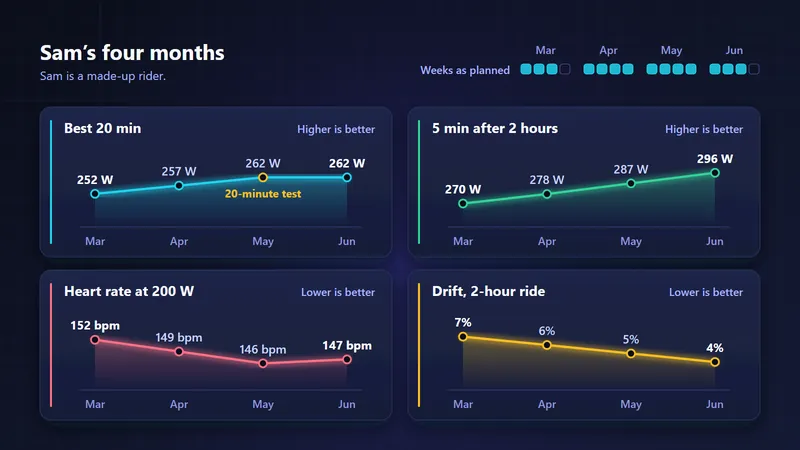
| Did I get fitter? | Both | More power at the same heart rate is the clearest sign. |
| Is today's easy ride easy enough? | Heart rate | A ceiling keeps easy days easy, even on hills. |
| How is my body coping with heat or a hard block? | Heart rate | It shows the rising cost of the same work. |
| How much training did I do? | Power | Training load counts the work directly. |
How long does heart rate lag behind power?
At the start of a hard effort, heart rate takes a minute or two to climb towards its new level. A 30-second attack can be over before heart rate peaks, and after the effort heart rate stays high while power is already back to zero.
In a set of one-minute efforts, heart rate usually rises from the first effort to the last even when the power is identical. That is why heart rate cannot pace short intervals. If you ride the first minutes of a time trial by heart rate, the number looks comfortable while you are already above the power you can hold, and you pay for it later. Pace with power, then read heart rate afterwards to see what the effort cost.
Why does heart rate rise when power stays the same?
Heart rate climbs at the same power mainly because your body temperature rises during a long, steady ride, and losing fluid and growing tired add to the climb. This slow rise is called cardiac drift, or cardiovascular drift.
In a 2001 review, Coyle and González-Alonso described it as a gradual fall in the amount of blood each heartbeat pumps, starting after 10 to 20 minutes of exercise. They argued that a heart rate rising with body temperature, more than extra blood flow to the skin, explains that fall. Three things make drift larger.
- Heat. As body temperature climbs, heart rate rises at the same power, so drift is larger on hot days and indoors without a fan.
- Dehydration. In a 1992 study, Montain and Coyle had eight trained cyclists ride two hours in 33 °C heat while drinking different amounts. The more body weight they lost (from about 1% to over 4%), the more their heart rate rose and their stroke volume fell, in an almost straight line.
- Fatigue. In a 2022 study by Stevenson and colleagues, two hours of moderate riding raised the heart rate at the first threshold from 142 to 151 beats per minute. The power at that threshold fell from 217 to 196 W.
Heart rate also varies from day to day for reasons that have nothing to do with fitness. In their 2003 review, Achten and Jeukendrup noted that dehydration and air temperature have a considerable effect on the link between heart rate and oxygen use. Caffeine, a poor night's sleep, stress, altitude and an oncoming cold can all nudge it too. After a heavy training block, many riders find their heart rate will not climb as high as usual on hard efforts, and coaches read that as a sign of fatigue.
How do heart rate and power together show endurance?
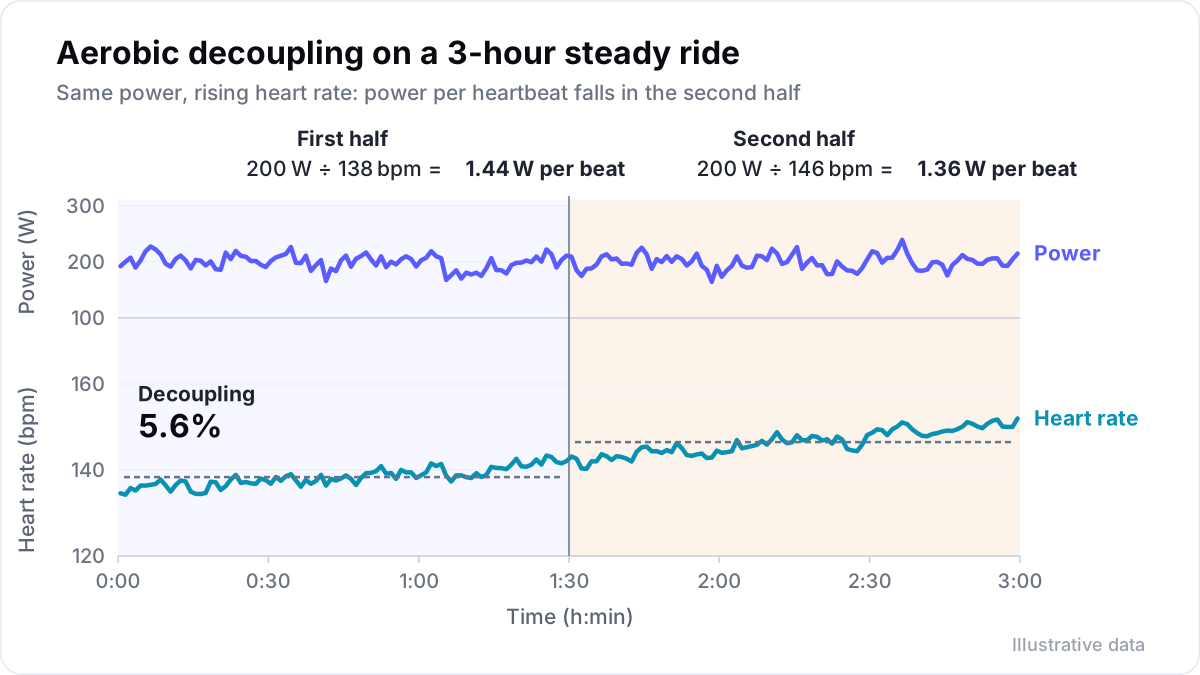
Heart rate and power show endurance through aerobic decoupling, which compares the two across a steady ride. Joe Friel described it for TrainingPeaks in 2008: split a steady effort into halves, divide power by heart rate in each half, and see how much the ratio falls. TrainingPeaks reports it as Pw:Hr for power.
A worked example over a three-hour steady ride:
| Half | Average power | Average heart rate | Watts per beat |
|---|---|---|---|
| First 90 minutes | 200 W | 138 bpm | 1.44 |
| Second 90 minutes | 200 W | 146 bpm | 1.36 |
The ratio fell from 1.44 to 1.36, which is 5.6%. The averages in the table are rounded to whole numbers; the ratios come from the unrounded ride data. Friel's reading: under 5% shows good aerobic endurance at that intensity, 5 to 10% points to some limitation or fatigue, and over 10% suggests the ride was above the aerobic threshold or longer than your endurance supports. He uses steady rides at aerobic threshold, as long as the target race up to about four hours. Under 5% over that duration is his sign that the base is ready for harder training.
Decoupling is only as good as the ride it comes from. For a result you can compare month to month:
- Ride steadily on flat roads or a trainer, with no stops, and leave out the warm-up and cool-down.
- Hold the same power each time, at an intensity a little below your first threshold. Zone 2 training explains where that is.
- Keep the conditions alike: temperature, fan, time of day, drinks and food.
- Compare like with like. An 8% result on a hot day may say more about the heat than about your fitness.
Clean data matters here. Velograph reads every ride from the original device file, so the power and heart rate it analyses are the numbers your devices recorded.
When is heart rate better than power?
Heart rate is the better guide on easy days, in heat and at altitude, on rides without a power meter and for watching how your body copes.
- Easy days. A heart-rate ceiling slightly below your first threshold stops easy rides drifting into tempo, especially on rolling roads where power jumps on every rise.
- Heat and altitude. A power target set in cool conditions can be too hard in the heat. If heart rate is well above its usual level at your normal power, the effort is costing more than planned.
- Riding without a power meter. On a commuter, a mountain bike or a run, heart rate is the measure you have. Cycling training zones shows how heart-rate zones are set from a threshold test.
- Watching how your body copes. Heart rate at a fixed power, morning heart rate and heart rate variability all show change that power alone cannot.
When is power better than heart rate?
Power is the better guide for intervals and efforts shorter than a few minutes, for pacing, for comparing performances and for riding indoors. It responds instantly, while heart rate is still catching up when a short effort ends.
- Intervals and anything shorter than a few minutes. Heart rate is still catching up when the effort ends.
- Pacing. Time trials, climbs and the first minutes of any effort need the instant number.
- Comparing performances. Records, your power curve and test results are measured in watts.
- Indoors. On a smart trainer in ERG mode, power is held for you and heart rate becomes the check on how you are coping. Indoor cycling training covers trainer data in more detail.
How do you check fitness with heart rate and power?
Ride six minutes at a fixed power on the trainer every two weeks, with the same warm-up and fan, and note your heart rate. If it falls at that power over the weeks, your aerobic fitness is improving.
Robert Lamberts and colleagues built a submaximal cycling test around this idea. In the Lamberts and Lambert Submaximal Cycle Test, the rider completes three stages at set heart rates. The power produced at each is recorded, along with how fast heart rate recovers afterwards. In their 2011 study of 17 trained road cyclists, power in the later stages was highly repeatable and tracked time-trial and peak power performance closely.
The home version is simpler. Warm up the same way each time, keep the fan in the same place and note your average heart rate in the last two of the six minutes. If it is clearly higher than usual, you may be tired, hot or coming down with something, so ease off and look for the reason. Persistent changes you cannot explain belong with a doctor.
Common mistakes
- Chasing heart rate in intervals. Riding harder to push heart rate up in the first minute of an effort makes the effort too hard.
- Comparing heart rates between riders. A heart rate of 165 says nothing on its own. Compare each rider with themselves.
- Ignoring drift on long days. Holding the same heart rate for five hours means slowly lowering your power, which may be right for a long event. Decide which one you are holding.
- Reading decoupling from a hilly group ride. Surges and stops spoil the ratio.
Further reading
- Aerobic endurance and decoupling, Joe Friel, TrainingPeaks, 2008.
- Cardiovascular drift during prolonged exercise: new perspectives, Coyle and González-Alonso, Exercise and Sport Sciences Reviews, 2001.
- Heart rate monitoring: applications and limitations, Achten and Jeukendrup, Sports Medicine, 2003.
- A novel submaximal cycle test to monitor fatigue and predict cycling performance, Lamberts and colleagues, British Journal of Sports Medicine, 2011.
Velograph is not affiliated with, sponsored by or endorsed by any team, rider or company named in this article. Names are used only to refer to publicly reported work.