What heart rate variability measures, what HRV-guided training studies found, how to take a clean morning reading, and why weekly trends beat single days.
HRV training means letting your heart rate variability, measured each morning, help decide how hard you train that day. Studies since 2007 suggest it can work. Athletes who swapped a hard session for an easy one when their HRV dropped clearly below their own normal improved as much as athletes on a fixed plan, or more, sometimes with fewer hard days. The catch lies in the words "clearly" and "own normal". A single morning's number is noisy. A weekly average against your own baseline carries the signal, and it is one input next to sleep, soreness and mood.
What is heart rate variability?
Heart rate variability (HRV) is how much the gaps between your heartbeats vary. Even at a steady 60 beats per minute, your heart does not beat exactly once a second, and the gaps differ by tens of milliseconds.
The gaps vary mostly because the parasympathetic nervous system, the body's brake, adjusts each beat. When you are rested, that brake is active and the gaps vary more. Hard training, poor sleep, illness, alcohol, travel, heat and stress all tend to reduce the variation.
The measure used in most research and many apps is rMSSD: the root mean square of the differences between successive beats, in milliseconds. Take four beat-to-beat gaps of 1,000, 1,040, 980 and 1,020 ms. The differences are 40, -60 and 40 ms; their squares average 2,267; the square root is about 48 ms. Researchers usually take the natural logarithm, written ln rMSSD, because it makes day-to-day changes behave more evenly.
Values differ hugely between people and fall with age, so one rider's 45 ms can be as normal for them as another's 110 ms. The only useful comparison is with yourself.
Does HRV training work?
HRV training looks promising and sensible, but it is not proven superior. In small, short studies, athletes guided by HRV improved as much as athletes on a fixed plan, or more, sometimes with fewer hard days.
| Study | Who | What happened |
|---|---|---|
| Kiviniemi and colleagues, 2007 | 26 moderately fit men, 4 weeks of running | The HRV group ran hard when HRV was stable or rising and easy or not at all when it fell below their 10-day average minus one standard deviation, or kept falling for two days. Their maximal running speed rose from 15.5 to 16.4 km/h and VO2peak from 56 to 60 ml/kg/min. The fixed-plan group's speed rose from 15.1 to 15.7 km/h, with no significant change in VO2peak. |
| Vesterinen and colleagues, 2016 | 40 recreational runners, 8 weeks | The HRV group did fewer moderate and hard sessions (about 13 against 18) and improved 3,000 m time by 2.1%. The fixed-plan group's 1.1% was not significant. Both improved VO2max. |
| Javaloyes and colleagues, 2019 | 17 well-trained cyclists, 8 weeks | The HRV-guided group improved peak power by 5.1%, power at the second threshold by 13.9% and a 40-minute time trial by 7.3%. The traditional group did not improve significantly, though the difference between groups was not statistically significant. |
Two things stand out. HRV guidance mostly changes when the hard sessions happen, not how much training is done. And the studies are small and short, so the honest summary is "promising and sensible", not "proven superior".
Long-term monitoring of elite athletes adds a warning sign. In a 2012 case study, Daniel Plews and colleagues followed two elite triathletes training about 23 hours a week for 77 days. In the athlete who raced poorly and was diagnosed with non-functional overreaching, the 7-day rolling average of ln rMSSD drifted down for weeks, and its day-to-day variation shrank. In the other athlete, both stayed stable.
Should you worry about one low morning HRV reading?
One low morning HRV reading is usually noise, because it can follow a late meal, a glass of wine, a bad night or an early alarm. A weekly average below your own normal band is the signal worth a look.
Plews and colleagues recommend averaging, and in 2014 they showed that at least three valid readings spread through a week give nearly the same weekly picture as seven. The gain levelled off after three or four days.
Their 2013 review of elite athletes adds a subtlety: HRV does not always move in the obvious direction. In some very fit athletes, HRV falls as fitness rises, so each athlete's pattern needs weeks of data before it can be read with confidence.
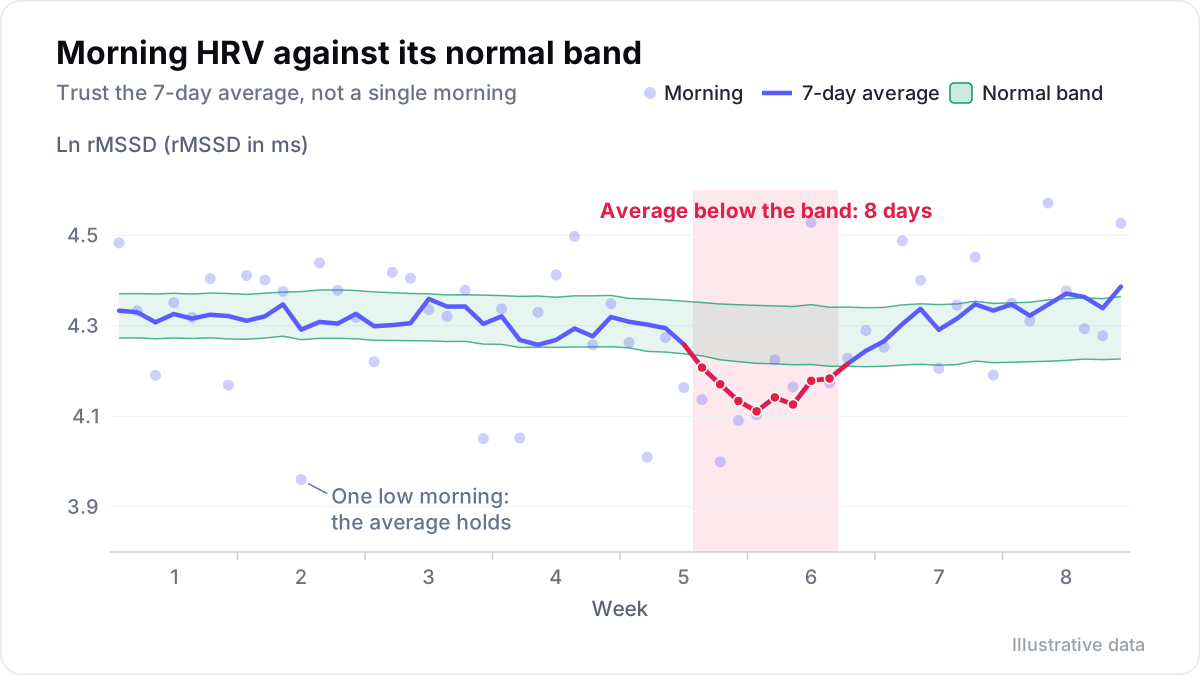
Here is a worked example. A rider's 60-day average is ln rMSSD 4.20 (about 67 ms) with a standard deviation of 0.10. Half a standard deviation either side gives a normal band of about 63 to 70 ms. One morning reads 52 ms, but the week averages 65 ms: inside the band, so that morning is noise. Two weeks later the week averages 59 ms: below the band. That is worth a look, whatever a single morning says.
How should you measure morning HRV?
Measure HRV at the same moment each morning, in the same position, with the same device and for the same length, on at least three mornings a week. Note anything unusual, such as alcohol or a poor night.
- Same moment each day, for example straight after waking, before coffee, phone messages or training.
- Same position, lying or sitting, every time. Position changes the number.
- Same device and app. Readings from different devices are not interchangeable, so a new device means a new baseline.
- Same length, one to five minutes of quiet, normal breathing.
- At least three mornings a week, daily if it is easy for you.
- A one-line note when something unusual happened: alcohol, a late meal, travel, a poor night, feeling ill.
Overnight wearables take the reading for you. Oura's ring, for example, records HRV through the night, and its readiness score includes an HRV balance that compares your recent HRV with your long-term average: the same idea the research uses.
A chest strap with a phone app, or a phone's camera, can also work. Plews and colleagues found in 2017 that both a smartphone camera reading and a chest strap agreed closely with an ECG at rest. In a 2021 comparison of seven device and app set-ups against an ECG, the HRV4Training app with a chest strap and the Oura ring came closest for rMSSD, while one camera app was far off. That study had only five participants, so treat it as a reminder that accuracy varies.
What does a readiness score measure?
Readiness scores combine HRV with other signals. Oura's, for example, uses resting heart rate, HRV, body temperature, sleep and recent activity. Coaches add what no sensor knows: how the legs feel, mood, motivation and life outside training.
Training load matters too. A drop after a planned hard block means something different from a drop after an easy week; fitness, fatigue and form shows how to read the load side.
A simple way to combine them, in the spirit of the Kiviniemi rule:
| 7-day HRV | How the rider feels | A typical call |
|---|---|---|
| In the normal band | Fine | Train as planned. |
| In the band, one low morning | Fine | Train as planned and note it. |
| Below the band during a planned hard block | Tired but motivated | Expected. Keep the plan and watch the next days. |
| Below the band | Flat legs, sore, low mood | Swap the hard session for an easy one or rest, and tell the coach. |
| Below the band, training has been light | Off, sleeping badly | Look outside training: stress, travel, illness. |
| Back in or above the band after rest | Fresh | A good day for the key session. |
Training camps are where this pays most, because load rises fast and fatigue builds within days; planning a training camp covers daily monitoring there. For teams, the morning check scales when it is visible in one place. On Velograph's squad board, each rider's readiness compares the last week's HRV with their own normal range. It sits beside resting heart rate, sleep, the rider's check-in and training load, with the reasons written out so a coach can disagree at a glance. Cycling team management software describes that morning routine for staff.
What are the limits of HRV training?
HRV cannot diagnose illness, say which part of you is tired or compare one rider with another. In very fit athletes it can mislead, so combine it with performance and how the rider feels.
- It is not a diagnosis. HRV that stays low with a raised resting heart rate, or any sign of illness, is a reason to see a doctor, not to read more charts.
- It does not say what is tired. Legs can be sore after a long ride while HRV is normal, and the reverse.
- It is personal. Never compare HRV between riders or rank a team by it.
- It can mislead in very fit athletes, as the elite data shows. Combine it with performance and how the rider feels.
- It should not become a worry. If checking the number every morning makes you anxious, or your sleep worse, measure three times a week instead.
HRV works best as a question rather than an order: is anything off, and if so, why? The rider, and the coach where there is one, give the answer. For how heart rate during rides fits in, see heart rate vs power.
Further reading
- Endurance training guided individually by daily heart rate variability measurements, Kiviniemi and colleagues, European Journal of Applied Physiology, 2007.
- Training adaptation and heart rate variability in elite endurance athletes: opening the door to effective monitoring, Plews and colleagues, Sports Medicine, 2013.
- Monitoring training with heart rate variability: how much compliance is needed for valid assessment?, Plews and colleagues, International Journal of Sports Physiology and Performance, 2014.
- Training prescription guided by heart-rate variability in cycling, Javaloyes and colleagues, International Journal of Sports Physiology and Performance, 2019.
Velograph is not affiliated with, sponsored by or endorsed by any team, rider or company named in this article. Names are used only to refer to publicly reported work.