What sports directors, coaches and mechanics need from cycling team management software each morning, and how to share rider data with consent.
Good cycling team management software answers the staff's morning questions on one screen: who is fit to train, who rode yesterday's plan, who races next and in what form, and what needs a decision today. It also gives each person only the part of a rider's data their role needs, with the rider's agreement. Everything else is a pleasant extra.
What should cycling team management software show each morning?
Team management software should show on one screen, health first, who is ill, injured or not absorbing their training. It should also show who rode the planned session, who races next and how fresh they will be, and which race plans and bikes need attention.
Every team, from a club's development squad to a WorldTour roster, starts the day with much the same list. The answers usually sit in five places: a training platform, a group chat, a spreadsheet of race programmes, a mechanic's notebook and somebody's memory.
- Is anyone ill, injured or showing signs of not absorbing their training?
- Who rode the planned session, who cut it short and who did far more?
- Who is selected for the next race, and how fresh will they be on the day?
- Which race plans are written but not yet shared with the riders?
- Which bikes need changing after a new fit?
Software earns its place when it answers these in the order they matter, health first, without anyone opening twenty ride files. A board that takes ten minutes of clicking will be abandoned by the second day of a stage race.
How do professional cycling teams organise their staff?
Some professional teams have built whole performance departments. In 2021, Groupama-FDJ described six coaches for 41 riders and a data scientist, and Decathlon CMA CGM's eight coaches work alongside nutritionists, medical staff and physiotherapists. A club or Continental team has the same jobs with far fewer people.
Groupama-FDJ set out its performance department for the 2022 season on the team's own website. Led by the performance director Fred Grappe, it had close links to the development team. A data scientist was writing software to process training files, so the coaches would spend less time on them. The stated aim was to give the sports directors what they need to work well at the start of each race.
TrainingPeaks published a case study in 2026 on Decathlon CMA CGM, which runs nearly 50 riders across a WorldTour team, a development team and under-19 riders with eight coaches. Each WorldTour coach looks after six to eight riders, and the article puts eight as about the most one coach can analyse in detail. Nutritionists, medical staff and physiotherapists plan around the same shared calendar.
In a club or Continental team, one person is often sports director, coach and van driver at once. That is why good software lets one person hold several roles rather than fixing a job title to each login: the person changes hats, and the access follows.
Which rider data does each team role need?
Each role needs only the rider data its job requires, so start from each person's job and give them the least data that does it. Shared folders and team logins fall down here, because they show everyone everything. That is convenient until a rider's illness note or body weight lands in front of a mechanic.
| Role | Needs to see | Rarely needs |
|---|---|---|
| Sports director or manager | Selection, race plans, readiness in a word, the race programme | Raw HRV, clinical notes |
| Coach | Rides, power, fitness and form, the training calendar | Notes marked confidential by a clinician |
| Mechanic | Bikes, fit numbers, what changed since the last fit | Training data and health data |
| Physio or doctor | Fits, the rider's profile, clinical notes | The full training calendar |
| Soigneur | Race programme, travel, feeding and bottle plans | Power files |
| Rider | Everything about themselves, and who sees it | Other riders' data |
The rider's view makes the rest work. A rider who can see exactly what the team sees, and change it, has less reason to hold anything back. Health data deserves extra care under European data protection law. Our guide to athlete data privacy and the GDPR for cycling teams explains why, and ends with a checklist.
What should you look for in cycling team software?
Look for software that measures plan against ridden from the rides, judges readiness against each rider's own normal, asks riders for consent part by part and does not charge for staff accounts. Demos look alike, and these questions separate the tools that survive a season from the ones that only look good in October.
- Is plan against ridden measured from the rides? Ticking sessions off by hand rarely lasts a month. The comparison should come from the ride file and the planned load.
- Is readiness judged against each rider's own normal? A resting heart rate of 48 means little without the rider's usual. The reason for a flag should be written in words a coach can disagree with.
- Do races carry their selection and plan status? You want to see at a glance which plans are shared, still in draft or not started. Our guide to writing a cycling race plan riders will use covers what goes in one.
- Can one person hold several roles, and can a coach work with only some riders? Teams are messier than organisation charts.
- Does the rider consent part by part, and can they take it back? Bikes and fits are one decision, rides another, health-related notes a third.
- Do staff accounts cost money? Paying per staff seat pushes teams back to shared logins.
- Where is the data hosted, and can riders take it with them? Ride files should leave as easily as they arrived.
- Does it work with what riders already use? FIT files from any head unit, intervals.icu and Strava, without asking anyone to change device.
The squad board in Velograph
Velograph is built around that list. Staff land on the squad board, a page worked out from the rides, check-ins and plans each time it opens, so it never disagrees with them.
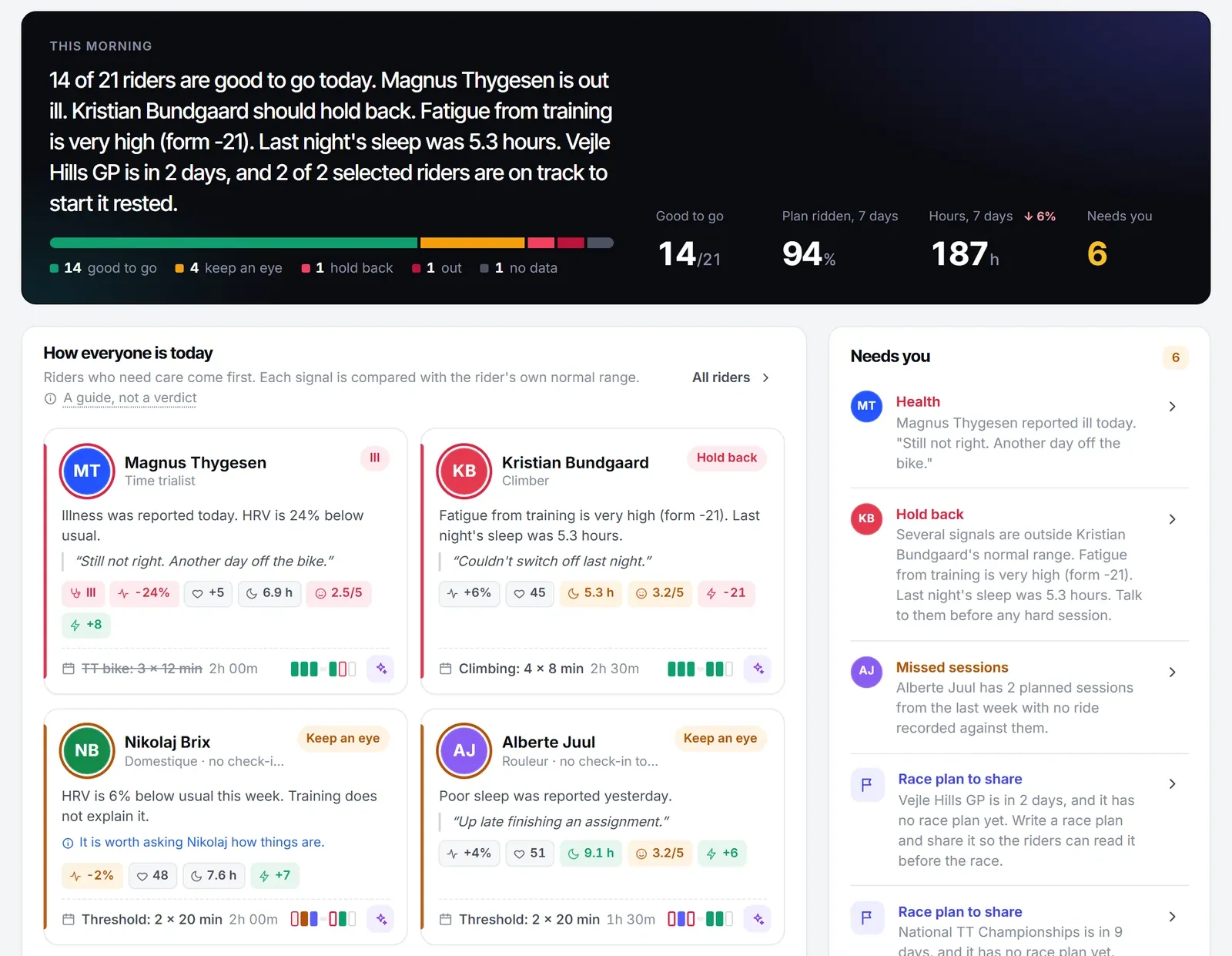
- The top line shows how many riders are good to go, the share of planned sessions ridden in the last seven days, the squad's hours and how many things need staff.
- How everyone is today gives each rider one word: good to go, keep an eye, hold back or out. It reads heart-rate variability and resting heart rate against the rider's own normal, last night's sleep, the morning check-in and training load, and says why in words. It is a prompt for a conversation, never a diagnosis.
- Needs you lists health first, then riders not absorbing training, then race plans to share and debriefs to write.
- Races ahead shows the next six weeks of races with their selections, each rider's projected form on the day, whether the plan is shared, and each rider's race days this season. Spreading racing fairly is a large part of rider selection.
- The fortnight against the plan draws the load each rider rode against the load planned. Within 20% of the planned load counts as ridden as planned; further under or over shows amber.
- Form map and good news show where each rider's fitness and form are heading, plus this week's new power bests and strong power late in long rides, each worth a word to the rider.
Body weight is deliberately left off the board. It belongs behind role-based views on the rider's profile, not on a screen the whole staff sees.
Roles, consent and free staff accounts
Velograph's team roles are owner, manager, coach, bike fitter, mechanic, clinician and rider, and one person can hold several. A mechanic sees bikes and fits, never training data. A clinician, such as a physio or doctor, sees profiles, bikes, fits and notes marked confidential, which only clinicians may read, and no training data unless they also coach. A personal coach can be linked to one rider and see that rider's training, and nothing else of the team.
When a team invites a rider, the invitation lists what the team asks for as boxes. The rider ticks them before joining: rides and training, bikes and fits, history from before joining, days with other teams and more. Nothing is ticked for the rider. Notes that can hold health information may be asked for but never required. Every answer is recorded in the words the rider read, and if a rider later switches a consent off, the team's managers are told.
The Team plan is priced by riders, and staff accounts are free, so the physio and the second mechanic never share a login. The details are on the pricing page. Studios and teams can try everything free, with no card needed, so you can run a training block or a race on it before deciding. Coaches who work with riders across several teams may also want our guide to cycling coaching software. When you are ready, start for free.
Velograph is not affiliated with, sponsored by or endorsed by any team, rider or company named in this article. Names are used only to refer to publicly reported work.