What a cycling team or club coach does each week: group plans, readiness checks, race preparation, debriefs, and talking to riders and parents, with checklists.
How to coach a cycling team comes down to a weekly rhythm that riders can rely on. You plan each group's week, check how riders cope, prepare races on paper, review them and keep everyone informed. A club's junior squad and a Continental team need the same jobs done; the difference is how many people share them.
What does a cycling team coach do?
A cycling team coach plans each rider's training, checks how riders cope with it, prepares them for races and reviews what happened, while keeping riders and parents informed. In a small club one person does all of it; in a bigger team the coach shares it with a sports director, a mechanic and a physio.
| Job | What it means each week | Who can share it |
|---|---|---|
| Plan | Sessions for each group, weekly targets, the race calendar | A second coach |
| Monitor | Check-ins, rides against the plan, illness | A physio or doctor for health |
| Prepare races | Selection, entries, the race plan, bikes and travel | Sports director, mechanic, parents |
| Review | Debriefs, tests, the season review | The riders, who speak first |
| Communicate | The weekly note, questions, meetings with parents | A team manager |
Write a name beside every job before the season starts. In a volunteer club, the coach is often also the driver and the mechanic. A parent can organise lifts, and an experienced rider can lead the skills session. The guide to cycling team management software shows which rider data each role needs to see.
What does a cycling coach's week look like?
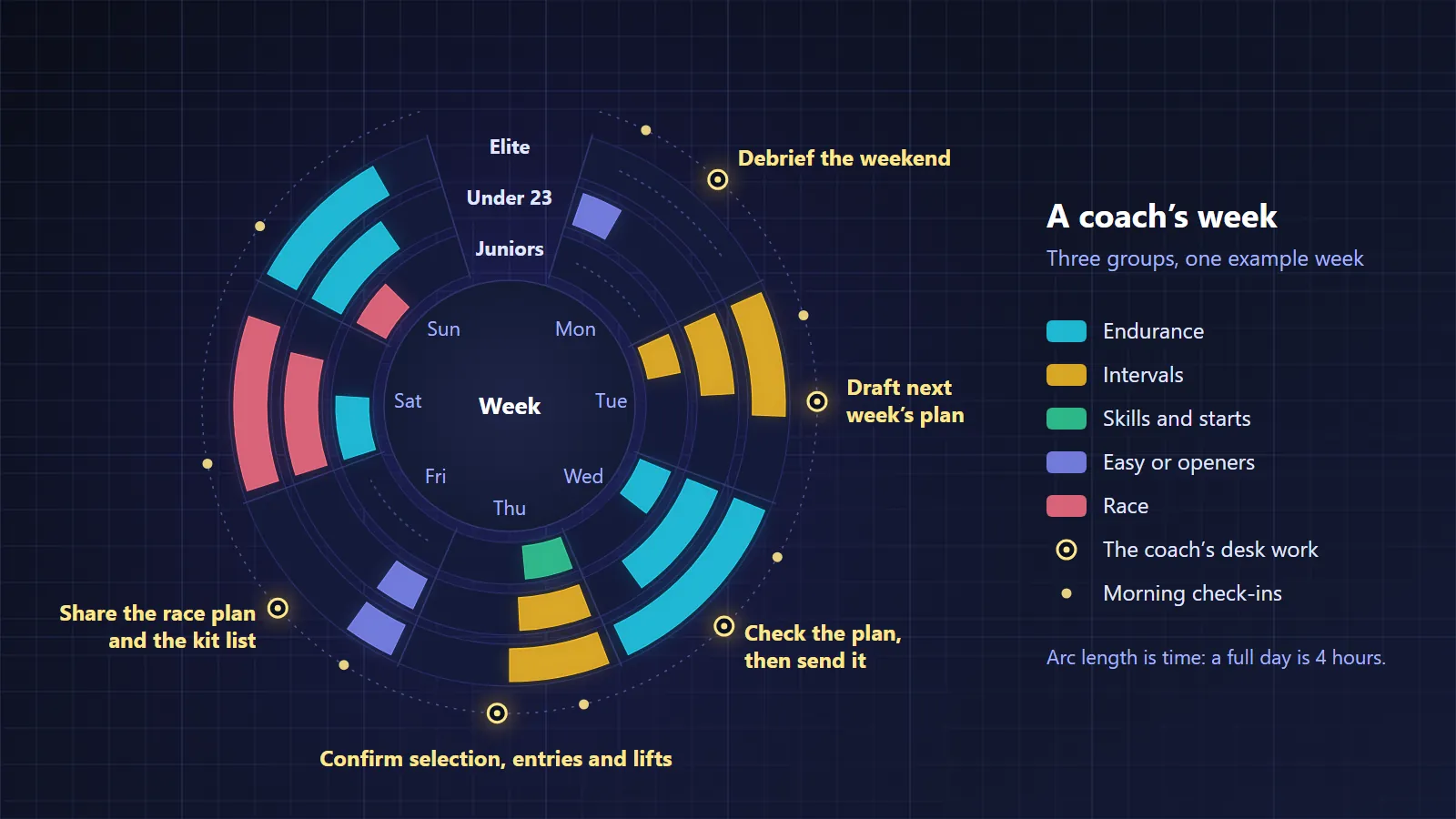
A cycling coach's week starts with the weekend's races and ends with the next ones. You review the weekend and debrief on Monday, write and send the next week's plan by Wednesday, and confirm selection and share the race plan by Friday. For 12 riders, the desk work takes about four and a half hours a week.
| Day | Task | Time for 12 riders |
|---|---|---|
| Every weekday morning | Check-ins and missed sessions; reply to anyone unwell | 10 minutes a day |
| Monday | Read the weekend's rides and results, then hold the debrief in person or on a call | 70 minutes |
| Tuesday | Draft next week's plan for each group, with the exceptions by name | 30 minutes |
| Wednesday | Check the draft against the check-ins, then send it | 30 minutes |
| Thursday | Confirm selection, entries and lifts | 30 minutes |
| Friday | Share the race plan and the kit list | 40 minutes |
| Saturday and Sunday | Race or long ride; the morning check-ins | 10 minutes a day |
Keep the rhythm the same every week, so riders know when the plan arrives. A plan sent on Wednesday leaves time to fit the week around school, work and lifts. For the Monday debrief, the guide to the race debrief has a four-question structure.
How do you plan training for a group of riders?
Plan one session for the whole group and set each rider's targets from their own numbers. Riders with power ride at a share of their own FTP, and riders without power go by heart rate or by effort on a 0 to 10 scale. Everyone rides the same session, but nobody chases a teammate's watts.
| Group | Main set on Tuesday | Target | Example |
|---|---|---|---|
| Elite and under-23 | 3 × 12 minutes, 4 minutes easy between | 95 to 100% of FTP | FTP 320 W: 304 to 320 W |
| Juniors, 17 and 18 | 3 × 10 minutes, 5 minutes easy between | 95 to 100% of FTP | FTP 260 W: 247 to 260 W |
| Under 17 | 4 × 5 minutes, 5 minutes easy between | Effort 7 out of 10 | No power meter needed |
Group riders by what they train for, not only by age. A strong 16-year-old may join the juniors for the Saturday ride and stay with their own age group for intervals. Then plan in this order:
- Mark every rider's races as A, B or C. The annual training plan guide shows how to build a season back from an A race.
- Give each group a weekly target in hours, with an easier week every third or fourth week.
- Write each session's purpose in one line, such as "threshold, steady, no surges".
- Put hard sessions straight after school, never late on an evening before an early start, and make exam weeks easier weeks.
- Plan the exceptions by name: the rider back from illness, the rider in exams, the rider who raced three days running.
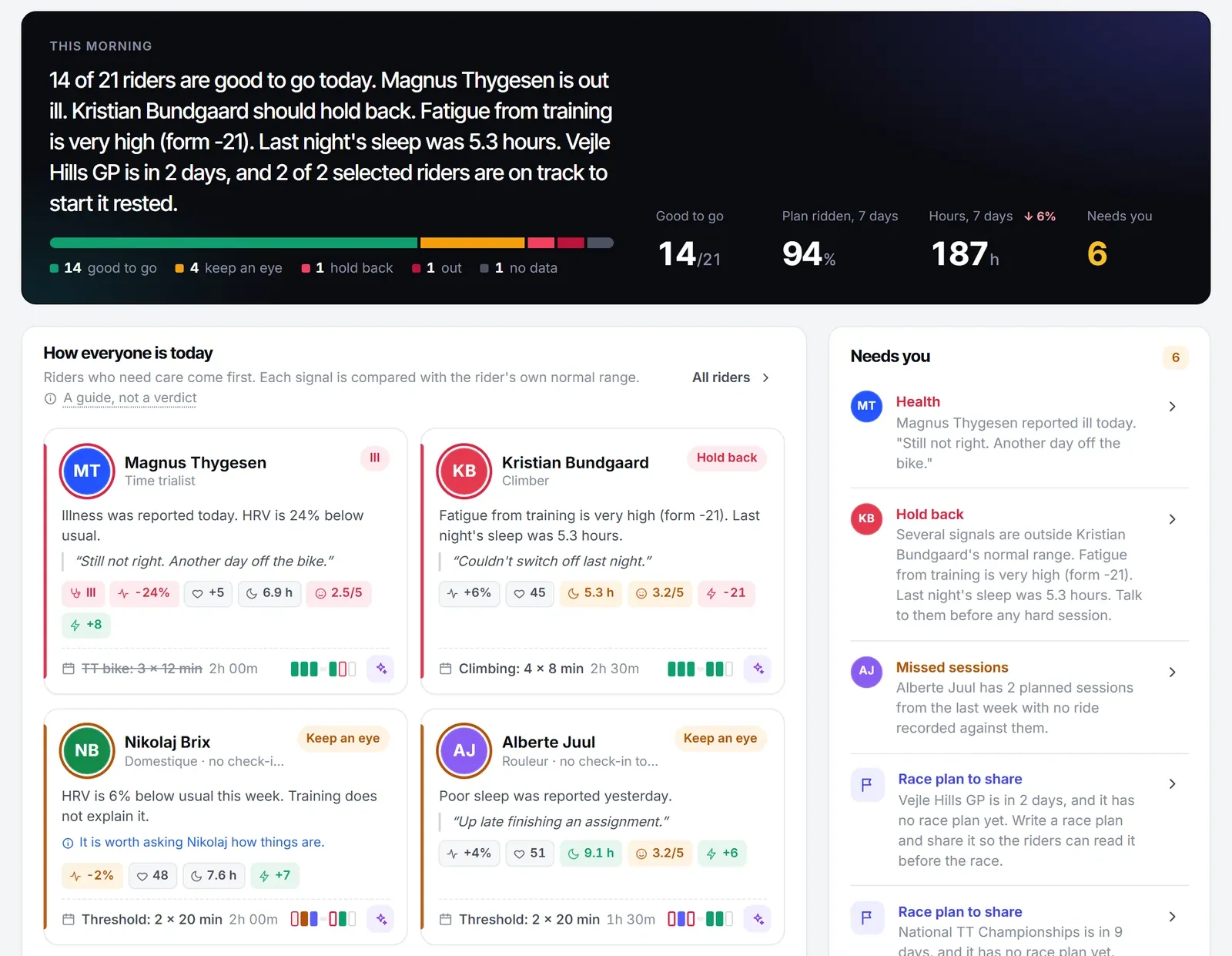
In Velograph, for example, a coach can lay a block of sessions onto a whole group's calendars at once, with the watts set from each rider's own FTP, as drafts the coach checks before riders see them. FTP, functional threshold power, is the highest power a rider can hold steadily for roughly 30 to 70 minutes, and the guide to what FTP is explains how to test it.
How should a cycling coach monitor riders?
Ask every rider for a short daily check-in and look at the exceptions first: who reported feeling ill or unusually tired, who missed planned sessions and whose training load jumped. Open individual ride files only when something stands out, and ten minutes a morning will cover a squad of 12.
In a 2016 systematic review of 56 studies, Saw, Main and Gastin found that athletes' own ratings of how they felt followed the rises and falls in training load more closely and more reliably than the objective measures most often used. The two kinds of measure generally did not agree, so a check-in does not replace heart rate or power. It tells you where to look.
| Question | Answer | When to act |
|---|---|---|
| How many hours did you sleep? | Hours | Two nights well below the rider's usual |
| How is your energy? | 1 to 5 | 2 or lower |
| How sore are your legs? | 1 to 5 | 4 or higher before a hard session |
| How are school, work and life? | 1 to 5 | 2 or lower |
| Do you feel ill? | Yes or no | Any yes: talk before the next hard session |
One flag is a reason to watch. Two flags on two days in a row are a reason to ease the next hard session. Illness means no hard training until the rider is well again, and pain or an injury belongs with a physio or doctor, not with the training plan. Riders should never see each other's check-ins.
How do you prepare a cycling team for a race?
Prepare a race by working back from race day, with one named person for each step. Select and enter riders about two weeks before, draft the race plan in the last week and share it two days out, check bikes and kit the day before, and hold the debrief within 48 hours.
| When | Task | Who |
|---|---|---|
| 14 days before | Selection and entries; tell riders who are not selected, and why | Coach or sports director |
| 7 days before | Draft the race plan: course, wind, roles, plan B, feeding | Coach |
| 5 days before | Travel and lifts; consent forms for riders under 18 | Team manager or a parent |
| 2 days before | Share the race plan with the riders | Coach |
| The day before | Bikes, spare wheels, bottles, kit, race numbers | Mechanic and riders |
| Race morning | A ten-minute briefing, then the warm-up | Coach |
| Within 48 hours | A debrief that ends with two or three actions | Coach and riders |
The article on rider selection covers telling a rider they were not picked, and the race day plan template is the form to fill in; how to write a race plan explains the thinking behind it.
Agree the crash rule before the season, not at the roadside. The UK's grassroots concussion guidelines, published in 2023 with the line "If in doubt, sit them out", say that anyone with a suspected concussion is removed at once, gets medical advice within 24 hours and does not return to sport within 24 hours. Other countries publish their own, so follow the one where your team races.
How should a coach communicate with riders and parents?
Use one channel and a fixed rhythm. Send a weekly note with the plan and the weekend, reply to every rider within a day, and meet the parents before the season and halfway through it. Talk to the rider first, and keep each rider's data between the rider, their coaches and, for a minor, their parents.
| Part of the weekly note | Example |
|---|---|
| The week's purpose | Base week 3, with a longer Saturday ride |
| Sessions for each group | Juniors 3 × 12 minutes at tempo on Tuesday; under 17 skills and sprints |
| The weekend | Saturday at 09:30 from the clubhouse, 3 hours; Sunday free |
| Who to contact | The coach for training, the team manager for lifts |
Parents are part of a junior team's staff. Tell them what you need from them: the school calendar and exam dates, news of illness or worries, and lifts. Tell them what you will do: plan the training, choose the races with the rider and call if something is wrong. Ask them to leave changes to the training and the tactics to the coach and the rider. Follow your club's and federation's safeguarding policy for riders under 18, including how adults may message them.
Listen for the reasons young riders stop. A 2015 review of 43 studies by Crane and Temple grouped the reasons children and adolescents leave organised sport under five headings: lack of enjoyment, how competent they felt, social pressure, other priorities, and physical factors such as maturation and injury. A coach can ask about each of them after a ride. For a rider under 18, involve a parent in what you record and who sees it; the guide to athlete data privacy covers consent for minors.
How is coaching juniors different from coaching elite riders?
Juniors, riders of 17 and 18 in the UCI's rules, are still growing and still at school, so their plan has fewer hours, more variety and school-first weeks, and a parent stays involved. Elite riders can take more racing and more structure, and they share more of the decisions with the coach.
| Juniors (17 and 18) and younger riders | Elite riders | |
|---|---|---|
| Weekly riding | 6 to 12 hours at 17 and 18, less when younger | Set by goals, work and racing |
| The week is built around | School, exams and sleep: 8 to 10 hours in every 24 for teenagers | Work, family and the race calendar |
| Who you talk to | The rider, and a parent of any rider under 18 | The rider |
| Numbers to leave out | Body weight, W/kg tables, FTP rankings | Whatever the rider has not agreed to share |
| Racing | Category by year of birth; national youth rules for 16 and under | The full calendar their level allows |
| Goals | Skills, enjoyment and steady progress over years | Results and selection |
The junior cycling training guide covers hours by age, growth and what to record. At the end of the year, hold a season review with each rider and build the next plan from it.
Further reading
- Monitoring the athlete training response: subjective self-reported measures trump commonly used objective measures: a systematic review, Saw, Main and Gastin, British Journal of Sports Medicine, 2016.
- A systematic review of dropout from organized sport among children and youth, Crane and Temple, European Physical Education Review, 2015.
- UK-wide concussion guidelines for grassroots sport, Sport and Recreation Alliance, 2023.
Velograph is not affiliated with, sponsored by or endorsed by any team, rider or company named in this article. Names are used only to refer to publicly reported work.