A fill-in race day plan for sports directors: course, weather, roles, plan B, feeding, kit and timings, each box shown filled in for a made-up race.
A race day plan template turns a sports director's thinking into ten boxes that staff fill in and riders read in two minutes. Each box below is a table to copy, filled in for the Brackmoor Classic, a made-up 132 km women's road race with a crosswind section and a hilly finishing circuit. For why each part matters, read how to write a cycling race plan; this page is the form.
What goes on a race day plan template?
A race day plan template has ten boxes: race facts, objective, course and key points, weather, roles and tactics, plan B, feeding, equipment, timings and open questions. Each box has an owner and a deadline, so most of the plan is ready two days before the race.
| Box | The question it answers | Filled in by | Ready |
|---|---|---|---|
| Race facts | When, where, how far, which category? | Team manager | At entry |
| Objective | What does success look like today? | Sports director | 3 days before |
| Course and key points | Where will the race turn? | Sports director and riders who know it | 3 days before |
| Weather | What will wind, heat or rain change? | Sports director | Evening before, rechecked on the day |
| Roles and tactics | Who does what, and until when? | Sports director and road captain | 2 days before |
| Plan B | What happens when it goes wrong? | Sports director and road captain | 2 days before |
| Feeding | What does each rider eat and drink, and where? | Soigneur and each rider | 2 days before |
| Equipment | Which wheels, tyres, gears and clothing? | Mechanic | Evening before |
| Timings | Where is everyone, and when? | Team manager | 2 days before |
| Open questions | What still needs checking? | Anyone; the sports director closes them | Race morning |
The example's objective is one sentence: win the sprint from a reduced group with Ida, or put Sofie in any move on the last two climbs.
How do you fill in the course and key points?
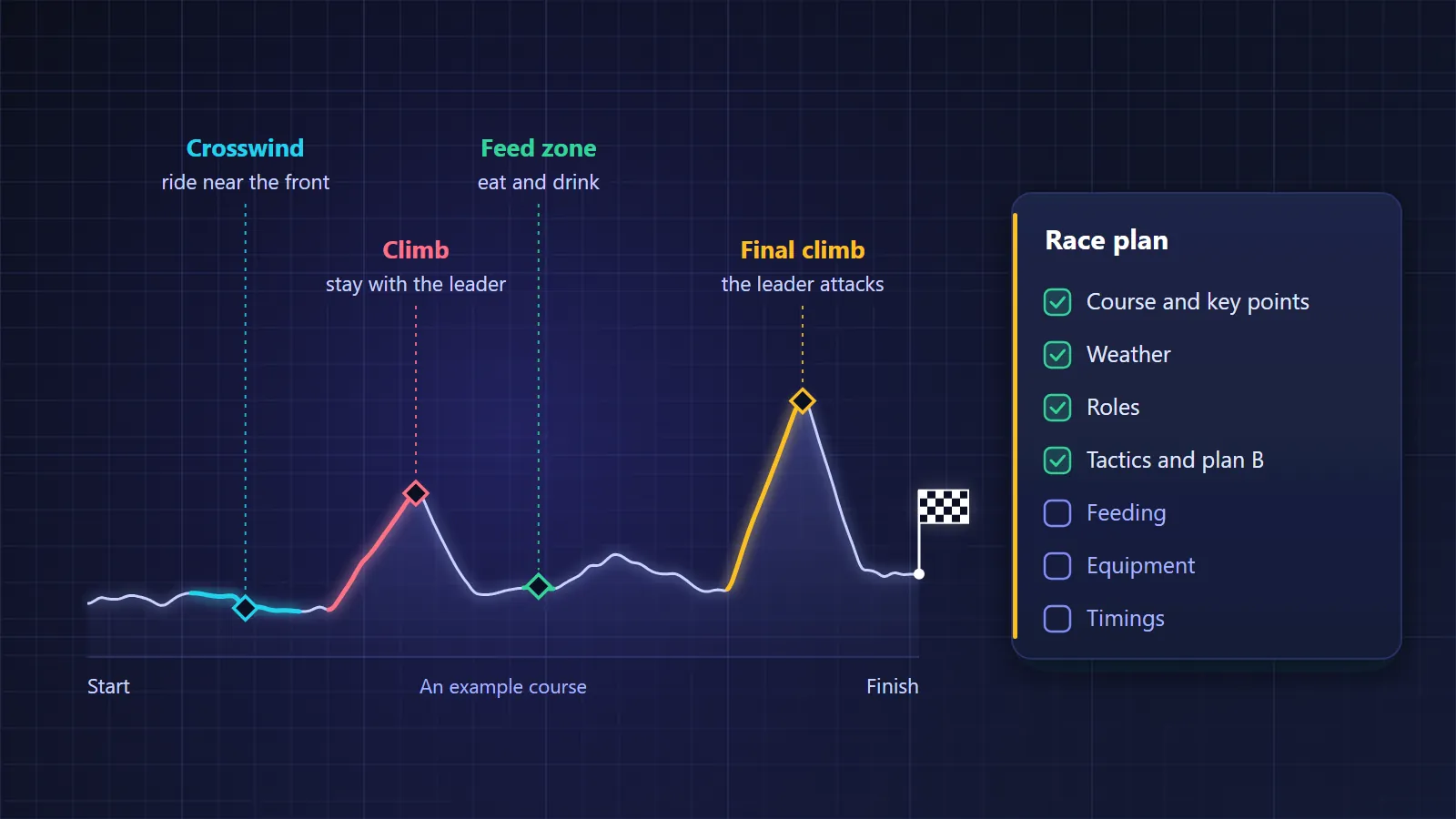
Fill in the race facts first, then list three to five places where the race will turn. Give each one its kilometre, what will happen there and where the team needs to be before it.
| Race facts | Brackmoor Classic |
|---|---|
| Category and date | Women's national road race, Sunday, start 11:00 |
| Distance and climbing | 132 km, 980 m |
| Route | 92 km along the coast, then four laps of a 10 km circuit over Brack Hill |
| Expected finish | About 14:35, at an average of 37 km/h |
| Km | Place | What happens | Where we need to be |
|---|---|---|---|
| 38 | Right turn onto the coast road | Crosswind from the left for 18 km | All six in the first 20 riders by km 35 |
| 61 | Feed zone, right-hand side | Bottles and musettes | Freja collects extra bottles for Ida and Sofie |
| 94 | Foot of Brack Hill, lap 1 | 1.2 km at 7%, climbed four times | Ida and Sofie in the first 15 at the foot |
| 114 and 124 | Brack Hill, laps 3 and 4 | The attacks start | Sofie on the wheel of the strongest climbers |
| 131.4 | Last corner, 600 m to go | Left turn, then 2% up to the line | Laura leads Ida out of the corner |
What weather should a race day plan include?
Write the wind direction and speed at each key point, the temperature at the start and the finish, and the chance and timing of rain. Add what each one changes for the team. Check the hourly forecast the evening before and again on race morning.
| Time | Where | Wind | Temperature | Rain | What it changes |
|---|---|---|---|---|---|
| 11:00 | Start | West-south-west, 20 km/h | 9 °C | Dry | Gilets and arm warmers on, off by km 30 |
| 12:00 to 12:30 | Coast road, km 38 to 56 | West-south-west, 25 km/h, gusts to 40 | 10 °C | Dry | Echelons likely; Maja calls the team forward at km 33 |
| 13:30 to 14:35 | Circuit | West-south-west, 25 km/h | 11 °C | 40% chance from 13:00 | Wet tyre pressures ready; descend in the first 10 |
Write the wind as a direction and a number, never as "windy". Take the times from the expected average speed.
How do you write roles, tactics and plan B on one page?
Give each rider one line with a role, a job, when the job ends and what comes next. Then write plan A by phase of the race, and plan B as "if, then" lines with the name of whoever makes the call. Use names, never "someone".
| Rider | Role | Job | Until | Then | Target |
|---|---|---|---|---|---|
| Ida | Leader, sprinter | Rides in the wheels and saves energy | The last lap | Sprints from 200 m | Under 300 W on Brack Hill, laps 1 and 2 |
| Sofie | Climber, second card | Follows attacks on Brack Hill | The finish | Rides for Ida if the group comes back together | |
| Maja | Road captain | Calls the team together 5 km before each key point | The finish | Makes the calls if the radio goes quiet | |
| Laura | Lead-out | Keeps Ida in the first 10 on the last lap | The last corner | Leads out to 200 m | |
| Freja | Domestique | Brings bottles and shelters Ida and Sofie | Km 92 | Places Ida at the foot of the first climb | |
| Emma | Breakaway rider | Goes with any early move of four or more riders | Km 38 | Helps Maja in the crosswind |
Ida's line says "in the wheels" for a reason. In a 2018 study with simulations and wind-tunnel tests, riders in the middle and rear of a 121-rider bunch had as little as 5 to 10% of the drag of a rider alone, with no strong wind. Rider selection with data shows how to match riders to roles.
| Phase | Km | The team's job |
|---|---|---|
| Start | 0 to 38 | Emma covers moves; the rest stay together in the first 30 |
| Crosswind | 38 to 56 | All six at the front before the turn; ride hard only if Ida and Sofie are in the first echelon |
| Feed and run to the circuit | 56 to 92 | Eat and drink, collect bottles at km 61, move up from km 88 |
| Circuit | 92 to 124 | Ida climbs at the target power; Sofie follows moves from lap 3 |
| Finale | 124 to 132 | If the group is together, the lead-out is for Ida. If Sofie is away, nobody chases |
| If | Then | Who calls it |
|---|---|---|
| Ida punctures before km 92 | Freja waits and paces Ida back; the rest hold position | Maja |
| Ida is dropped on Brack Hill | Sofie becomes the leader, and Laura rides for Sofie | Sports director, or Maja without radio |
| A break of five or more goes without us before km 38 | Emma bridges; after km 38 the team chases only on Maja's call | Maja |
Feeding and equipment
Write each rider's carbohydrate target in grams per hour, at the amount they have practised in training, and when each bottle reaches them. Individual fuelling plans belong with a registered sports dietitian; cycling nutrition by the numbers explains the usual ranges.
| Rider | Carbohydrate per hour | Bottles from the car | Feed zone, km 61 |
|---|---|---|---|
| Ida and Sofie | 80 g and 70 g | Km 30 and km 85 | A musette and two bottles each |
| Maja and Laura | 80 g each | Km 30 | Two bottles each |
| Freja and Emma | 60 g each | Collect extras at km 30 | Two bottles each, plus two for Ida and Sofie |
The equipment box is the mechanic's checklist. The reason beside each choice shows what to change when the forecast changes.
| Item | Choice | Why |
|---|---|---|
| Wheels | Mid-depth front, about 45 mm | Gusts to 40 km/h on the coast road |
| Tyres | 30 mm at each rider's dry pressure, wet pressures written down | Showers possible on the circuit |
| Gearing | 52/36 chainrings with an 11–30 cassette | Four climbs at 7% after 90 km |
| Clothing | Gilets and arm warmers at the start, rain jackets in the car | 9 °C at the start, showers from 13:00 |
What timings belong on a race day plan?
Write the day backwards from the start: when riders eat, leave, sign on, warm up and line up, then when they cool down, eat again and write their reflection. Each line gets a time, a place and a name.
| Time | What | Who |
|---|---|---|
| 07:30 | Breakfast, the one each rider uses before hard training | Riders |
| 09:00 | Leave the hotel | Team manager |
| 09:45 | Arrive; a ten-minute recap of the plan | Sports director |
| 10:00 | Sign-on, numbers and chips checked | Team manager |
| 10:15 | Warm-up on rollers, 20 minutes with three short efforts | Riders |
| 10:45 | Jackets on, at the start line | Riders |
| About 12:40 | Feed zone, km 61 | Soigneur |
| About 14:35 | Finish; dry clothes and a recovery drink | Soigneur |
| Evening | Each rider writes a short reflection | Riders |
Keep the warm-up easy and keep riders warm until the start. A review of warm-up research by David Bishop (2003) found that a warm-up that is too hard, or leaves too little recovery, can hurt short efforts. It also found that staying warm helps when the start is delayed or the day is cold. Afterwards, the plan goes to the race debrief.
How do you turn the plan into a briefing and a rider card?
Brief the plan box by box the evening before, in about 20 minutes. Then give each rider a card with only their own lines: their role, three key kilometres, their feeding, the plan B lines that name them and the time to be at the start.
| Minutes | Box | Who speaks |
|---|---|---|
| 0 to 2 | Objective | Sports director |
| 2 to 8 | Course, key points and weather, with the profile on screen | Sports director |
| 8 to 13 | Roles and tactics, rider by rider | Sports director, then each rider says their job back |
| 13 to 16 | Plan B | Road captain |
| 16 to 19 | Feeding, equipment and timings | Soigneur and mechanic |
| 19 to 20 | Open questions | Everyone |
Ida's card fits on a phone screen or a top tube:
- Leader. Stay in the wheels until the last lap, then sprint from 200 m.
- Km 35: in the first 20. Km 94: in the first 15. Km 131.4: on Laura's wheel.
- Under 300 W on Brack Hill, laps 1 and 2.
- 80 g of carbohydrate an hour; bottles at km 30, 61 and 85.
- Puncture before km 92: Freja waits. Dropped on Brack Hill: ride for Sofie.
- At the start line at 10:45.
Keeping the template with the race
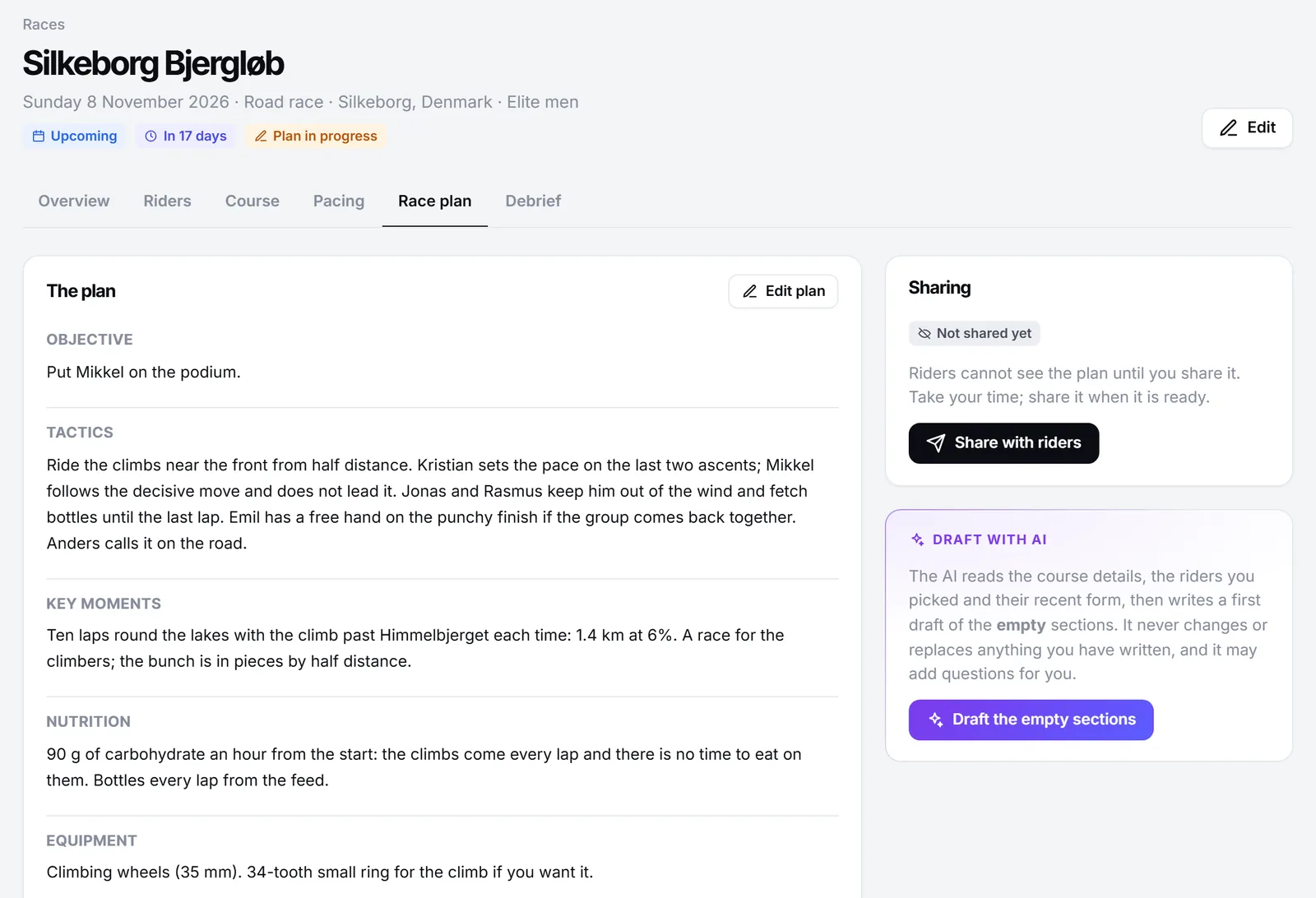
In Velograph, each race has a page with its riders, course, pacing, race plan and debrief. The plan has seven of the template's boxes: objective, tactics, key moments, nutrition, equipment, contingencies and open questions. Weather and timings have no box of their own, so they go under key moments and open questions.
Each selected rider gets a role with their own instructions and targets, shown at the top of the plan once staff share it. Pacing sets a target power for each section of the course, with the wind along the road. With AI credits, the AI can draft the empty sections, marked as AI, without changing what a person wrote.
The pricing page shows which plans include race plans and pacing.
Further reading
- Aerodynamic drag in cycling pelotons: new insights by CFD simulation and wind tunnel testing, Blocken and colleagues, Journal of Wind Engineering and Industrial Aerodynamics, 2018.
- Warm up II: performance changes following active warm up and how to structure the warm up, Bishop, Sports Medicine, 2003.
Velograph is not affiliated with, sponsored by or endorsed by any team, rider or company named in this article. Names are used only to refer to publicly reported work.