Run a race debrief within 48 hours: a four-question structure, the data worth bringing, the riders' own view, and two or three actions to keep.
A race debrief compares what the team planned with what happened, finds out why the two differed, and ends with two or three actions for the next race. Hold it within 24 to 48 hours, while memories are fresh and before the next race takes over. Ask the riders for their own view before staff give theirs, bring a few numbers rather than every file, and keep the talk on decisions, not on people.
Do debriefs improve performance?
Yes, debriefs improved performance by roughly 20 to 25% on average compared with no debrief, in a 2013 meta-analysis of 46 samples with 2,136 people. The effect was similar for teams and for individuals.
The researchers Tannenbaum and Cerasoli published that meta-analysis in the journal Human Factors. The effect held in real work as well as in simulations.
None of those samples were cyclists, but the lesson carries over. A short, structured conversation after the event is one of the cheapest ways a team has to get better. It costs an hour and some honesty, and the alternative is repeating the same mistakes at the same corner next year.
Most good debriefs borrow their shape from the after-action review, which the US Army developed in the 1970s. It discusses four things: the outcome the team wanted, the outcome it got, whether and why the two differed, and what was learned. The idea is that the people who were there work out for themselves what happened and why, rather than receive a verdict from above.
When should you hold a race debrief?
Hold the team debrief within 24 to 48 hours of the race, not at the bus straight after the finish and not a week later. Each rider writes a short reflection alone first, the evening of the race or the next morning.
A rider who has lost a sprint by half a wheel will not give a calm account ten minutes later. A week later, details have faded and the next race is on everyone's mind. Four layers work well for most teams.
| Debrief | When | Who | How long |
|---|---|---|---|
| Rider's own reflection | The evening of the race or the next morning | Each rider, alone, in writing | 10 minutes |
| Team debrief | Within 24 to 48 hours | Riders who raced, sports director, coach, and staff whose area came up | 30 to 45 minutes |
| Individual debrief | Within a week | One rider and their coach | 15 to 20 minutes |
| Stage race debrief | Every evening, after massage and dinner | Riders and staff | 10 minutes, then tomorrow's plan |
The riders write their reflection alone and first, for a reason. Once the loudest voice in the room has spoken, or the result is known to everyone, memories bend towards it. The same happens with data. When a power chart is already on the screen, riders tend to explain the chart instead of saying what they saw.
How do you structure a race debrief?
Use the same four parts every time, asking what the plan was, what happened, why there was a difference and what you will do next time. The riders then know what is coming and prepare for it. The times below are for a 40-minute team debrief.
- 1. What was the plan? Read the objective and the key moments from the race plan aloud. Allow 3 minutes. If the plan was vague, that is the first finding.
- 2. What happened? Rebuild the race in order, from the start to the finish, using the riders' accounts first and the files second. Agree on the facts before anyone gives an opinion. Allow 12 minutes.
- 3. Why was there a difference? At each moment where the race went another way than planned, ask why. Separate what the team controlled, such as positioning, timing, feeding and equipment, from what it did not, such as a crash ahead or a stronger rival. Allow 15 minutes.
- 4. What will we do next time? Agree two or three actions, each with an owner and a date. Allow 10 minutes. With more than three, usually none of them happen.
A worked example shows the level of detail that makes an action stick. The plan said "top 20 before the left turn into the crosswind at km 118". Only three of six riders made it. The riders said the road captain's call came 2 km before the turn, on a narrow road where nobody could move up. The action: call the team together 5 km before each crosswind section, and practise moving up as a group on Thursday's ride. The owner is the road captain, and the check comes at the next flat race.
What data should you bring to a race debrief?
Bring only the numbers that answer the questions the race raised, such as power before each key moment, climbs side by side, surges, late power and fuelling. Leave the rest of the file for the coach's own analysis.
Data confirms or corrects memory at the key moments. It does not replace the story. For a full method, see how to read a race file.
- Power and position in the two minutes before each key moment, such as the crosswind turn or the foot of the climb.
- Each rider's time and watts per kilo on each climb, side by side.
- The surges above critical power, the highest power a rider can sustain without draining a limited reserve. Note how many there were, when they came and who covered them.
- The best 5-minute power in the last hour against the rider's fresh best, which shows durability, how much power is left late in a long race.
- Carbohydrate and bottles taken against the plan.
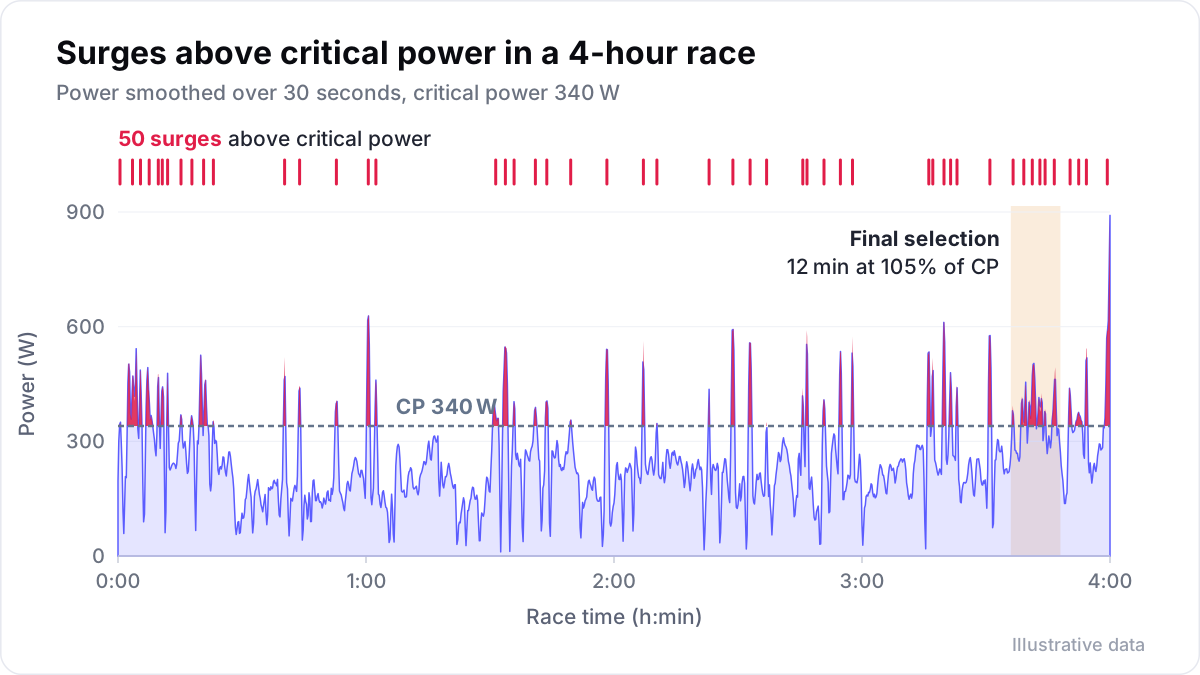
Read numbers in context. Low power in the finale can mean a rider was sheltered and perfectly placed, not tired. High power in the first hour can mean a rider was chasing moves the plan said to let go. The riders' accounts tell you which.
What should a rider write after a race?
After a race, each rider writes down how it went on a scale from 1 to 5, what went well, what they would do differently next time, and anything else.
Each rider's written reflection needs only four items. How did the race go for you, from 1 (very badly) to 5 (very well)? What went well? What would you do differently next time? Is there anything else, such as equipment, food, how you felt or the team's tactics? The number makes it easy to spot a rider who finished well but had a miserable day, or the reverse.
Keep the rider's words and the coach's assessment apart. A rider should never be asked to sign off on what a coach wrote about them, and a coach's notes should never be mistaken for the rider's own words. In the individual debrief, the coach adds an assessment of how the rider did their job and the lessons for next time, and then decides what to share. The finished debrief belongs with that rider's other races, so trends show up over a season.
How do you keep a debrief blame-free?
Keep a debrief blame-free by setting a few rules, saying them out loud the first time, and asking what riders saw rather than why they got it wrong. A debrief where riders defend themselves teaches nothing.
- Talk about decisions and moments, not about character.
- Judge a decision by what was known at the time, not by the result. A good decision can lose a race, and a poor one can win it.
- The sports director speaks last, so riders say what they saw before they hear what the boss thinks.
- Praise specific actions, not general effort.
- Disagreements about selection or roles go to a one-to-one meeting, not the team room.
The wording of the questions does most of the work.
| Instead of | Ask |
|---|---|
| Why did you miss the break? | What did you see when the break went? |
| You ate too late. | When did you take your first gel, and what got in the way? |
| The lead-out was a mess. | Where did the train lose the front, and what would have kept it there? |
| Who was supposed to be on the wheel? | What did the plan say here, and was it clear on the road? |
This is the same habit that sits behind marginal gains: measure, compare and change one thing, without anyone needing to lose face.
Make it findable for next year's edition
Most teams ride the same races year after year, and the course rarely changes much. A debrief that lives in a group chat is gone by next spring. Store it with the race: its name, date and edition, the plan, the riders' reflections, the staff assessment, the lessons and the course with its key kilometres. Next year's plan then starts by reading last year's lessons.
Keep a short "lessons for this race" list at the top. For example: "Crosswind after the turn at km 118 whenever the wind is from the south-west. Feed zone on the right after a left-hand bend. The finishing straight rises gently, so start the sprint later than it looks." The same notes help with rider selection for the next edition.
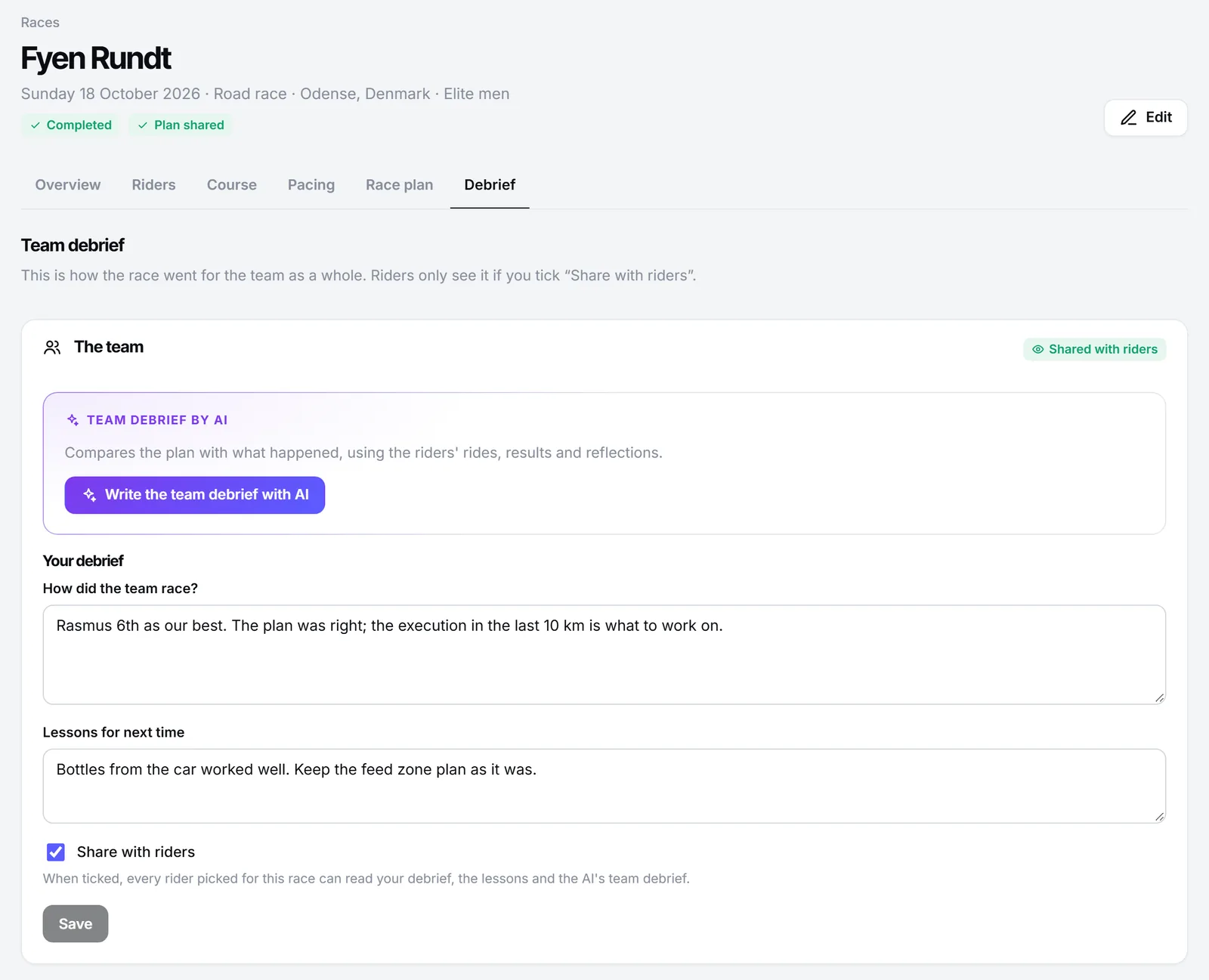
In Velograph, each race keeps its plan and its debriefs on one page. Riders write their own reflection, staff write the team debrief and one for each rider, and any AI reading of the data is labelled and kept apart from what people wrote. Staff choose what each rider gets to read. A table of the climbs sets every rider's time and watts per kilo side by side.
Further reading
- Do team and individual debriefs enhance performance? A meta-analysis, Tannenbaum and Cerasoli, Human Factors, 2013.
- An After Action Review of a Research Project Team: A Teaching Case, Mack Center, University of California, Berkeley, 2015.
Velograph is not affiliated with, sponsored by or endorsed by any team, rider or company named in this article. Names are used only to refer to publicly reported work.