Heated trousers and travelling pillows made the headlines. The lasting lesson of marginal gains was to measure every change, and any club can copy it.
Marginal gains is the idea that many small improvements, each one tested and kept only if it works, add up to a large one. Dave Brailsford made the phrase famous at British Cycling and then at Team Sky. The stories that travelled were the quirky ones: heated trousers, riders' own pillows, advice on washing hands. The lasting lesson is plainer and more useful: treat every change as an experiment, measure it before and after, and weigh it against the big things that decide most races. That method works for a club rider with a power meter as well as it worked for an Olympic squad.
What is the aggregation of marginal gains?
The aggregation of marginal gains means improving every part of riding a bike by about 1%, so the small improvements add up to something significant. Dave Brailsford called it that when he explained the principle to the BBC during the London 2012 Olympics.
Brailsford was British Cycling's performance director from the early 2000s until 2014, and principal of Team Sky from its first season in 2010. The results gave the idea its fame. Britain won seven of the ten Olympic track cycling titles at Beijing in 2008 and matched that in London four years later, as Harvard Business Review later summarised. Team Sky launched with the stated aim of a British Tour de France winner within five years, and Bradley Wiggins won the Tour in 2012. By then the idea had its own department: Matt Parker was director of British Cycling's Marginal Gains department in the run-up to London.
Behind the slogan sat performance scientists. Tim Kerrison, an Australian sports scientist who came to cycling from swimming and rowing, joined Team Sky before its first season. In 2016, as road.cc reported, WIRED described his five-page checklist for each rider. It listed 74 factors, from power-curve analysis and the demands of the event to fat and carbohydrate metabolism, heat and altitude. That is the real model: a written list of what decides performance, with a measurement against each line.
What are examples of marginal gains in cycling?
The best-known marginal gains in cycling are electrically heated trousers worn between the warm-up and the start, riders' own pillows and bedding at races, and hygiene habits such as washing hands properly. Each one targets a specific loss that can, in principle, be measured.
That makes the publicly reported examples worth reading as experiments rather than anecdotes.
| Reported gain | The loss it targets | How you could measure it |
|---|---|---|
| Electrically heated trousers worn between the warm-up and the start | Muscle temperature falling while a rider waits | Sprint power after a fixed wait, with and without them |
| Riders' own pillows, memory-foam mattresses and hypoallergenic bedding at races | Poor sleep in a different hotel every night | Hours slept, morning readiness, how a rider rates the night |
| Hygiene habits, such as how to wash hands properly | Colds and stomach bugs during races and camps | Training days lost to illness over a season |
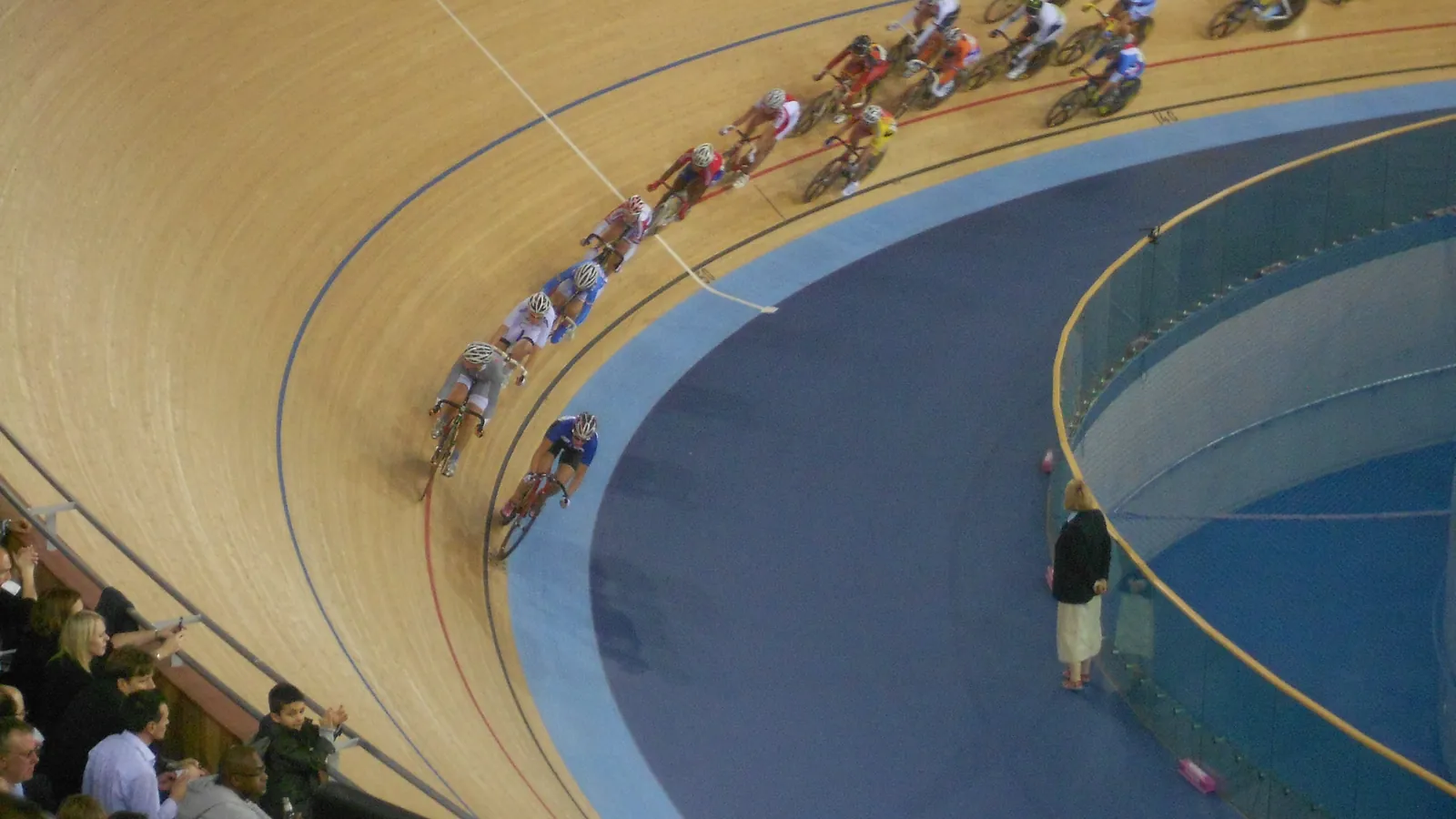
The heated trousers are the most thoroughly documented. Adidas developed them with British Cycling and Loughborough University for the London track programme, according to BikeRadar. A Loughborough study by Faulkner and colleagues (2013) then put a number on the idea. Eleven male cyclists warmed up, waited 30 minutes, and sprinted for 30 seconds. With electrically heated trousers during the wait, their peak power was 9.6% higher than in ordinary tracksuit trousers. Insulated trousers without heating did not keep the muscles as warm. That comparison is the method in miniature: the idea was tested against a cheaper alternative rather than taken on trust.
Sleep and hygiene are harder to measure directly. In 2016, BikeRadar visited Team Sky's service course in Belgium. Its reporter was shown riders' own pillows for the season, mattresses in different thicknesses for different riders, hypoallergenic bedding and air purifiers, and a routine of preparing and cleaning each hotel room every night. Nobody can measure what a pillow is worth in a stage win. You can measure sleep and days lost to illness, and five days lost to a cold is a large loss for any rider.
Do marginal gains add up?
They do on paper, where ten separate improvements of 1% each multiply to about 10.5% (1.01 to the power of ten). In practice they add up to less, because gains overlap, and a single 1% gain is hard to see through day-to-day noise.
The appeal of marginal gains is compounding. Even one gain matters. In a one-hour time trial, 1% more speed is about 36 seconds.
Two cautions keep the arithmetic honest. First, gains overlap. A better aero position and a faster skinsuit both reduce the same drag, so their effects do not stack neatly. Second, 1% of power is not 1% of speed. On flat roads most of your power pushes air, and air resistance rises steeply with speed, so 1% more speed costs roughly 3% more power.
The bigger problem is noise. Paton and Hopkins (2001) reviewed the tests used in cycling research. In a self-paced test, such as a time trial over a set distance, power typically varies by about 2 to 3% from one attempt to the next. The most controlled laboratory tests vary by about 1%. A single test before and a single test after cannot show a 1% gain, because the day-to-day noise is two or three times larger than the effect.
There are three ways around it, and good performance staff use all three:
- Measure closer to the change. Test the effect of a new skinsuit on drag, not on race results.
- Repeat. Three or four runs of each option show you the spread, so you can tell a real difference from a lucky day.
- Control the conditions. The same route, time of day, tyre pressure, warm-up and fuelling, or an indoor track where the weather cannot change.
What matters more than marginal gains?
Consistent training, health, sleep and fuelling, and a position you can hold matter more than marginal gains. Small gains add to these large factors and never replace them.
A rider who sleeps six hours, trains erratically and holds a position they cannot sustain has nothing to aggregate. Kerrison's checklist is a useful reminder: the factors reported were about the race and the rider's physiology, not bedding.
For most riders, this is the order in which the watts are found:
Consistent training. Months of steady, well-planned load move the whole power curve. For a rider with a 250 W FTP, a 5% gain over a winter is 12.5 W on every road, climbs included.
Health, sleep and fuelling. Days lost to illness and underfuelled long rides cost fitness that no training trick replaces.
A position you can hold. A fit that is comfortable for the full race duration lets you produce your power. Keep a record of every bike fit so you know what changed and why.
Aerodynamics of the position. On the flat, the rider's body makes most of the drag.
Pacing and tactics. Even time trial pacing and staying sheltered in a bunch save energy in every race.
Equipment and the small things. Tyres, clothing, chain, warm-up routine, the pillow.
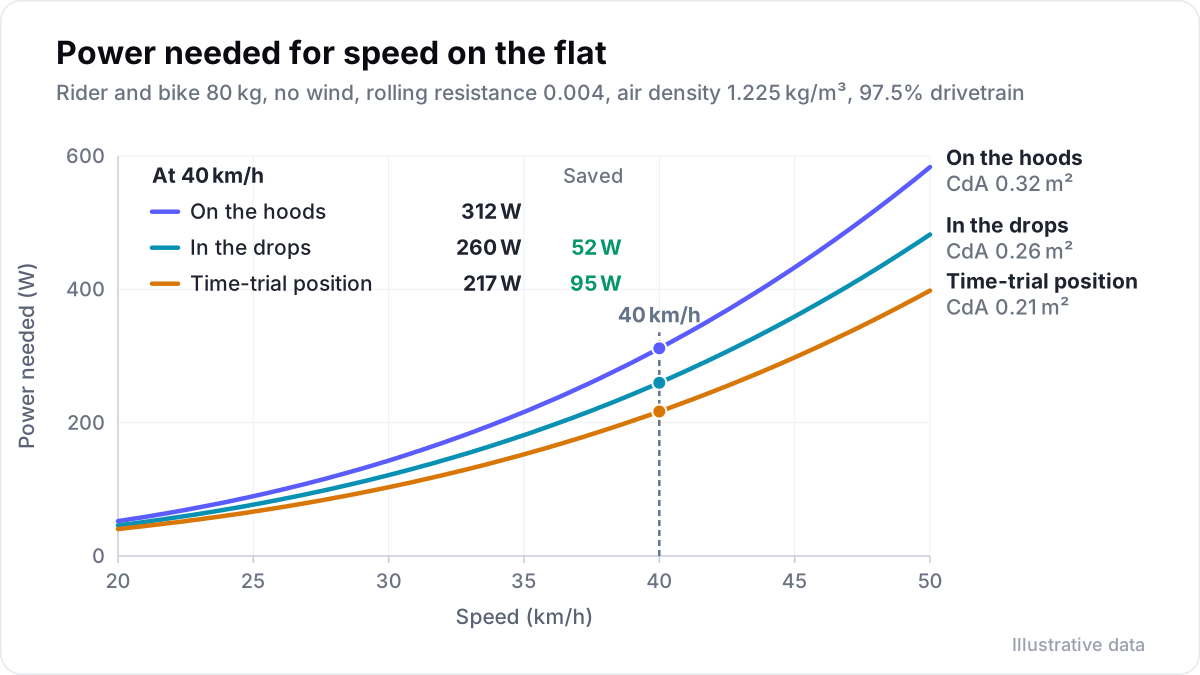
Aerodynamics shows why measuring matters. In the diagram below, the power needed on flat roads climbs steeply with speed in each of three positions. At 40 km/h, lowering your drag area (CdA, explained in cycling aerodynamics) by 0.01 square metres saves about 8.6 W for an 80 kg rider and bike. Over a 40 km time trial at 250 W, that small change is worth about 45 seconds.
How do you measure a marginal gain?
Measure the same number several times before and after one change, under the same conditions. Keep the change only if the difference is larger than the spread of the runs for each option.
The method is the part worth copying, whether the change is a saddle, new tyres, a warm-up or a training block.
Write the question and the number that should move. "Are the new tyres faster?" becomes "speed at 220 W on my test loop".
Record a baseline more than once. Three runs give you a spread; one run gives you a guess.
Change one thing. Two changes at once teach you nothing about either.
Repeat the same protocol. Same route, time of day, tyre pressure, warm-up and food. Note the temperature and wind.
Alternate the options. Run them in the order A, B, A, B, so a change in the weather or your legs during the session affects both.
Compare the difference with the noise. Keep the change only if the difference between A and B is larger than the spread within A and within B.
Write it down where you will find it next season. Most lost gains are forgotten gains.
A gains log does not need software. A table with five columns is enough:
| Date | Change | Test | Result | Decision |
|---|---|---|---|---|
| 12 March | Saddle 4 mm higher | 20 minutes at the same heart rate, twice each | +3 W, within the spread | Keep for comfort, test again in May |
| 2 April | Bars 2 cm narrower | Test loop, four runs of each | Drag area 0.262 to 0.254 | Keep |
| 20 April | Warm-up ends 30 minutes before the start | Two club time trials | First 5 minutes felt flat both times | Move to 10 to 15 minutes before |
The entries are made up; the structure is the point. Every change has a test, a result and a decision. When fits, bikes and rides sit in one record, as they do in Velograph, the before and after are easy to find a year later.
How can amateur cyclists use marginal gains?
Amateur cyclists can use marginal gains by copying the habits behind them. Keep warm after the warm-up, protect sleep on race trips, take hygiene seriously, check the bike, debrief every race and test one thing a month. You do not need a performance department.
- Keep warm after the warm-up. For short, hard events, time the warm-up to finish close to the start and wear warm layers while you wait. The Loughborough study shows how much a cooling muscle can cost in a sprint.
- Protect sleep on race trips. Your own pillow weighs nothing in a car. A familiar routine, a dark, cool room and a regular bedtime are within anyone's reach.
- Take hygiene seriously at camps and stage races. Wash hands before meals, use your own bottles, and keep a sick rider away from the group. If you are ill, see a doctor rather than training through it.
- Check the bike before every race. Tyre pressure, a clean and lubricated chain, brakes that do not rub. These are free.
- Debrief every race. A short race debrief turns each result into one or two things to change.
- Give staff one view of the squad. For a club or team, cycling team management software puts readiness, plans and rides in one place, so a coach spots a problem early.
- Test one thing a month. Twelve honest tests a year beat a garage full of untested upgrades.
Read this way, marginal gains is not a list of tricks. It is a habit: ask what limits performance, measure it, change one thing and check again. The habit is free, and it works for a WorldTour team and a Tuesday-night chaingang alike.
Further reading
- How 1% performance improvements led to Olympic gold, Harvard Business Review, 2015.
- 'Hot pants' to power Team GB's pursuit of Olympic glory, BikeRadar, 2012.
- From pillows to Pinarellos: inside Team Sky's marginal-gains world, BikeRadar, 2016.
- Reducing muscle temperature drop after warm-up improves sprint cycling performance, Faulkner and colleagues, Medicine and Science in Sports and Exercise, 2013.
- Tests of cycling performance, Paton and Hopkins, Sports Medicine, 2001.
Velograph is not affiliated with, sponsored by or endorsed by any team, rider or company named in this article. Names are used only to refer to publicly reported work.