What professional cycling teams say they measure, who turns ride files into decisions, what the UCI allows in races and what a club can copy.
How pro cycling teams use data is best described from what the teams themselves have said, not from the power numbers shown on television. They record power and heart rate on their rides, test riders at camps, log meals in apps and study races afterwards. Analysts turn the files into reports for coaches and sports directors, and people make the decisions. Here is what teams have reported, who does what with the data, what the UCI allows in races and what a small club can copy. The Team Sky years are covered in our article on marginal gains.
What data do pro cycling teams collect?
Teams collect power and heart rate from rides, test results such as blood lactate at training camps, and meal logs from nutrition apps. With UCI approval, some add new measures such as breathing. Some keep the data for years, so a young rider can be compared with those who came before.
| What is measured | Example a team or its partner reported |
|---|---|
| Power and heart rate from rides | At Jumbo-Visma, riders' power meters and heart-rate monitors sent data to the cloud over wifi near the team bus (Leiden University, 2021) |
| Lactate tests at camps, race files, a database of past riders | Lidl-Trek, on Trek's racing website (2024) |
| Meals logged in an app | The Visma team said its riders logged 55,000 meals in the FoodCoach app in 2024 |
| Energy needs before a race | Visma's nutrition model uses heart rate, average power, height, weight, the rider's role, the race profile and the weather (team website, 2024) |
| Breathing during races | The UCI approved the Visma team's breathing sensors from Tymewear for the 2025 Tour de France (Domestique, 2025) |
The data also moves between systems. When Visma | Lease a Bike named TrainingPeaks its official training software in 2024, the team said training and race files would flow into FoodCoach automatically. Its performance nutritionist said that when a session runs longer or harder than planned, the rest of the day's meals get bigger. In February 2025, Wielerflits reported that Red Bull-BORA-hansgrohe would use the same app.
What does a cycling team performance analyst do?
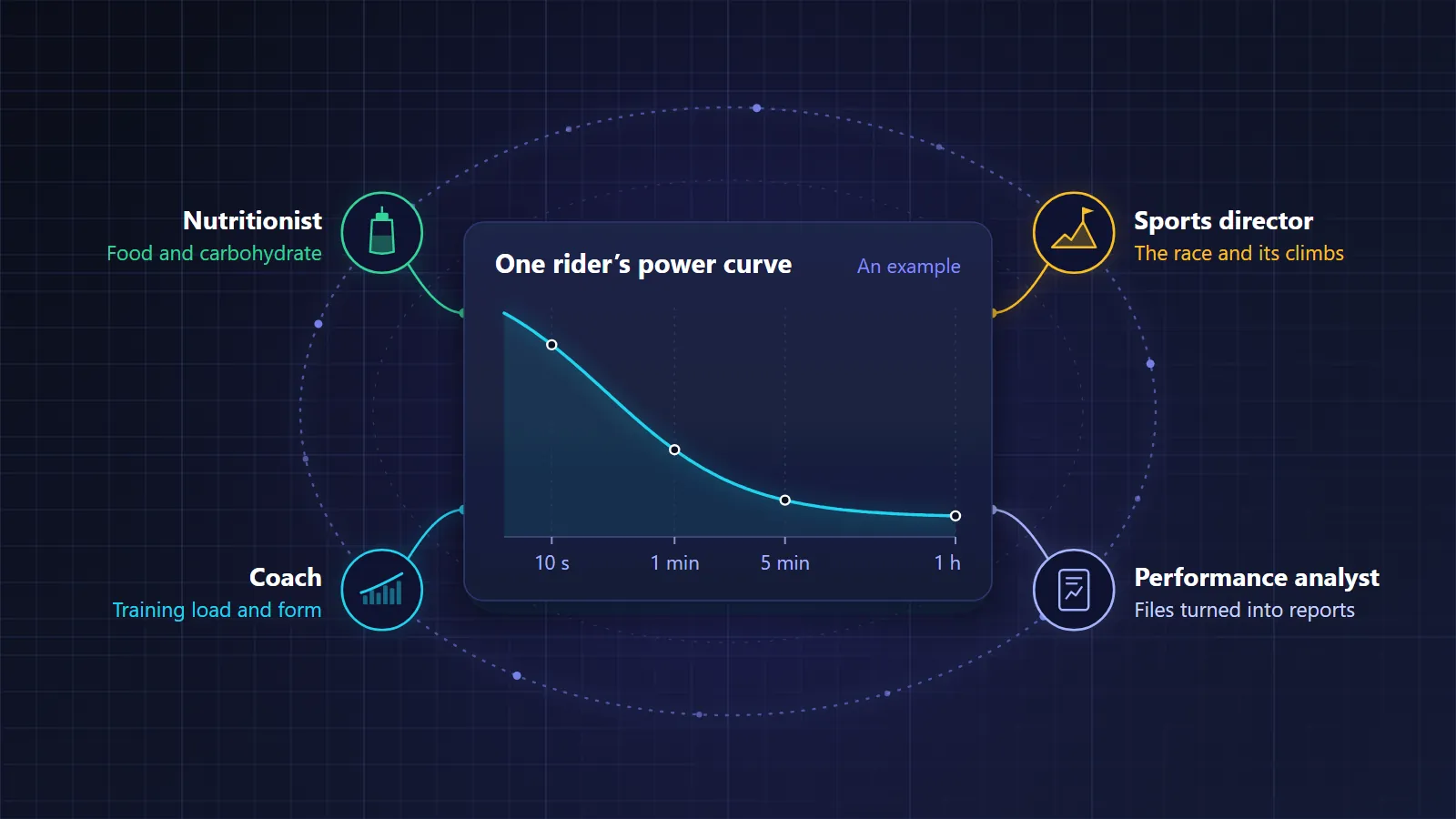
A performance analyst turns riders' files into reports that each specialist can use. Lidl-Trek has described two data analysts who arrange the numbers for its coaches. They also prepare race reports for sports directors, and reports on a rider's development that doctors or nutritionists can use.
In January 2024, Lidl-Trek described the set-up on Trek's racing website. Josu Larrazabal, then head of performance, had designed it. The analysts Xavi Tarralardona and Javi Angulo prepare the data, and the coaches Aritz Arberas and Xabi Zabalo turn it into training. The team said its analysis now covers every race day of the men's and women's calendars, not only the key races. A database of past riders lets staff compare young riders with those who came before. When the team signed Jonathan Milan, the numbers confirmed what staff believed about his potential, although intuition still played a part.
The role keeps growing. In June 2026, Lidl-Trek announced that Dan Lorang would become head of performance from 1 August. His remit covers coaching, nutrition, health, recovery and athletics, as well as data and AI.
| Role | What it does with data, as teams describe it | Who does it in a club |
|---|---|---|
| Data analyst | Extracts files and builds reports for each specialist | The coach, or a volunteer who likes spreadsheets |
| Coach | Reads the reports and turns them into training | The coach |
| Sports director | Uses race-specific reports for decisions in the race | The team manager or captain |
| Doctor or nutritionist | Uses reports on a rider's development in particular situations | A doctor, physio or registered sports dietitian outside the club |
| Head of performance | Oversees the departments, data and AI included | The head coach |
| Data scientist | Looks for patterns across seasons, at Jumbo-Visma with a university | Rarely anyone, and that is fine |
Our guide to cycling team management software covers which rider data each role needs to see.
Do pro teams publish their riders' data?
Some teams do, through research with universities. Mathieu Heijboer, now Visma | Lease a Bike's head of performance, co-wrote a peer-reviewed study of nine riders' files from the 2016 Giro d'Italia. Jumbo-Visma also worked with Leiden University's data scientists on its general classification riders.
Dajo Sanders and Mathieu Heijboer (2019) analysed the power and heart rate of nine riders from one WorldTour team across that Giro. Heijboer's affiliation on the paper was Team LottoNL-Jumbo, as Visma | Lease a Bike was then called. Time trials were the most intense stages, and mountain stages carried the highest load. Flat stages called for higher peak power over 5 to 30 seconds, and hilly stages over 30 seconds to 2 minutes. Time trials and mountain stages called for higher power over efforts longer than 10 minutes. A club can use the same split to pick training for a target race, and race analysis shows how to read your own race files that way.
In June 2021, Leiden University described its data scientists' work with Jumbo-Visma. They were studying the team's general classification riders, such as Primož Roglič, Steven Kruijswijk and George Bennett. The question was whether hard days before a key stage left a rider short of their best, so that staff would know when to ease off. Heijboer said the results had helped shape the team's tactics for new races that year. The same article noted that INEOS and EF also worked with data scientists.
Is pro cycling as data-driven as it looks?
Less than it looks, according to Visma | Lease a Bike's head of performance. In May 2026, Mathieu Heijboer said the power numbers fans see after stages create the image of a data-driven team. Riders are coached to race on feel, and data works mainly in the background.
"People think it's very data-driven, but we are above all very people-driven," he said on the In De Waaier podcast, as IDL Pro Cycling reported. He said most of the team's riders do not check their numbers on climbs, and that time trials are paced by feel, sector by sector. He does not want riders tied to a number, because that can hold them back or leave them disappointed. Some data is kept from riders, because knowing everything does not always help them.
His example was Jonas Vingegaard's time trial on stage 16 of the 2023 Tour de France. Vingegaard saw that his power looked too high, felt good and kept going. In this account, data teaches the team after the race, and the rider decides during it.
What data can riders use during a race?
Under UCI article 1.3.006 bis, bikes and riders may carry devices that record position, images and mechanical data such as power. Heart rate, body temperature and sweat rate are allowed too, but only the rider may see them during a race. Devices that measure metabolic values such as glucose or lactate are not allowed in competition.
- In force since June 2021. BikeRadar reported that the ban on metabolic sensors took effect on 10 June 2021. Glucose sensors can still be worn in training.
- Only your own team's data. A rider may not see another rider's data. A team may receive data only from its own riders, where sending it is allowed, apart from what is public.
- Checks on new set-ups. When Visma | Lease a Bike unveiled a "control room" van before the 2024 Tour, the UCI said it would check how data was captured and sent. Its statement named article 1.3.006 bis and the primacy of the human over the machine.
- Smaller screens from 2028. From 1 January 2028, bike computers in competition may be at most 126 by 71 mm, as road.cc reported in June 2026. The UCI gave the riders' cognitive load as the reason.
Are pro teams using AI coaching platforms?
Some teams say so in partnership announcements. In February 2026, Vekta announced that Lidl-Trek and Team TotalEnergies had made it their official training and coaching platform. It said Decathlon CMA CGM was using it across its squads.
These are partnership announcements. They say what a platform is meant to do: plan training, prepare races and review performance, with less time spent handling files. They do not report any effect on results. Our article on AI coaching for cycling teams covers what such platforms do for staff and who should decide.
What can a club or small team copy?
A club can copy the method with one coach. Keep every rider's files in one place, rate every session from 0 to 10, review each rider for ten minutes a week, report on key races and keep each rider's numbers across seasons.
One place for files. Every ride from every rider lands in one system, not in ten phones.
A rating for every session. Riders give each session a 0-to-10 rating, and duration times rating gives a load score without any sensor. Our guide to cycling training data explains why that simple number holds up in research.
A weekly review. The coach spends ten minutes per rider on hours against plan, sessions done and how the rider feels. Then the coach talks to the two or three riders who stand out.
A report after key races. Note the course, the best efforts at 1, 5 and 20 minutes, and one thing to change. The race debrief has a template.
A season record per rider. Keep yearly hours and best efforts, so that selection rests on trends. Rider selection shows how to use them.
Consent first. Riders agree to what is shared and with whom, and a parent does too for riders under 18. See athlete data privacy.
The conversation last. Heijboer's account is a reminder that a number should lead to a talk with the rider, not replace it.
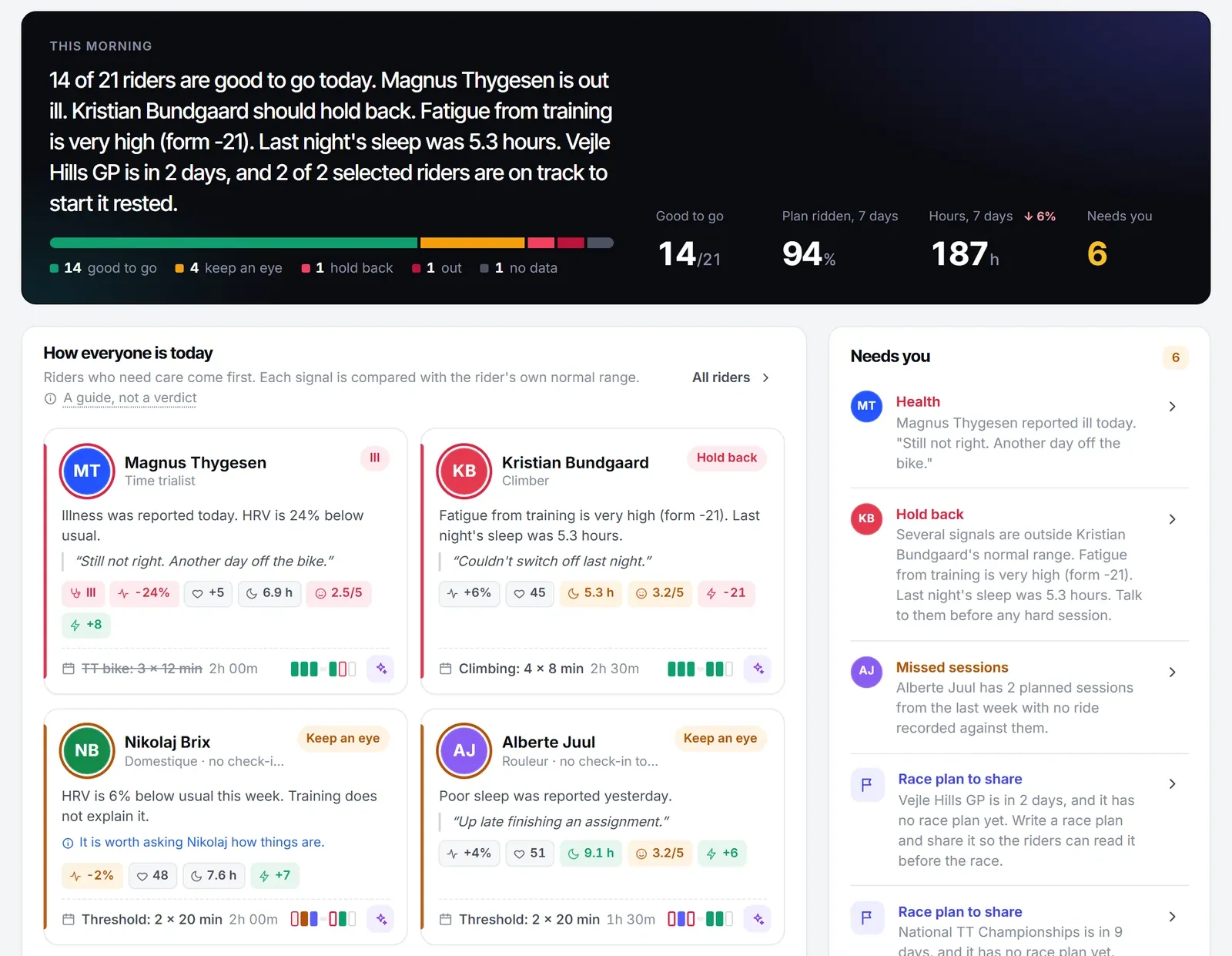
Software can carry the first three steps for a small staff. Velograph's squad board, shown above with demo data, starts each morning with every rider's readiness, plan against what was ridden, form and coming races. Staff accounts are free. Each rider decides which parts the team sees, as our overview of a cycling performance platform explains. The decisions stay with the coach and the sports director, as they do at the professional teams.
Further reading
- From data to decisions: how Lidl-Trek are using analytics to enhance rider performance, Lidl-Trek on Trek's racing website, 2024.
- Physical demands and power profile of different stage types within a cycling grand tour, Sanders and Heijboer, European Journal of Sport Science, 2019.
- Arno Knobbe: data science in the Tour de France, Leiden University, 2021.
- Mathieu Heijboer pushes back on cycling's data myth, IDL Pro Cycling, 2026.
- UCI bans blood glucose and lactate monitoring devices from competition, BikeRadar, 2021.
Velograph is not affiliated with, sponsored by or endorsed by any team, rider or company named in this article. Names are used only to refer to publicly reported work.