What AI coaching does for a cycling team's coaches and staff, where it falls short, who should decide, and which platforms are built for teams.
AI coaching for cycling teams works best as a second pair of eyes for the staff. It reads every rider's rides overnight, flags the few riders who need a person today, and drafts readings and sessions for the coach to approve. It falls short on everything a coach learns by talking to riders, so the decisions should stay with the coach.
What can AI do for a cycling team?
AI can read every ride of every rider every day, which no staff can. It turns ride files into short readings, flags riders whose numbers moved, estimates markers such as critical power from hard efforts, and drafts sessions or easy weeks for a coach to check.
The arithmetic explains why teams look at AI at all. A squad of 20 riders who ride six days a week saves about 120 ride files a week. At five minutes a file, reading them all takes a coach ten hours, before a single plan is written. Most coaches skim, and the ride that mattered gets missed.
- Reading every ride. The AI writes a few sentences per ride from numbers worked out by fixed rules: how the intervals went against their targets, where power faded, how hard the day was. The coach reads the ones that matter.
- Flagging, not deciding. The useful output is a short list. Two riders whose form fell further than planned, one who cut the intervals short three times, one whose power late in long rides has dropped. Our guide to durability in cycling explains that last measure.
- Markers from ordinary riding. Critical power and W′ can be estimated from the best efforts in training and races, so riders need fewer formal tests. An estimate is only as good as the efforts behind it: a rider who has not gone hard for five minutes in six weeks has no recent five-minute point. Our article on critical power and W′ explains both.
- Drafting the routine. An easy week after a block, recovery after a stage race, a test week before selection. These are the plans a coach writes many times a season, and a draft saves the typing, not the thinking.
Where does AI coaching fall short for a team?
AI falls short wherever the answer is not in the data. It does not know about a rider's exams, a contract worry or how they sounded on the phone. It cannot read a race, judge morale or pick a team, and it plans best from the kinds of sessions it has seen.
- Context it is never told. A coach who hears that a rider's partner has just had a baby changes the week. The AI sees only the rides that follow, and it may read the drop as a loss of form.
- Race craft and selection. Tactics, roles in the team and who races where are judgements built on conversations. They belong to the sports director and the coach.
- Variety. An AI that builds sessions from a library repeats the shapes it knows. Coaches add motor-paced efforts, group rides, race simulations and sessions on a particular climb.
- Thin or wrong data. A power meter that was not zeroed, a ride on a team-mate's bike or missing heart rate can each produce a confident but wrong reading. A review of load monitoring by Shona Halson found that no single marker of fatigue is definitive, which is why a flag should start a conversation, not end one.
- Health. Illness, injury, pain, eating and body weight belong with the team doctor, physio or a registered sports dietitian. A good AI says so and stops there.
Who should decide when the AI proposes a change?
The rider's coach should decide. The AI can draft, explain and flag, but a session should reach a rider's calendar only after the coach approves it. For a coached rider, AI readings should reach the coach first, so the rider hears one voice and not two.
One voice matters more than it sounds. A rider who gets a plan from the coach and a different suggestion from an app has to choose between them, and either choice costs trust. When a coached rider doubts a session, the AI is more useful explaining the coach's likely reasoning, from the block, the races ahead and the rider's numbers, and suggesting the rider raise the doubt with the coach.
Riders without a coach are different. A development rider or a club member who trains alone can let the AI propose sessions within written safety rules and decide for themselves what goes on the calendar. Our article on the AI cycling coach explains how one assistant can work both ways.
What should team staff check before choosing an AI platform?
Check five things: whether the coach approves what the AI proposes, whether riders consent part by part to what each staff role sees, where the data is kept, which safety rules the AI follows for juniors and health, and how a rider or the team takes the data out.
| Question | Why it matters |
|---|---|
| Does the coach approve every AI session and reading? | The coach answers for the plan, and riders should hear one voice. |
| Is everything the AI writes labelled as AI? | Staff and riders must always know who wrote what. |
| Does each rider consent, part by part, to what each role sees? | A mechanic needs the bike and the fit, not the rider's health notes. |
| Where is the data kept, and under which law? | Health-related data is a special category under the EU's data protection rules. |
| Which safety rules apply to juniors and health? | No weight targets for under-18s, no diagnosis, a doctor for warning signs. |
| Can riders take their data with them? | Riders change teams, and their rides and fits should go with them. |
| Who pays for the AI, and can you use your own AI key? | Costs grow with the squad, and a team may already have an AI account. |
Our guide to athlete data privacy and the GDPR for cycling teams goes through consent and data protection in more detail, and the junior cycling training guide covers what changes for riders under 18.
Which AI platforms are built for teams?
Only a few AI training platforms have tools for staff. On 29 October 2026, Vekta, Stride and Xert had roles or communities for coaches and staff, AI Endurance had a coaching portal paid per athlete, and TrainingPeaks and intervals.icu had coach accounts and coaching groups that AI tools can work beside.
Each line below comes from the platform's own pages, and each link leads to a comparison with every source listed.
- Vekta names WorldTour teams among its partners. Its workspaces have admin and coach roles, coach seats are free, and its AI summarises every session for the coach and the athlete. Weeks planned through its API stay hidden until the coach shows them. Velograph and Vekta compared.
- Stride has team admin, coach and athlete roles, group coaches and one bill for the athletes' seats. Its AI plans sessions and writes insights after each session. Velograph and Stride compared.
- AI Endurance has a coaching portal that flags the athletes who need attention, with an automatic weekly re-plan the coach can turn on. Clubs and teams of 25 or more are asked to get in touch. Velograph and AI Endurance compared.
- Xert has coach communities with a head coach and further coaches, messaging with athletes and live group sessions on a shared screen. Its Forecast AI plans towards a goal, and key workouts from a coach can be pinned so the plan works around them. Velograph and Xert compared.
- TrainingPeaks gives coaches a head coach, assistant coaches and athlete groups, and an AI workout generator that turns a written description into a structured workout. Velograph and TrainingPeaks compared.
- intervals.icu has coaching groups with admin, coach, member and follower roles. AI comes from other apps that connect through its API. How Velograph and intervals.icu work together.
- TrainerRoad and JOIN are built for one rider per account. TrainerRoad offers teams pro deal pricing on yearly memberships, and JOIN works with clubs and federations through partnerships. See TrainerRoad and JOIN.
Our roundup of AI cycling coach apps describes the same platforms from a rider's side.
How do you bring AI into a team without losing the coach's voice?
Start small and keep the coach in charge. Give the AI a month in which it reads rides for the staff only, then add flags, then drafts that the coach approves. Riders see AI text only once the coach trusts it, and every AI line stays labelled as AI.
| Week | What the AI does | What the staff do |
|---|---|---|
| 1 | Writes a reading for every ride, seen by staff only | Compare the readings with their own, and note where they disagree |
| 2 | Flags riders whose numbers moved | Agree which three flags matter, such as a fall in form, missed sessions and a note about illness |
| 3 | Drafts easy weeks and recovery sessions | The coach approves, edits or rejects each draft |
| 4 | Keeps all of the above | Decide, rider by rider, whether readings reach the rider at once or wait for the coach, and tell the riders what the AI sees |
At the end of the month the staff know where the AI is reliable and where it is not. That knowledge is worth more than any feature list, and it differs from team to team.
How does Velograph use AI for a team?
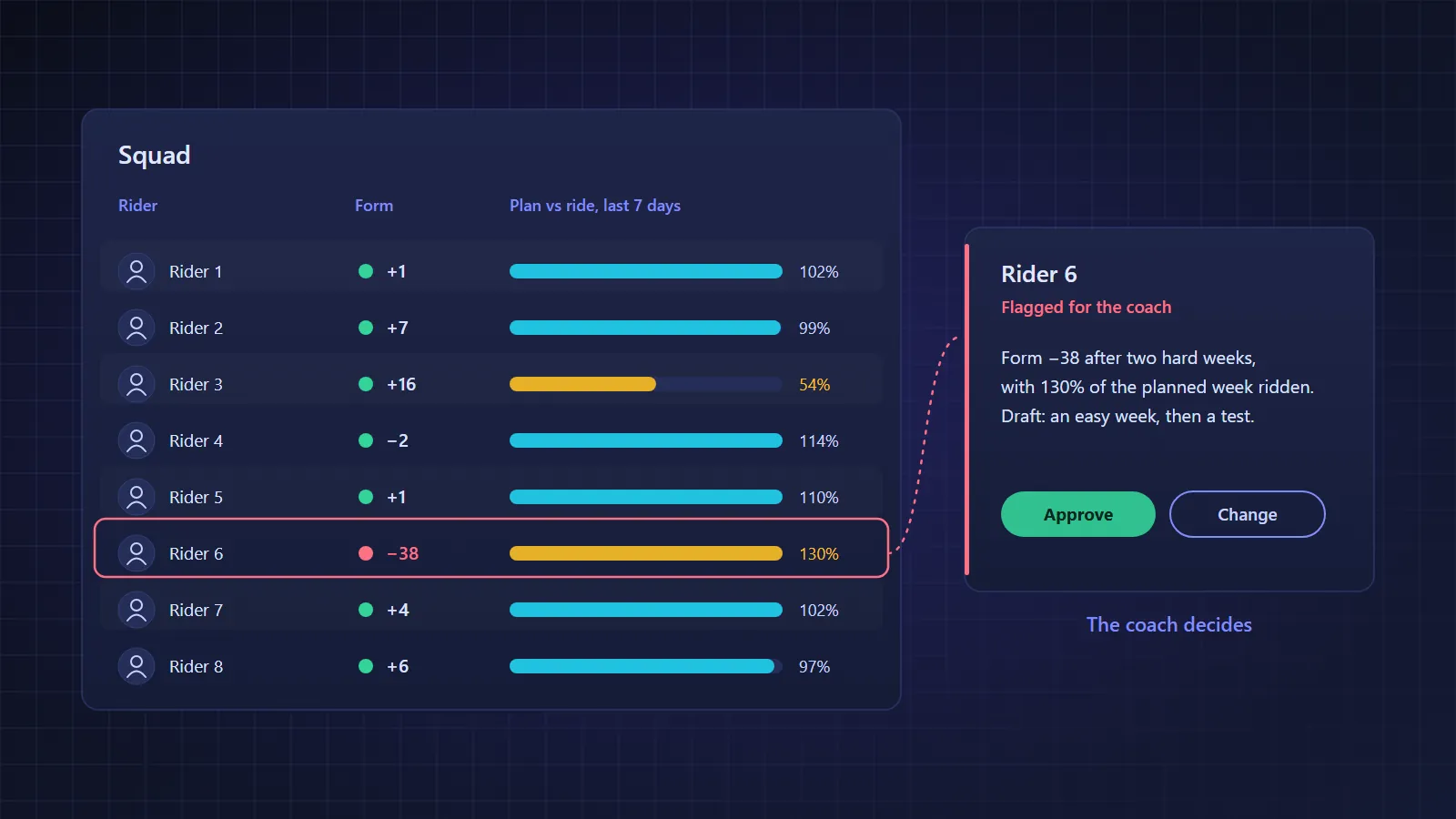
In Velograph the squad board starts each day with who is good to go and who needs a word. AI works on the coach's side: its proposals for coached riders wait in an approvals list, and its readings are held for the coach by default.
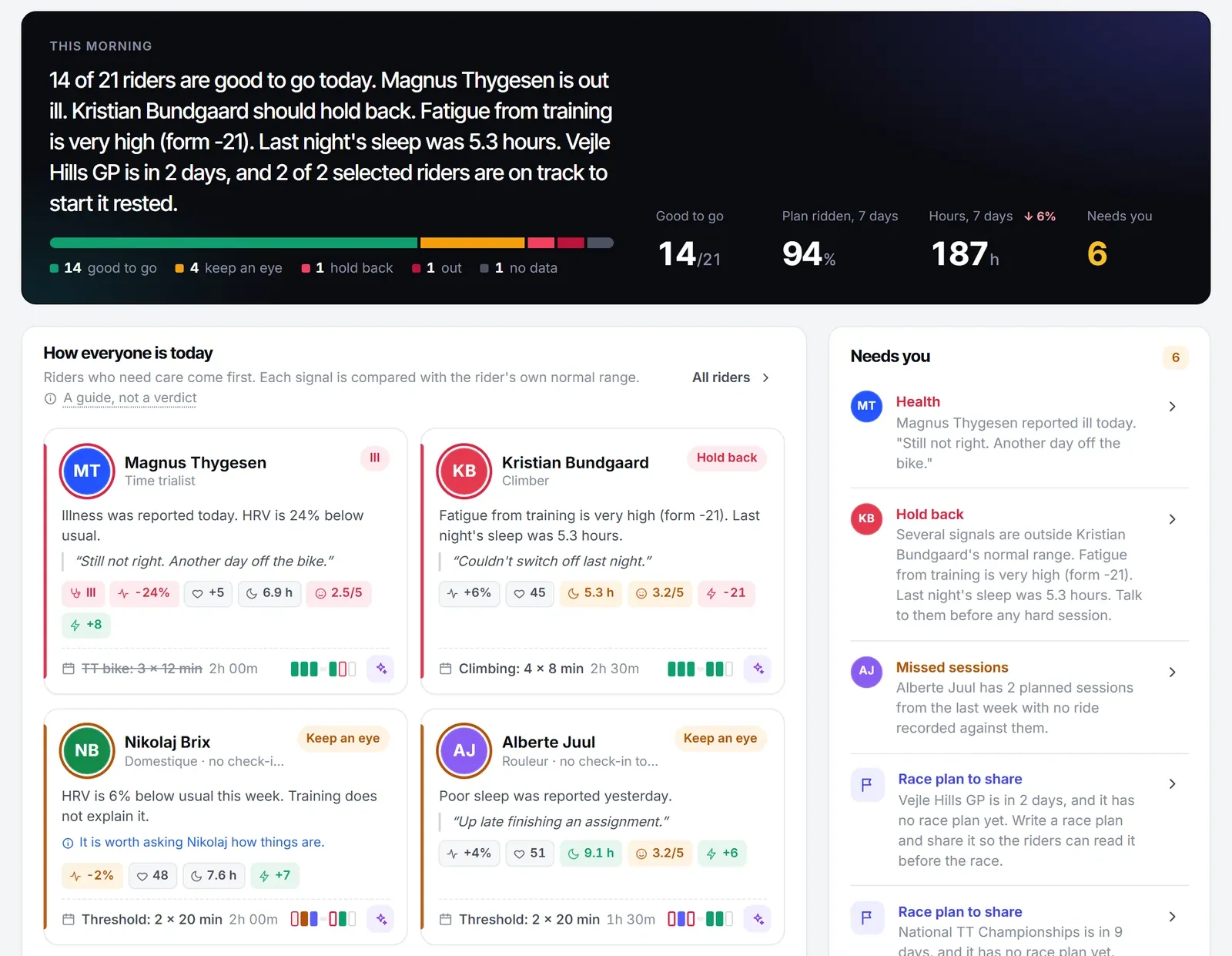
- The coach's desk. Sessions the AI proposed, numbers a rider set themselves and held readings wait in one list. The coach approves, edits or rejects each, and nothing changes before that. A weekly summary on Monday names the riders who need attention, and every AI line in it is marked as AI.
- Staff roles. Coaches, managers, bike fitters, mechanics and physios each have a role, and staff accounts are free. Each rider decides, part by part, what the team sees.
- Safety rules. Every AI answer follows Velograph's written safety rules for training advice, and teams and coaches can add their own. A small set marked Always forms a floor nobody can lower: warning signs go to a doctor, and there are no weight targets for under-18s.
- Numbers from the ride file. Velograph works out power, critical power, W′, durability and training load from the original file each device saved. The AI explains those numbers and does not invent its own.
The data is kept in the EU, in Frankfurt, and the AI runs on Velograph's AI credits or on the team's own Claude or OpenAI key. Our article on cycling team management software covers the rest of the staff's morning, and the plans are on the pricing page.
Further reading
- Monitoring training load to understand fatigue in athletes, Sports Medicine, 2014.
- Internal and External Training Load: 15 Years On, International Journal of Sports Physiology and Performance, 2019.
- Guidelines 05/2020 on consent under Regulation 2016/679, European Data Protection Board, 2020.
Velograph is not affiliated with, sponsored by or endorsed by any team, rider or company named in this article. Names are used only to refer to publicly reported work.