Growth, load, sleep and school: the few numbers that help clubs and parents train young cyclists well, the ones to leave alone, and consent for minors.
Junior cycling training works when it treats young riders as growing people first and athletes second. In practice that means varied riding, load that rises slowly, protected sleep and school time, and a handful of simple numbers that help adults spot trouble early. Power files and rankings can wait. This guide shows clubs and parents what to record, what to leave alone, and how to look after a minor's data.
How does growth affect junior cycling training?
Growth changes a young rider's performance, coordination and bike fit, so junior cycling training has to follow each rider's own growth. Two 15-year-olds in the same club group can be years apart in biological age.
The International Olympic Committee's consensus statement on youth athletic development (Bergeron and colleagues, 2015) places the adolescent growth spurt between about 9 and 15 years of age. Its timing varies a great deal from child to child. The same statement warns that a young athlete's ups and downs in performance may owe more to biological clocks than to coaching or training.
For a club, that has three practical consequences:
- An early maturer looks like a talent. Extra height, muscle and aerobic capacity win races at 14. Part of that edge is timing, and the IOC statement notes that early selection often leaves out late developers.
- A growth spurt changes the rider on the bike. Many riders feel less coordinated for a few months, and some get growth-related aches in the knees or heels. Aches belong with a doctor or physiotherapist, not with a training plan.
- The bike has to grow too. A bike that fitted in spring may not fit by autumn. Check saddle height and reach every few months while a rider is growing.
One simple habit helps more than any power meter. Measure standing height at home every three months, against the same wall, at the same time of day. A jump of several centimetres in a quarter tells you a growth spurt is under way. That is a good moment to keep riding playful, hold intensity steady and recheck the bike.
Should young cyclists specialise early?
No, young riders should avoid early specialisation, as the International Olympic Committee's statement on youth development advises. Varied sport builds motor skills and athletic capacity, lowers injury risk and gives a child a better chance to find the sport they will enjoy and stay in. Many elite athletes played several sports before they specialised.
For a cyclist, much of that variety can stay on two wheels. Cyclo-cross, mountain biking, track and BMX teach handling, sprinting and reading a race. Running, swimming, team sports and age-appropriate strength work build the rest of the athlete, and the IOC statement supports strength and conditioning for young people when it suits their age and is well taught.
How many hours a week should a junior cyclist ride?
Riding time grows with age, from about 1 to 3 hours a week under 12, plus other sports, to 6 to 12 hours at 17 and 18. The table below is one way to frame the years. Treat the ranges as starting points to adapt, not targets.
| Age in the season | Riding per week | Main focus | Structured intensity |
|---|---|---|---|
| Under 12 | 1 to 3 hours, plus other sports | Skills, games, confidence | None; hard efforts come from play |
| 12 to 14 | 2 to 5 hours, plus other sports | Handling, group riding, short races | Short, playful efforts |
| 15 to 16 | 4 to 8 hours | Steady base riding, first planned sessions | One or two sessions a week |
| 17 and 18 (UCI juniors) | 6 to 12 hours | A planned season with racing | Two or three sessions a week |
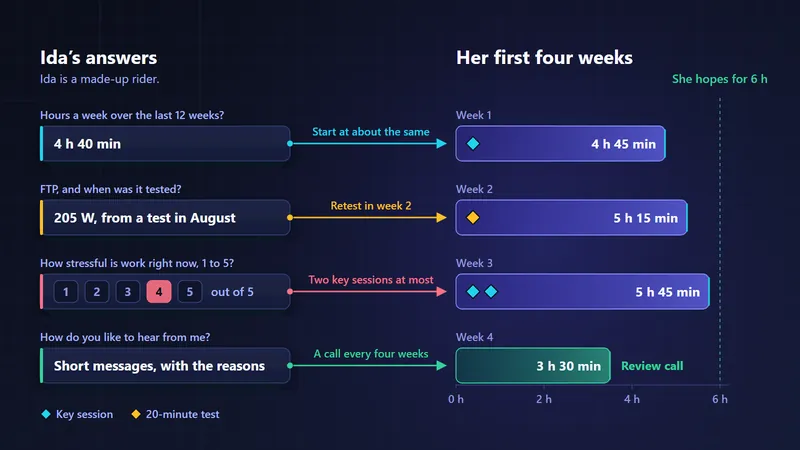
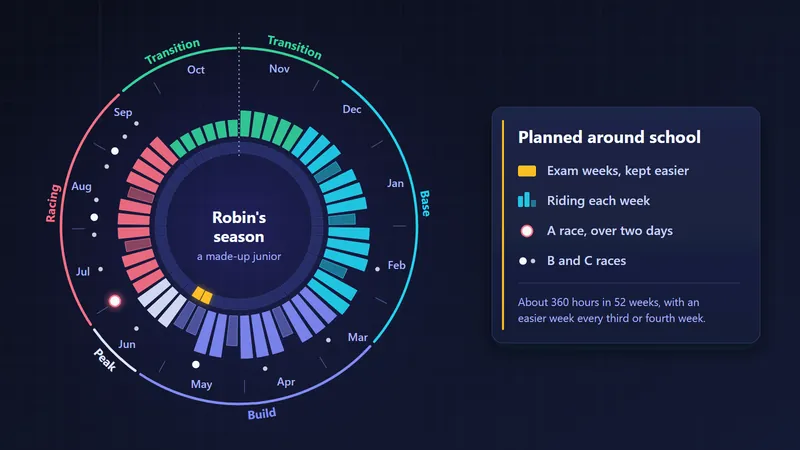
A rider who copes well, sleeps well and still loves it can do more. A rider who is tired, sore or losing interest needs less, whatever the table says. When the hours rise, raise them in small steps, hold each step for a few weeks, and plan an easier week every third or fourth week. The fitness, fatigue and form model explains why the easier weeks matter.
How much sleep does a junior cyclist need?
Riders aged 13 to 18 need 8 to 10 hours of sleep in every 24, as the American Academy of Sleep Medicine recommends. That is more than adults need. The IOC statement adds that adolescents' body clocks shift later, while early school starts, homework and screens push the other way, and training schedules can make it worse.
So plan the week around school, not the other way round. Avoid hard evening sessions before early school days. Make exam weeks easy weeks and say so on the calendar, so nobody feels guilty about it. A junior who sleeps seven hours on school nights is likely to gain more from an extra hour in bed than from an extra interval session.
Fun is not a soft extra. The IOC statement asks coaches to build competence, confidence, connection and character, through regular activities that are both fun and challenging. Young riders who enjoy the club stay in the sport, and staying in the sport is the first condition for ever becoming good at it. Ask every week whether they enjoyed it. The answer is data.
What training data should a junior cyclist record?
The most useful numbers for a young rider are time on the bike, session effort, sleep on school nights, a weekly check-in and standing height. None of them need expensive equipment, and a rider or parent can note each one in a minute.
| What to record | Why it helps | How often |
|---|---|---|
| Time on the bike and number of sessions | The simplest measure of load | Every ride |
| Session effort: how hard it felt, 0 to 10, times the minutes | Training load without a power meter | Every session |
| Sleep on school nights | The first thing to slip when life gets busy | Daily, or a weekly average |
| A weekly check-in: energy, mood, enjoyment, school pressure, aches | Early warning before a problem grows | Weekly |
| Standing height | Shows when a growth spurt starts | Every three months |
| Heart rate | Keeps easy rides easy for older riders | When they ride with a strap |
| Power and a test ride | Sets zones for juniors with a planned season | Two or three tests a year |
The session effort score comes from Carl Foster's work on monitoring training (2001). A 45-minute session that felt like 6 out of 10 scores 270. Add the week's sessions together and compare this week with the last few weeks for the same rider. Never compare one rider's total with a teammate's: they are growing at different speeds.
Which numbers should junior cyclists not track?
Body weight, watts per kilo, power rankings across a group and adult benchmarks do more harm than good with young riders. Keep them out of club life. Put the rider's own feeling before a daily readiness score, and never let a junior ride through pain.
- Body weight and watts per kilo. The IOC statement reports that eating disorders are far more common in elite adolescent athletes than in their peers: 14% of girls against 5%, and 3% of boys against none. Weight talk belongs with parents and a doctor or registered sports dietitian, never on a club spreadsheet.
- Power rankings across a group. A league table of FTPs mostly ranks riders by their stage of growth.
- Adult benchmarks. Comparing a 16-year-old's numbers with a professional's sets the wrong goal and the wrong timescale.
- A daily readiness score before the rider's own feeling. Asking how they feel is simpler, and it teaches them to read their own body.
- Riding through pain. The IOC statement is strict: no young athlete should race, or train in a way that loads an injured area, while in pain or before full recovery from an illness or injury.
When a junior stands out, resist the urge to pick winners early. The article on talent identification in cycling explains why a single season's numbers predict little.
Who gives consent for a junior cyclist's data?
When an online service relies on consent and is offered directly to a child, a parent gives or authorises that consent while the rider is under 16, as Article 8 of the GDPR sets out. Each country may lower that age to no less than 13.
A junior's training record is personal data, and parts of it are health data: illness, injuries, sometimes sleep or the menstrual cycle. Under the GDPR, data concerning health is a special category with extra protection (Article 9).
For a club, a few rules cover most of it:
- Tell riders and parents what you record, why, and who sees it, before the season starts.
- Record the minimum you need. Most under-15 groups need hours, session effort and the weekly check-in, nothing more.
- Give access by role: the rider's coach yes, other parents no.
- Apart from race results, never publish a junior's data without the rider's and a parent's agreement.
- Hand data back or delete it when a rider leaves.
Software can help here. In Velograph, for example, a team or coach only sees the parts of a rider's record the rider has agreed to share. This is general guidance, not legal advice; the article on athlete data privacy goes further.
How can a club set up junior cycling training?
A club sets up junior cycling training with a lead coach for each age group, a parents' meeting before the season, one shared calendar and a regular review of each rider. The steps below take them in order.
Name a lead coach for each age group and write the group's purpose in one sentence.
Meet the parents before the season. Explain the plan, what is recorded and who sees it, and collect consent.
Keep one shared calendar so riders, parents and coaches see the same week.
Use the weekly check-in and session effort for every group, and add heart rate and power only for older juniors.
Review each rider every six to eight weeks with the rider, and with a parent for younger riders.
Know the rules. In the UCI's regulations, juniors are riders aged 17 and 18, counted by year of birth, and riders of 16 and under are governed by national federations. The UCI removed junior gear restrictions on the road from 1 January 2023; British Cycling followed and kept its gearing rules for youth categories. Check your own federation's rules for younger riders.
The practical side of running groups, calendars and volunteers is in the guide to cycling club training.
Further reading
- International Olympic Committee consensus statement on youth athletic development, Bergeron and colleagues, British Journal of Sports Medicine, 2015.
- Recommended amount of sleep for pediatric populations, Paruthi and colleagues, Journal of Clinical Sleep Medicine, 2016.
- Regulation change: junior gearing, British Cycling, 2022.
- UCI Cycling Regulations, Part 1: General organisation of cycling as a sport, UCI, 2026.
Velograph is not affiliated with, sponsored by or endorsed by any team, rider or company named in this article. Names are used only to refer to publicly reported work.