How a cycling club can use a few well-chosen numbers to group rides, plan the week and develop riders, while keeping it social, safe and private.
Cycling club training works when the data serves the ride, not the other way round. A few well-chosen numbers help a club group riders fairly, plan the week and keep its development riders moving forward. Everything else should stay social, safe and fun. This guide shows how to split club rides from coached squads, which numbers earn their place, and how to do it without burning out the volunteers who run the club.
How is a club ride different from a development squad?
A club ride exists so people can ride together safely and enjoy it, while a development squad exists to help each rider improve. Most clubs run both under one name. Mixing the two is where data starts to spoil the fun, because nobody joined the café ride to have their power file judged.
| Club ride | Development squad | |
|---|---|---|
| Purpose | Ride together, safely | Help each rider improve |
| Who leads | Ride leaders | Coaches |
| Numbers used | Distance, climbing, pace group | Hours, session effort, heart rate or power, tests |
| Who sees individual data | Nobody needs to | The rider and their coach, with consent |
| Planning | A list of routes and meeting points | A calendar for each rider |
Keep that line clear in how you talk about each. Club rides use numbers to set expectations. Squads use numbers to coach.
How do you set pace groups for a club ride?
Give each group an honest average speed and publish it with the route, along with the distance and climbing. That speed is the most useful number in club cycling. A new member can then pick a group that suits them, and the group does not split on the first drag.
- State it honestly. Give the average moving speed on a typical loop in calm weather, for example 24 to 26 km/h, 27 to 29 km/h and 30 km/h and over. Say that hills and wind change it.
- Add distance and climbing. 70 km with 400 metres of climbing is a different ride from 70 km with 1,200.
- Set regroup points at the top of climbs and every 20 to 30 minutes on rolling roads.
- Use the talk test for steady groups. If riders at the back cannot speak in full sentences, the pace is too high for an endurance ride.
Ride leaders do not need anyone's file to do this well. They need a route, a pace and the confidence to slow the front down.
How should a cycling club plan its training week?
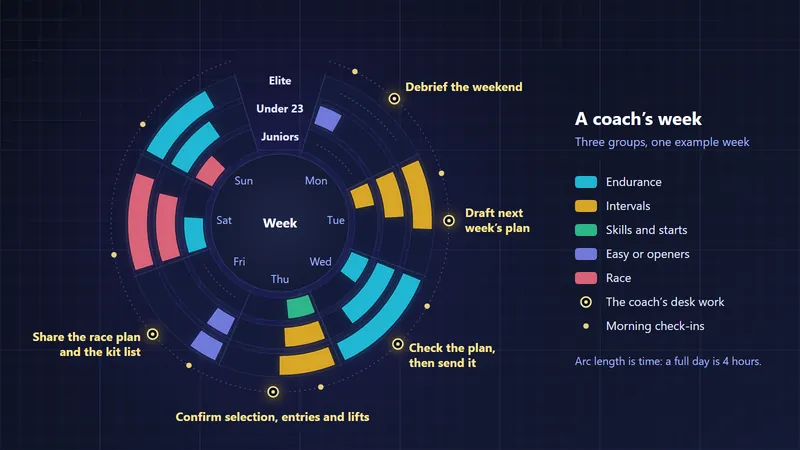
Put the club's week in one calendar that riders, parents and coaches all see, with each session's purpose written beside it. It stops the question "what are we doing on Tuesday?" from filling the club chat.
| Day | Session | For whom | Purpose |
|---|---|---|---|
| Tuesday evening | Intervals or a chaingang on a safe loop | Squad and confident riders | Threshold and VO2max work |
| Thursday | Skills in a car park or on grass | Juniors and newer riders | Cornering, braking, riding close |
| Saturday | Long group ride in pace groups | Everyone | Endurance and club life |
| Sunday | Racing, cyclo-cross or an easy café ride | By choice | Racing or recovery |
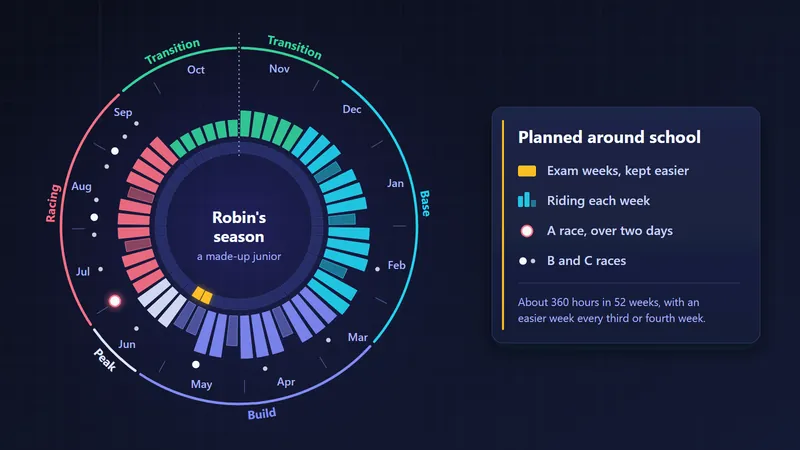
Write each session in words and in zones, so it works for riders with and without power meters. "Two blocks of 15 minutes at a pace where you can only speak in short sentences" is tempo, or zone 3, and everyone understands it. Plan in blocks of four to six weeks, post the next block a week ahead and mark the racing weekends. The guide to structured training plans covers how to build the sessions themselves.
Which numbers should a club squad track?
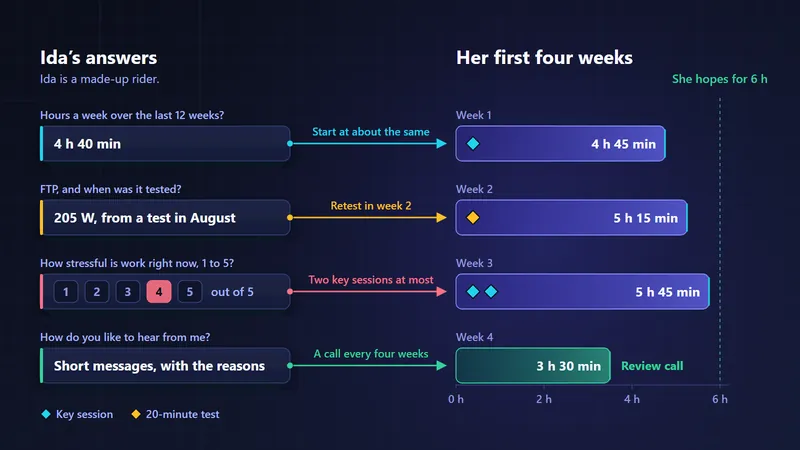
Four or five numbers are enough to coach a development squad well: weekly hours, session effort, heart rate or power, a regular test and a short weekly check-in. Body weight and tables ranking members' FTPs are better kept out of club life.
- Weekly hours and sessions. The simplest measure of load, and the first to show a rider is overdoing it or drifting away.
- Session effort. How hard the session felt from 0 to 10, multiplied by its minutes. A 60-minute session at 7 scores 420. It works without any sensors.
- Heart rate or power for riders who have them, mainly to keep easy rides easy and hard sessions on target.
- A test every eight to twelve weeks, the same one each time, such as a 20-minute effort or a ramp test on a trainer, to set zones. The article on what FTP is explains the options.
- A three-question weekly check-in: how is your energy, how is life outside cycling, did you enjoy the week?
Some numbers are better kept out of club life. Body weight and watts per kilo belong with the rider, and with a doctor or registered sports dietitian if weight ever becomes a question. Tables ranking members' FTPs turn training into a contest nobody signed up for. If you want a shared number, celebrate club totals, such as the kilometres everyone rode for a charity month, rather than individual ranks.
How can data save a volunteer coach's time?
Keep plans, rides and notes in one place, review the exceptions first and give the weekly review about fifteen minutes per coach. Clubs run on volunteers, and a coach who gives two evenings a week cannot spend a third chasing files. Data should save their time, not cost it.
- One place. Plans, rides and notes in one system, not five apps and a spreadsheet.
- Exceptions first. A coach's weekly review should start with who missed sessions, who reported feeling unwell and whose load jumped, not with every ride of every rider.
- Fifteen minutes a week per coach for the review, at a fixed time. If it takes longer, the system is wrong.
- Rides that arrive on their own. Riders should not upload files by hand every week; let them connect what they already use.
- Reusable sessions. Build a small library of the club's standard sessions and use it every season.
- A clean handover. When a volunteer coach steps down, the plans and notes should stay with the club and the riders, not leave on a laptop.
How should a cycling club handle riders' data?
Ask riders before you record anything, record only what you use, and give access by role, so a rider's coach sees their training and other members do not. When a rider leaves the club, hand back or delete what you hold.
A club holds personal data about its members, and a squad's training records include health information such as illness and injuries. Juniors need a parent involved, and the rules for minors are stricter; the junior cycling training guide covers growth, load and consent for young riders. For the legal side, read the article on athlete data privacy.
A Team space for the club's squad
A club that runs a development squad can give it one place in Velograph. The Team plan is priced by the number of riders, and staff accounts are free, so coaches, ride leaders and the club mechanic join at no cost.
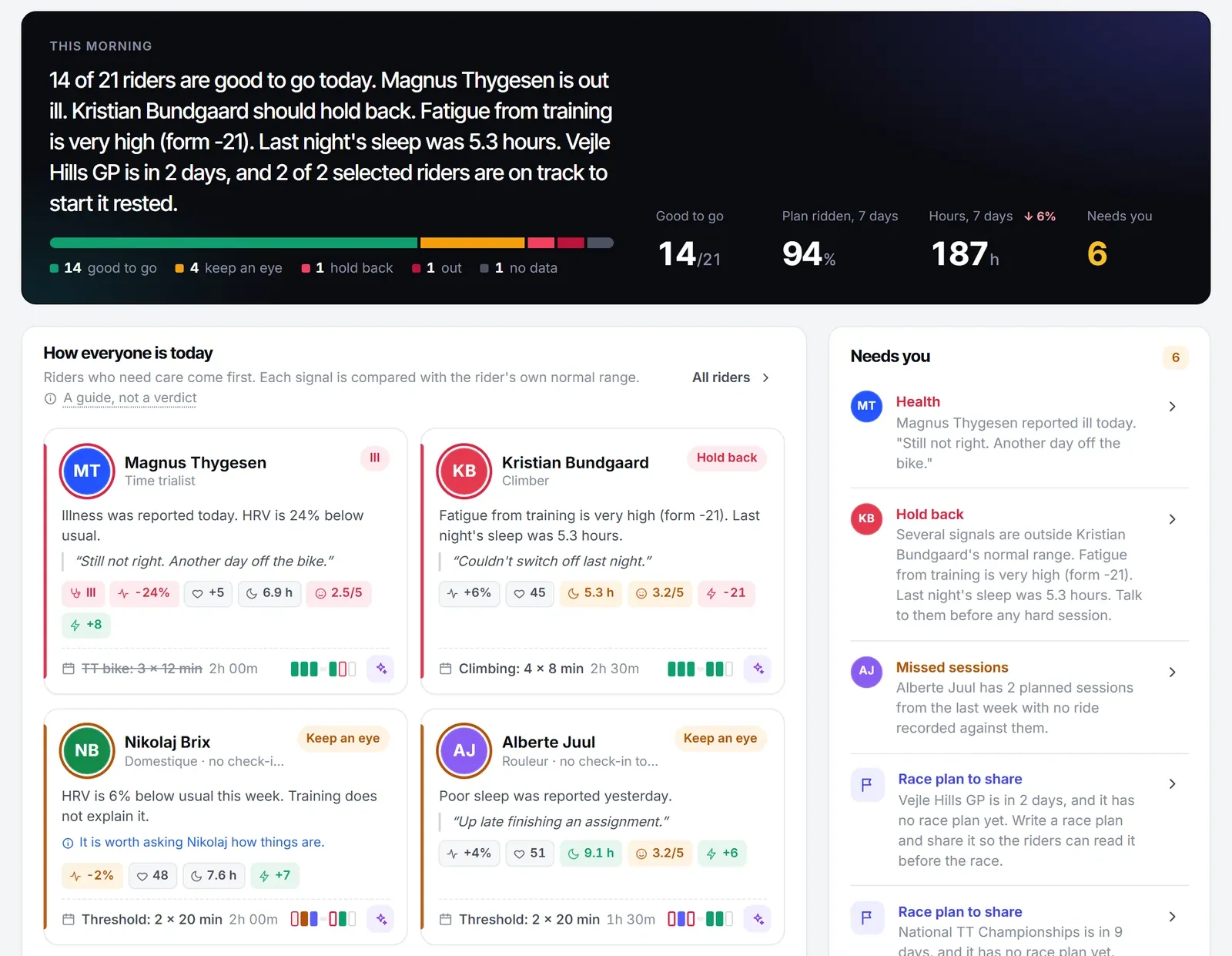
Each morning the squad board shows every rider's readiness, the plan against what was ridden, form and coming races, which is the exceptions-first review in one screen. Coaches drag structured sessions onto the calendar, copy them across riders and keep a usual week, with notes for the day and the week. Riders connect intervals.icu, so their rides arrive without anyone chasing them, and FIT files from any device can be uploaded too. Each rider decides, part by part, what the club sees. A club can try it free first; the pricing page has the current terms. For what a bigger squad's staff need, see cycling team management software.
Further reading
- British Cycling Go-Ride, British Cycling, 2026.
- International Olympic Committee consensus statement on youth athletic development, Bergeron and colleagues, British Journal of Sports Medicine, 2015.
Velograph is not affiliated with, sponsored by or endorsed by any team, rider or company named in this article. Names are used only to refer to publicly reported work.