Rider data sits on devices, in apps, in fitters' notes and team spreadsheets. One record the rider owns, shared part by part with each expert.
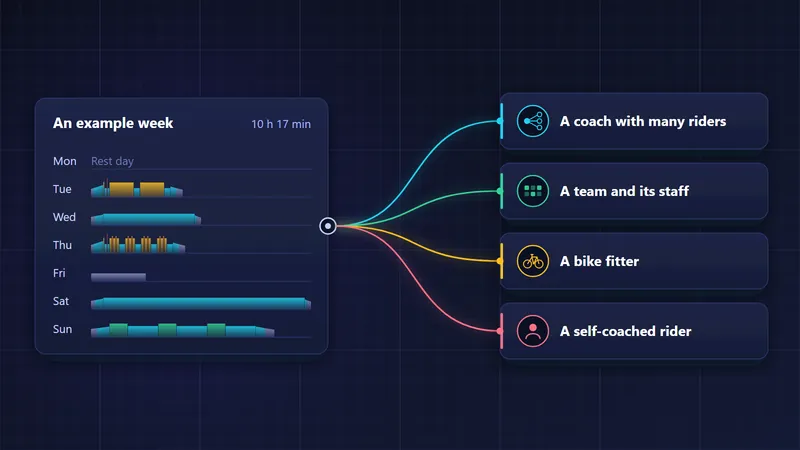
A cycling performance platform keeps a rider's bikes, bike fits, rides and plans in one record, and lets each expert around the rider see the part they need. Velograph is built that way. The record belongs to the rider and is free for them, and the team, the coach, the bike fitter and the physio each see what the rider agrees to share.
Why does a rider's data end up in so many places?
Each device and app is good at its own job, so a rider's data ends up in several places. Nobody sees the whole rider, and the rider cannot easily show them.
A rider's data usually lives in several places, each good at its own job. A Garmin or Wahoo head unit records the ride. Strava carries the social side, with its community and segments. Many riders turn to intervals.icu for deep analysis at no cost, and TrainingPeaks has been a home for coaches and their plans since the late 1990s. The fit sits in a fitter's software or on a paper sheet, the physio's notes in a clinic system, and the team's view in a spreadsheet.
The trouble starts between them. A rider who changes team in November arrives with no fit numbers. A new fitter starts from zero because the last fit is in an old email. A coach sees the power files but not that the saddle went up 8 millimetres the week the rider's knee began to complain.
Is Velograph free for riders?
Yes, Velograph's Rider plan is free and never expires. It holds every bike, every bike fit from every fitter, and the rider's rides, in one record that belongs to the rider. Rider Plus, a paid plan, adds training plans, race tools and an AI coach.
Rides come in from intervals.icu and Strava, or as FIT files from any device, several at a time. A Strava or Garmin account export, a zip file, brings a rider's full history in, and riders can download their own rides again as FIT files, as GPX where an outdoor ride has a GPS track, or all at once as a zip. Rides from Strava stay on Strava. Our guide to importing your cycling history shows how.
Velograph reads each ride from the original device file wherever there is one, so the numbers come from what the device recorded. Fits are kept as history and never overwritten, so a rider can see how their position changed across bikes and years. The free cycling app for bikes, fits and rides walks through the rider's side in detail.
Does the rider decide who sees their data?
The rider decides who sees what. A team, a coach or a fitter sees only the parts the rider agrees to, such as bikes and fits, rides and training, or history from before joining, each with its own box.
Notes that can hold health information may be asked for but are never required, and a rider can switch a part off later. Strava rides are shown to the rider only and are never used by the AI.
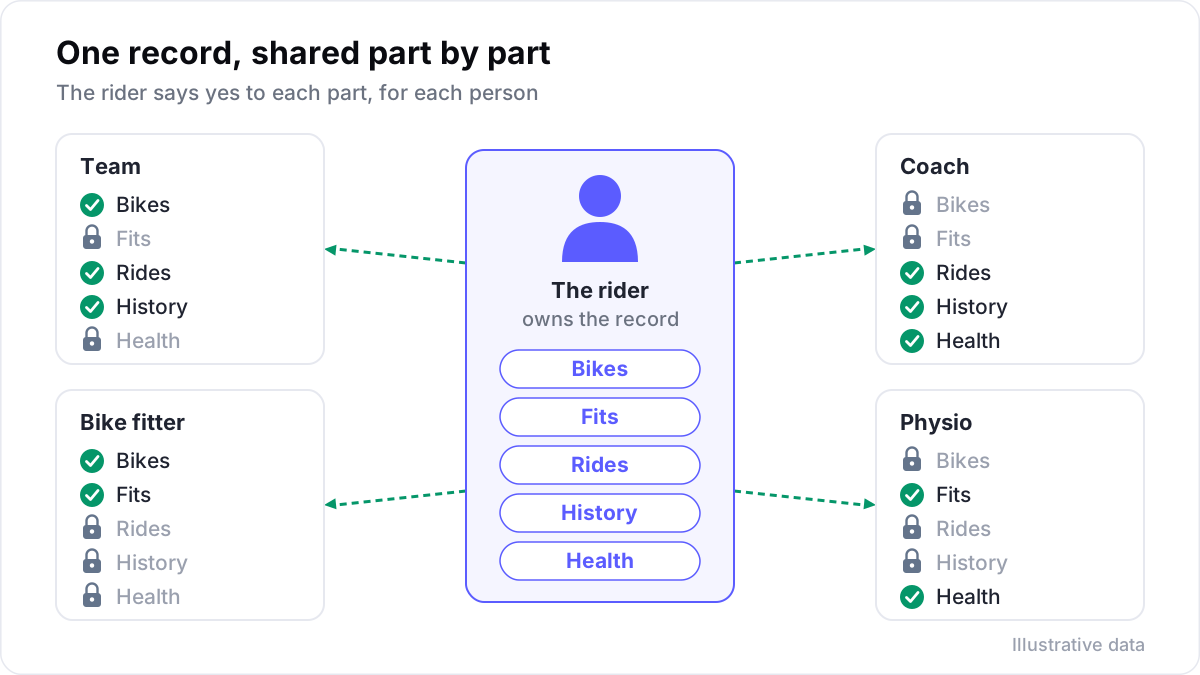
The Passport card makes this quick at a counter or a team camp. A studio or team scans its QR code, and the rider says yes on their own phone, part by part, before anything is shared. Read more in the bike fit passport.
What does a cycling performance platform give each role?
Each role gets its own plan around the same rider record. Riders keep bikes, fits and rides in one place, and Rider Plus adds training plans and an AI coach. Bike fitters, coaches and physios work in a Studio, and teams and clubs work in a Team space.
| Who | Plan | What it gives them |
|---|---|---|
| Riders | Rider (free) and Rider Plus | Bikes, fits and rides in one place; Rider Plus adds training plans, race tools and an AI coach with monthly AI credits |
| Bike fitters, coaches, physios | Studio, priced per practitioner, unlimited clients | A calendar with bookings, a client journal with dictation, fits with diagrams, follow-ups, branded client reports and AI |
| Teams and clubs | Team, priced by riders, staff accounts free | The squad board, training plans, race plans with pacing, debriefs, fitness and form, power curves, and fits and bikes for the whole squad |
Fitters and clinics. Every fit a studio records lands in the client's own free Passport, so the client keeps it when they change fitter or team. That can sound like a risk for the studio, but it works both ways: new clients arrive with their history too, and a fitter who never holds data hostage is easier to trust. See bike fitting software for what a studio needs beyond its capture tool, and physio and bike fitter for how the two share one record.
Coaches. The coach's desk holds an approvals list, AI readings held for the coach before a coached rider sees them, and a weekly digest of which riders need the coach, and why. Our guide to cycling coaching software explains it in detail.
Teams. Staff land on the squad board: each rider's readiness, plan against what was ridden, form and the races ahead, with health first in the list of what needs a decision.
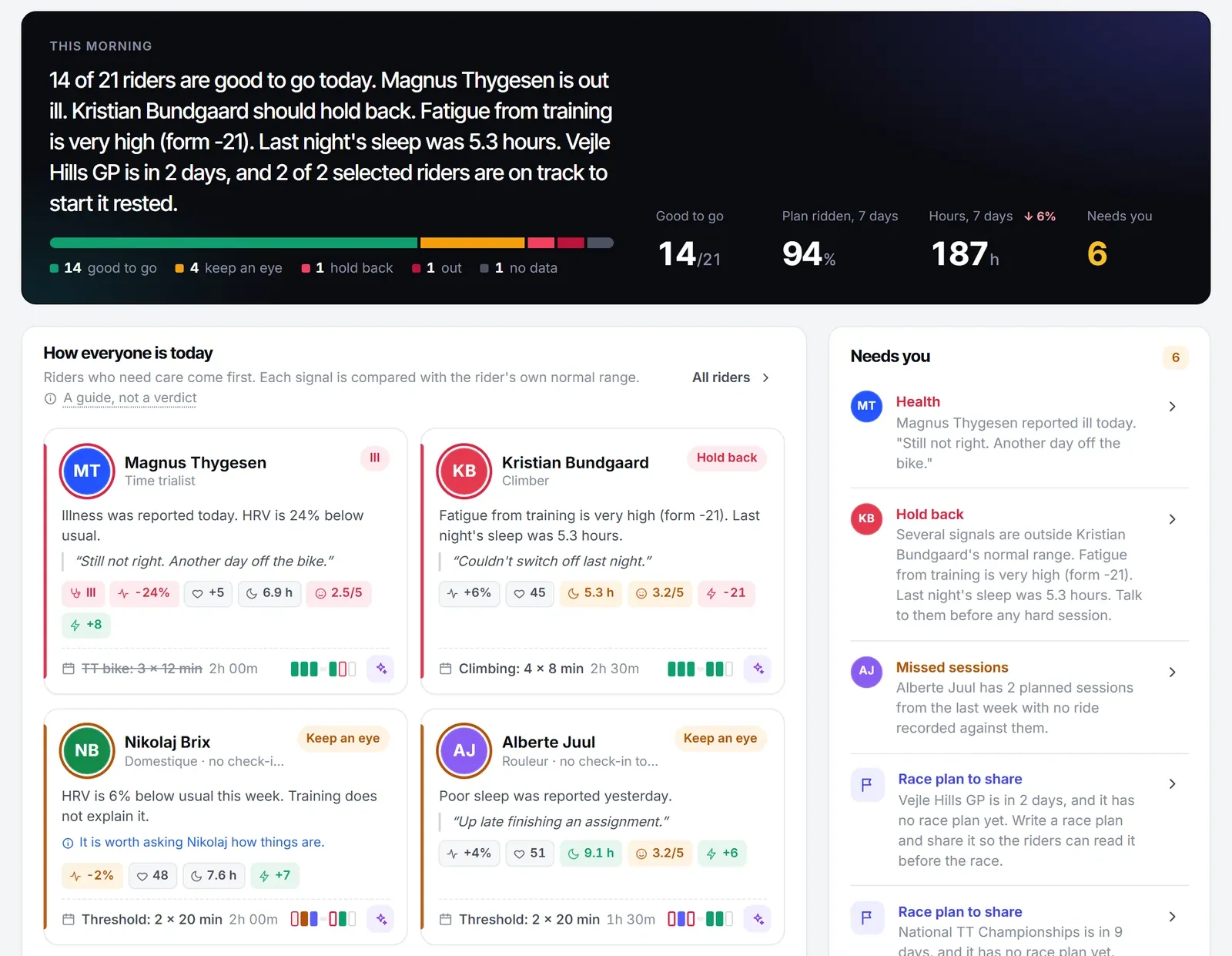
Our guide to cycling team management software covers roles, access and consent in a team.
What does Velograph measure from the rides?
Velograph measures the power curve, W′, durability, the limiter, marked intervals, and fitness, fatigue and form over time. Every role sees the same analysis, worked out from the rides by fixed rules:
- the power curve and records, and W′ (the reserve above critical power) with surges;
- durability, meaning how much power is left late in a long ride, labelled by time into the ride;
- the limiter, the weakest part of the power curve, asked as a question when it may only be untested;
- marked intervals, and any stretch of a ride dragged across the chart to see its numbers;
- fitness, fatigue and form over time, with periods, reviews and up to eight riders side by side.
Runs, swims, gym sessions and triathlon are counted and planned too, with cycling first. For the ideas behind the charts, start with the power curve explained and durability in cycling.
Who decides when the AI proposes training?
A person decides, not the AI. Ask, Velograph's AI assistant, answers from the rider's own data and proposes sessions, and a person puts them on the calendar. With a coach attached, the AI assists the rider and the coach, and the coach decides.
AI is always labelled as AI, and it runs on Velograph's AI credits or on a team's own Claude or OpenAI key. Our article on an AI cycling coach that answers to your coach explains the rules it follows.
Made in Denmark, run in the EU
Velograph is made in Denmark by Pro Cykling ApS and runs in the EU, in Frankfurt. It carries no advertising and no third-party trackers. Riders start on the free plan. Studios and teams can try everything free, with no card needed. Compare the plans on the pricing page, or start for free.
Velograph is not affiliated with, sponsored by or endorsed by any team, rider or company named in this article. Names are used only to refer to publicly reported work.