Plan a cycling training camp with data: one or two goals, a gradual load ramp, a one-minute morning check, altitude basics and the recovery week.
A cycling training camp works when it has one or two clear goals and a load that rises in steps rather than one leap. It also needs a short check of every rider each morning, and a recovery week planned before anyone packs a bike box. The data does not run the camp. It tells staff early which rider needs an easy day, and afterwards it shows whether the week did what it was meant to do. This guide is for coaches, team staff and club organisers planning a week or more away.
What should a cycling training camp focus on?
A cycling training camp should focus on one or two clear goals, such as aerobic volume, climbing at threshold or race skills. "Get fit" is not a goal. A camp goal names what should change and how you will see it in the data.
| Goal | Key sessions | What to measure |
|---|---|---|
| Aerobic volume | Long endurance rides, one longer day | Hours, work done in kJ, heart-rate drift on the long rides |
| Climbing at threshold | Two or three days of repeated long climbs a little below FTP | Power on each climb, heart rate at that power |
| Race skills | Group riding, lead-outs, echelons, a race simulation | Surges above threshold, positions, a short debrief |
| Altitude adaptation | Three to four weeks living high | Sleep, morning heart rate and heart rate variability (HRV), power at a given heart rate |
| A team that knows each other | Shared rides, meals, meetings | Not everything is a number |
Keep it to two goals at most. A camp that tries to build volume, sharpen VO2max and practise lead-outs in the same week ends with tired riders and no clear answer to any of the three.
How do you build up to a cycling training camp?
Build the load over the three to four weeks before the camp, adding a little each week, so the camp is a step rather than a leap. A camp week often holds twice a rider's normal hours, and the risk is less the hard week itself than the jump into it.
Fatigue rises within days while fitness builds over weeks, so a sudden spike pushes form far below zero. Fitness, fatigue and form shows the model behind this and what a planned dip looks like.
Research on load spikes is less tidy than it is often presented. Gabbett (2016) argued that rapid increases in training load explain many soft-tissue injuries in team sports, and popularised the acute:chronic workload ratio. Impellizzeri and colleagues (2020) then showed that the ratio has serious statistical flaws, and concluded there is no evidence for using it to manage training load. The careful conclusion is that there is no magic ratio. Building into a camp over several weeks is still plain common sense, and it costs nothing.
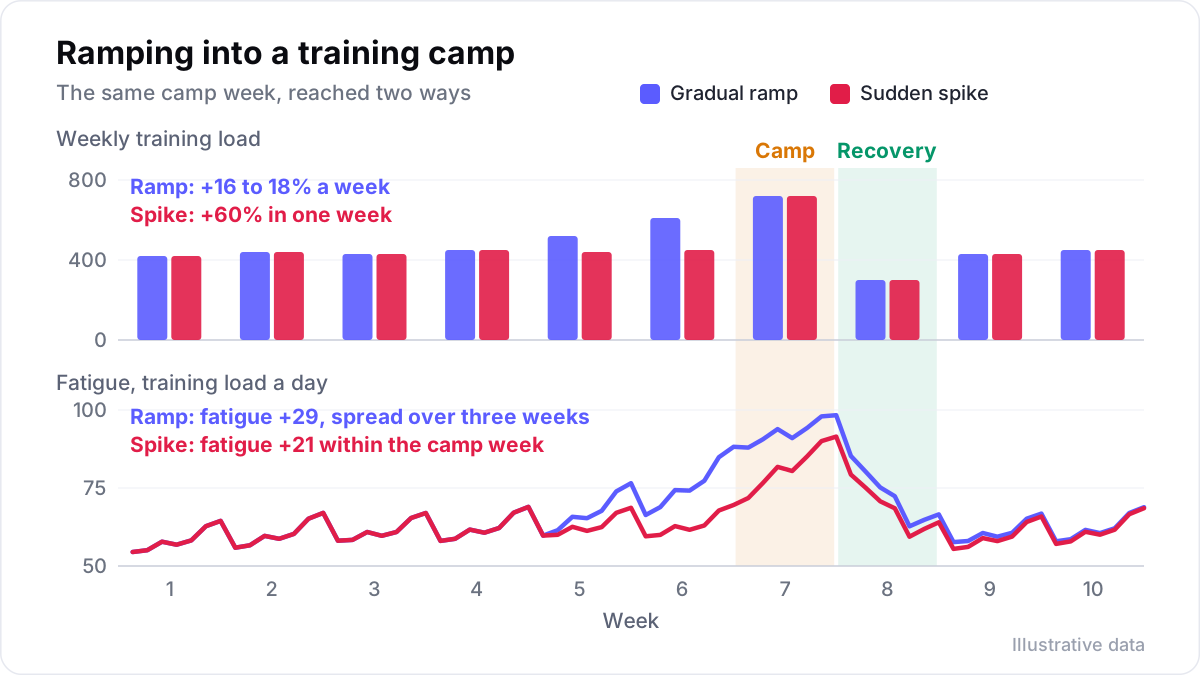
Here is a worked example for a rider who normally trains 10 hours a week, going to a seven-day camp planned at 19.5 hours. The three weeks before build through 11, 12 and 13 hours, each with one longer weekend ride. The week after drops to 5 or 6 easy hours. The camp itself:
| Day | Session | Hours |
|---|---|---|
| 1 | Arrival: easy spin, check bikes and positions | 1.5 |
| 2 | Endurance with steady climbs | 3.5 |
| 3 | Goal session: 3 × 15 minutes climbing a little below threshold | 4 |
| 4 | Easy ride with a coffee stop | 1.5 |
| 5 | Long endurance | 4.5 |
| 6 | Goal session or race simulation | 3.5 |
| 7 | Easy spin, then travel | 1 |
Plan by rider, not by group. Twenty hours is a camp for one rider and a normal week for another. Set each rider's camp from their own recent weeks, and split the groups so that nobody rides someone else's camp.
What should you check every morning at a camp?
Check five things in under a minute: morning HRV and resting heart rate, sleep, leg soreness, mood and yesterday's session effort. At a camp, staff see every rider at breakfast, which makes daily monitoring easy and valuable.
- Morning HRV and resting heart rate, compared with the rider's own normal from home. HRV training explains how to read them as trends.
- Sleep: hours and a rating from 1 to 5. Travel, heat, altitude and shared rooms all disturb it.
- Leg soreness, from 1 to 5.
- Mood and motivation, from 1 to 5.
- Yesterday's session RPE: the rider's rating of the whole session from 0 to 10, multiplied by its minutes, as Foster and colleagues (2001) proposed. A 240-minute ride rated 6 scores 1,440.
A simple rule works better than a clever score. If two or more answers are clearly worse than the rider's normal, the next hard session becomes an easy ride, and a coach talks to the rider. Signs of illness, such as a sore throat, a fever or an upset stomach, are for the team doctor or a local doctor, not for the training plan. In a shared house, illness also travels.
Compare plan against what was ridden every evening, too. Camps overshoot: a group ride planned as 3.5 hours of endurance comes back as four hours with a sprint for every town sign. Spot it the same day, not in the debrief.
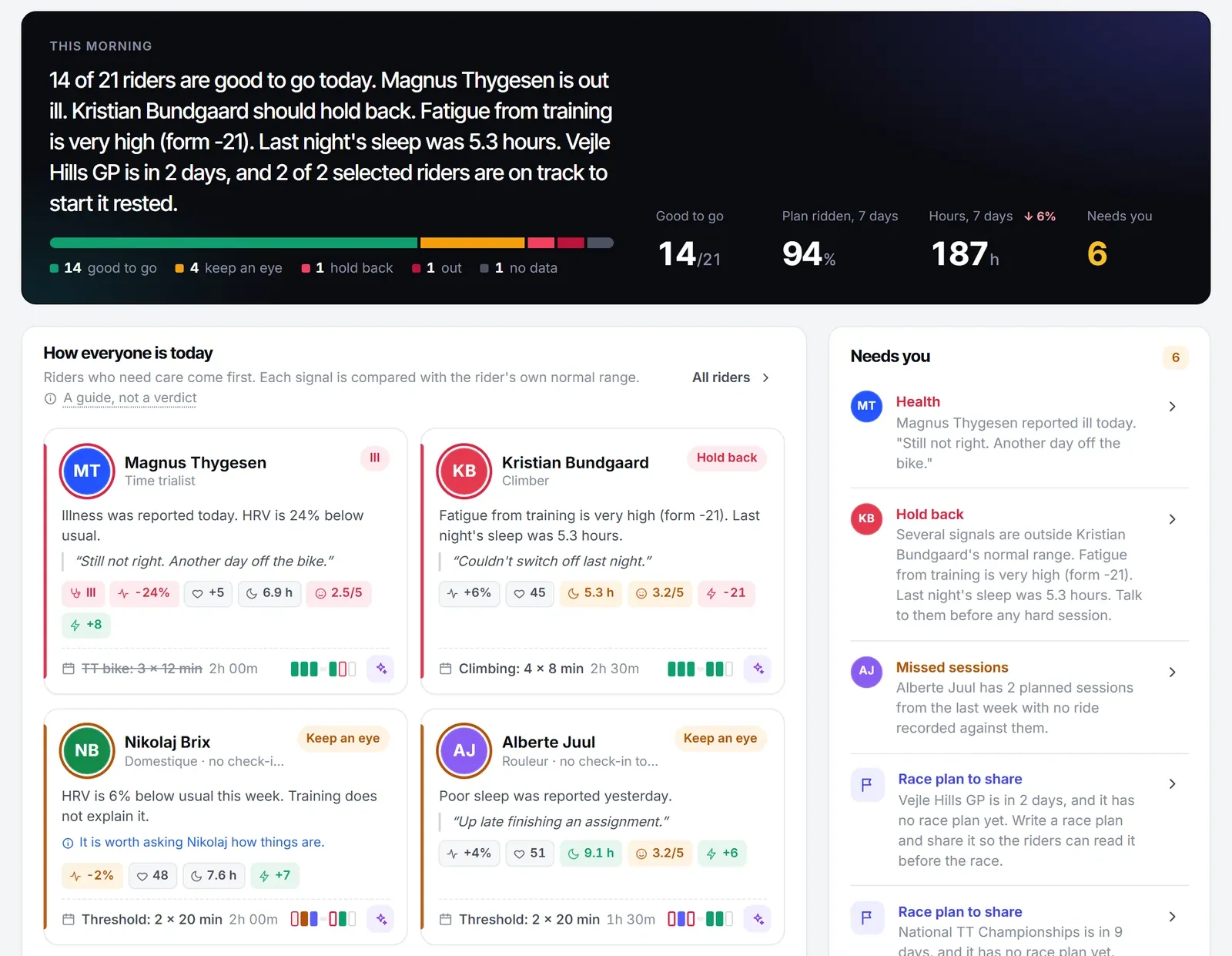
In Velograph, the squad board shows every rider's readiness, plan against what was ridden, form and coming races together. Cycling team management software describes what else staff need from such a view.
Where should you go for a winter training camp?
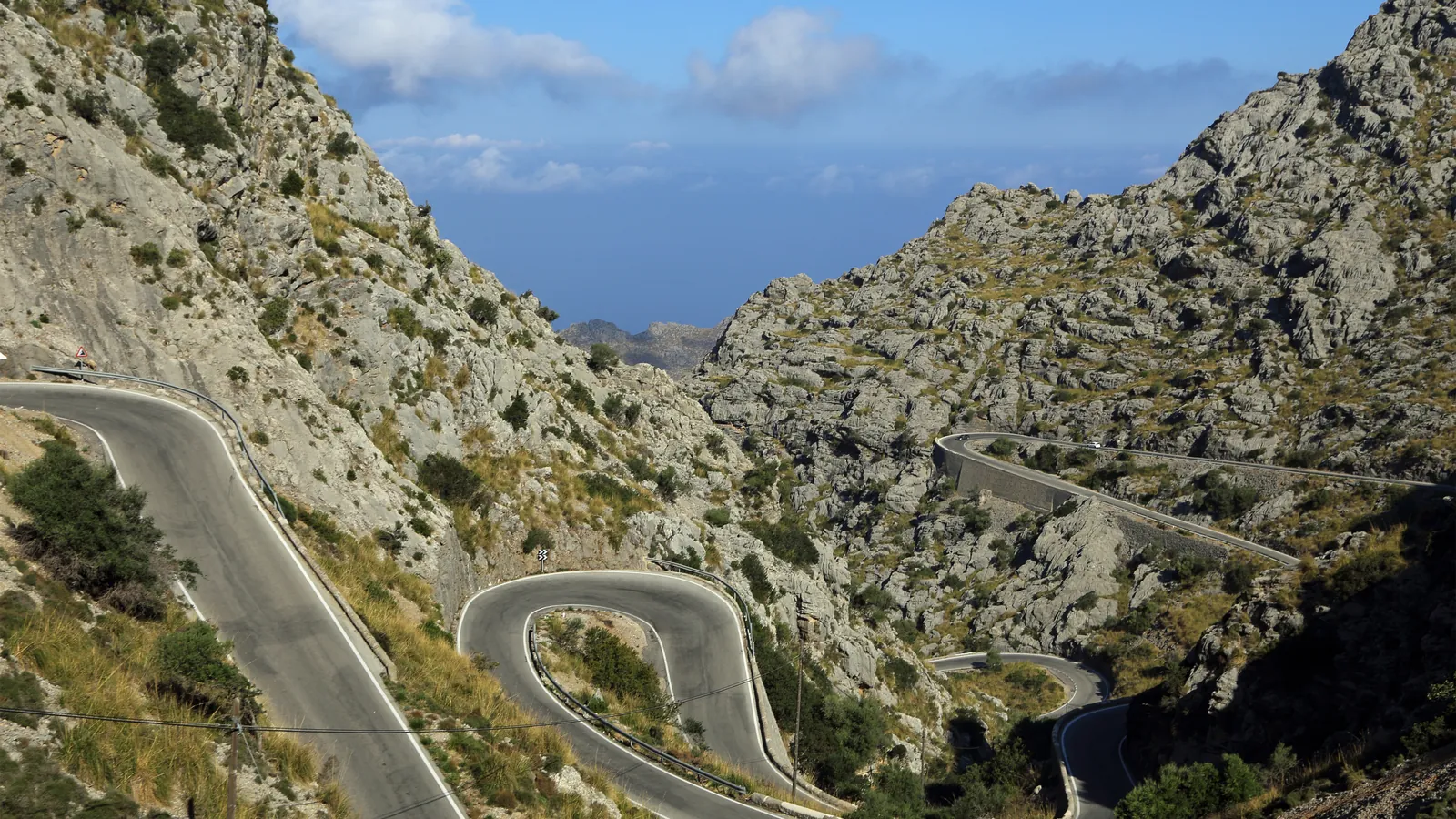
Winter camps for riders from northern Europe usually head south for daylight, warmth and climbs. Mallorca, one of Europe's most popular cycling destinations, and the Costa Blanca around Calpe both offer mild winters and climbs close to the coast.
Whatever the destination, check these before you book:
- climbs that match your goals in length and gradient;
- quiet roads and enough daylight for the longest planned day;
- a base where riders can eat well, rest and wash kit;
- a mechanic, or at least a workshop nearby;
- travel time, bike transport and the cost of a lost day at each end.
How long should an altitude training camp be?
An altitude camp is a three to four-week commitment, not a long weekend. In the studies behind it, runners lived high for four weeks, and the gains came at living altitudes of about 2,100 to 2,500 m.
Altitude is a different kind of camp. In Levine and Stray-Gundersen's 1997 study, runners who lived at 2,500 m and trained at 1,250 m for four weeks improved their 5,000 m time trial by about 13 seconds. Runners who lived and trained low did not. Chapman and colleagues (2014) compared four living altitudes over four weeks. The 3,000 m time trial improved in the groups living at 2,085 m and 2,454 m, but not in those at 1,780 m or 2,800 m. On Tenerife, the floor of the Teide caldera lies at 2,000 to 2,200 m, close to that band.
What that means in practice:
- Power at a given effort is lower in the first days, so targets come down.
- Sleep and morning heart rate need close watching.
- A doctor or the team's medical staff should check each rider's health, including iron status, before the camp.
How do you recover after a cycling training camp?
Plan an easy recovery week straight after the camp, because the camp's benefit appears after the recovery. In the fitness-fatigue model, fatigue falls within days while fitness fades over weeks, so form climbs in the week or two after a well-placed camp.
- Ride 50 to 60% of a normal week, with no hard intensity for the first three or four days.
- Place an opener or a short test at the end of the week, not before.
- Wait for morning readiness to return to normal before the next hard block.
- Eat and sleep as deliberately as at the camp: doubling your hours roughly doubles the energy you spend on the bike, as carbohydrate by the numbers explains.
Then debrief the camp against its goals within a few days. Look at hours and load planned against ridden, the numbers from the key sessions, the readiness trend through the week, any illness or niggles, and what to change next time. Store it where next year's planner will find it. Camps belong in the season plan, and the annual training plan shows where they fit on the way to the A race.
Camp planning checklist
- Eight weeks before: set one or two goals, choose the place, book travel and bike transport.
- Three to four weeks before: start the ramp, and record each rider's normal morning numbers at home.
- One week before: service the bikes, pack spares, write the food plan and agree the morning check.
- During: morning check, evening plan against ridden, one easy day in the middle.
- After: recovery week, debrief and the date of the next test.
Further reading
- Defining the "dose" of altitude training: how high to live for optimal sea level performance enhancement, Journal of Applied Physiology, 2014.
- "Living high-training low": effect of moderate-altitude acclimatization with low-altitude training on performance, Journal of Applied Physiology, 1997.
- A new approach to monitoring exercise training, Journal of Strength and Conditioning Research, 2001.
- Acute:chronic workload ratio: conceptual issues and fundamental pitfalls, International Journal of Sports Physiology and Performance, 2020.