On a steep climb, power per kilogram decides who reaches the top first. How W/kg, VAM and climb times connect, and where the number misleads.
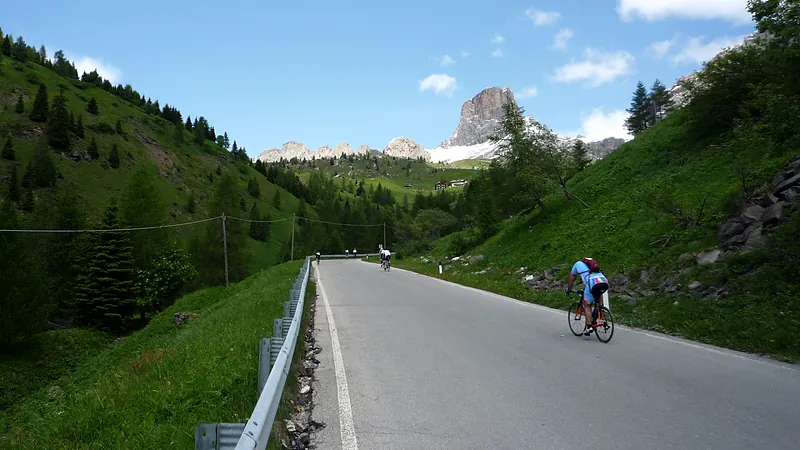
Watts per kilo is your power divided by your body weight, and on a steep climb it is the number that decides how fast you go. A 75 kg rider holding 300 W climbs at 4.0 W/kg. On a 7% gradient, almost nine tenths of that power goes into lifting rider and bike against gravity, so twice the mass needs about twice the power to climb at the same speed. That is why climbers talk in W/kg. On flat roads the picture changes completely, and that is where the number starts to mislead.
Why is watts per kilo so important on climbs?
Watts per kilo matters on climbs because gravity, which pulls on your total mass, takes most of your power when the road is steep. On a 7% climb, about 88% of a 75 kg rider's 300 W goes into lifting rider and bike.
Three things resist you on a climb: gravity, the air and the tyres. Gravity is proportional to the total mass you carry up, so the power it takes rises in step with your weight and your vertical speed. The air depends on your speed and your shape, not your weight.
On a steep climb you are slow, so the air takes little. Here is how the power splits for a 75 kg rider on an 8 kg bike holding 300 W:
| Gradient | Speed | Share of power lifting the mass | Share pushing air |
|---|---|---|---|
| 3% | 26.6 km/h | about 62% | about 30% |
| 5% | 20.6 km/h | about 80% | about 14% |
| 7% | 16.3 km/h | about 88% | about 7% |
| 10% | 12.1 km/h | about 93% | about 3% |
The steeper the road, the more W/kg alone predicts your speed. On a 3% climb, almost a third of the power still goes into air, and position and aerodynamics matter again; cycling aerodynamics explains that side.
Two details are easy to forget. First, gravity pulls on the bike, bottles and shoes as well as the rider, so W/kg of body weight is a slight simplification. An 8 kg bike adds 13% to a 60 kg rider's load but only 10% to an 80 kg rider's. Second, the W/kg that matters on a climb is the one you can hold for that climb's duration, not your peak.
How much time does an extra W/kg save on a climb?
On a 10 km climb at 7%, going from 3 to 4 W/kg saves about 11 minutes, while going from 5 to 6 W/kg saves about 4. Each step saves less time than the one before, because the same extra watts are worth less when the climb is already short.
How long does a 10 km climb at an average 7% take? The table below uses the physics, for a 75 kg rider on an 8 kg bike, riding alone in still air at sea-level air density, with typical tyres and a sitting-up climbing position.
| W/kg | Power | Time | Average speed | VAM |
|---|---|---|---|---|
| 2.5 | 188 W | 56:31 | 10.6 km/h | 741 m/h |
| 3.0 | 225 W | 47:41 | 12.6 km/h | 878 m/h |
| 3.5 | 263 W | 41:26 | 14.5 km/h | 1,011 m/h |
| 4.0 | 300 W | 36:48 | 16.3 km/h | 1,138 m/h |
| 4.5 | 338 W | 33:14 | 18.1 km/h | 1,260 m/h |
| 5.0 | 375 W | 30:24 | 19.7 km/h | 1,378 m/h |
| 6.0 | 450 W | 26:12 | 22.9 km/h | 1,598 m/h |
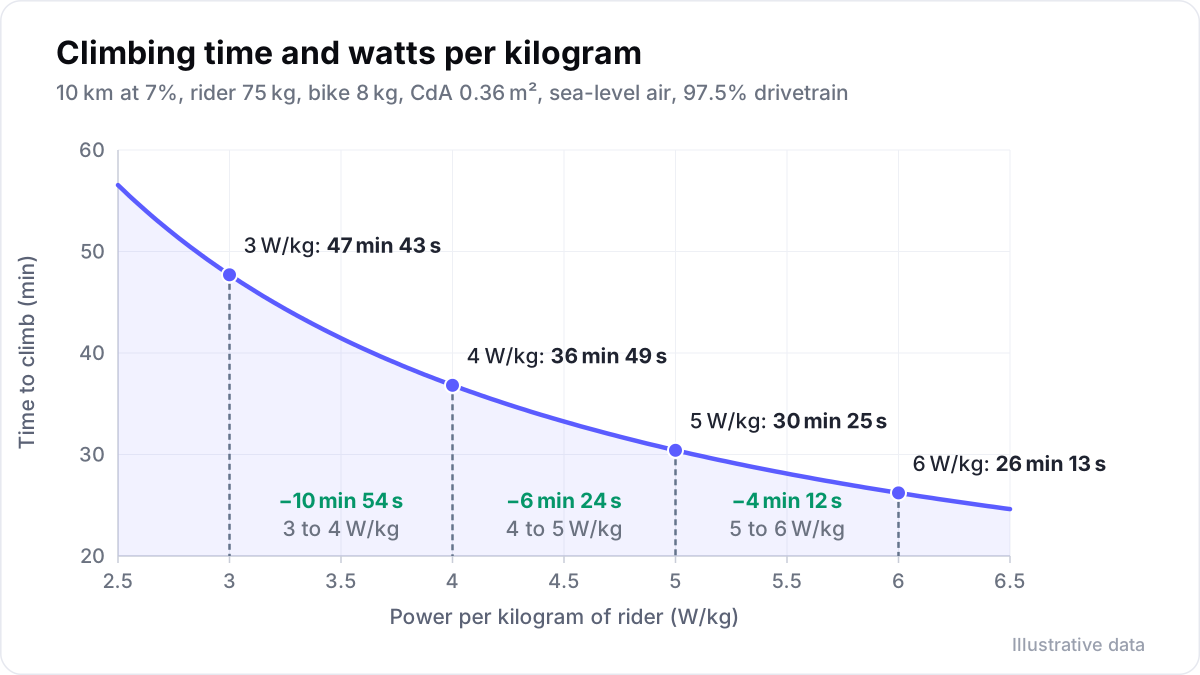
The curve flattens as power rises. Going from 3 to 4 W/kg saves about 11 minutes; going from 5 to 6 saves about 4. The same extra watts are worth less time when the climb is already short.
The table also shows why every gram is discussed on climbing bikes. At 300 W on this climb, one kilogram less total mass saves about 22 seconds, and 3 W more power (1%) saves about 19 seconds. A full 500 ml bottle costs about 11 seconds. Mass matters, but it is the total mass: bike, bottles, kit and rider together.
What is VAM in cycling?
VAM is your average climbing speed, measured as the height you gain in an hour. The name comes from the Italian velocità ascensionale media. It is popular because it needs no power meter, only a climb's height gain and a stopwatch.
Climb 698 metres in 36 minutes 49 seconds and your VAM is 1,138 metres per hour. VAM converts to power through gravity. Every 1,000 metres per hour of VAM takes about 2.7 W for each kilogram of rider and bike, for the lifting alone. Rolling resistance, air and drivetrain losses come on top: on a 7% climb they add roughly another 10 to 25%, more at higher speeds and on shallower climbs.
Worked through for the 4 W/kg rider above:
- VAM 1,138 m/h × 2.72 ÷ 1,000 = 3.10 W for each kilogram of rider and bike.
- Rider and bike weigh 83 kg, the rider 75 kg: 3.10 × 83 ÷ 75 = 3.43 W per kilogram of rider, for lifting alone.
- Add tyres, air and drivetrain (about 17% here): about 4.0 W/kg.
VAM also depends on the gradient. At the same power, the same rider climbs at a higher VAM on a steeper road, because less power goes into the air. A VAM of 1,200 m/h on a 10% climb takes less power than 1,200 m/h on a 5% climb.
How accurate are W/kg estimates of pro climbs?
Estimates of a pro rider's W/kg from climb times and VAM are rough, because small errors in gradient, wind, drafting and weight grow quickly. An estimate within 5% is good work.
Commentators and analysts often estimate professional riders' W/kg from climb times and VAM. Treat those numbers as estimates, because small errors grow quickly. For the 4 W/kg example above:
- If the true average gradient is 7% but the analyst assumes 7.5%, the estimate becomes 4.25 W/kg.
- A 2 m/s (7 km/h) headwind means the real effort was about 4.3 W/kg; a tailwind of the same speed, about 3.8 W/kg.
- Riding on a wheel in a group cuts air resistance, so a solo-rider calculation overstates what a rider in a group produced.
- The rider's weight and bike weight are often guessed.
An estimate within 5% is good work. A precise-looking number to two decimals from a broadcast time is not.
Does W/kg matter on flat roads?
W/kg matters much less on flat roads, because most of your power goes into the air, and air resistance depends on your size and shape, not your mass. Heavier, more powerful riders often have the advantage on the flat, even with fewer watts per kilo.
A heavier rider has a bigger frontal area, but it grows much more slowly than their weight. Research on professional riders shows the same split. Padilla and colleagues (1999) tested 24 professionals in a laboratory. The flat-terrain specialists had the highest absolute maximal power, 481 W on average, while the climbers had the highest power per kilogram, 6.47 W/kg. The authors concluded that power per kilogram suits uphill riding. On level ground, riders are better compared by power against body mass raised to the power of about 0.32, a figure that grows much more slowly than weight itself.
A worked example makes it concrete. Take two riders, each on an 8 kg bike:
| Rider A | Rider B | |
|---|---|---|
| Weight | 60 kg | 80 kg |
| Power held | 300 W | 360 W |
| W/kg | 5.0 | 4.5 |
| 10 km at 7% | 31:19 | 33:04 |
| 40 km flat, in the drops | 55:50 | 55:24 |
Rider A wins the climb by 1 minute 45 seconds. Rider B wins the flat time trial by 26 seconds. The example assumes a drag area of 0.25 square metres for A and 0.29 for B in the drops, and 0.33 and 0.38 sitting up on the climb. Neither rider is better; they are built for different roads. That is also why your power curve and rider type matter more than a single W/kg figure.
Should you lose weight to raise your W/kg?
Not by setting a weight target from a W/kg calculation, because power that falls with weight is not a gain. For most riders, the healthy route to more W/kg runs through the watts. Questions about your weight, energy or health belong with a doctor or a registered sports dietitian.
The arithmetic above tempts riders to chase body weight. That is where W/kg becomes risky. When the energy you eat does not cover what training costs, the body starts to save energy in ways that harm health and, sooner or later, performance. The International Olympic Committee's 2023 consensus statement calls this relative energy deficiency in sport (REDs), and it affects men as well as women.
So fuel training properly, especially long and hard sessions. Carbohydrate by the numbers explains how much a ride uses.
How should you use W/kg in your training?
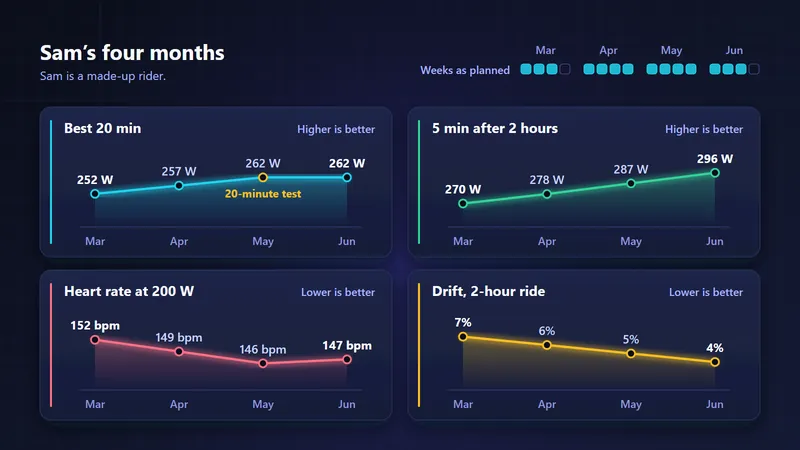
W/kg is most useful when you compare yourself with yourself, on climbs that suit your events. Know it at the durations that matter, use one steady weight figure and time a regular test climb.
- Know your W/kg at the durations that matter. A 20-minute climb asks for your 20-minute power, not your FTP. See what FTP is and how it relates to longer and shorter efforts.
- Use one weight figure consistently. Body weight moves by a kilogram or more from day to day with water and food. Use a steady figure updated now and then, not today's reading.
- Time a regular test climb. Same climb, similar weather, same bike. Time and average power together tell you more than either alone.
- Pace climbs by W/kg. If your 30-minute power is 4.0 W/kg, start a 30-minute climb at that and resist the first-minute surge.
- Look at W/kg late in long rides. Climbs at the end of a race are ridden on tired legs. Your best 20-minute W/kg after three hours is the number that wins hilly races.
In Velograph, selecting any stretch of a ride shows its average power and W/kg, which makes comparing the same climb across months straightforward.
Further reading
- Level ground and uphill cycling ability in professional road cycling, Padilla and colleagues, Medicine and Science in Sports and Exercise, 1999.
- 2023 International Olympic Committee's (IOC) consensus statement on Relative Energy Deficiency in Sport (REDs), Mountjoy and colleagues, British Journal of Sports Medicine, 2023.
- Validation of a mathematical model for road cycling power, Martin and colleagues, Journal of Applied Biomechanics, 1998.