How to raise your FTP with steady riding, sweet spot, threshold and VO2max work: how much it rises at each level, a 12-week block and a fair retest.
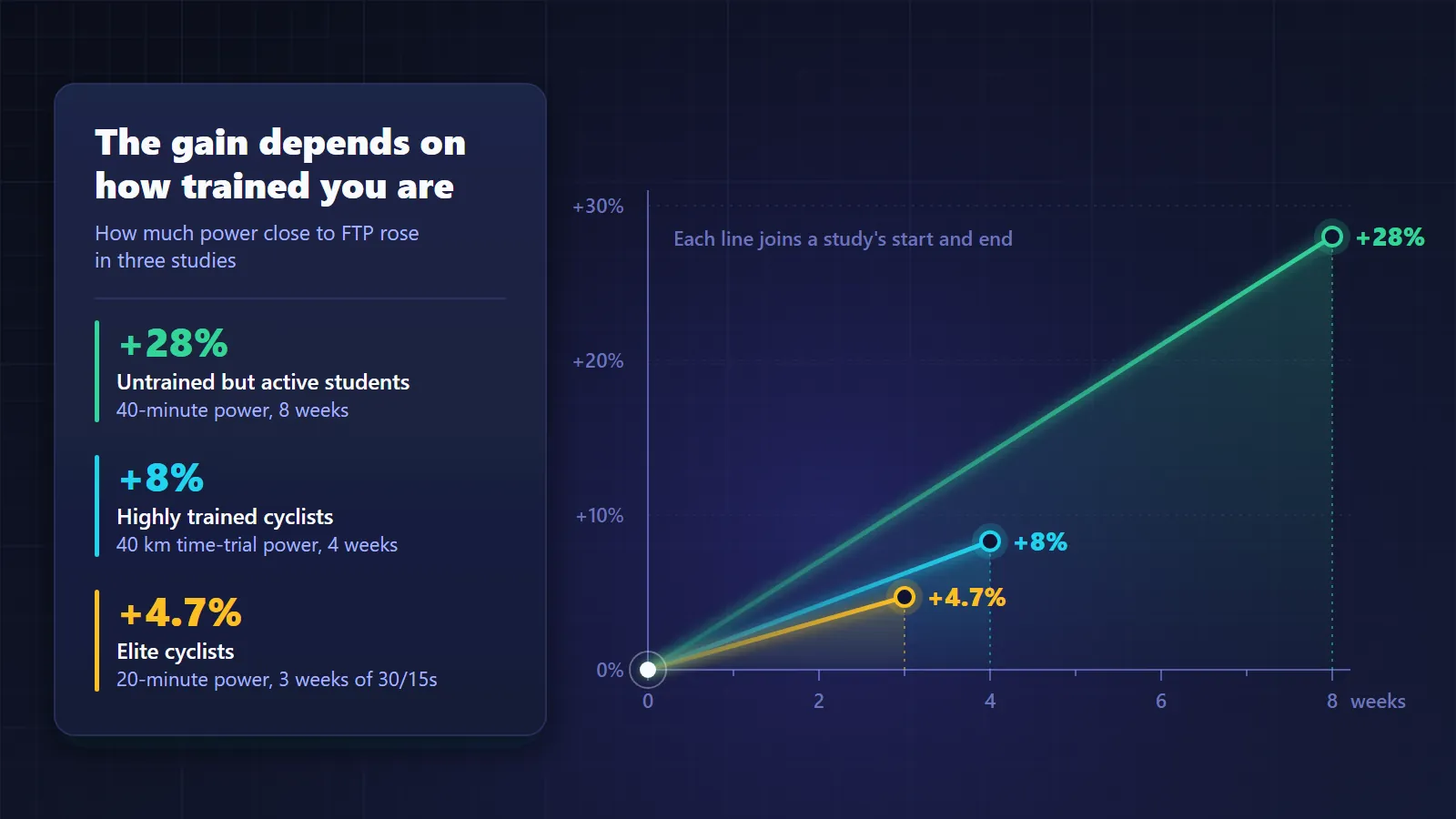
How to increase FTP comes down to three habits kept up for months: ride most of your hours steadily, add two harder sessions a week around threshold and at VO2max, and take an easier week every three or four. FTP, your functional threshold power, is the highest power you can hold steadily for a long effort, usually 30 to 70 minutes. How much it rises depends on how trained you are. Untrained young men in one study raised their 40-minute power by 28% in eight weeks; elite cyclists in another gained about 5% in 20-minute power from three weeks of short intervals. Below are the evidence, a 12-week block and a fair retest.
How do you increase your FTP?
You increase your FTP by training consistently for weeks and months, with most of your hours easy, two key sessions a week near or above threshold, and an easier week every three or four. A plan you ride every week does more than a harder one you keep missing.
Five levers do most of the work, with percentages from the standard cycling training zones.
- Ride often and steadily. Endurance riding at 56 to 75% of FTP builds the aerobic base, and it fills most of the week.
- Spend time near threshold. Sweet spot at 88 to 93% of FTP and threshold intervals at 95 to 100% train you to hold high power for longer.
- Raise the ceiling. VO2max intervals of 3 to 8 minutes at 106 to 120% of FTP raise the most oxygen your body can use. FTP is a share of that ceiling: in Lindsay and colleagues' 1996 study, four weeks of hard 5-minute repeats raised highly trained cyclists' peak power from 416 to 434 W.
- Recover on purpose. The body adapts in the easy days and weeks, not during the intervals.
- Change one thing at a time. Add time at a target before you raise the target.
How much can FTP increase?
How much FTP can increase depends mostly on how trained you already are. In a 2021 meta-analysis of interval training, trained people improved their time-trial performance by about 2%, while people of lower training status improved by up to 6%.
The studies below measured something close to FTP rather than FTP itself.
| Who | Training | What changed | Study |
|---|---|---|---|
| 12 untrained but active male students, aged about 19 | 8 weeks, 30 to 40 minutes three times a week at critical power | 40-minute power from 190 to 242 W on average, a rise the study reports as 28% | Jenkins and Quigley, 1992 |
| 12 trained male cyclists | 6 weeks polarised (6.4 h a week), 6 weeks threshold-heavy (7.5 h) | Lactate threshold up 9% polarised, 2% threshold-heavy | Neal and colleagues, 2013 |
| 8 highly trained cyclists, about 300 km a week | 4 weeks, 15% of riding replaced by 6 to 8 × 5 minutes hard | 40 km time-trial power from 301 to 326 W, up about 8% | Lindsay and colleagues, 1996 |
| 18 elite cyclists | 3 weeks, nine sessions of 30/15s or 5-minute intervals | 20-minute power up 4.7% with 30/15s, down 1.4% with 5-minute intervals | Rønnestad and colleagues, 2020 |
The first months of structured training bring the largest gains, but a new kind of session can still move a well-trained rider. The same plan also works differently for different people. In the HERITAGE Family Study, 481 sedentary adults trained for 20 weeks. Their VO2max rose by about 400 ml a minute on average, but some gained little or nothing and others more than a litre. At the top, gains are small: in 61 professional men followed for a median of four seasons, critical power varied by about 3% from one season to the next.
What kind of training raises FTP most?
No single kind of training raises FTP most for everyone. A mix of steady riding, work near threshold and some VO2max intervals is a sound default. A 2025 network meta-analysis of endurance athletes found no overall difference between polarised and pyramidal training in VO2max or time-trial performance.
Polarised training keeps most riding easy and adds very hard intervals; pyramidal training adds more time near threshold, where sweet spot sits. Neal's study in the table favoured polarised training over a threshold-heavy plan. The 2025 analysis by Rosenblat and colleagues pooled 13 studies and 348 athletes. It suggested that competitive athletes may gain more from polarised training and recreational athletes from pyramidal training. The article on polarised training covers the debate. The block below does both: it starts near threshold, adds VO2max work, and keeps most hours easy.
What does a 12-week FTP training plan look like?
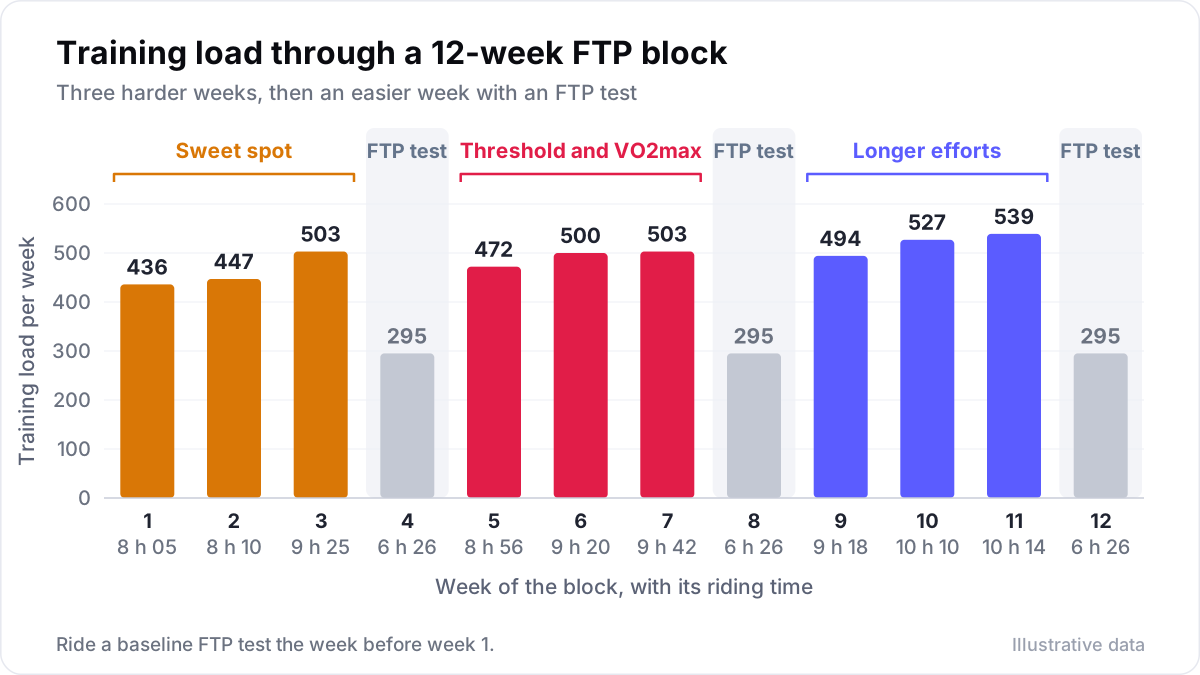
A 12-week FTP training plan can be three blocks of three harder weeks and one easier test week. The example below starts with sweet spot, moves to threshold and VO2max, and ends with longer efforts, for about 8 to 10 hours a week.
Monday is rest, and Tuesday and Thursday hold the key sessions, each with a 15-minute warm-up and a 10-minute cool-down. Wednesday is 60 to 120 minutes of endurance, Friday is rest or a 45-minute recovery spin, Saturday is the long ride and Sunday is 2 hours of endurance.
| Week | Tuesday | Thursday | Saturday | Hours | Training load |
|---|---|---|---|---|---|
| 1 | Sweet spot 3 × 10 min | Sweet spot 3 × 15 min | 2 h 30 with 3 × 15 min tempo | 8 h 05 | 436 |
| 2 | Sweet spot 3 × 15 min | Sweet spot 2 × 20 min | 2 h 30 with tempo | 8 h 10 | 447 |
| 3 | Sweet spot 2 × 20 min | Sweet spot 3 × 20 min | 3 h endurance | 9 h 25 | 503 |
| 4 | 45 min recovery | Openers; 20-min test Friday | 45 min recovery | 6 h 26 | 295 |
| 5 | Threshold 2 × 15 min | VO2max 6 × 3 min | 2 h 30 with tempo | 8 h 56 | 472 |
| 6 | Threshold 2 × 20 min | VO2max 5 × 4 min | 2 h 30 with tempo | 9 h 20 | 500 |
| 7 | Over-unders 4 × 8 min | VO2max 4 × 8 min | 3 h endurance | 9 h 42 | 503 |
| 8 | 45 min recovery | Openers; 20-min test Friday | 45 min recovery | 6 h 26 | 295 |
| 9 | Threshold 2 × 20 min | 30/15s 3 × 13 | 2 h 30 with tempo | 9 h 18 | 494 |
| 10 | Sweet spot 2 × 30 min | VO2max 5 × 4 min | 3 h endurance | 10 h 10 | 527 |
| 11 | Over-unders 3 × 12 min | VO2max 4 × 8 min | 3 h endurance, 2 h on Wednesday | 10 h 14 | 539 |
| 12 | 45 min recovery | Openers; 20-min test Friday | 45 min recovery | 6 h 26 | 295 |
Training load is the time of each session weighted by how hard it was, so that an hour at threshold scores 100. The figures come from each session's targets, so they are the same for any FTP.
For a rider with an FTP of 250 W, sweet spot is 220 to 233 W and threshold 238 to 250 W. The over-unders 4 × 8 minutes alternate 225 to 235 W with 263 to 275 W. VO2max 5 × 4 minutes is 270 to 295 W, and the 30-second efforts of the 30/15s are 288 to 313 W.
Ride a 20-minute test the week before week 1, so that week 4 has a number to compare with. If the second key session of a week fails, repeat that week rather than move on. After each test, set the new FTP, and every target moves with it. The guide to structured training plans explains how to build and adjust sessions like these.
How do you retest FTP fairly?
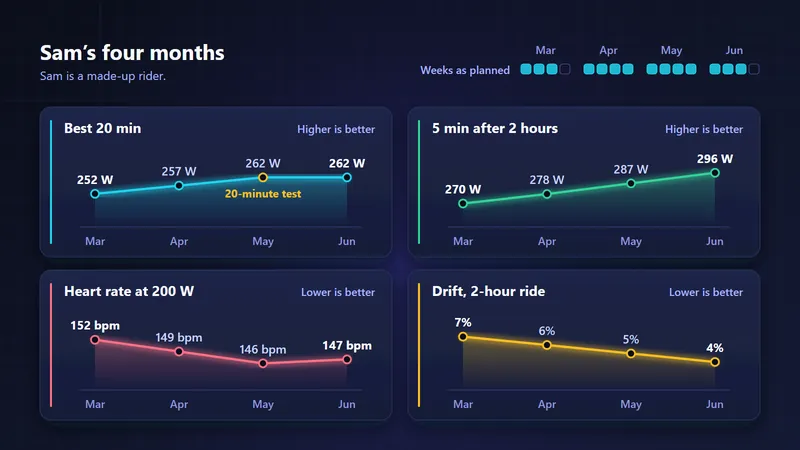
Retest FTP with the same test, on the same bike and power meter or trainer, at the same time of day, after the same easy days and warm-up. A change of 2 to 3% can be day-to-day variation, so check it against your sessions before you trust it.
Borszcz and colleagues had 25 trained cyclists ride the 20-minute test twice, a week apart, and found a typical variation of 2.9%. At an FTP of 250 W, that is about 7 W either way. A checklist keeps tests comparable:
- The same test. A ramp test and a 20-minute test can give one rider different FTPs, as what FTP is explains.
- The same power source. Use one power meter or one smart trainer, and keep indoor and outdoor numbers apart.
- The same lead-in. Ride the same easy days and openers before each test.
- The same conditions. Keep the time of day, the room temperature, the fan and the meal before the same.
- The same pacing. Turn ERG off, start a little below your target and finish hardest.
- A note. Write down sleep, temperature and how the test felt.
A rise that also shows in training is real: sweet spot sets that feel easier at the same heart rate, or a ride with a 20-minute effort above your old FTP divided by 0.95. In Velograph, a planned test ride is read when it comes in, and the new FTP it shows can be set with one click; ordinary rides that point to a higher FTP are flagged too. The free Rider plan keeps your rides with ride analysis, and Rider Plus adds training plans, as what a rider gets on their own explains.
Why is my FTP not going up?
Your FTP is usually not going up for one of four reasons: too much fatigue, too little consistency, the same sessions for too long, or tests that cannot be compared. Check them in that order before you add more hard work.
- Fatigue. Heavy legs, failed intervals and poor sleep point to too much load, often from easy rides that drift into tempo. Take the easier week early.
- Consistency. Count the key sessions you rode in the last eight weeks. Fewer than twelve out of sixteen is usually the problem.
- Sameness. Months of the same 2 × 20 minutes stop working. Change the stimulus, as week 5 does.
- Tests. A hot room, a different trainer or a test after a hard week reads low.
If you stay unusually tired for weeks, or illness keeps coming back, see a doctor; questions about eating enough for your training belong with a registered sports dietitian.
When is FTP the wrong target?
FTP is the wrong target when your events are decided by something else: sprints, repeated efforts above threshold, or the power you have left late in a long ride. Then the sprint, W′ or durability deserves the training time.
W′ is the work you can do above critical power before you have to slow down, and a criterium draws on it again and again. The article on critical power and W′ explains how to measure and train it. Durability, how much power is left late in a long ride, makes the difference in many sportives and road races; the guide to durability in cycling shows how to track it. Look at your whole power curve before you choose the next block.
Further reading
- Endurance training enhances critical power, Jenkins and Quigley, Medicine and Science in Sports and Exercise, 1992.
- Programming interval training to optimize time-trial performance: a systematic review and meta-analysis, Rosenblat and colleagues, Sports Medicine, 2021.
- Reliability of the functional threshold power in competitive cyclists, Borszcz and colleagues, International Journal of Sports Medicine, 2020.