Polarised, pyramidal or threshold? What the studies show, why the way you count intensity matters, and how to use it on 6 to 10 hours a week.
Polarised training means doing most of your training easy, a smaller part very hard, and little in between. The 80/20 label comes from Stephen Seiler's observation that elite endurance athletes do roughly 80% of their sessions at low intensity and about 20% hard. Training studies show it works well, especially for raising VO2max, but not that it beats every alternative. Many professional cyclists train pyramidally, with more middle-zone work. For a rider with 6 to 10 hours a week, the lasting lesson is to make easy days easy and hard days hard.
What are the three zones in polarised training?
The three zones of polarised training are easy riding below the first threshold, work between the two thresholds, and efforts above the second threshold, which lies roughly at FTP for most riders.
Intensity distribution research uses a three-zone model built on two thresholds. The first threshold is where blood lactate first rises above resting levels and breathing starts to deepen; below it you can talk in full sentences for hours. The second threshold sits close to critical power, roughly where FTP lies for most riders; above it, fatigue builds within minutes.
- Zone 1: below the first threshold. Easy endurance riding.
- Zone 2: between the thresholds. Tempo, sweet spot and threshold work a little below the second threshold.
- Zone 3: above the second threshold. VO2max intervals, hard climbs and attacks.
Zone 2 here is not the zone 2 of the five- and seven-zone models: those models' endurance zone mostly sits inside zone 1 of this one. Cycling training zones shows how the systems line up, and zone 2 training covers the easy end in detail.
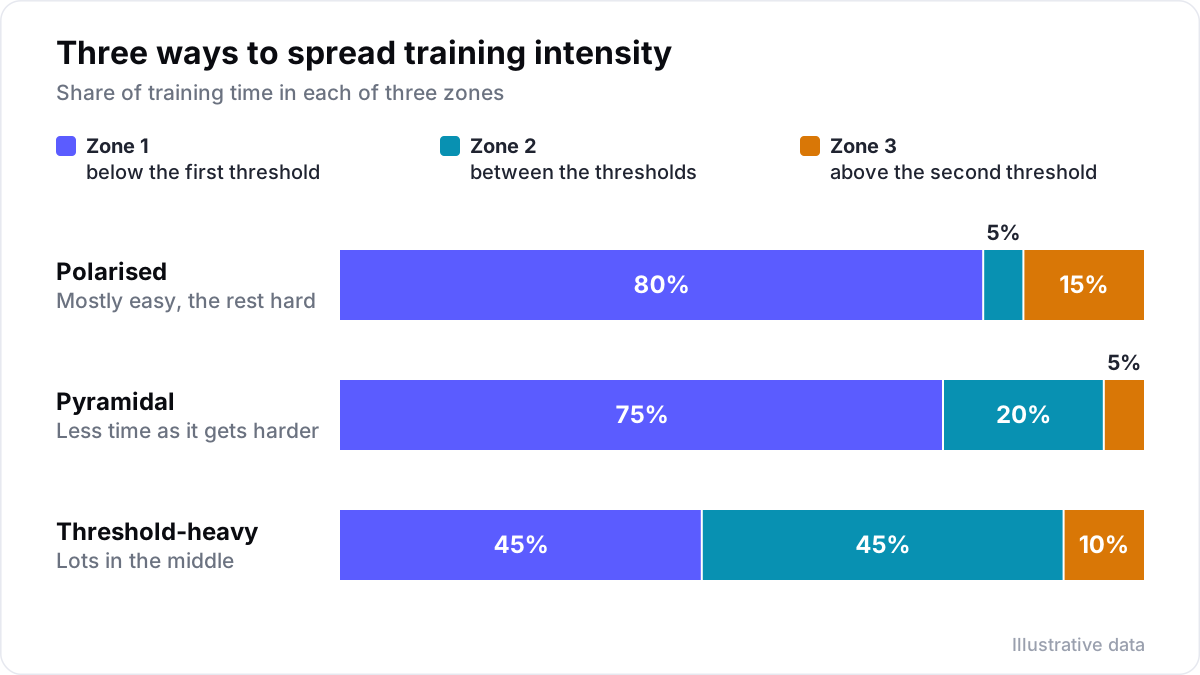
The names describe shape, not exact numbers. Smith, Taylor and Berger surveyed 117 cycling coaches in 2024. The coaches described polarised training as about 81% in zone 1, 3% in zone 2 and 17% in zone 3, and pyramidal training as about 68%, 23% and 9%. Both put most time in zone 1. The difference is whether zone 2 or zone 3 comes second.
Where does 80/20 training come from?
The 80/20 label comes from Stephen Seiler's research on elite endurance athletes, who did about 80% of their sessions at low intensity and about 20% hard.
In a 2006 study, Seiler and Kjerland followed 11 nationally competitive junior cross-country skiers for 32 days. By heart rate, about 75% of their endurance training was in zone 1, 8% in zone 2 and 17% in zone 3. Counting by perceived effort or blood lactate gave a similar picture. These athletes did surprisingly little at threshold.
In a 2010 review, Seiler found the same pattern across nationally and internationally competitive endurance athletes training 10 to 13 sessions a week: about 80% of sessions at low intensity and about 20% hard. Note the word sessions. The famous 80/20 counts workouts, not minutes.
Is 80/20 counted by time or by sessions?
The original 80/20 counts sessions, not minutes, and counting by time gives a very different split for the same week. Hard work looks far smaller when it is counted by the clock.
A 90-minute session with five 4-minute hard efforts is one hard session. Counted by the clock, it is 20 minutes of zone 3 and 70 minutes of zone 1.
Sylta, Tønnessen and Seiler showed this with 570 sessions from 29 elite cross-country skiers at an altitude camp. By time in zone, 96% of training was in zone 1. By session goal, 87% of sessions were zone 1 sessions. For hard training, the session count came out about three times higher than the time count.
Here is the same 8-hour week counted both ways:
| Day | Session | Zone 1 | Zone 2 | Zone 3 |
|---|---|---|---|---|
| Tuesday | 90 minutes with 5 × 4 minutes hard | 70 min | 0 | 20 min |
| Wednesday | 60 minutes easy | 60 min | 0 | 0 |
| Thursday | 90 minutes with 4 × 8 minutes hard | 58 min | 0 | 32 min |
| Saturday | 2.5 hours easy | 150 min | 0 | 0 |
| Sunday | 90 minutes easy | 90 min | 0 | 0 |
By time, the week is 89% zone 1 and 11% zone 3. By session, it is three easy sessions and two hard ones, 60/40. An 80/20 split by time on 8 hours would mean 96 minutes above threshold each week, which is a lot of very hard work for most riders. Heart rate also lags behind short efforts, so a week of short intervals counted from heart rate usually shows less zone 3 than the same week counted from power.
Is polarised training better than threshold training?
In studies of a few weeks, polarised training raised VO2max and peak power more than threshold-heavy plans, but it has not been shown to beat every alternative. A 2024 meta-analysis found a small advantage for VO2peak and no difference in time-trial performance.
Several controlled studies have compared polarised training with other distributions over weeks:
| Study | Who | What happened |
|---|---|---|
| Neal and colleagues, 2013 | 12 trained male cyclists, 6 weeks of each plan | Polarised (80/0/20, about 6.4 hours a week) raised peak power by 8% and the lactate threshold by 9%. Threshold training (57/43/0, about 7.5 hours) raised them by 3% and 2%. |
| Stöggl and Sperlich, 2014 | 48 well-trained runners, cyclists, triathletes and skiers, 9 weeks | Polarised gave the largest gains: VO2peak up 11.7%, peak power or speed up 5.1%. Its split by heart rate was about 68/6/26. |
| Muñoz and colleagues, 2014 | 30 recreational runners, 10 weeks | Polarised improved 10 km time by 5.0%, the between-thresholds plan by 3.6%. The difference was not statistically significant. |
| Oliveira, Boppre and Fonseca, 2024 | Meta-analysis of 17 studies, 437 participants | Polarised gave a small advantage for VO2peak, larger in highly trained athletes and in programmes under 12 weeks. Time-trial performance did not differ. |
Two points stand out. Most of these studies lasted weeks, not seasons, and compared polarised training with a deliberately threshold-heavy plan. And the debate is open. In 2022, Medicine and Science in Sports and Exercise published a point-counterpoint: Burnley, Bearden and Jones argued that polarised training is not optimal, and Foster, Seiler and colleagues argued that it is.
Do professional cyclists use polarised training?
Professional cyclists mostly train pyramidally over a season, with more middle-zone work than a polarised plan has. Stöggl and Sperlich's 2015 review found that most retrospective studies of competitive endurance athletes show pyramidal distributions, with some elite athletes switching to polarised training in certain phases of the season.
Two cycling studies show this in detail. Gallo and colleagues analysed the 22 weeks before the Giro d'Italia for three riders who finished in the top five overall. They trained 15 to 20 hours a week on average and spread it 91/7/2, 84/11/6 and 87/9/4 across the three zones. That is pyramidal, with more high intensity and a more polarised spread in race weeks. A 2025 study of 28 WorldTour riders by Mateo-March and colleagues found a pyramidal distribution through the whole season, with the hard share rising towards competition.
Remember the context. These riders train 15 to 20 hours a week and race often: the three Giro riders started between 17 and 29 races in those 22 weeks, and races supply much of their zone 3. Copying their percentages on a third of their hours copies the shape without the volume that makes it work.
How should you use polarised training on 6 to 10 hours a week?
Keep easy days below the first threshold, do one or two hard sessions a week, and keep middle-zone work for a reason. The studies closest to an amateur's week, Neal's cyclists at 6 to 8 hours and Muñoz's recreational runners, both favoured a polarised plan or found it at least as good.
That gives a sensible default with room for judgement:
- Keep easy days below the first threshold. You should be able to talk in full sentences. Easy group rides often drift into zone 2.
- Do one or two hard sessions a week, with at least a day between them. On 6 hours, one may be enough; on 10, two.
- Keep the middle zone for a reason. Threshold and sweet-spot work suit time trials, long climbs and riders short of time. A pyramidal week is a legitimate choice, not a mistake. Double threshold training shows how some athletes build a whole method around controlled middle-zone work.
- Change the emphasis through the season. Professionals tend to add zone 3 as racing approaches; a rider's base phase can carry more steady middle-zone work.
Here is the same 8 hours as a pyramidal week: Tuesday 2 × 20 minutes at sweet spot, Wednesday an hour easy, Thursday 4 × 4 minutes hard, Saturday 2.5 hours with 45 minutes of tempo, Sunday 90 minutes easy. By time, that is about 79% zone 1, 18% zone 2 and 3% zone 3. Both weeks are reasonable. The polarised one asks for more very hard work; the pyramidal one for more sustained work.
Check what you rode, not only what you planned. Count each month by time in zone and by sessions. In Velograph, the calendar shows each week's planned sessions against what was ridden, next to weekly targets for time or training load. A structured training plan helps keep the hard days hard by giving them a clear purpose.
Common mistakes
- Grey-zone easy days. The easy ride becomes tempo, the legs are tired for the intervals, and the week ends up threshold-heavy by accident.
- Hard days that are not hard. Zone 3 intervals should feel like work you could not double.
- Counting short intervals by heart rate. Use power for the hard sessions and heart rate as a ceiling on the easy ones.
- Treating 80/20 as a law. It describes what successful athletes tend to do. Your hours, events and recovery decide your version.
Further reading
- What is best practice for training intensity and duration distribution in endurance athletes?, Stephen Seiler, International Journal of Sports Physiology and Performance, 2010.
- Polarized training has greater impact on key endurance variables than threshold, high intensity, or high volume training, Stöggl and Sperlich, Frontiers in Physiology, 2014.
- Comparison of polarized versus other types of endurance training intensity distribution on athletes' endurance performance, Oliveira, Boppre and Fonseca, Sports Medicine, 2024.
- How do world class top 5 Giro d'Italia finishers train? A qualitative multiple case study, Gallo and colleagues, Scandinavian Journal of Medicine and Science in Sports, 2022.
Velograph is not affiliated with, sponsored by or endorsed by any team, rider or company named in this article. Names are used only to refer to publicly reported work.