What double threshold training is, where the Norwegian method came from, how lactate-guided intervals work and how a cyclist could try it with care.
Double threshold training means two controlled threshold sessions on the same day, one in the morning and one in the afternoon. Each is held at or a little below the point where blood lactate starts to climb steeply. It is the core of what runners call the Norwegian method, and its defining tool is a lactate meter that keeps every interval honest. For a cyclist with the time to train and recover, it is a way to pile up quality work without the fatigue of all-out intervals. For a rider on six hours a week, it is usually the wrong tool.
Where did the Norwegian method come from?
The Norwegian method grew out of Norwegian distance running around the turn of the century. The runner Marius Bakken began doubling threshold sessions in 1999, and the Ingebrigtsen brothers later made the method widely known.
Bakken, a 5,000 m runner who competed at the 2000 and 2004 Olympics and ran 13:06.39 in 2004, describes the change on his website. He usually doubled on two days a week, with one session in the morning and one in the evening. He also lowered his threshold target from the textbook 4.0 mmol/L of blood lactate to about 3.0, with most sessions between 2.3 and 3.0 mmol/L.
The method became widely known through the Ingebrigtsen brothers. Leif Inge Tjelta's 2019 case study of Henrik, Filip and Jakob, all European 1,500 m champions, found that in the build-up to the 2018 and 2019 seasons they averaged 140 to 160 km a week. Between 23 and 25% of that was at or above threshold pace, and blood lactate was measured in every interval session. Jakob later won Olympic gold over 1,500 m in Tokyo and over 5,000 m in Paris.
In 2023, Casado, Foster, Bakken and Tjelta summarised the model for distance runners: three to four lactate-guided threshold interval sessions and one VO2max session a week, with easy running bringing the total to about 150 to 180 km. In the threshold sessions, pace is set by a lactate target, typically between 2 and 4.5 mmol/L.
Norway's triathletes have drawn attention to the country's training too. Kristian Blummenfelt won Olympic gold in Tokyo and the Ironman world title for 2021, raced in St George in May 2022. Gustav Iden won the Ironman World Championship in Kona in 2022. Olav Aleksander Bu, a Norwegian sports scientist, co-authored a 2024 paper on the training volume and energy use of an Olympic and Ironman world champion, measured with doubly labelled water alongside the training data. How closely any triathlete's week follows the runners' double-threshold pattern is not settled by the published record, so treat "Norwegian method" as a family of ideas rather than one recipe.
How hard is double threshold training?
Double threshold sessions are hard but controlled. They sit in the upper part of the band between the two lactate thresholds, deliberately below the steep rise in blood lactate. They are interval sessions, not continuous efforts.
Blood lactate is measured in millimoles per litre (mmol/L) from a drop of blood from a fingertip or earlobe. At an easy pace it stays near resting values. Above the first threshold it starts to rise. Near the second threshold, close to where FTP sits for most riders, it climbs quickly and fatigue builds within minutes. Cycling training zones shows how the two thresholds line up with power zones.
Bakken's own rule of thumb links the length of a repetition to its intensity: short repetitions of about a minute can sit at or slightly above threshold, while long ones stay a little below it. In the model he describes for the Ingebrigtsen family, the morning session is the gentler one and the evening session sits at or a little above threshold.
Casado and colleagues argue that this control is the point. Because no session goes deep into the red, recovery between hard days is faster, and a week can hold more quality work than it could with all-out intervals.
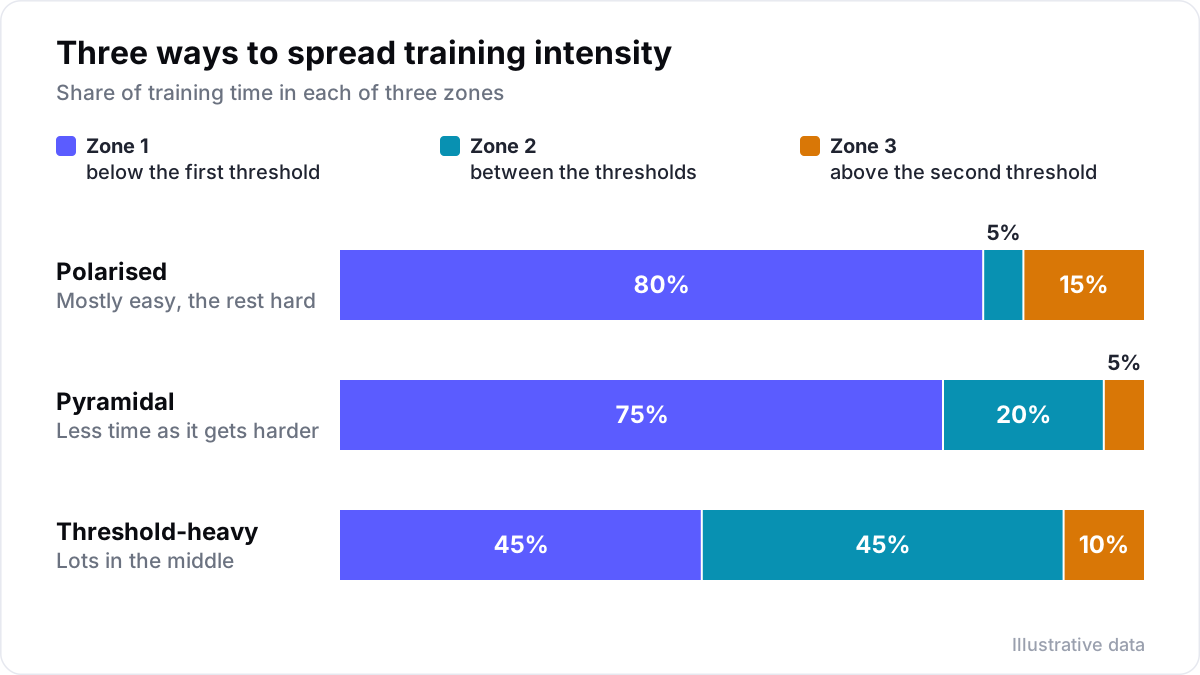
Threshold-rich does not mean threshold-only. In a 2022 review of world-class distance runners, Haugen and colleagues found at least 80% of running volume at low intensity, all year round. The Ingebrigtsens' 23 to 25% at or above threshold sits on top of a large easy base. Polarised training explains how the way you count time in zone changes these percentages.
What does a double threshold day look like on the bike?
A double threshold day for a cyclist could be 5 × 8 minutes at 82 to 85% of FTP in the morning and 10 × 3 minutes at 88 to 92% in the afternoon, at least 5 hours apart. Both sets stay below FTP and under a lactate ceiling.
Most published detail comes from running, and controlled trials of double-threshold days in cyclists are scarce. Treat what follows as a worked example of how the principles translate, not as a tested prescription.
Take a rider with an FTP of 300 W whose lactate step test shows 2.0 mmol/L at 235 W, 3.0 at 260 W and 4.0 at 280 W:
| Morning | Afternoon, at least 5 hours later | |
|---|---|---|
| Main set | 5 × 8 min, 90 s easy between | 10 × 3 min, 60 s easy between |
| Power | 245 to 255 W (82 to 85% of FTP) | 265 to 275 W (88 to 92% of FTP) |
| Lactate ceiling | 2.5 mmol/L | 3.5 mmol/L |
| Time at intensity | 40 minutes | 30 minutes |
| Lactate checks | After repetitions 2 and 4 | After repetitions 3, 6 and 9 |
The ceiling is a limit, not a target. If a reading lands above it, take 5 to 10 W off the next repetition and finish the set there. A session that ends with the feeling that two more repetitions were possible is a session done right.
Bakken's own weeks built two double-threshold days around one harder session, such as hill work or short intervals, with easy running on every other day. On the bike, a week of about 15 to 17 hours could look like this:
| Day | Session |
|---|---|
| Monday | Rest or 1 hour easy |
| Tuesday | Double threshold |
| Wednesday | 3 hours endurance, easy |
| Thursday | Double threshold |
| Friday | 1 hour easy |
| Saturday | One hard session: VO2max intervals, hill repeats or a race |
| Sunday | 4 hours endurance, easy |
How do you get reliable lactate readings?
Use the same meter, site and timing every time, clean the skin first, and log power, heart rate and effort beside each reading. A lactate meter is only as good as the routine around it.
- Use the same meter, the same site and the same timing every time, for example within 30 seconds of the end of a repetition.
- Clean and dry the skin first: sweat contains lactate and can spoil the sample.
- Compare trends within one meter; readings from different devices are not interchangeable.
- Low carbohydrate stores can lower lactate at a given power, so after a poorly fuelled day a hard effort can look easy on the meter.
- Log power, heart rate and perceived effort beside every reading. Within a few weeks you will know the power that matches your ceiling, and the meter becomes a weekly check rather than a constant one.
Can you do double threshold training without a lactate meter?
Double threshold training still works without a lactate meter, with care. Anchor power to a recent test, keep heart rate well below your threshold value in the first repetitions, and hold an effort where you could still speak in short sentences.
Who should try double threshold training?
Double threshold training suits experienced riders who train 12 hours a week or more and can fit two sessions into a day. On 6 to 8 hours a week, one threshold session plus endurance riding gives most of the benefit at far lower cost.
It fits riders who:
- train 12 hours a week or more, with days that allow two sessions;
- have several years of consistent training behind them;
- target long, steady efforts such as time trials, long climbs or stage races;
- sleep well and can keep easy days genuinely easy.
It is the wrong choice when:
- you train 6 to 8 hours a week, where one threshold session plus endurance riding gives most of the benefit at far lower cost;
- you are in a dense racing period;
- you are ill, sleeping badly or under heavy stress at work or at home;
- your limiter is the sprint or VO2max, which this method does not train.
Count the cost before you start. Two sessions a day means two warm-ups, food between them and carbohydrate for both, as carbohydrate by the numbers explains. Watch morning readiness and the fatigue trend; if your morning heart-rate variability sits below your normal range for several days, swap the next double day for easy riding. HRV training shows how to read that signal without overreacting to one morning.
How do you start double threshold training?
Start with a lactate step test or a recent FTP test, then add one double day a week for two weeks. Keep the power targets steady, protect the easy days and re-test after six weeks.
- Test first: a lactate step test, or a recent FTP test if you have no meter.
- Start small: one double day a week for two weeks; add a second only if readiness holds.
- Hold targets steady: keep the power targets for two weeks, and raise them by 5 W only when lactate stays under the ceiling at the end of the set.
- Protect the easy days: no extra intensity sneaking into endurance rides.
- Re-test after six weeks: compare the power at 2 and 4 mmol/L, or your FTP, with the start of the block.
Write the block into a structured training plan before you begin, so that planned and ridden can be compared each week. In Velograph, a coach can copy a double-threshold day from one rider's calendar to another's and send planned sessions to intervals.icu.
Further reading
- The Norwegian model, Marius Bakken.
- Does lactate-guided threshold interval training within a high-volume low-intensity approach represent the "next step" in the evolution of distance running training?, International Journal of Environmental Research and Public Health, 2023.
- Three Norwegian brothers all European 1500 m champions: what is the secret?, International Journal of Sports Science and Coaching, 2019.
- The training characteristics of world-class distance runners, Sports Medicine - Open, 2022.
Velograph is not affiliated with, sponsored by or endorsed by any team, rider or company named in this article. Names are used only to refer to publicly reported work.