What to write in a cycling training diary in under a minute, a week's template to copy, the weekly look back, and how a coach reads a diary.
A training diary is a short written record of every ride and every day: what you did, how hard it felt and how you were. For a cyclist, it records what the bike computer cannot, such as the effort out of 10, heavy legs, a short night or a new saddle. One entry takes under a minute, and a ten-minute look back each week turns the entries into decisions. Below are the fields, a week's template to copy, the look back and how a coach reads a diary.
Why keep a training diary?
A training diary often shows tiredness building before the ride file does, and it explains the numbers afterwards. In studies, athletes' daily ratings of how they felt tracked overtraining and predicted how much a taper helped. Diaries are also kept far more faithfully when a coach or programme backs them.
Three studies show what a diary does.
- Swimmers' logs. Hooper and colleagues (1995) followed 14 elite swimmers through a six-month season. Each day the swimmers logged their training and rated their sleep, fatigue, stress and muscle soreness. Three became stale. During the taper, the same ratings explained 72% of the variation in how much their race times improved, and the authors concluded that such ratings may be an efficient way to monitor overtraining and recovery.
- Illness and heavy, unvaried weeks. Foster (1998) had 25 experienced athletes log every session as its minutes and how hard it felt. Most illnesses came when an athlete went above a threshold of their own, mostly in training strain. Strain is high when a week is heavy and every day is about the same.
- Someone backing it. Saw and colleagues (2015) followed athletes for 16 weeks as they began using a self-report questionnaire. Team-sport athletes whose coach or programme backed it filled in 84% of their entries on average. Athletes left to do it on their own filled in 28% in individual sports and 8% in team sports.
Our guide to cycling training data sums up the wider research on recording progress. The six-season study of a future Grand Tour rider in data-driven training counted his training load from the minutes and 0-to-10 ratings kept in a diary.
What should you write in a training diary?
After each ride, write what the session was, how long it lasted, how hard it felt from 0 to 10, how your legs were, and one line on anything unusual. Each morning, add your hours of sleep and how you feel. Together that takes under a minute.
| Field | What to write | Example |
|---|---|---|
| Session | What was planned, and what you did | Planned 5 × 3 minutes hard; did four |
| Time | Minutes ridden | 70 |
| Effort | How hard the whole session felt, from 0 (rest) to 10 (maximal) | 8 |
| Legs | From 1 (empty) to 5 (fresh) | 2, heavy from the first effort |
| Sleep | Hours, and anything that broke the night | 5.5 hours, awake at 4 |
| Life | One line on work, school, family or travel | Deadline at work |
| Fuel | What you ate and drank on the bike, and how your stomach was | One bottle with 40 g of carbohydrate, fine |
| Kit | Anything new or changed | New cleats, saddle 2 mm higher |
| Pain or illness | Where, how bad from 0 to 10, and when it started | Left knee, 2 out of 10, after an hour |
Rate the whole session once you have cooled down, not its hardest minute. Use the same scales every time, so that a 7 in March means what a 7 means in June. Multiply the effort by the minutes and you have a load score that needs no sensor: the session above scores 8 × 70 = 560. Our guide to TRIMP and training load compares this score with heart-rate and power-based load.
Write what was unusual rather than what was normal. "Good ride" tells you nothing in six months, but "headwind home, last 20 minutes at 150 W" does.
What does a week in a training diary look like?
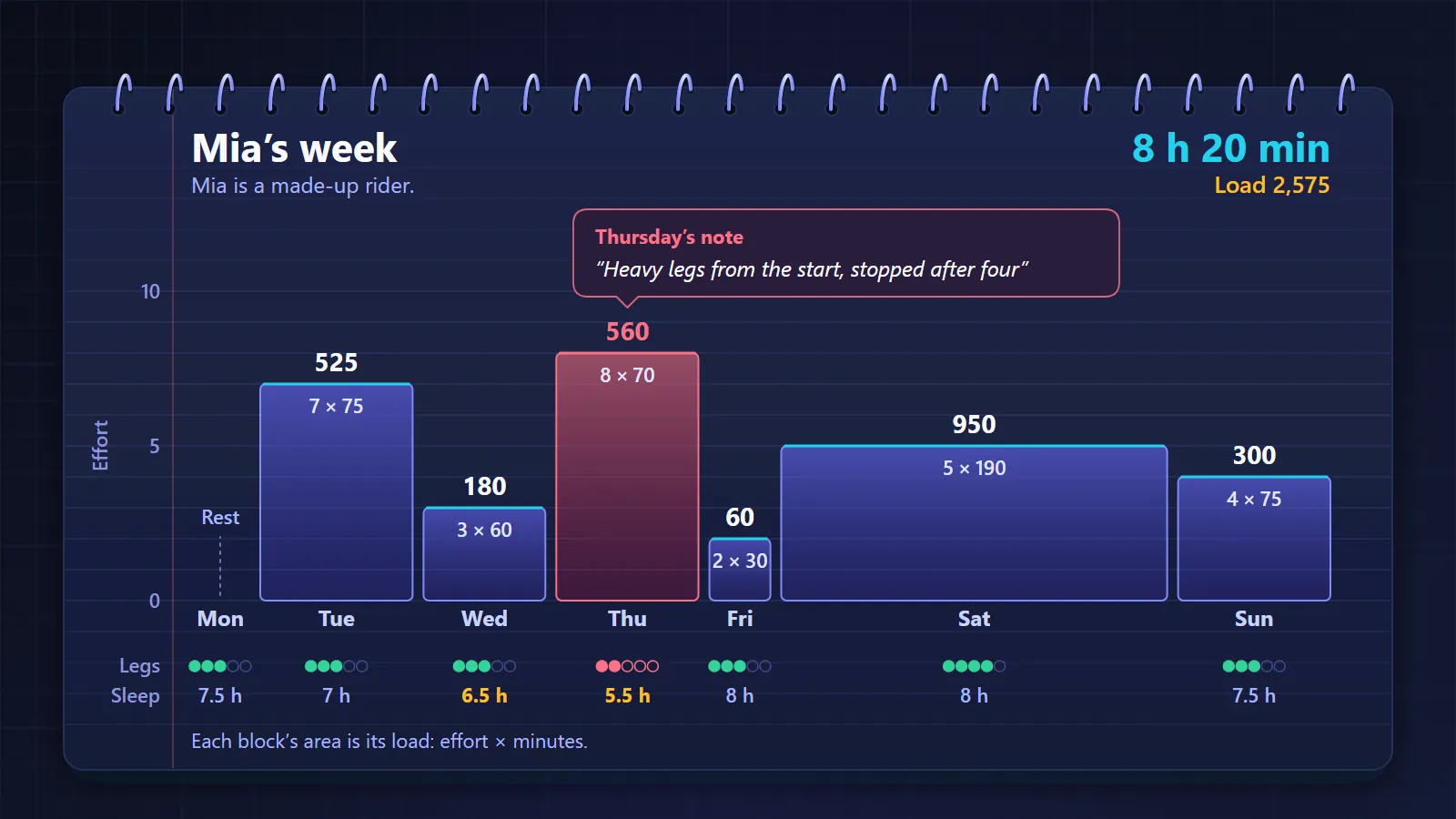
A week in a training diary is one row a day, with the session, minutes, effort, a load score, legs, sleep and a note, and one line at the bottom for the whole week. The example belongs to Mia, a made-up rider who trains about eight hours a week.
| Day | Session, planned → done | Minutes | Effort | Load | Legs | Sleep | Note |
|---|---|---|---|---|---|---|---|
| Mon | Rest → rest | 0 | – | 0 | 3 | 7.5 h | Work trip |
| Tue | 4 × 8 min at threshold → all four | 75 | 7 | 525 | 3 | 7 h | Last one at 262 W, in control |
| Wed | Easy 60 min → easy 60 min | 60 | 3 | 180 | 3 | 6.5 h | Windy, kept it easy |
| Thu | 5 × 3 min hard → four | 70 | 8 | 560 | 2 | 5.5 h | Heavy legs from the start, stopped after four |
| Fri | Rest → 30 min spin | 30 | 2 | 60 | 3 | 8 h | |
| Sat | Long ride, 3 h → 3 h 10 min | 190 | 5 | 950 | 4 | 8 h | Two bottles and two bars, no fade; new 30 mm tyres |
| Sun | Easy 60 min → club ride, 75 min | 75 | 4 | 300 | 3 | 7.5 h | Club ride harder than planned |
| Week | Long ride done; one key session done, one cut short | 500 | 2,575 | Two nights under 7 h |
Copy the columns into a notebook or a spreadsheet, and start each look back from the week's line.
How does the ride file fit with the diary?
The ride file records what you did, second by second, and the diary records what it cost you and why. Let the file keep time, power, heart rate and training load, and use the diary for effort, legs, sleep and the reason behind anything unusual.
| Question | The ride file answers | The diary answers |
|---|---|---|
| How long and how hard? | Time, distance, power, heart rate and training load | How hard it felt |
| Was it the planned session? | The intervals and laps you rode | What you meant to do, and why it changed |
| Why was the power low? | It cannot say | A short night, a headwind or a cold coming on |
| Is tiredness building? | Fitness, fatigue and form from your load | Legs, mood, and effort that rises for the same power |
| What changed? | Sometimes the name of a new device | A new bike, bike fit, saddle, tyres or cleats |
The most useful line in a diary is a mismatch between the two. Say a threshold session at 255 W felt like a 6 last month and an 8 today. Something has changed, though the file looks normal. Your fitness, fatigue and form show whether the training load explains it, and heart rate vs power gives a second view.
If you measure resting heart rate or heart rate variability, add it each morning. One low reading means little, but three in a row beside heavy legs and short nights mean a lot.
How do you look back at your training diary each week?
Once a week, spend ten minutes reading the week's entries and answer four questions. What did you do against the plan, how did it feel, what repeated, and what one thing will change next week? Write the answers as one line under the week.
| Question | Mia's answer |
|---|---|
| What did I do against the plan? | 8 h 20 min and a load of 2,575. The long ride was done, and Thursday's session was cut short. |
| How did it feel? | The easy days were easy. Thursday felt like an 8, with legs at 2. |
| What repeated? | Two short nights came before Thursday's session. |
| What changes next week? | The hard session moves to Friday, with an easy day before it. |
These patterns are worth acting on:
- the same session rated two points harder than usual, twice in a row;
- legs at 1 or 2 for three days running;
- three or more nights under 7 hours in one week;
- a key session cut short two weeks running;
- a week with no easy days, the heavy and unvaried kind that Foster linked with illness.
These are prompts, not diagnoses. Two or more together usually mean an easier few days now. The guide for the self-coached cyclist lists more warning signs, and when to ease off. The same pain written down twice is a matter for a physio or doctor rather than for the plan.
Once a month, read four weeks at once, because slow trends such as sleep sliding in a busy month show only then. At the end of the year, the diary feeds the season review.
How does a coach read a rider's training diary?
A coach reads a rider's diary for patterns and mismatches rather than single bad days: effort rising at the same power, sleep falling, a note that repeats. A short reply within a few days shows the rider that someone reads it, and that keeps the entries coming and honest.
In an earlier study, Saw and colleagues interviewed 30 athletes, coaches and staff at a national sports institute. Feedback was the factor they named most often for keeping athletes engaged. Athletes who thought nobody read their entries tended to fill them in without thought. Punishing missed entries led to careless answers, and half the athletes interviewed said they had sometimes held back the truth.
- Read the week's line first, then the days with a mismatch.
- Ask before you explain. "Thursday felt like an 8. Was it the sleep or the legs?"
- Reply every week with one line, even when all is well.
- Never punish an honest entry. "Skipped, too tired" is what you need to know.
- Agree who reads the diary. Health notes stay with the staff who coach the rider. Our guide to athlete data privacy covers consent and juniors.
Should you keep a training diary on paper or in an app?
Keep it wherever you will write every day. Paper costs nothing and is quick, a spreadsheet adds up the load and draws trends, and an app can put the notes next to the ride file. The fields and the weekly look back matter more than the tool.
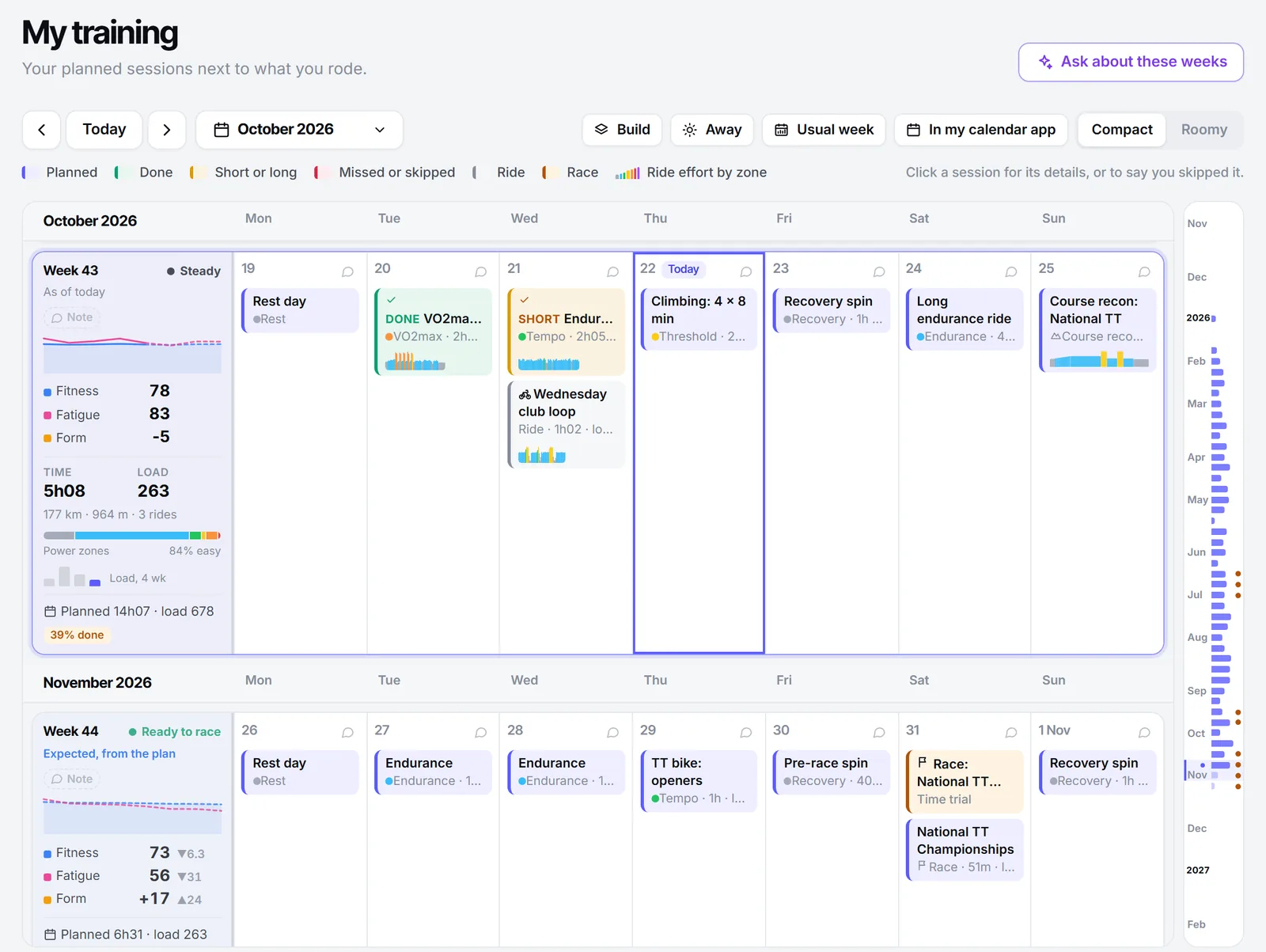
Velograph, for example, asks "How was it?" on each ride's page: the kind of ride, the effort from 1 to 10, and how your legs and you felt. Its morning check-in asks about energy, legs, sleep quality and mood from 1 to 5, hours slept, and illness or pain. Notes on a calendar day or week are read only by you and whoever plans your training. All of this is in the free Rider plan, which keeps your rides with ride analysis; see what a rider gets on their own.
Further reading
- Markers for monitoring overtraining and recovery, Hooper and colleagues, Medicine and Science in Sports and Exercise, 1995.
- Monitoring training in athletes with reference to overtraining syndrome, Foster, Medicine and Science in Sports and Exercise, 1998.
- Monitoring athletes through self-report: factors influencing implementation, Saw, Main and Gastin, Journal of Sports Science and Medicine, 2015.
- Impact of sport context and support on the use of a self-report measure for athlete monitoring, Saw, Main and Gastin, Journal of Sports Science and Medicine, 2015.
Velograph is not affiliated with, sponsored by or endorsed by any team, rider or company named in this article. Names are used only to refer to publicly reported work.