How to coach yourself on the bike: plan back from one goal, repeat a simple week, test FTP, read your form, back off in time and fuel long rides.
A self-coached cyclist does a coach's four jobs alone: plan the season back from one goal, set the sessions, test and review. You repeat a simple week with two hard sessions and one long ride, and test every four to eight weeks so the targets stay true. The skill is in the weekly review, where you notice early that something is wrong and change it.
How do I plan a cycling season on my own?
Count the season back from one goal that has a date and a measure. "Get fitter" gives you nothing to plan towards, but "ride the 160 km sportive on 14 June in under seven hours" does. Choose one main goal, your A event, and at most one or two smaller ones.
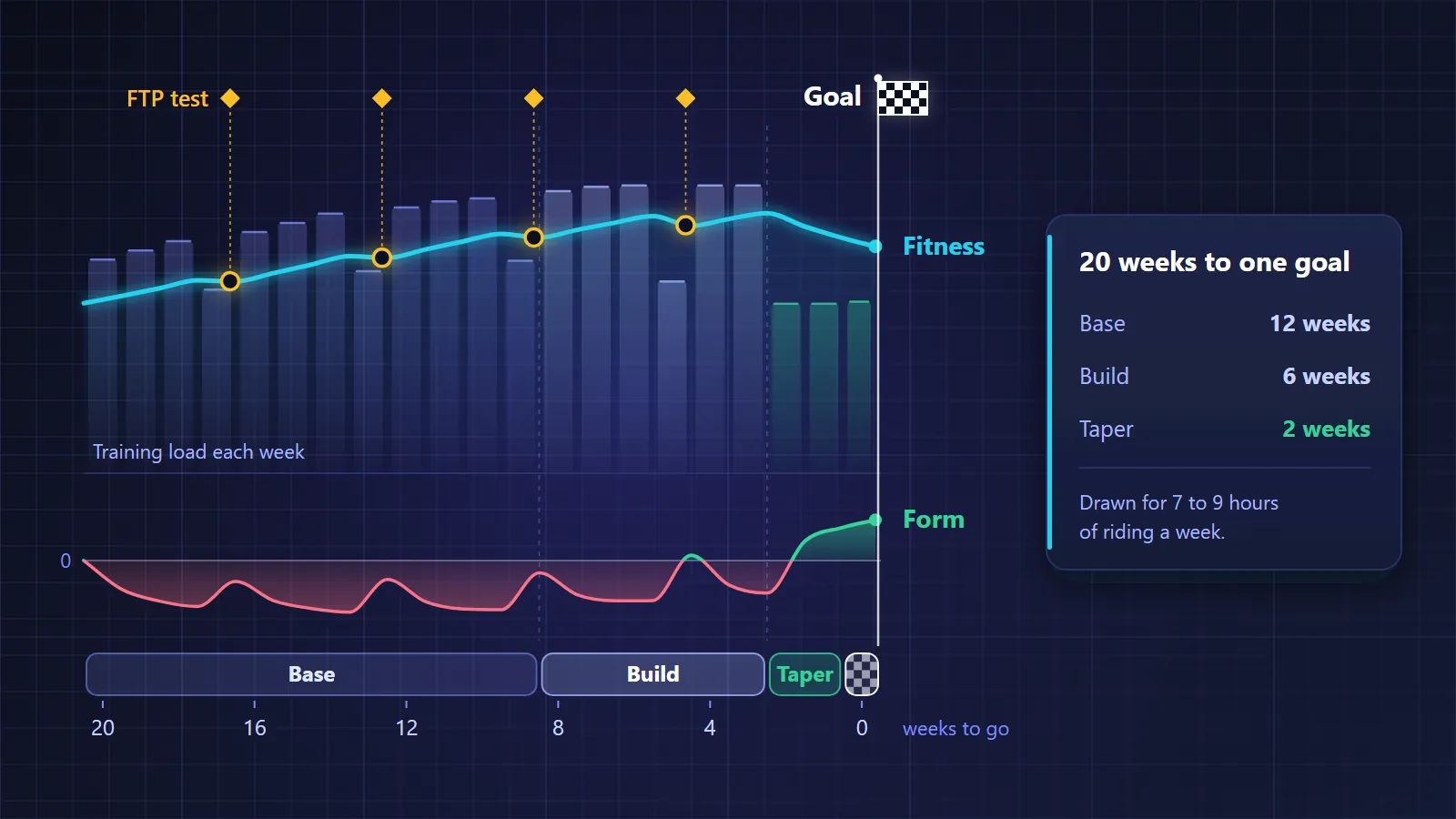
Here is a 20-week run-up for a rider with 7 to 9 hours a week.
| Weeks before the goal | Phase | What the weeks work on |
|---|---|---|
| 0 | Event week | Short openers two days before, rest the day before |
| 1 to 2 | Taper | Less riding, with a few short efforts at race pace |
| 3 to 8 | Build | Two key sessions a week, such as threshold and VO2max, plus the long ride |
| 9 to 20 | Base | Long steady rides, some tempo and short sprints, with hours rising gently |
Put an easier week in every third or fourth week, at about three quarters of the usual hours. The taper has the clearest research behind it. In a 2007 meta-analysis, Bosquet and colleagues found the largest gains from a taper of about two weeks. Training volume came down by 41 to 60%, while intensity and the number of sessions stayed the same.
If the goal is less than 20 weeks away, shorten the base and keep the build and the taper. The guide to the annual training plan adds smaller races and longer seasons.
What does a good training week look like?
A good week keeps the easy days easy and the hard days hard. For most riders, that means two key sessions, one long ride, easy riding around them and at least one rest day. A common trap when you train without a coach is to ride every ride a little hard, so that no ride is hard enough.
| Day | Session | Time |
|---|---|---|
| Monday | Rest | 0 |
| Tuesday | Key session: 3 × 10 minutes at threshold (95 to 100% of FTP) | 1 h 15 min |
| Wednesday | Easy ride, below 75% of FTP | 1 h |
| Thursday | Key session: 5 × 3 minutes at VO2max (110 to 120% of FTP) | 1 h 15 min |
| Friday | Rest, or a 30-minute easy spin | 0 to 30 min |
| Saturday | Long steady ride, eating from the first hour | 2 h 30 min to 3 h |
| Sunday | Easy ride | 1 h |
In the build, make one thing harder at a time: go from 3 × 10 minutes to 4 × 10, then to 2 × 20, before you raise the target itself. When life squeezes a week, protect the two key sessions and the long ride, and drop the easy rides first. The guide to structured training plans covers session design, and heart rate vs power helps if you train with heart rate.
How do I test my FTP on my own?
Choose one test, such as a 20-minute test or a ramp test, and repeat it in the same conditions every four to eight weeks. Ride it rested at the end of an easier week, and test again after illness or a break.
Every target in your week is a share of your FTP, or functional threshold power. That is the highest power you can hold in a steady effort without fatiguing. If your FTP is set 5% too high, every session is 5% harder than planned. The guide to what FTP is compares these tests.
- 20-minute test. After a proper warm-up, ride 20 minutes as hard as you can hold evenly. The usual factor, from Hunter Allen and Andrew Coggan, takes 95% of the average as your FTP.
- Ramp test. The power rises every minute until you cannot hold it. Zwift and TrainerRoad take 75% of your highest one-minute power. It needs no pacing, but it can overstate FTP for riders with a strong sprint.
- Critical power. Ride at least three all-out efforts between 2 and 15 minutes, such as 3, 7 and 12 minutes. Leo and colleagues (2022) recommend at least 30 minutes of easy riding between them. Critical power is the highest power you can sustain without steadily using up a limited reserve, and the test also gives you the size of that reserve, W′. The guide to critical power and W′ explains both.
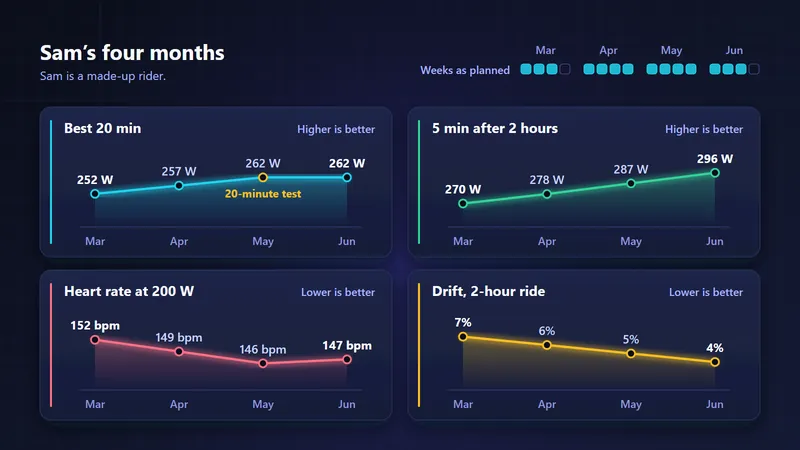
The 95% factor does not suit everyone. Sitko and colleagues (2023) tested 120 cyclists and found that the factor which predicted their hour power ranged from 96% in professionals to 88% in recreational riders. For a rider who averages 262 W for 20 minutes, that is the difference between an FTP of 249 W and one of 231 W. If you are new to hard efforts, use 88 to 92%, and raise your FTP if the sessions feel easy.
How do I review my training each week?
Spend about ten minutes each week checking your fitness, fatigue and form against the plan, and answer five questions in your log.
Each ride gets a training load score from its duration and intensity. Fitness is a slow average of that load over about six weeks. Fatigue is a fast average over about a week. Form is fitness minus fatigue, so it falls below zero when you train harder than usual and rises when you rest.
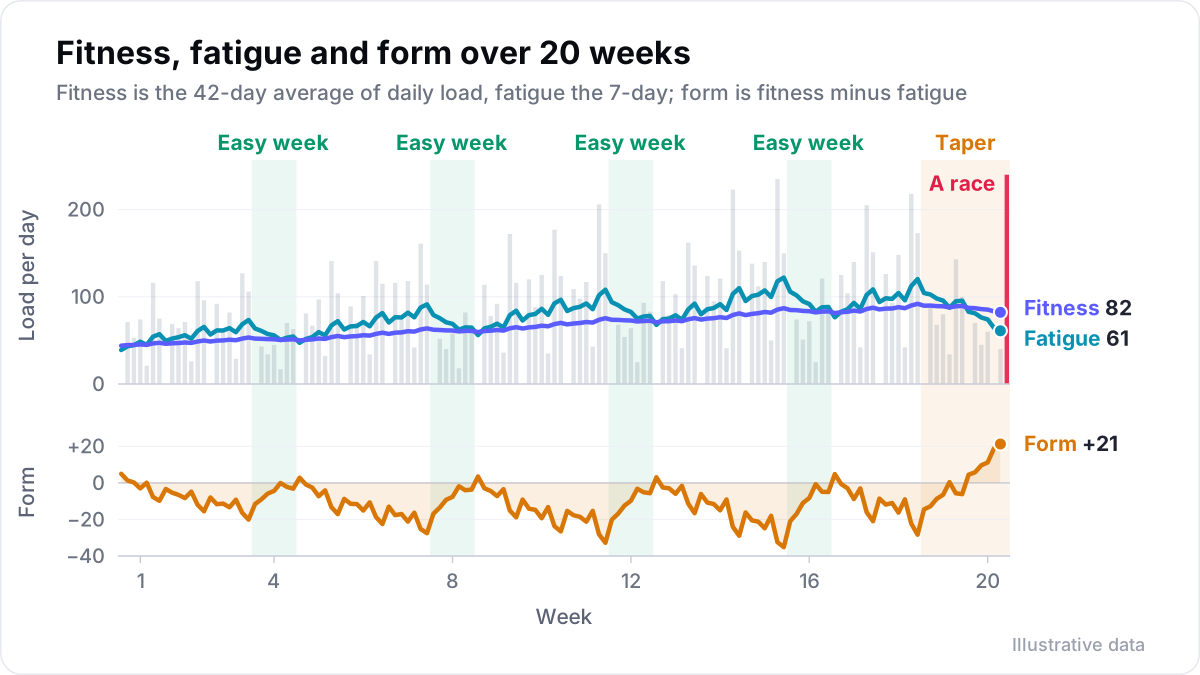
Read form as a share of fitness, because minus 20 is a hard week at a fitness of 40 and an ordinary one at 100. In a build week, a form of minus 10% to minus 30% of fitness is the tiredness that builds fitness. After an easier week, form should be back near zero or slightly above. Before the goal, it should be about plus 5% to plus 25% of fitness, the window for racing. The guide to fitness, fatigue and form explains the model, its limits and these bands.
These are the five questions:
- Did I ride both key sessions and the long ride, and on target?
- How hard did each one feel from 0 to 10, and does that match the numbers?
- Is form where the plan wanted it this week?
- How were my sleep, resting heart rate and mood?
- What, if anything, will I change next week?
No power meter? Rate how hard each whole session felt from 0 to 10, and multiply by its minutes. A 90-minute ride rated 4 scores 360. Carl Foster and colleagues proposed this session rating in 2001. A 2017 review of 36 studies by Haddad and colleagues concluded that it is valid and reliable in several sports.
When should I back off?
Back off when tiredness no longer clears after a few easy days. Fatigue that does clear is part of training. The 2013 joint consensus statement on overtraining calls it functional overreaching, a short dip in performance followed by improvement after recovery.
Each of these signs is worth an easy day:
- Key sessions fail at targets you hit two weeks ago.
- Your heart rate is higher than usual on easy rides, or slow to rise in hard efforts.
- Your resting heart rate or heart rate variability is outside your normal range for several days.
- Your sleep, your mood or your wish to ride drops away.
- Form stays below minus 30% of fitness when you did not plan a hard block.
Two or more signs for several days mean an easier week now, not after the next key session. With an infection, stop or ease right off, as the consensus advises. If your performance has not come back after about two weeks of easy riding, it is no longer a training question. The consensus lists illness, eating too little, poor sleep and stress among the causes to rule out. See a doctor, and take questions about your own diet to a registered sports dietitian.
Fuel the long rides
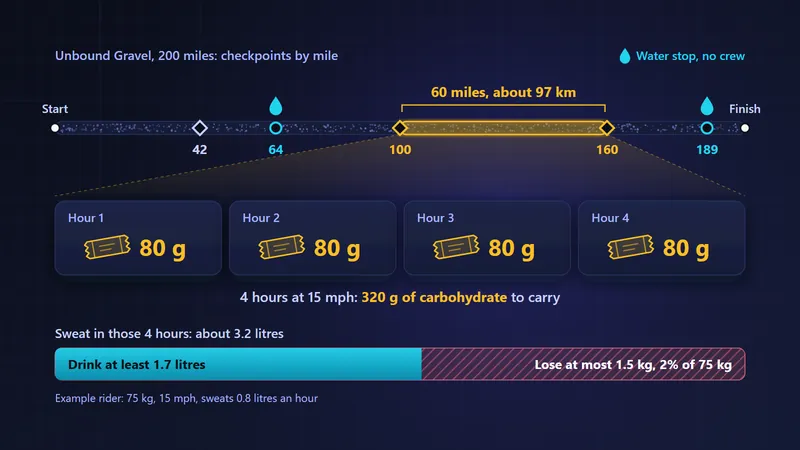
Each kilojoule of work your power meter records costs roughly one kilocalorie of food energy. A four-hour ride at an average of 180 W is 180 × 4 × 3.6 = 2,592 kJ. You use about 2,600 kcal, and much of it comes from carbohydrate, which your body stores only in limited amounts.
Asker Jeukendrup's 2014 review sets out how much carbohydrate to take by the length of the effort. The figures are for well-trained athletes and may need to come down when your riding is less intense.
| Ride | Carbohydrate per hour | What that looks like |
|---|---|---|
| About an hour, hard | A mouth rinse or small amounts | A few sips of a sports drink |
| 2 to 3 hours | Up to about 60 g | A bottle with 30 g and a gel or bar with 30 g each hour |
| Longer events | About 90 g, from glucose and fructose together | A bottle with 40 g and two gels with 25 g each, every hour |
Start eating in the first 30 to 45 minutes, then little and often, and eat before climbs rather than on them. Practise your event fuelling on long rides, with the products you will use on the day, as the review advises. The guide to carbohydrate per hour shows how to plan event fuelling from your expected kilojoules.
When is a coach or a bike fitter worth it?
A coach is worth paying for when cycling training on your own has stopped working, and a bike fitter when your bike, shoes or position change. These are the usual signs that a coach would help:
- Your fitness has not moved for a season, even though you trained consistently.
- You have a big goal and little time, and cannot afford a wasted block.
- You keep ending the build ill or exhausted, or cannot keep easy days easy.
A coach need not be full-time, and a few sessions to set up the season with a monthly review can be enough. A fitter is also worth seeing before a big rise in hours. Many fitters work alongside physios, as the guide to the physio and the bike fitter explains.
Velograph's free Rider plan keeps your bikes, bike fits and rides, with your power curve, training load and form, with no end date. Rider Plus adds training plans and Ask, an AI coach that answers from your own rides and proposes sessions for you to add. If you work with a human coach, the coach decides and the AI helps you both. See what a rider gets on their own, or read about the AI cycling coach.
Further reading
- Effects of tapering on performance: a meta-analysis, Medicine and Science in Sports and Exercise, 2007.
- Prevention, diagnosis, and treatment of the overtraining syndrome, Medicine and Science in Sports and Exercise, 2013.
- Session-RPE method for training load monitoring: validity, ecological usefulness, and influencing factors, Frontiers in Neuroscience, 2017.
- A step towards personalized sports nutrition: carbohydrate intake during exercise, Sports Medicine, 2014.
Velograph is not affiliated with, sponsored by or endorsed by any team, rider or company named in this article. Names are used only to refer to publicly reported work.