What research says about menstrual cycle training, why your own pattern beats generic phase plans, and how riders and teams can handle the data with care.
Menstrual cycle training is most useful as an individual practice, not a calendar of rules. Large reviews find that, on average, the phase of the cycle changes exercise performance only a little, while symptoms differ widely between women and from month to month. The useful data is therefore your own: when each cycle starts, which symptoms you get, how you slept and how sessions felt. A rider who tracks that for a few months can plan around her own pattern, and a team that handles the data with care can support her without prying.
Does the menstrual cycle affect exercise performance?
On average, the phase of the menstrual cycle changes exercise performance only a little. The largest review so far found that performance might be trivially lower in the early follicular phase than in the other phases, and it rated the evidence as low quality.
That review, by McNulty and colleagues (2020), pooled studies of naturally menstruating women. The early follicular phase is the days from the start of bleeding, when oestrogen and progesterone are both low. The authors concluded that general guidelines cannot be formed. They recommended a personalised approach, based on each woman's own response.
A companion review by Elliott-Sale and colleagues (2020) looked at oral contraceptive pills: users might have slightly lower performance on average than naturally menstruating women, again a small effect. That matters, because hormonal contraception is common in sport. In a survey of 430 elite athletes by Martin and colleagues (2018), about half (49.5%) were using it.
The phases, in brief:
| Phase | When | Hormones |
|---|---|---|
| Early follicular | From the first day of bleeding | Oestrogen and progesterone both low |
| Late follicular | The days before ovulation | Oestrogen rising |
| Ovulation | Around mid-cycle | Oestrogen peaks shortly before ovulation |
| Luteal | From ovulation to the next period | Progesterone and oestrogen raised, falling before the next period |
Cycle length varies. Among the athletes in Martin's survey who did not use hormonal contraception, cycles averaged 29 days, with a standard deviation of 5 days. Generic plans that ban intervals in one phase or promise personal records in another go well beyond what the evidence supports.
Do menstrual cycle symptoms affect training?
Yes, and symptoms matter more for training than the phase does. In a survey of 6,812 exercising women, the more symptoms a woman had, and the more often, the more likely she was to miss or change training and to miss a competition.
That survey, by Bruinvels and colleagues (2021), recruited the women through the Strava app, and none of them used combined hormonal contraception. The most common cycle symptoms were mood changes or anxiety (90.6%), tiredness (86.2%), stomach cramps (84.2%) and breast pain or tenderness (83.1%).
Elite sport shows the same picture. In a study of international rugby players by Findlay and colleagues (2020), 93% reported cycle-related symptoms and 67% felt those symptoms impaired their performance.
So the practical question is "how do you feel today?" rather than "which phase are you in?". Symptoms, sleep and how a session felt are what should change a plan, and they are what is worth recording.
What should you track for menstrual cycle training?
Track the first day of each cycle, your symptoms, sleep, morning resting heart rate or HRV, how each session felt and any contraception. Give it at least three cycles before drawing conclusions.
| What | How | Why |
|---|---|---|
| Day 1 of each cycle | The first day of bleeding, in a diary or an app | Anchors everything else |
| Symptoms | Each one rated from 0 to 3 | Shows which days may need a different plan |
| Sleep | Hours, and a rating from 1 to 5 | A bad night can explain a bad session better than the phase |
| Morning resting heart rate or HRV | The same routine every morning | Your own baseline shows whether you have a pattern |
| How each session felt | Effort rated 0 to 10, next to power and heart rate | Separates "felt hard" from "was hard" |
| Contraception | The type, and any change | A change alters the pattern you are looking at |
Compare like with like, such as the same threshold session or the same endurance loop on different days of the cycle. HRV training explains how to build a morning baseline that makes such comparisons fair.
A worked example shows the scale of change that usually makes sense. Over three cycles, a rider notes cramps rated 2 or 3 on days 1 and 2. On those days, her usual 4 × 8 minutes at threshold feels about one point harder on the effort scale at the same power. On other days she sees no pattern. Her coach moves the threshold session to day 3 or 4 when it would fall on day 1 or 2, and keeps the rest of the plan as it was. The change is small, specific and based on her own data rather than a chart.
Some apps specialise in this. FitrWoman, made by Orreco, is a cycle-tracking app built for athletes, with a coach platform called FitrCoach. Wild.AI, now part of Zepp Health, offers training, nutrition and recovery guidance that takes the cycle into account. Use whichever tool you trust; what matters is that the record stays yours.
Should a team see a rider's menstrual cycle data?
A team should see a rider's menstrual data only when she agrees, and then only the staff who need it. Menstrual data is health data, so the rider decides who sees it and can change her mind.
Under the EU's General Data Protection Regulation (GDPR), data concerning health is a special category: Article 9 prohibits processing it unless a condition applies, such as the person's explicit consent for specified purposes. For a team, that becomes a few plain rules:
- Ask, never require. Sharing cycle data must never affect selection, contracts or a place in the squad.
- Share the minimum. "Rough day, can we swap the intervals?" often does the job of a full cycle calendar.
- Limit who sees it. The team doctor or physio may need detail; the sports director rarely does.
- Let the rider change her mind, and delete what is no longer needed.
- Take extra care with juniors, and involve parents or guardians; junior cycling training covers consent for minors.
The guide to athlete data privacy covers the law in more detail. Neither article is legal advice.
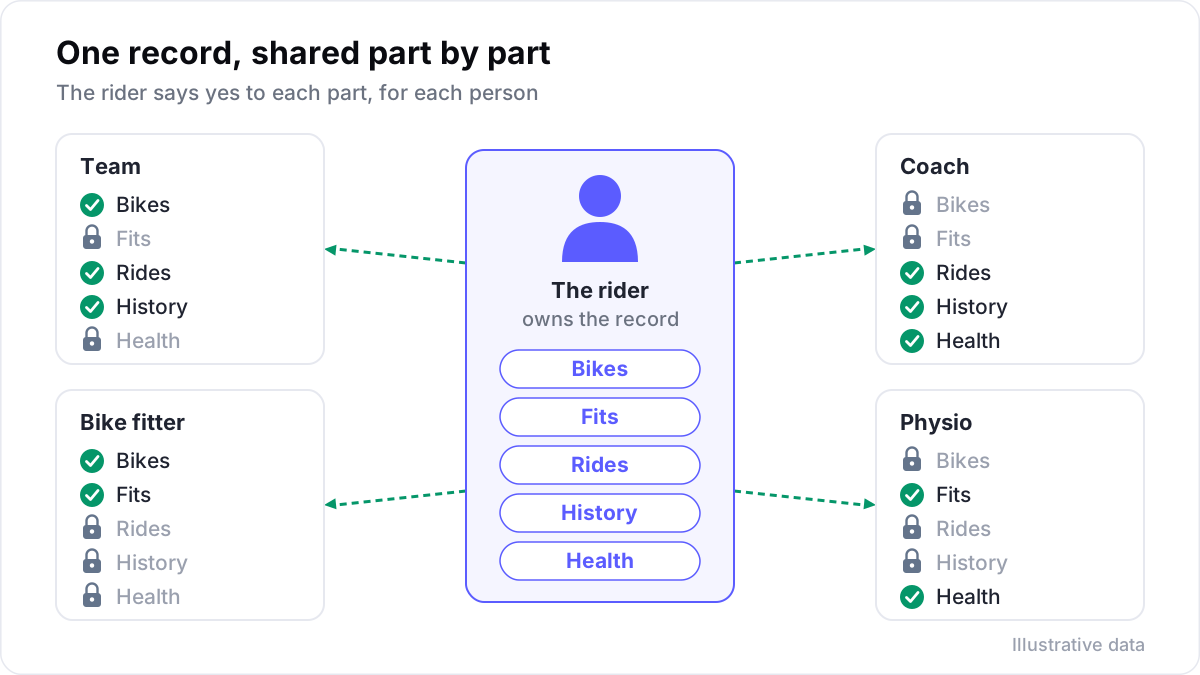
In Velograph, team invitations ask the rider for consent part by part, with health as a part of its own.
How can coaches talk about the menstrual cycle?
Coaches can make the subject ordinary by naming a person riders can go to, adding an optional line to the morning check-in, and asking how a rider feels rather than which phase she is in. Many riders never raise their cycle because nobody else does.
In Findlay's rugby study, support and comfort in discussing menstrual issues emerged as a theme of its own. A few habits make the conversation ordinary:
- Name a person riders can go to, ideally including a woman on the staff or the team doctor.
- Make it routine and optional: a line in the morning check-in, such as "anything we should plan around today?", answered or not.
- As a coach, ask how the rider feels, not which phase she is in, and act on what she tells you.
- Sort out the practical things: dark shorts for racing, toilet access at race starts and on long stage days, spare products in the team car.
- Never comment on bodies or weight.
If you coach several riders, choose tools that let each rider decide who sees what. Cycling coaching software covers what else to look for.
When should you see a doctor about your cycle?
Questions about your own cycle belong with a doctor rather than a training plan, especially when periods stop or change, when bleeding is very heavy, or when pain or other symptoms regularly keep you off the bike.
In athletes, missing periods can be linked to eating too little for the training load. The International Olympic Committee's 2023 consensus statement on Relative Energy Deficiency in Sport (REDs) describes how low energy availability harms both health and performance. The same doctor is the person to ask about hormonal contraception. Your tracking helps here too: a few months of notes make that appointment shorter and more useful.
Further reading
- The effects of menstrual cycle phase on exercise performance in eumenorrheic women: a systematic review and meta-analysis, Sports Medicine, 2020.
- The effects of oral contraceptives on exercise performance in women: a systematic review and meta-analysis, Sports Medicine, 2020.
- Prevalence and frequency of menstrual cycle symptoms are associated with availability to train and compete, British Journal of Sports Medicine, 2021.
- 2023 International Olympic Committee's consensus statement on Relative Energy Deficiency in Sport, British Journal of Sports Medicine, 2023.
Velograph is not affiliated with, sponsored by or endorsed by any team, rider or company named in this article. Names are used only to refer to publicly reported work.