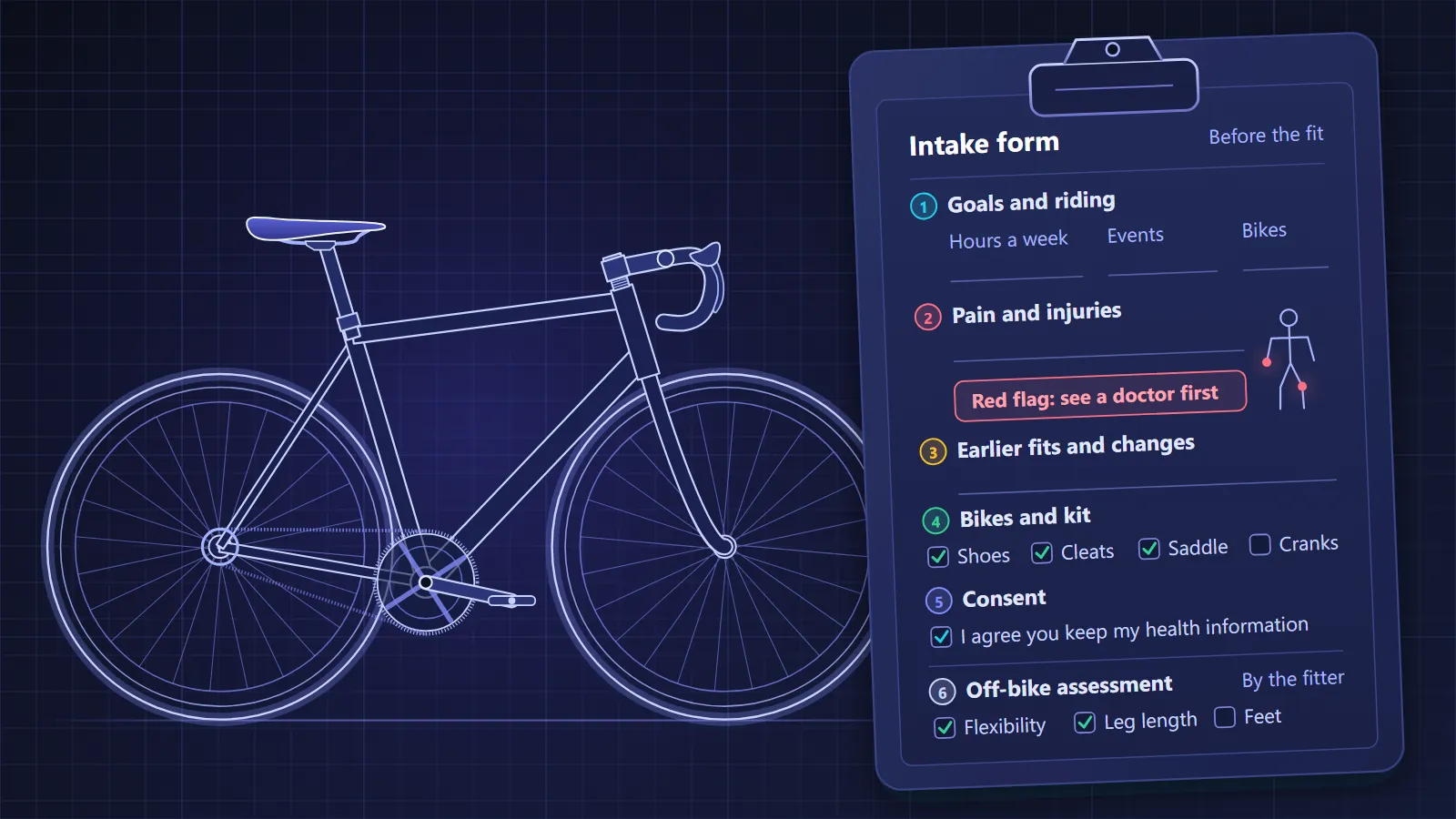
A bike fit intake form in six parts: the questions to ask, why each one matters, a red-flag line, a consent box and a filled-in example to copy.
A bike fit intake form collects what a fitter needs to know before the rider sits on the bike: the goal, how much and how they ride, what hurts and when, earlier fits, the kit, and consent to keep health information. The rider fills in five parts before the session, and the fitter completes the pre-fit assessment with off-bike tests on the day. Read in advance, it tells you which tests to run first and which riders to send to a clinician. The six parts follow as tables to copy, with a filled-in example.
What should a bike fit intake form include?
A bike fit intake form should cover the rider's goals and riding, pain and injuries with a red-flag line, earlier fits and changes since, the bikes and kit, consent to keep health information, and a part for the fitter's off-bike tests. Every question should change what you test or adjust.
| Part | Filled in by | What it changes in the fit |
|---|---|---|
| 1. Goals and riding | Rider | The position you aim for, and how long it must be held |
| 2. Pain and injuries | Rider | What you test first, and whether to refer before you start |
| 3. Earlier fits and changes | Rider | Your starting numbers, and what has already been tried |
| 4. Bikes and kit | Rider | Which parts can change, and what the rider must bring |
| 5. Consent | Rider | What you may record, and who may read it |
| 6. Off-bike assessment | Fitter | The limits the position has to respect |
Keep the rider's parts to two pages, with open questions for the goal and the pain and closed ones for numbers.
The form, part by part
The left column is the question as the rider reads it. The right column says why you ask, and it stays off the rider's copy.
Part 1: goals and riding
| Question | Why it matters |
|---|---|
| What do you want from this fit? | Comfort on long days and a lower race position are different fits |
| Which events are you preparing for, and when? | Close to a key event, you may choose smaller changes |
| How many hours do you ride in a normal week, indoors and outdoors? | More hours repeat a small error more often |
| How long is your longest ride, and how often do you ride that far? | Discomfort after three hours needs more than a ten-minute test |
| How much of your riding is on the hoods, in the drops or on aero bars? | The position held most is the one to fit first |
Which pain questions belong on a bike fit questionnaire?
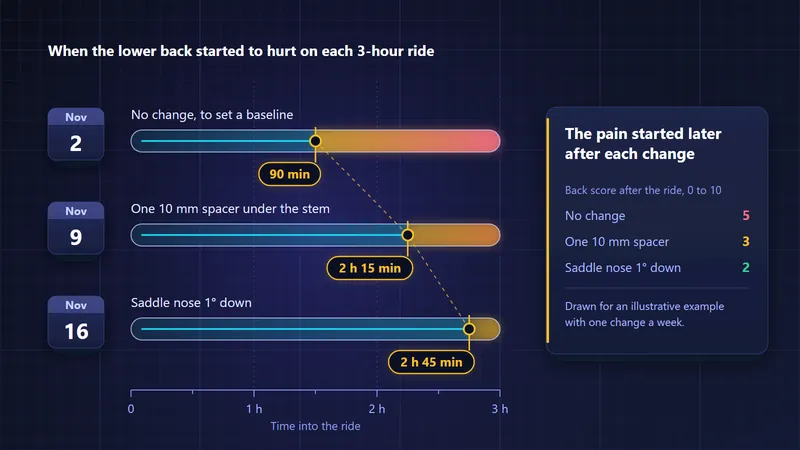
Ask where it hurts or goes numb, on which side, how bad it is from 0 to 10, when in the ride it starts, and whether it lasts after riding. When it starts matters most, because pain after ten minutes and pain after three hours call for different tests.
These questions make up part 2 of the form.
| Question | Why it matters |
|---|---|
| Where does it hurt or go numb? Mark it on the body outline. | A mark on a drawing is clearer than "my knee" |
| Left, right or both? | A one-sided problem can point to the cleats, leg length or an old injury |
| How bad is it, from 0 (none) to 10 (stops the ride)? | The same scale at the follow-up shows whether the fit worked |
| When does it start: after how many minutes, on climbs, in the drops? | It sets how long to test, and in which position |
| Does it go after the ride? How long does that take? | Pain that stays off the bike may need a clinician first |
| Which injuries, operations or conditions affect how you move? | They set limits the new position must respect |
Which red flags should send a rider to a doctor before a fit?
Send the rider to a doctor or physio before the fit if pain began suddenly or after a crash, a joint swells, locks or gives way, pain wakes them at night, numbness or weakness lasts after riding, or riding brings on chest pain, faintness or unusual breathlessness.
Put them on the form as tick boxes with one instruction: "If you tick any box, please see your doctor or physio before your fit, and bring what they told you." You then work from the clinician's findings, as our guide to the physio and the bike fitter describes. Studios that run hard pedalling tests can add the PAR-Q+, a screening questionnaire whose first page asks seven general health questions.
Part 3: earlier fits and changes
| Question | Why it matters |
|---|---|
| Have you had a bike fit before? When, where and on which bike? | It gives you a starting record |
| Can you bring or attach the report? | Numbers with their reference points save measuring again |
| What has changed since: bike, saddle, shoes, cleats, weight, training? | Many new complaints follow a change |
| What have you tried for the problem, and did it help? | You avoid repeating a change that failed |
Our article on bike fit history explains what makes an old report reusable.
Part 4: bikes and kit
| Question | Why it matters |
|---|---|
| Which bike will you bring: make, model, size and year? | Its geometry sets what stems and seatposts can do |
| Which saddle do you ride, and how wide is it? | Shape and width matter as much as height |
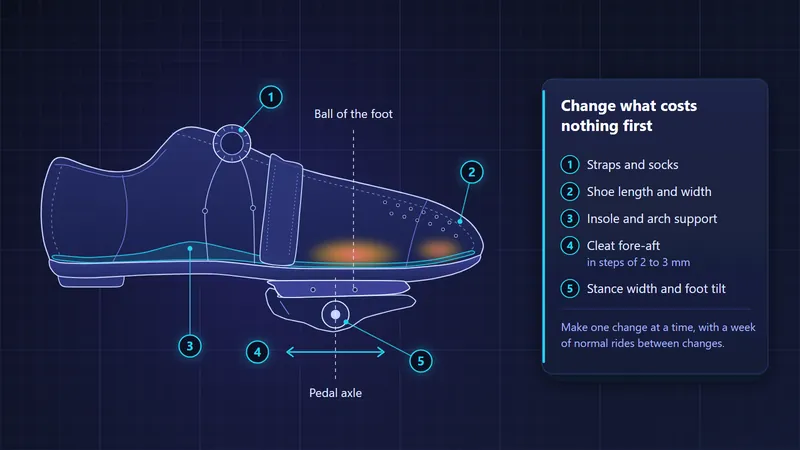
| Which shoes, insoles, pedals and cleats do you use? Please bring them. | The feet are where most fits start |
| Do you know your crank length and handlebar width? | Both change joint angles and reach |
How do you ask for consent to keep health information?
Ask in a separate box that the rider ticks, saying which health information you keep, why, who can read it and how to withdraw. Under the GDPR, health data may be processed with the person's explicit consent for stated purposes, and withdrawing consent must be as easy as giving it.
This is part 5 of the form. Article 9 lists health data as a special category, and Article 7(3) lets the person withdraw consent at any time. Recital 32 says pre-ticked boxes are not consent, so leave every box empty. A wording to adapt:
☐ I agree that [studio] keeps the health information on this form, such as pain, injuries and test results, to plan and record my bike fit. Only the fitters at [studio] can read it. I can withdraw this at any time by telling [studio].
☐ I agree that [studio] may share my fit record with [physio, coach or team].
For riders under 18, check who can give consent in your country. Our guide to athlete data privacy covers juniors and teams. This is general information, not legal advice.
What goes in the fitter's off-bike assessment?
The off-bike assessment records the tests that limit the position: hamstring and hip flexibility, how far the ankle bends, foot posture, any leg-length difference, and the body measurements that set a starting point. Record each test by name, side, method and result, so that the next fitter can repeat it.
This is part 6, filled in by the fitter.
| Test | What it shows | What to record |
|---|---|---|
| Passive straight-leg raise | Hamstring flexibility | Angle, each leg |
| Modified Thomas test | Length of the hip flexors and the front of the thigh | Angles or pass and fail, each side |
| Weight-bearing lunge | How far the ankle bends forward | Toe-to-wall distance, each side |
| Foot Posture Index | Standing foot posture, from six checks | Score, each foot |
| Leg length | A difference between the legs | Millimetres and the method, or a clinician's finding |
| Sit-bone width | The saddle widths that suit | Millimetres |
| Height, inseam, arm length, shoulder width | A starting point for size and position | Centimetres |
These tests have published methods. Harvey used the modified Thomas test on 117 elite athletes in four sports. Bennell and colleagues found the weight-bearing lunge highly repeatable between testers in 13 people, read either as a distance from the wall or as an angle. Keep to one, because the two cannot be compared. Redmond and colleagues cut 36 candidate checks to the six of the Foot Posture Index.
What does a filled-in bike fit intake form look like?
A filled-in intake form is short, specific and full of numbers: where it hurts, how badly, after how long, and what changed before it began. This example belongs to an illustrative rider, Jonas, who is preparing for a 300 km gravel event.
| Part | Jonas's answers |
|---|---|
| Goal | Ride the 300 km event without stopping for back pain |
| Riding | 8 hours a week, longest ride 160 km, gravel since last year, road before that |
| What hurts | Lower back, both sides, 4 out of 10, after about 2 hours, better when standing. Right hand: ring and little fingers numb after 90 minutes, gone an hour after the ride |
| Red flags | None ticked |
| Injuries | Broken left collarbone in 2019, plated, no problems since |
| Earlier fits | Road bike fit in 2023: saddle height 752 mm, setback 62 mm, drop 85 mm. Report attached |
| Changes since | New gravel bike in March, saddle lowered 5 mm because it "felt high", new shoes |
| Kit | Gravel bike, size L, 172.5 mm cranks, 42 cm flared bar, two-bolt pedals, 143 mm saddle |
| Consent | Health information: ticked. Sharing with a physio: not ticked |
Each answer becomes a task for the session:
- The back ache starts after two hours, so test for longer than a short spin and check hip and hamstring flexibility first.
- The saddle is 5 mm lower than in 2023. Compare it with the old record before changing anything else.
- Numb ring and little fingers ask for a look at bar roll, hood angle and the weight on the hands.
- The new shoes mean checking the cleats too.
- The plated collarbone may limit reach on the left, so ask before lengthening the front.
How should a studio use the intake form?
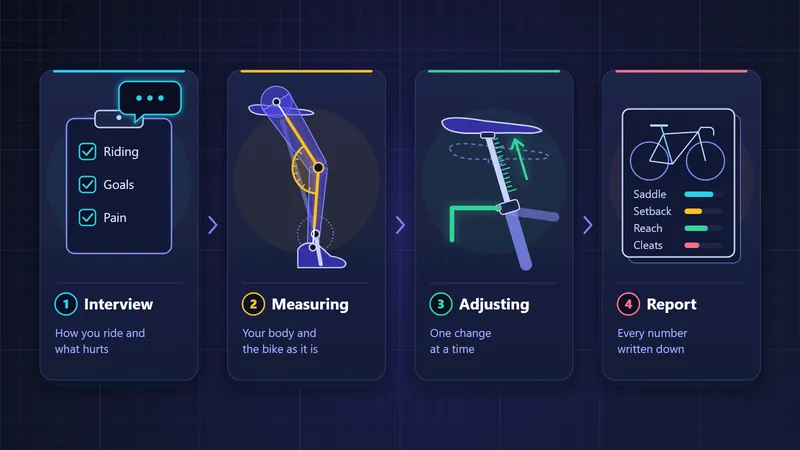
Send the form when the rider books, ask for it back a day before, and read it before they arrive. At the follow-up, ask about the same complaints on the same 0 to 10 scale, so that you and the rider can see whether the fit worked.
- Send the form with the booking confirmation.
- Read it before the session, and call the rider if a red-flag box is ticked.
- Go through it together at the start. The written answers open the conversation.
- Keep the form with the fit record, not in an email inbox.
- Use its complaints at the bike fit follow-up two and six weeks later.
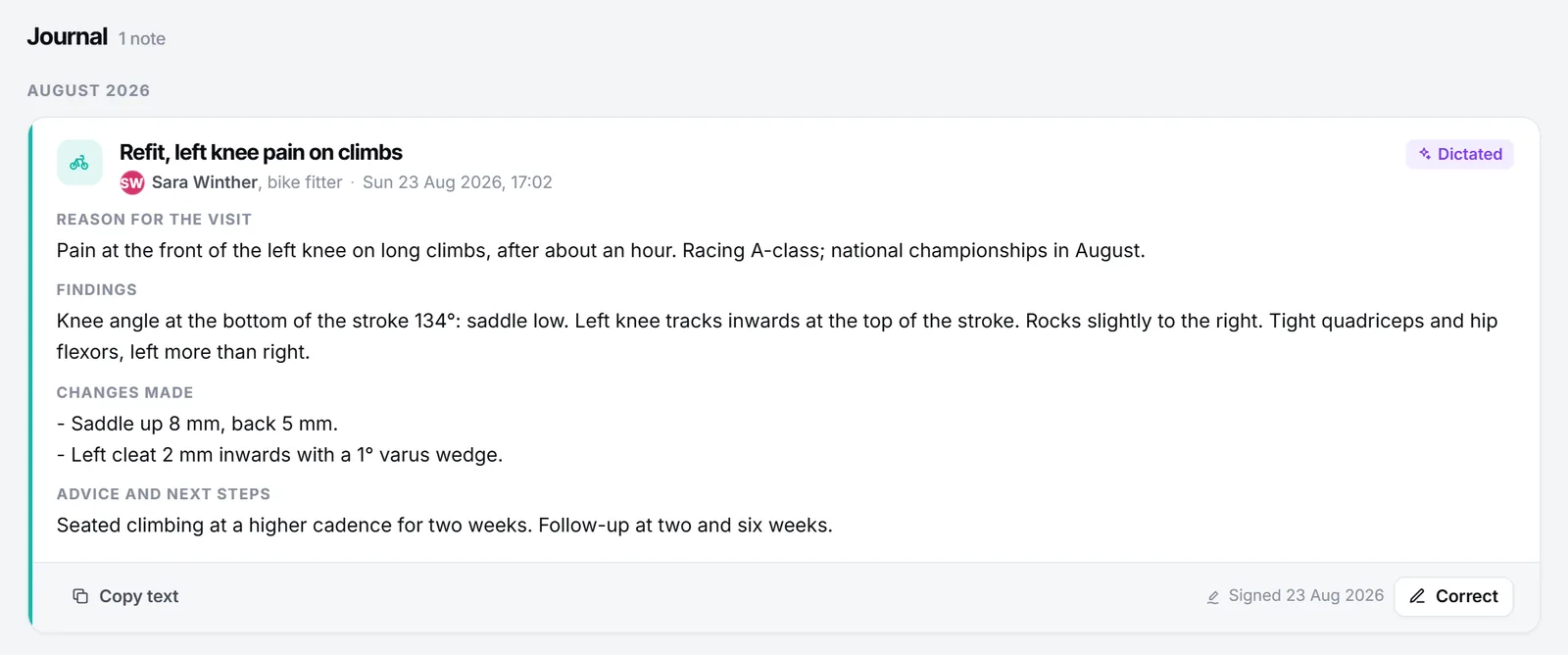
In Velograph's Studio plan, the fitter records the answers in the fit's Assessment: notes on goals, riding, history and injuries, flexibility and tests, and what was seen on the bike, plus a list of what hurts with the area, side, a score from 0 to 10 and when it starts. The follow-ups ask about each complaint again. The session goes into the client journal, typed or dictated, as bike fitter client notes describes. A studio's other tools are in bike fitting software.
Further reading
- Art. 9 GDPR: processing of special categories of personal data, gdpr-info.eu, 2018.
- PAR-Q+: pre-participation screening, PAR-Q+ Collaboration, 2025.
- Development and validation of a novel rating system for scoring standing foot posture: the Foot Posture Index, Clinical Biomechanics, 2006.
- Intra-rater and inter-rater reliability of a weight-bearing lunge measure of ankle dorsiflexion, Australian Journal of Physiotherapy, 1998.
Velograph is not affiliated with, sponsored by or endorsed by any team, rider or company named in this article. Names are used only to refer to publicly reported work.