A short check two and six weeks after a fit settles the position and brings clients back. When to book it, what to ask and what to send home.
A bike fit follow up is a short check a few weeks after the fit, once the client has ridden the new position long enough to know how it feels. Two check-ins cover most fits: one at about two weeks to catch early trouble, and one at about six weeks once the body has adapted. Book them before the client leaves, ask the same questions every time, and compare the answers with what the client told you on the day.
Why does a bike fit need a follow up?
Some problems only show up on long rides after the fit, and some changes need time before anyone can judge them. A fit session usually lasts a couple of hours, on a fit bike or on the client's bike in a trainer.
The client's real test comes later, in hour four of a sportive, on a cold morning or on a long climb seated. Coaches also advise giving the body time. Jim Rutberg of CTS suggests that a rider who rides three to five times a week, for eight hours or more in total, should give a new position about three weeks before moving anything. He makes an exception for acute, sharp pain in a joint, tendon or muscle, and for soreness that keeps getting worse after the first week. Those riders should go back to their fitter sooner.
Bikes change too. Saddles slip in a crash or in a bike bag. Cleats wear. A client buys new shoes, a new saddle or a new bike and assumes the fit comes along on its own. A planned check catches all of this before it turns into a complaint.
When should you book a bike fit follow up?
Book a first check-in about two weeks after the fit and a second at about six weeks. Put both dates in the calendar on the day of the fit, and keep the other checks below as reasons to get in touch. This simple pattern works for most studios.
| Check | When | What it catches |
|---|---|---|
| First check-in | About 2 weeks after the fit | Numbness, new pain, a change that went too far |
| Second check-in | About 6 weeks after the fit | Whether the old complaint has gone, and whether the client can keep the position on long rides |
| Before the main event | A month or two before it | Time to adjust without racing on a new position |
| Yearly check | About 12 months after the last fit | A body, bike or goal that has changed |
| Out of turn | Any time | Sharp pain, a crash, new shoes, a new saddle or a new bike |
A fit after an injury may need closer checks, agreed with the client's physio or doctor. Pain that does not settle belongs with them, not with another saddle adjustment.
What should you ask at a bike fit follow up?
Ask the same questions you asked at the fit, in the same words, so the answers can be compared. A check-in that only asks "how is it going?" gets a polite "fine".
- Overall, how does the bike feel?
- For each complaint from the fit: how bad is it now, on a scale of 0 to 10? Ask about the same area and the same side.
- Is anything new? New pain after a fit is exactly what you need to hear about.
- When does any discomfort start: after how long, and on which kind of ride?
- What were the longest and hardest rides since the fit?
- Has anything changed on the bike or the shoes, and has anything moved?
- Have the client's goals or race calendar changed?
Many follow-ups can start as these questions sent by link or by phone. Clients who are happy confirm it in a minute and save themselves a trip. Clients with a problem get a slot in the studio, where you check the bike against the record and look at them riding again.
What should a bike fit report include?
A bike fit report should include the client's goals and why they came, what hurt and how badly, what you changed and why, the numbers to keep, your advice and the dates of the check-ins. Write it for the client, not the mechanic.
A client who leaves with that report knows the fit is not finished on the day, and knows when you will be in touch.
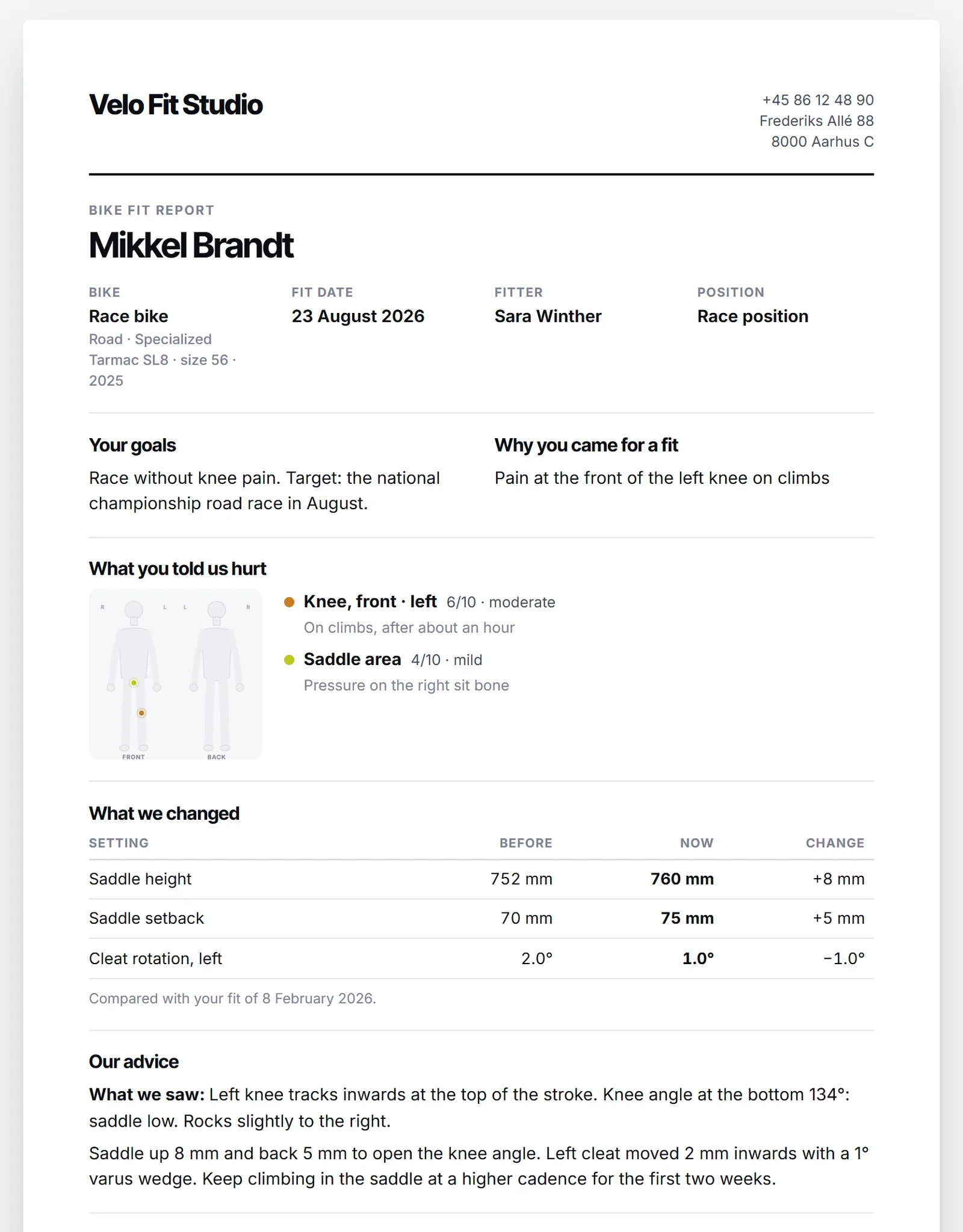
The report also travels. Clients show it to riding friends and to their next mechanic, so a clear page with your studio's name on it is good publicity.
How does a bike fitter keep clients coming back?
Clients return to the fitter they believe knows their body and their bikes best, so client retention in a fitting studio comes down to trust. A complete fit history makes that belief true.
When the client brings a new frame, a new pair of shoes or a new goal, you start from every fit you have done together rather than from zero. Our guide to why every bike fit is worth keeping explains what that history should contain.
It can feel risky to let the client keep that history. The client could take it to another fitter. A client who has their full record, and a fitter who knows it well, has little reason to start again elsewhere. Your studio also gains clients who arrive with a history from someone else, so you begin from their last fit rather than from a blank sheet.
How Velograph runs follow-ups
Velograph's Studio plan builds this routine into every fit.
- Check-ins at two and six weeks are suggested when you record a fit. You can move them, switch them off or add more, up to six within a year of the fit.
- Reminders tell you when a check-in is due, on the studio's Today page. You email the client a link, or copy a ready-made message into a text from your own phone.
- Three quick questions open on the client's phone, with no account needed: how the bike feels overall, each earlier complaint rated again from 0 to 10, and room to say anything else.
- Before and now are shown side by side for each complaint, marked better, the same or worse. New pain is shown too.
- Due for a check lists clients who were last fitted more than a year ago.
- Did the fit work? compares the client's riding for four, six or eight weeks either side of the fit, as averages of rides, hours, cadence and power per heartbeat. It appears only when the client has agreed to share summaries of their riding.
- Client reports print or save as a PDF, with your studio's name, logo and contact details, and list the check-in dates.
Every fit you record is saved in the client's free Passport, and your notes go into the client journal with dictation. For the whole studio picture, read what a studio needs from bike fitting software.
The Studio plan is priced per practitioner with unlimited clients, and the details are on the pricing page. You can start for free: studios try it with everything switched on, and no card is needed.
Velograph is not affiliated with, sponsored by or endorsed by any team, rider or company named in this article. Names are used only to refer to publicly reported work.