What to write down after every fit, a clinician's structure that keeps notes short, and how dictation gets them done before the next client arrives.
Good bike fitter client notes answer three questions for whoever opens them next: what the rider came in with, what you changed, and why. The numbers on the fit sheet show where the saddle is. Only the notes explain how it got there. A fixed structure keeps those notes short, and dictating them straight after the session means they get written at all.
Why do bike fit notes matter more than the numbers?
Bike fit notes matter because a number without its reason tells the next fitter very little. Without the reason, the next person to touch the bike either copies a number they do not understand or undoes a change that was working.
A saddle that went down 6 mm might have stopped a rocking pelvis. It might also have been a short-term answer to a sore hamstring that has since healed.
That next person is often you, a year later, when the client comes back with a new frame and you no longer remember the session. It may also be another fitter in another city, or the client's physio. In each case the reasoning is the valuable part of the record, and it is the part most often missing.
Records also protect the studio. In a 2017 interview with Cycling Industry News, Andy Brooke, director of the International Bike Fitting Institute, said he knew of two lawsuits against bike fitters, both in the United States and both successfully defended. He credited fitters who were well trained and had kept excellent records.
What should bike fitter client notes include?
Write down why the client came, their riding and injuries, complaints, findings, equipment, measurements before and after, every change with its reason, and your advice. A complete note does not need to be long. It needs to cover the same ground every time, so that two notes from two years apart can be compared line by line.
- Reason for the visit, in the client's words: goals, events, a new bike or a complaint.
- Riding background: hours a week, the kind of riding, the longest rides, the events coming up.
- Injuries and surgery that matter for the position, recorded with the client's agreement.
- Complaints: where, which side, how bad on a scale of 0 to 10, and when they start (after 20 minutes, after three hours, only on climbs).
- Off-bike findings: flexibility, foot shape, anything that limits the position.
- Equipment: shoes and size, insoles, pedals and cleats, saddle model and width, crank length, bar width.
- Measurements before and after, with units and the method used to take them.
- Every change and the reason for it.
- What the client felt after each change.
- Advice and the next check: what to watch for, and when you will check in.
Write the measuring method down once and keep to it. Saddle height measured from the centre of the bottom bracket along the seat tube is not the same number as saddle height measured to the pedal axle. Our guide to saddle height methods explains why this matters when fits are compared.
What is a SOAP note for a bike fit?
A SOAP note splits a record into Subjective, Objective, Assessment and Plan, a fixed structure doctors and physiotherapists have used for decades. It maps neatly onto a bike fit.
The SOAP note grew out of the problem-oriented medical record that Dr Lawrence Weed described in the New England Journal of Medicine in 1968.
| Section | What goes in it | A fitting example |
|---|---|---|
| Subjective | The client's own account | Pain at the front of the left knee on long climbs, after about an hour. National championships in August. |
| Objective | What you saw and measured | Knee bent 46 degrees from straight at the bottom of the stroke, measured while pedalling. Left knee tracks inwards at the top of the stroke. Tight hip flexors, left more than right. |
| Assessment | Your reasoning | Saddle low for this rider. Knee tracking may respond to a wedge. |
| Plan | What you changed and what comes next | Saddle up 8 mm and back 5 mm. Left cleat 2 mm inwards with a 1-degree varus wedge. Check-ins at two and six weeks. |
The assessment line is the one fitters skip most often, and it is the one the next reader needs. If you only add one habit, write one sentence on why you made the change.
How should you dictate bike fit notes?
Dictate as soon as the client leaves, in the same order every time, saying the side, every number with its unit and the reason for each change. Then read the draft and correct anything that was misheard.
Clinicians have dictated their notes for a long time, and speech-to-text tools have made dictation far more practical. The rule that comes with it is a sound one for fitters too. When NHS England published guidance on AI note-taking tools in 2025, it stressed that practitioners remain responsible for reviewing and revising what the tool produces.
Dictation works best with a few habits:
- Dictate as soon as the client leaves, before the next session starts.
- Follow the same order every time, using the four SOAP headings or your own.
- Say the side every time: left or right.
- Say every number with its unit: "saddle up eight millimetres, to 742".
- Give the reason with each change.
- Read the draft before you save it, and correct anything that was misheard.
Two minutes of talking after a two-hour fit is a small price for a record you can rely on next year.
Are bike fit notes health data under the GDPR?
Notes about injuries, surgery and pain are health data under the GDPR. Data concerning health is one of the special categories in Article 9, and processing it is prohibited unless an exception applies, such as the person's explicit consent. This is general information, not legal advice, so check your own obligations with a professional.
In practice, a few rules cover most studios:
- Record what the fit needs, not everything the client mentions.
- Tell the client what you write down and who can read it.
- Keep notes in one secure place, not on paper, in emails and in photos on your phone.
- Share notes with a physio or coach only when the client agrees. Our article on the physio and the bike fitter covers how two experts can work from one record.
- Keep clinical detail away from people who do not need it, such as the team mechanic.
- Write every note as if the client will read it. Under Article 15 of the GDPR, people have the right to a copy of the personal data held about them, which can include your notes.
Our guide to athlete data privacy goes further for teams and clubs.
How the client journal works in Velograph
Velograph's Studio plan includes a client journal built around these habits. You open a note from the booking or from the client's page. A bike fit note starts with four headings: Reason for the visit, Findings, Changes made, and Advice and next steps. Physios and doctors start from Subjective, Objective, Assessment and Plan. You can rename, add or remove headings.
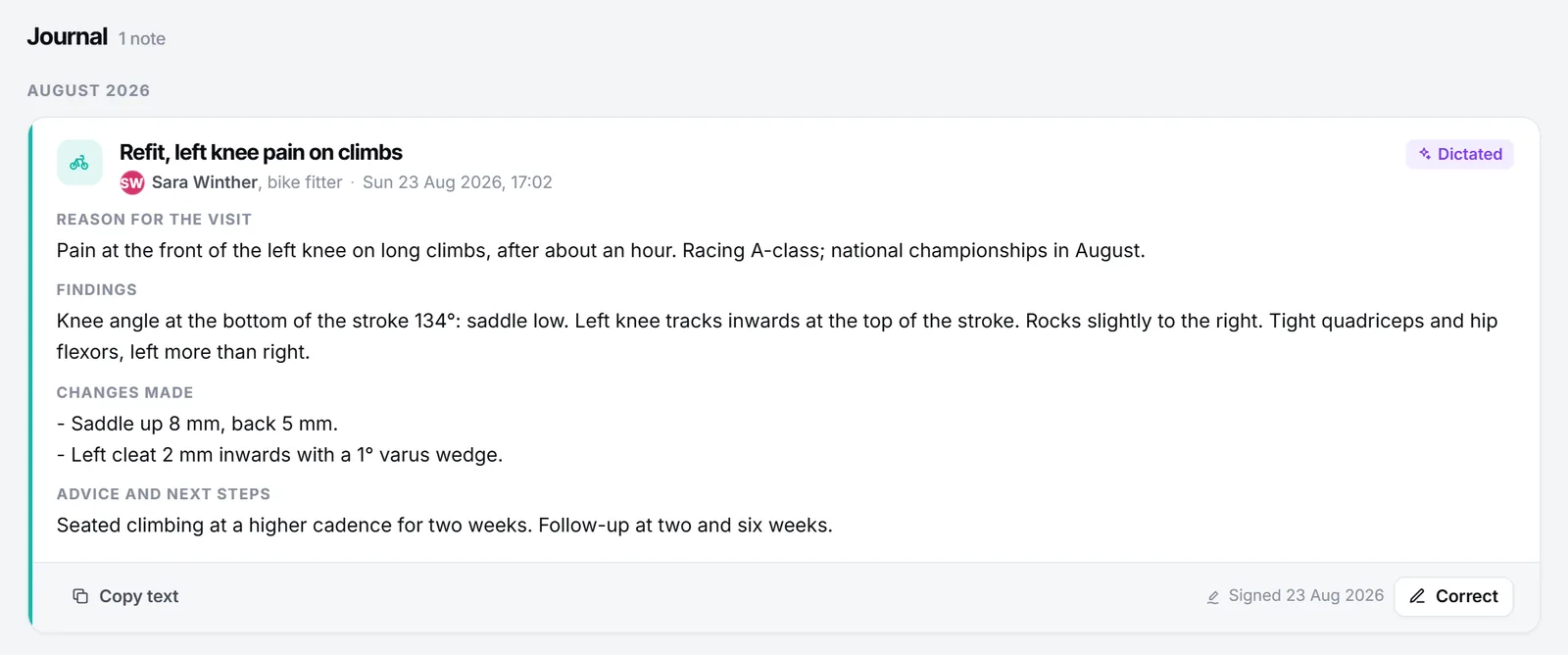
You can type a note, or dictate for up to 20 minutes. Because journal notes are health records, the AI that drafts them runs only on your practice's own Claude or OpenAI key, never on Velograph's AI credits. The practice chooses its AI provider and holds the agreement with it. Dictation needs an OpenAI key, because OpenAI turns the speech into text. AI then sorts what you said under the headings. It may tidy and spell, but it never adds a finding, a number or a piece of advice you did not say. Anything it could not make out is listed for you to check, and the word-for-word transcript stays beside the note.
A draft is visible only to you until you sign it. A signed note is never edited in place: a correction keeps the earlier wording, as a medical record should. The voice recording is deleted once the note is signed or discarded, and never kept longer than 14 days.
The note belongs to the client's record, next to their bikes and their fits with diagrams. The client can read every signed note about them in their own Passport. Another studio or team can read a note only if the client allows it. Within a studio or team, notes marked confidential are read only by clinicians. To see how the journal fits with bookings, reports and follow-ups, read what a studio needs from bike fitting software and how to run a bike fit follow-up.
The Studio plan is priced per practitioner with unlimited clients, and the details are on the pricing page. You can start for free: studios try it with everything switched on, and no card is needed.
Velograph is not affiliated with, sponsored by or endorsed by any team, rider or company named in this article. Names are used only to refer to publicly reported work.