How to set cycling goals that work: outcome, performance and process goals, measurable targets, three worked examples, a monthly review and what research shows.
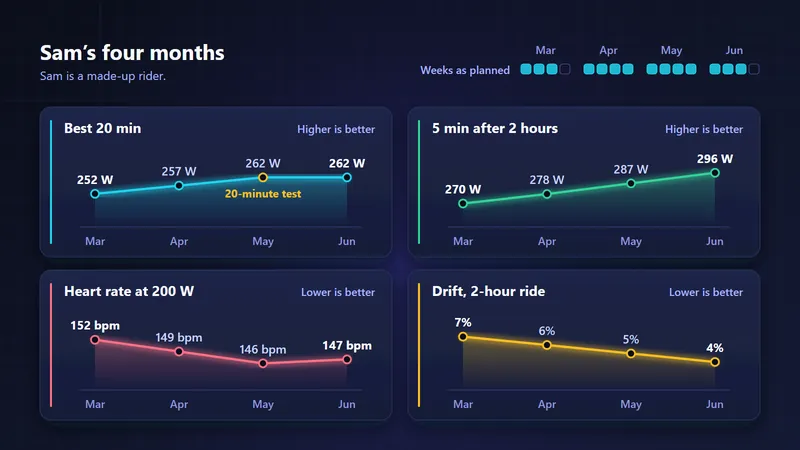
Cycling goals work when they come in three layers. One outcome goal has a date, such as a sportive or a race. A few performance targets can be measured, such as your 20-minute power. Process goals are what you control every week, such as three rides including one long one. Research on goal setting supports each layer for a different reason. Below are the three layers, worked examples for three kinds of rider and a monthly review.
What makes a good cycling goal?
A good cycling goal is specific enough to plan for, hard enough to need real training and important enough that you keep at it when the weather turns. It names a date and a measure, and it comes with weekly actions you control.
Most of the research comes from work and laboratory tasks. Summing up 35 years of studies in 2002, Edwin Locke and Gary Latham reported that people given specific, hard goals performed better, study after study, than people told to do their best. In their words, "when people are asked to do their best, they do not do so". Goals worked better when people were committed to them and got feedback on their progress.
Sport adds a twist. A 2022 meta-analysis of 27 sport studies by Williamson and colleagues found that process goals improved performance most, performance goals less and outcome goals hardly at all. In those studies, specific goals did no better than less specific ones. A race result is a fine target for the season, but the weekly goals are what move you towards it.
The SMART checklist (specific, measurable, achievable, realistic, time-bound) is the advice most riders meet first. A 2023 review by Swann and colleagues concluded that, for physical activity, the acronym has no grounding in theory, does not fit the evidence and says nothing about which type of goal to set. Keep its useful parts, a date and a measure, and choose the type of goal on purpose.
What are outcome, performance and process goals?
An outcome goal is a result against other riders or the clock on one day, such as a top-ten finish. A performance goal is a number you can improve on your own, such as your 20-minute power. A process goal is something you do every week, such as three rides with one long one.
| Type | What it measures | Cycling examples | How much you control it |
|---|---|---|---|
| Outcome | A result on one day | Top 10 in a regional championship; a 160 km sportive in under 7 hours | Partly, because rivals, weather and luck play a part |
| Performance | Your own numbers | 5-minute power of 360 W; 5 hours at a steady pace; an FTP of 250 W | Mostly |
| Process | What you do | Three rides a week; the long ride every Sunday; 60 g of carbohydrate an hour on long rides | Fully, in most weeks |
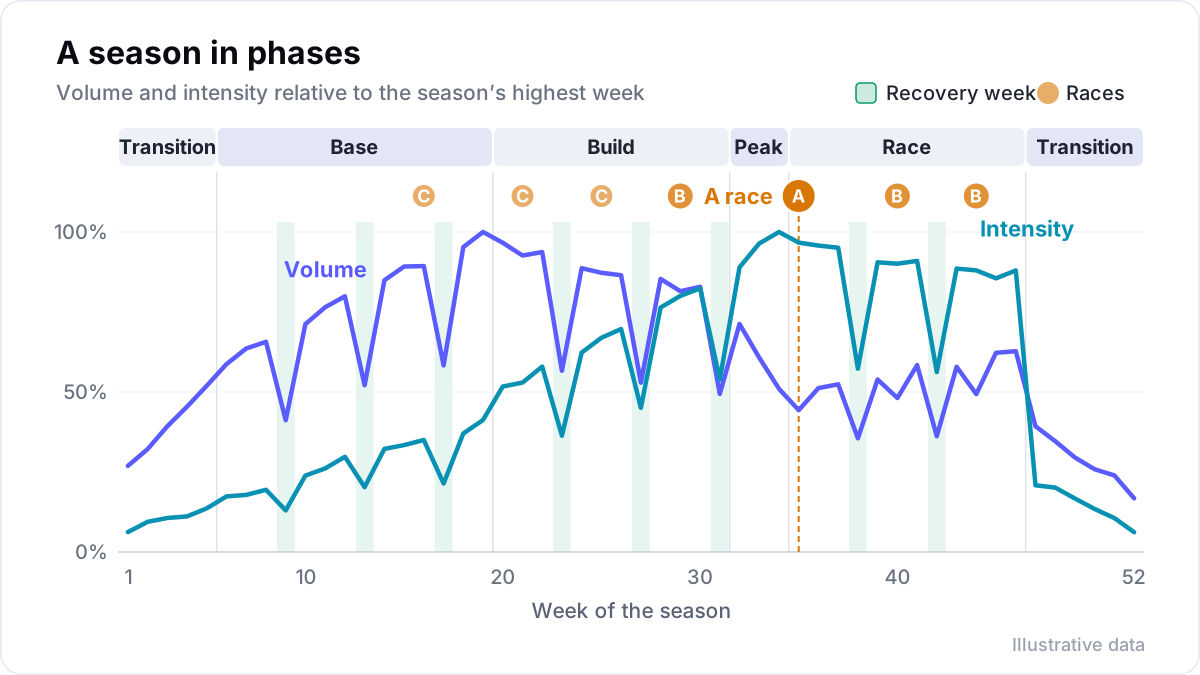
Plan the three in that order. The outcome sets the date, the performance targets say what the date needs, and the process goals fill the weeks. The guide to the annual training plan shows how to build a season back from that date.
How do you make a cycling goal measurable?
Turn the outcome into the numbers it needs, then turn the numbers into weekly actions. A 160 km sportive in under 7 hours needs an average of about 23 km/h with stops included, a long ride of about 5 hours before the day and fuelling you have practised, and each of those becomes a target with a date.
- Write the outcome with its date and its measure: a time, a place or a distance.
- Find the durations that decide it. A race decided on a 4-minute climb needs 5-minute power. A long sportive needs a steady effort that lasts for hours. The guide to reading a power curve shows which durations matter for which events.
- Set each target from your own history. If your 5-minute best rose by 4% last season, a target of 5 to 6% this season is hard but possible. For threshold targets, the guide to what FTP is explains how to test it the same way each time.
- Turn each target into process goals: the sessions, the long ride and the habits each week needs.
- Add an if-then plan for the usual obstacle.
The last step has good evidence behind it. An if-then plan links a situation to an action in advance. In Gollwitzer and Sheeran's 2006 meta-analysis of 94 tests, such plans had a medium-to-large effect on reaching goals. For a rider, it might be this: if it rains on Saturday, I ride 90 minutes on the trainer, and if work runs late on Tuesday, the intervals move to Wednesday morning.
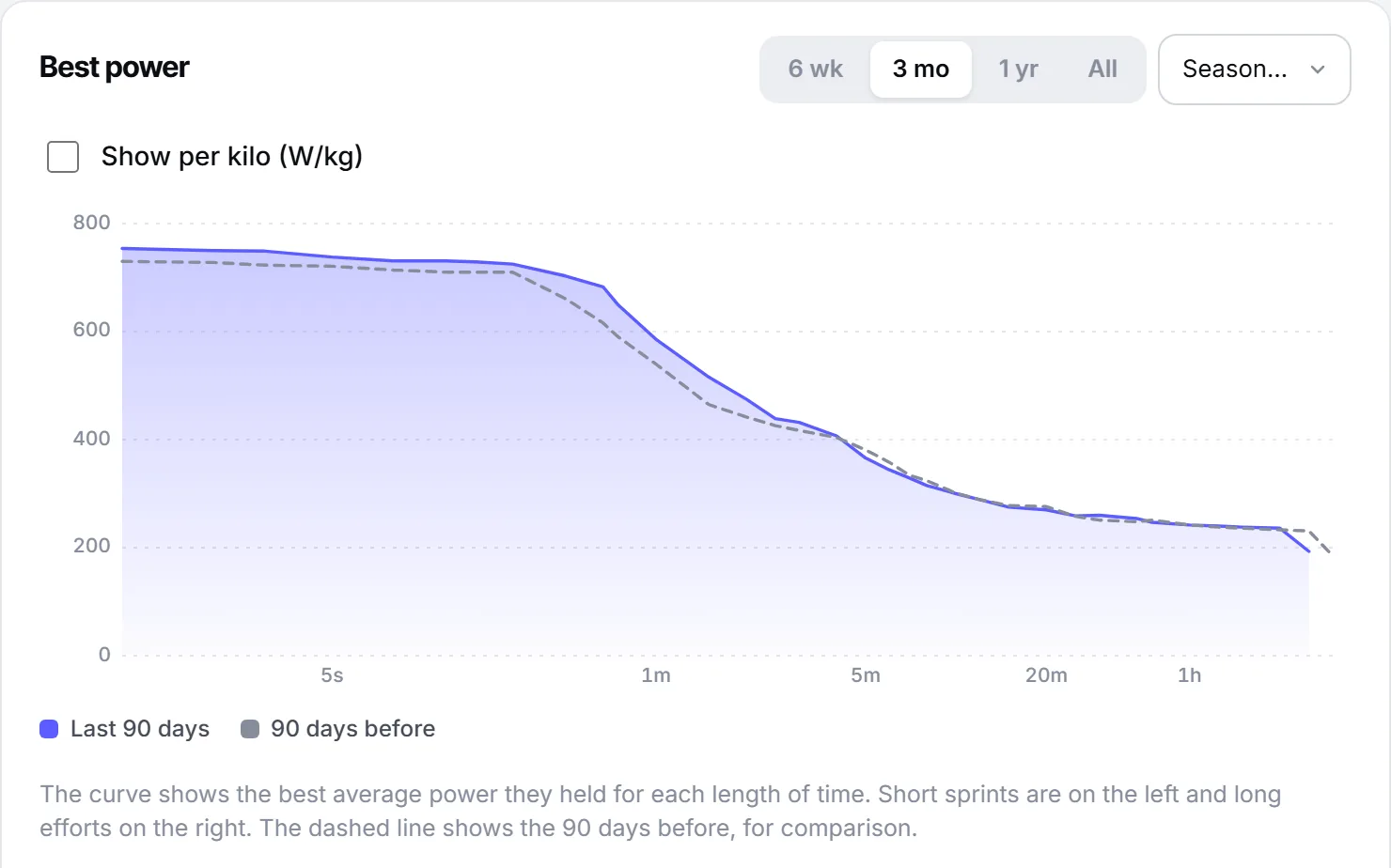
In Velograph, for example, the free Rider plan draws this curve from your own rides and shows the gap between your FTP and a goal FTP you set; with a coach linked, you propose the goal and the coach sets it. The page for riders lists what you keep on your own, without a team.
What are good cycling goals for different riders?
Good goals fit the rider's life as well as their ambition. A sportive rider aims at a finishing time, a racer at a result and the numbers behind it, and a rider coming back after a long break at a habit first. Each example below has all three layers and a date to check them.
A sportive rider
| Layer | Goal | When to check |
|---|---|---|
| Outcome | Ride a 160 km sportive with 2,000 m of climbing on Sunday 13 June 2027 in under 7 hours | 13 June |
| Performance | Ride 5 hours at a steady pace, without fading, by 16 May | The long ride on 16 May |
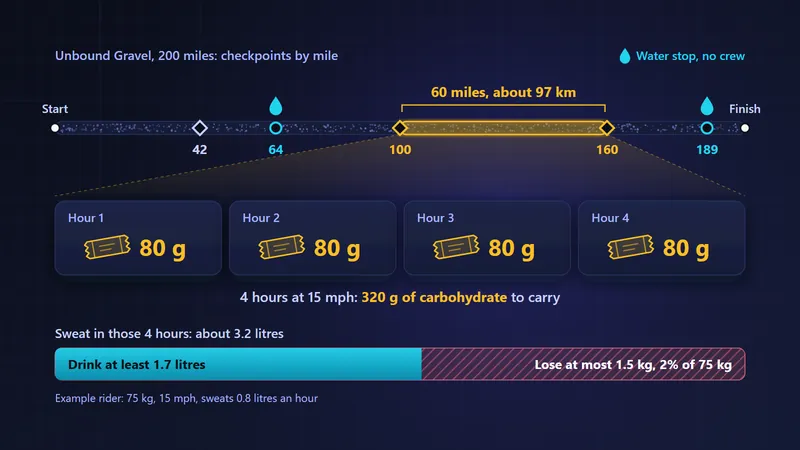
| Performance | Eat 60 g of carbohydrate an hour for 4 hours without stomach trouble | Every long ride from March |
| Process | Ride three times a week, with the Sunday ride growing by 20 minutes every second week from 2 h 40 min on 7 February | Monthly |
The guide to carbohydrate on the bike explains how much to eat on longer rides.
A racer
| Layer | Goal | When to check |
|---|---|---|
| Outcome | Top 10 in the regional road race championship on 27 June 2027 | 27 June |
| Performance | Raise 5-minute power from 340 W to 360 W by 1 June, because the race is decided on a 4-minute climb | The best 5 minutes in May |
| Performance | Reach the foot of the last climb in the front 20 riders in three of four spring races | After each race |
| Process | Ride both key sessions in at least four weeks out of five | Monthly |
A rider coming back after a long break
| Layer | Goal | When to check |
|---|---|---|
| Outcome | Ride the club's 80 km Saturday ride in the middle group on 4 September | 4 September |
| Performance | Ride 2 hours at an easy pace without stopping by 1 May | A ride in late April |
| Process | Ride three times a week for 12 weeks, once a week with the club | A weekly tick list |
| Process | If the weather is bad, ride 45 minutes indoors instead of skipping the ride | Weekly |
A rider returning after illness or injury should agree the first weeks with a doctor or physiotherapist. The guide for the self-coached cyclist covers a simple training week and how to back off in time.
How often should you review your cycling goals?
Check your process goals every week and the whole set once a month, in writing. Writing progress down, or reporting it to someone, makes monitoring work better, so a monthly note shared with a coach or a training partner is worth its ten minutes.
That advice rests on two meta-analyses. In 138 experiments pooled by Harkin and colleagues in 2016, people who were prompted to check their progress reached their goals more often, and the effect grew when they recorded the progress physically or reported it to others. In 141 papers, Epton, Currie and Armitage (2017) found goal setting worked better when the goal was difficult, set publicly or shared as a group goal.
Use the first of the month as the review day. Dai, Milkman and Riis (2014) found that gym visits and new goal commitments rose after landmarks such as the start of a week, a month or a year, a birthday or a holiday. New Year is one such landmark, and the first of each month gives you twelve more. Here is the sportive rider's review from the first example.
| Review on | Rides done | Long ride | Decision |
|---|---|---|---|
| 1 March | 11 of 12 | 3 h 00 min, as planned | Carry on |
| 1 April | 8 of 13, with a cold in mid-March | 3 h 20 min, against 3 h 40 min planned | Resume the steps from 3 h 20 min; the 5-hour ride moves to 30 May |
| 1 May | 13 of 13 | 4 h 00 min on 18 April, as replanned | On track for the new date |
| 1 June | 12 of 13 | 5 h 00 min on 30 May | Taper for 13 June; the outcome goal stays |
When should you change a cycling goal?
Change a goal when the facts behind it change, such as two weeks or more lost to illness, a target reached early or a new job that removes training hours. Move the date or the number and keep the process goals. Never try to win back lost weeks by doubling the next ones.
| What happened | What to change |
|---|---|
| Two weeks or more lost to illness or injury | Move the performance dates, then check whether the outcome date still fits |
| A performance target reached six weeks or more early | Raise it |
| Process goals missed two months running | Shrink the week to what fits your life before you touch the outcome |
| Training feels like a chore for weeks | Change the goal itself; a goal you dread is the wrong goal |
| You work with a coach | Change goals together; the coach decides the plan |
At the end of the season, set the goals against the results in a season review, and let next year's goals start from what you learnt.
Further reading
- Building a practically useful theory of goal setting and task motivation: a 35-year odyssey, Locke and Latham, American Psychologist, 2002.
- The performance and psychological effects of goal setting in sport: a systematic review and meta-analysis, Williamson and colleagues, International Review of Sport and Exercise Psychology, 2022.
- Does monitoring goal progress promote goal attainment? A meta-analysis of the experimental evidence, Harkin and colleagues, Psychological Bulletin, 2016.
- Implementation intentions and goal achievement: a meta-analysis of effects and processes, Gollwitzer and Sheeran, Advances in Experimental Social Psychology, 2006.
Velograph is not affiliated with, sponsored by or endorsed by any team, rider or company named in this article. Names are used only to refer to publicly reported work.